

Intermittent Fasting Calculator: Optimize Your Schedule
You're trying to figure out when to eat and when to fast for maximum benefit. Not just randomly skipping breakfast, but structuring your eating windows based on how your metabolism actually responds to fasting. This calculator shows you exactly what's happening in your body hour by hour.
Key takeaways
1. The 16:8 protocol (16 hours fasting, 8 hours eating) is among the most widely studied approaches and tends to be sustainable for daily practice
2. Fat burning accelerates during the extended fasted state, while full autophagy activation occurs with longer fasting durations
3. Most metabolic benefits come from the caloric deficit, not magical fasting windows
The tool maps your chosen fasting schedule against metabolic milestones. Set your eating window, and you'll see when insulin drops, when fat burning accelerates, and when cellular cleanup processes begin. It's based on physiological timelines from research showing distinct metabolic phases as fasting duration increases.
For a comprehensive collection of evidence-based health calculators, including metabolic tracking tools, visit our resources hub.
What Is Intermittent Fasting?
Intermittent fasting (IF) cycles between defined periods of eating and fasting. Unlike traditional diets that restrict what you eat, IF restricts when you eat. You're compressing your normal daily calories into a shorter window.
During your eating window, you consume adequate calories to support your activity and daily energy expenditure. The extended fasting period triggers metabolic changes: insulin sensitivity improves, fat oxidation increases, and cellular repair processes activate. These aren't magical effects. They're your body's natural response to the absence of incoming food energy.
The most studied protocol is 16:8. You fast for 16 hours and eat within an 8-hour window. Simple math, powerful results when done consistently.
How This Tool Works
Select your preferred fasting protocol from the dropdown menu. The calculator displays a 24-hour timeline showing your eating and fasting windows. Color-coded zones indicate which metabolic phase you're in at each hour.
The metabolic phases are based on average timelines from controlled studies. Your individual timeline depends on factors like metabolic health, activity level, and what you ate during your last meal.
Start with a 14:10 schedule if you're new to fasting. Track how you feel, your energy levels, and your hunger patterns. To make tracking systematic, log your fasting windows and energy levels through the huuman app and watch patterns emerge over weeks of consistent practice.
The Science Behind IF: Metabolic Phases
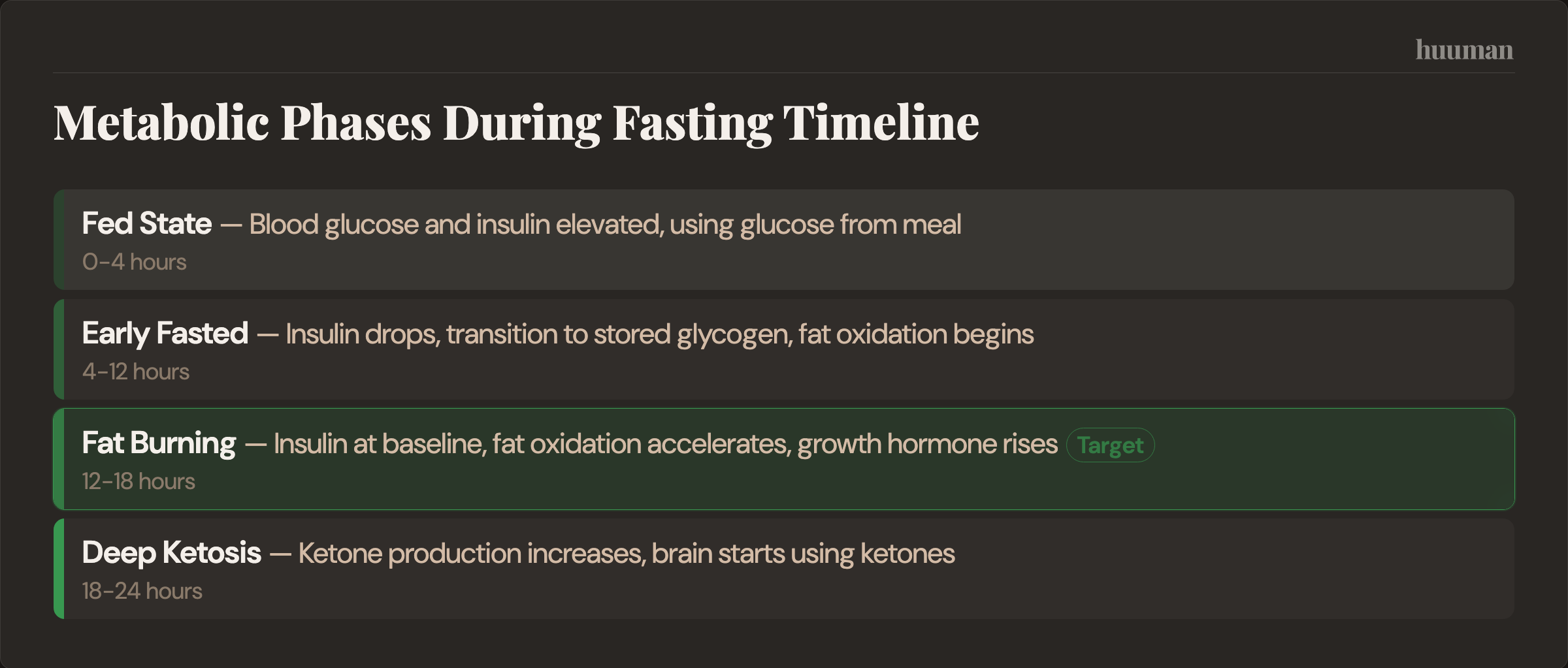
0 to 4 hours (Fed state): You've just eaten. Blood glucose and insulin are elevated. Your body uses glucose from your meal as primary fuel. Any excess gets stored as glycogen in muscles and liver, or as fat if glycogen stores are full.
4 to 12 hours (Early fasted): Blood glucose normalizes. Insulin drops significantly. Your body transitions from burning dietary glucose to stored glycogen. Fat oxidation begins to increase.
12 to 18 hours (Fat burning): Insulin reaches baseline levels. Fat oxidation accelerates as primary fuel source. Growth hormone rises to preserve muscle mass. This is where most IF benefits occur. The metabolic switch to fat burning happens predictably in this window.
18 to 24 hours (Early ketosis): Ketone production increases significantly. Your brain starts using ketones for fuel alongside glucose. Early autophagy markers appear.
24+ hours (Extended fasting): Full autophagy activation. Significant cellular repair and recycling. Extended fasts should only be done under medical supervision. For those exploring extended protocols, Huuman - Huuman Blog provide insights into longer fasting windows.
Popular IF Protocols
16:8: The gold standard for daily practice. Eating window typically noon to 8 PM. Studies suggest improved insulin sensitivity, modest weight loss, and reduced inflammation markers.
18:6: Extends fasting by 2 hours for deeper ketosis. Eating window often 2 to 8 PM. More challenging but still sustainable daily.
20:4 (Warrior Diet): One main meal plus small snacks in a 4-hour window. Risk of inadequate protein distribution for muscle synthesis.
5:2: Normal eating 5 days per week, 500 to 600 calories on 2 non-consecutive days. Research shows similar weight loss to daily caloric restriction.
Alternate Day Fasting: Alternating between fasting days (0 to 25% calories) and feeding days. Produces weight loss comparable to daily caloric restriction, but dropout rates are notably higher, suggesting poor long-term adherence.
Choosing the Right Fasting Protocol
IF works well for many people, but it's not universal. Pregnant and breastfeeding women need consistent nutrition throughout the day. People with active eating disorders risk triggering restrictive behaviors. Type 1 diabetics face dangerous blood sugar swings without careful medical monitoring.
Medication timing matters. Diabetes medications require adjustment under medical supervision. Some medications need food for absorption.
Athletes need strategic implementation. Zone 2 cardio works fine fasted. High-intensity training suffers without pre-workout fuel.
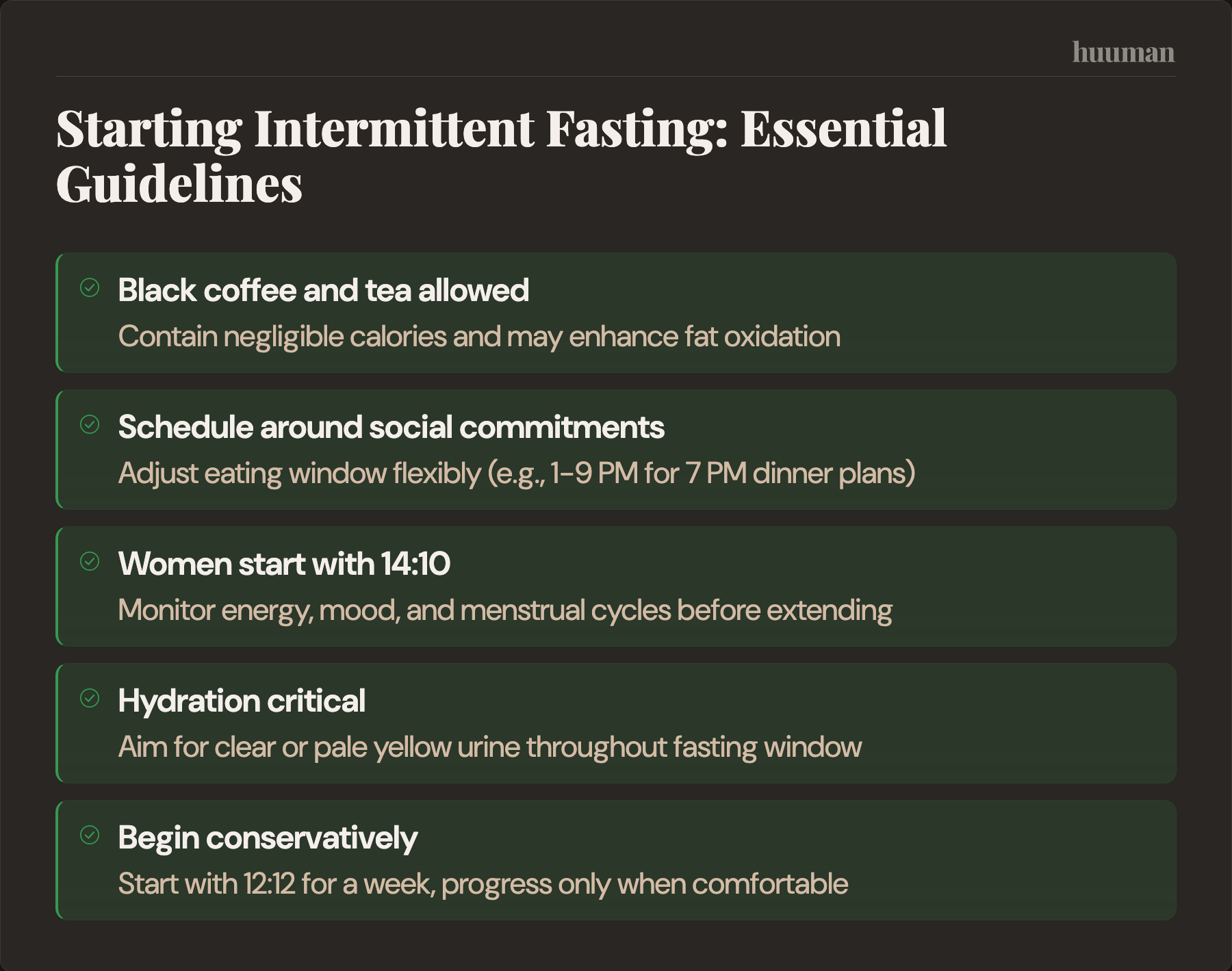
Start conservatively. If you currently eat from 7 AM to 10 PM, begin with 12:12 for a week. Progress to 14:10, then 16:8 only when the previous schedule feels easy. Rather than following generic schedules, your huuman Coach can design fasting protocols that adapt to your sleep patterns and training schedule for sustainable implementation.
Frequently Asked Questions
How do I calculate my intermittent fasting?
Choose your target fasting window based on experience and goals. Beginners start with 14:10. Set your eating window to match your lifestyle. Noon to 8 PM works for social meals. Our calculator shows your metabolic phase throughout the day.
Is 16:8 fasting enough?
Yes, 16:8 delivers most documented IF benefits. Research suggests it can support improved insulin sensitivity, modest weight loss, and reductions in inflammation markers. Longer fasts may enhance autophagy but they're harder to sustain.
When does autophagy start during fasting?
Significant autophagy activation is generally thought to require extended fasting beyond 24 hours of complete food abstention. The 16:8 protocol triggers early autophagy processes but doesn't reach full activation. The metabolic improvements from consistent 16:8 practice outweigh the theoretical advantages of occasional extreme fasts.
Common Myths About Intermittent Fasting
Myth: Fasting causes muscle loss. Reality: Muscle mass is largely preserved when protein intake is adequate and resistance training is maintained. Growth hormone also rises during fasting, which may help spare lean tissue.
Myth: Breakfast is essential. Reality: No metabolic advantage exists for eating early. Your total daily intake matters more than meal timing.
Myth: Fasting slows metabolism. Reality: Short-term fasting does not appear to reduce metabolic rate; significant metabolic slowdown is associated with chronic severe caloric restriction, not typical IF protocols.
Implementation Tips
Black coffee and tea don't break your fast. They contain negligible calories and caffeine may enhance fat oxidation. Avoid cream, sugar, or sweeteners during fasting hours.
Schedule your eating window around social commitments. If you have dinner plans at 7 PM, adjust to 1 to 9 PM that day. Flexibility prevents IF from becoming socially isolating.
Women may need modified approaches. ncbi.nlm.nih.gov/36297033/" target="_blank" rel="noopener noreferrer">Animal research suggests fasting can disrupt hormonal cycles, though human evidence is limited. Start with 14:10 and monitor energy, mood, and menstrual cycles.
Hydration becomes critical during fasting. You're missing the water content from food. Aim for clear or pale yellow urine throughout your fasting window.
References
- metabolic effects of fasting cycles
- Fernandes-Alves D et al. — Systematic Review and Meta-analysis of Randomized Clinical Trials Comparing Time-Restricted Eating W... (2026)
- Mattson M et al. — Impact of intermittent fasting on health and disease processes. (2017)
- Semnani-Azad Z et al. — Intermittent fasting strategies and their effects on body weight and other cardiometabolic risk fact... — (2025)
- Trepanowski J et al. — Effect of Alternate-Day Fasting on Weight Loss, Weight Maintenance, and Cardioprotection Among Metab... (2017)
- Conger SA et al. — Does Caffeine Increase Fat Metabolism? A Systematic Review and Meta-Analysis (2023)
About this article · Written by the huuman Team. Our content is based on peer-reviewed research and clinical guidelines. We follow editorial standards grounded in scientific evidence.
This article is for educational purposes only and does not constitute medical advice. Health and training decisions should be discussed with qualified professionals.