

Protein Calculator: How Much Protein Do You Need?
You're trying to nail down your optimal protein intake. Not the generic number on a nutrition label that applies to everyone and no one. You need a target that matches your actual body, your training, and whether you're building muscle or cutting fat. The right amount can accelerate your progress. The wrong amount wastes effort.
Key takeaways
1. Active people need 1.4–2.0 g/kg daily, double the government RDA of 0.8 g/kg
2. Fat loss requires more protein (2.0–2.4 g/kg), not less, to preserve muscle
3. Distribute protein evenly across meals (20–40g each) for optimal muscle synthesis
How Much Protein Do You Really Need?
Your protein needs depend on three factors: body weight, activity level, and current goal. The US RDA sits at 0.8 g/kg per day. That's enough to prevent deficiency in sedentary adults. It's nowhere near optimal for anyone who trains.
The International Society of Sports Nutrition (ISSN) recommends 1.4–2.0 g/kg per day for physically active individuals. That's nearly double the RDA. The difference isn't academic. It shows up in muscle mass, recovery speed, and body composition.
A 2018 meta-analysis by Morton and colleagues changed how we think about protein ceilings. They analyzed 49 studies with 1,863 participants and found that protein supplementation beyond roughly 1.6 g/kg did not further increase resistance training–induced gains in muscle mass and strength in most people. This establishes 1.6 g/kg as the evidence-based sweet spot for muscle building. Going higher won't hurt, but it won't help muscle growth either.
Here's what surprises people: protein needs go up during fat loss, not down. Higher intakes of 2.0–2.4 g/kg help preserve lean mass when you're in a calorie deficit. Most dieters cut protein along with calories. Research says that's exactly backwards. Your muscles need extra protection when energy is scarce.
If you're concerned that excess protein might be stored as fat, that's a common misconception. Your body has to work hard to convert protein to fat, making it the least likely macronutrient to end up in fat stores.
To track your protein systematically, log your meals through photo capture with the huuman app and let it extract protein content automatically while monitoring trends over weeks.
How This Calculator Works
The calculator uses evidence-based protein ranges derived from the ISSN position stand and the Morton meta-analysis. These aren't arbitrary multipliers. They represent the current scientific consensus on optimal protein intake for different populations and goals.

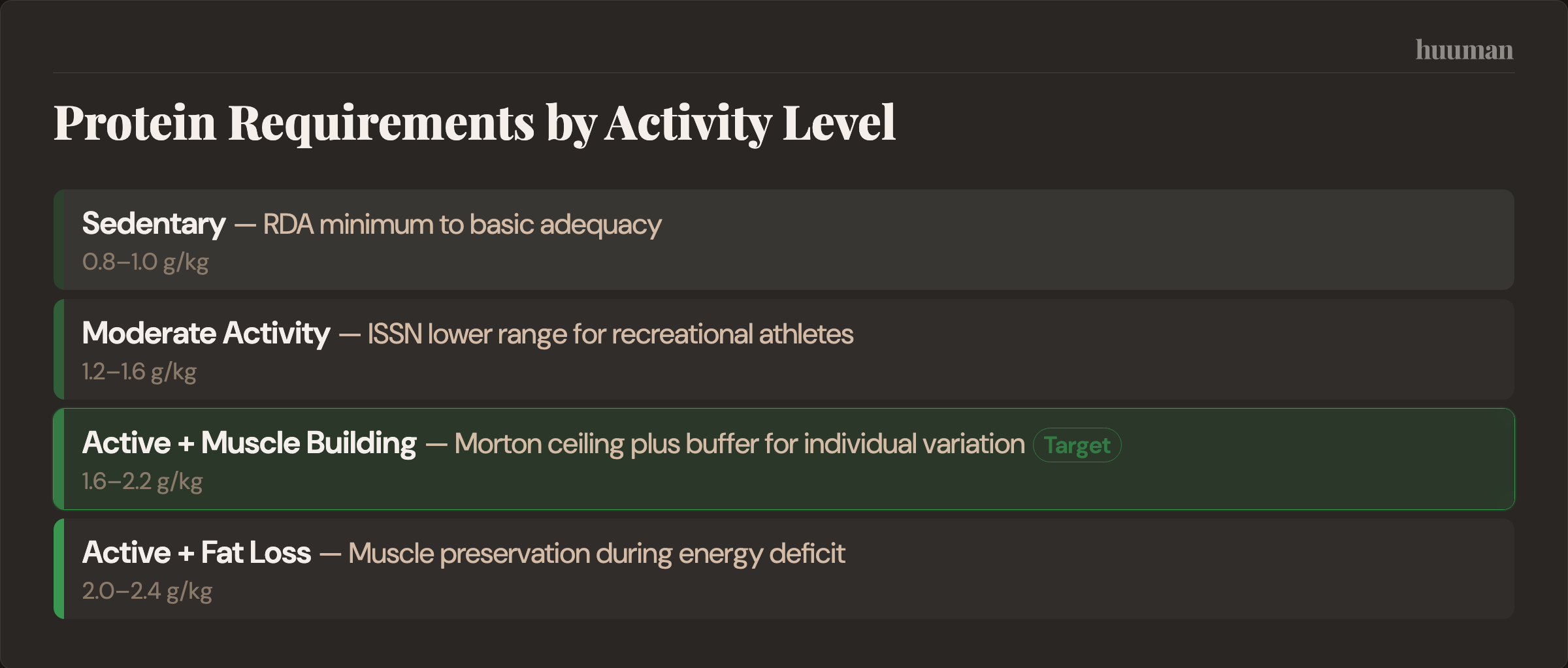
The ranges break down like this:
- Sedentary + maintain: 0.8–1.0 g/kg (RDA minimum to basic adequacy)
- Moderate + maintain: 1.2–1.6 g/kg (ISSN lower range for recreational athletes)
- Active + build muscle: 1.6–2.2 g/kg (Morton ceiling plus buffer for individual variation)
- Active + fat loss: 2.0–2.4 g/kg (muscle preservation during energy deficit)
After calculating your daily total, the calculator shows how to distribute it across 3, 4, or 5 meals. This distribution matters more than the fitness industry acknowledged until recently. Your muscles can't bank protein for later like they do with carbs. Each meal triggers its own muscle protein synthesis response. Miss the threshold at one meal and you've missed that opportunity.
The calculator splits your daily total across 3–4 meals, the distribution shown to maximize muscle protein synthesis in trained athletes. Below 20g, you might not hit the leucine threshold. Above 40g, additional protein doesn't enhance the muscle-building signal in that meal.
Protein Distribution Across Meals
The leucine threshold concept explains why meal timing matters. Leucine acts as the master switch for muscle protein synthesis. You need approximately 2.5g of leucine per meal to flip that switch fully. In practical terms, that's 20–40g of high-quality protein.
Quality matters here. Whey protein contains about 11% leucine, so 23g of whey hits the threshold. Chicken breast contains about 8% leucine, so you'd need 31g. Plant proteins typically contain 6–8% leucine, meaning you need 31–42g to trigger the same response.
This creates a practical problem. Many people eat minimal protein at breakfast, moderate amounts at lunch, and a huge portion at dinner. That pattern wastes opportunities. Your muscles respond to each meal independently. They don't average your daily intake across meals.
Older adults face a tougher challenge. Age-related anabolic resistance means the leucine threshold rises. Older adults need roughly 0.40 g/kg per meal to maximize muscle protein synthesis, compared with about 0.24 g/kg in younger men, so a 65-year-old typically needs a larger per-meal dose than a 30-year-old of the same weight to achieve the same anabolic response. The total daily target might stay similar, but the per-meal minimums increase.
Rather than guessing at portion sizes, your huuman Coach can create personalized weekly plans that distribute protein targets appropriately across your training and rest days.
Protein Calculator
Use this calculator to determine your optimal daily protein intake based on your body weight, activity level, and fitness goals. The recommendations follow evidence-based guidelines from sports nutrition research.
Frequently Asked Questions
How do I calculate how much protein I need?
Multiply your body weight in kg by the appropriate factor for your activity and goal. For a 75 kg moderately active person maintaining weight: 75 × 1.2–1.6 = 90–120g per day. Divide this by your meal frequency to get per-meal targets. For comprehensive nutrition planning, combine this with your total daily energy expenditure to ensure you're hitting protein goals within appropriate calories. The complete suite of health optimization tools includes calculators that automate these calculations.
How much protein do I need for my age?
Adults under 65 can use the standard ranges based on activity and goals. Adults 65 and older benefit from higher intakes even at maintenance: 1.2–1.6 g/kg instead of 0.8–1.0. This compensates for anabolic resistance, where muscles become less responsive to protein's muscle-building signals. Each meal should contain 30–40g minimum for older adults, compared to 20–30g for younger adults. The total might be similar, but the distribution becomes more critical with age.
Is 100g of protein a day too much?
For most adults, 100g isn't too much. It's often too little. A 75 kg active person needs roughly 120–150g daily based on ISSN recommendations of 1.4–2.0 g/kg for active individuals. That 100g would fall below optimal for muscle building or fat loss. Concerns about kidney damage come from studies on people with existing kidney disease. Higher protein intakes don't adversely affect kidney function in healthy adults. The real concern isn't eating too much protein. It's eating too little and compromising your training results. For example, a 200g chicken breast provides about 43g of protein, meaning you'd need 2-3 servings daily to meet optimal targets.
What is the best protein for sarcopenia?
Leucine-rich proteins offer the strongest defense against age-related muscle loss. Whey protein is particularly leucine-rich, followed by other animal proteins such as eggs, beef, chicken, and fish. Older adults generally benefit from higher protein intakes (around 1.2–1.6 g/kg) distributed across 3–4 meals, with larger per-meal portions to overcome anabolic resistance. Plant proteins work but require larger portions to hit leucine thresholds. Focus on high bioavailability proteins that maximize usable amino acids, especially important when appetite naturally decreases with age.
Take Action
You've calculated your protein target. The next step is tracking whether you actually hit it. That gap between perception and reality explains why many training programs underdeliver. Use a comprehensive macro calculator to see how protein fits within your total nutrition picture.
References
- Morton et al. - Protein Intake and Resistance Training: Meta-Analysis of Muscle Mass and Strength (2018)
- Hector AJ & Phillips SM - Protein Recommendations for Weight Loss in Elite Athletes: A Focus on Body Co... (2018)
- Phillips SM & Van Loon LJ - Dietary protein for athletes: from requirements to optimum adaptation (2011)
- Helms E et al. — A systematic review of dietary protein during caloric restriction in resistance trained lean athlete... (2014)
- Stubbs R et al. — Carbohydrates and energy balance. (1997)
- Paddon-Jones D et al. — Dietary protein recommendations and the prevention of sarcopenia — (2009)
- Moore D et al. — Protein ingestion to stimulate myofibrillar protein synthesis requires greater relative protein inta... (2015)
- Devries MC et al. — Changes in Kidney Function Do Not Differ between Healthy Adults Consuming Higher- Compared with Lowe... — (2018)
About this article · Written by the huuman Team. Our content is based on peer-reviewed research and clinical guidelines. We follow editorial standards grounded in scientific evidence.
This article is for educational purposes only and does not constitute medical advice. Health and training decisions should be discussed with qualified professionals.