

How to Improve VO2max: Evidence-Based Training Plans
You're looking at your VO2max score and wondering how to push it higher. Maybe you've plateaued after months of steady running. Maybe you're starting from scratch and want the most efficient path forward. Either way, you need a structured approach that actually works.
Key takeaways
1. Combine Zone 2 base work (80% of training) with targeted HIIT sessions (20%) for optimal VO2max gains
2. Beginners and intermediate athletes can achieve meaningful VO2max improvements with 8-12 weeks of structured training, with larger gains in those starting from lower fitness
3. Each 1-MET increase in VO2max is associated with a 13% reduction in all-cause mortality, a bigger impact than most medications
What Determines Your VO2max?
Your VO2max hinges on two physiological factors: cardiac output (how much blood your heart pumps per minute) and arteriovenous oxygen difference (how efficiently your muscles extract oxygen from that blood). Training improves both, but not equally for everyone. Individual response varies wildly. Some people gain substantially from identical training that produces near-zero improvement in others.
You can calculate your VO2max using various test methods to establish your baseline before starting any training plan. Without knowing where you're starting, you're flying blind.
Age matters, but less than you'd think. Yes, VO2max declines about 10% per decade after 30 in sedentary folks. But regular training cuts that to 5% per decade. A fit 60-year-old often outperforms a sedentary 40-year-old. Check huuman's collection of health tools for calculators that help you track multiple fitness metrics alongside VO2max.
The Two Pillars: Zone 2 + HIIT
The most effective VO2max improvement strategy combines high-volume low-intensity work with targeted high-intensity intervals. A meta-analysis of 28 studies found HIIT improved VO2max by 5.5 ml/kg/min versus 4.9 for endurance training. But here's what most people miss: you need both for sustainable gains.

Zone 2 (80% of volume): This is your aerobic foundation. Schedule 3-5 sessions weekly, 30-60 minutes each, at 60-70% of heart rate reserve. You should be able to hold a conversation. Zone 2 builds mitochondrial density and creates the aerobic base that supports everything else. Use a Zone 2 heart rate calculator to nail your personal training zones.
If you're serious about tracking this properly, log your Zone 2 sessions with heart rate data through the huuman app to spot whether you're actually staying in the right zone consistently. Most people drift too high without realizing it.
HIIT (20% of volume): Once or twice weekly, no more. The gold standard remains the Norwegian 4×4 protocol: 4 minutes at 85-95% max heart rate, 3 minutes active recovery, repeated 4 times. Below 85% and you're not recruiting enough muscle fibers. Above 95% and you'll fade before completing the intervals.
Beginner Protocol (12 weeks)
Weeks 1-4: Foundation phase. Start with 3× Zone 2 sessions, 30 minutes each. Your only job is consistency and learning to pace by feel. Don't add intensity yet.
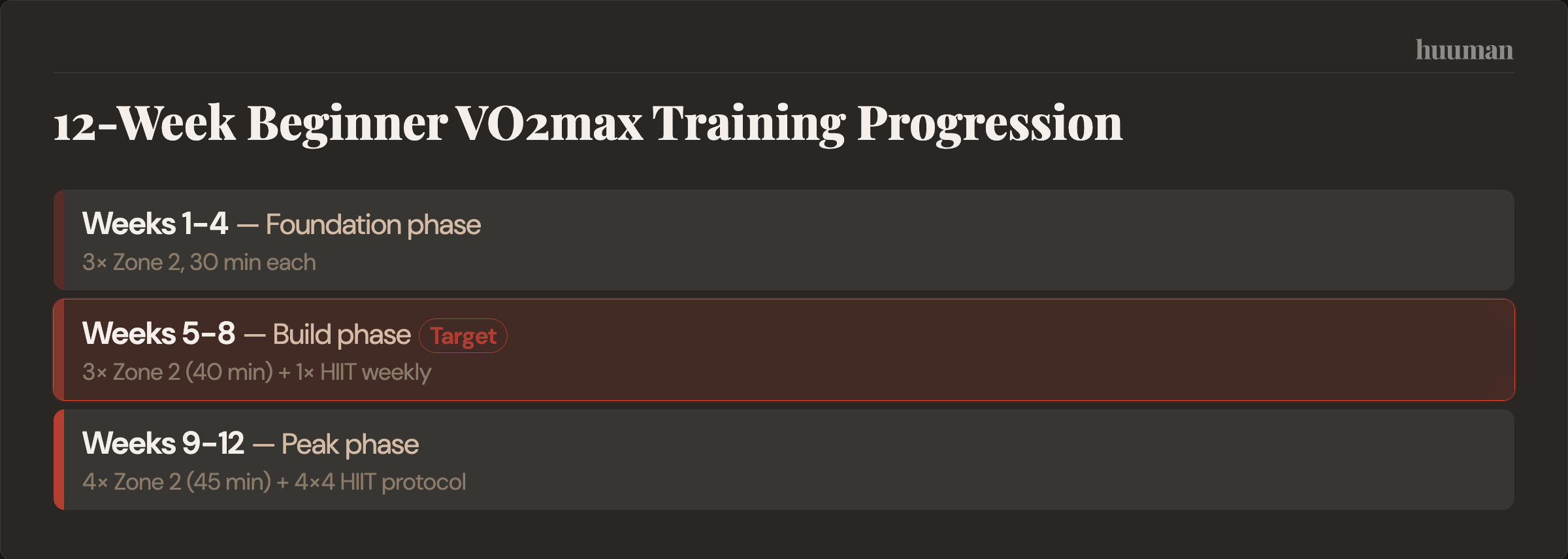
Weeks 5-8: Build phase. Maintain 3× Zone 2 but extend to 40 minutes. Add 1× HIIT session weekly. Start conservative: 4×3 minutes at 80-85% max HR with 3 minutes easy recovery.
Weeks 9-12: Peak phase. Progress to 4× Zone 2 sessions at 45 minutes each. Your weekly HIIT session now uses the full 4×4 protocol at 85-95% max HR. By week 12, consistent training at this structure can produce meaningful VO2max improvements, with adherence being the primary driver of results.
Intermediate Protocol (Periodized Blocks)
Already training 4+ hours weekly? You need systematic variation to prevent plateaus.
Block 1 (Weeks 1-4): Build volume with 4× Zone 2 sessions at 50 minutes each. Add 1× tempo run weekly: 30 minutes at Zone 3 (75-80% max HR).
Block 2 (Weeks 5-8): Shift focus toward intensity. Drop to 3× Zone 2 (50 minutes) but add 2× HIIT sessions using the 4×4 protocol. Space HIIT sessions at least 48 hours apart.
Block 3 (Weeks 9-12): Maintain 3× Zone 2 (45 minutes) + 2× HIIT. Progress your intervals: try 5×4 minutes or 3×8 minutes. Cyclists can follow specific VO2max workouts designed for cycling that adapt these intervals to power zones.
Block 4 (Week 13): Critical deload week. Just 3× easy Zone 2 at 30 minutes. Your body adapts during recovery, not training.
Expected improvement varies based on starting fitness and recovery quality, with intermediate athletes typically seeing meaningful gains from periodized blocks.
Advanced Protocol (Competitive Athletes)
Years of structured training with 6+ hours weekly volume? This protocol uses complex periodization.
Mesocycle 1 (4 weeks): Heavy volume base phase. Schedule 5× Zone 2 sessions (60-90 minutes). Add 1× threshold session: 2×20 minutes at lactate threshold with 5 minutes recovery.
Mesocycle 2 (3 weeks): VO2max focus. Reduce to 3× Zone 2 but add 3× HIIT weekly. Vary intervals: Monday 5×5 minutes, Wednesday 8×3 minutes, Saturday 3×8 minutes.
Mesocycle 3 (2 weeks): Peak and taper. Maintain intensity but slash volume by 40%. Just 2× Zone 2 + 2× HIIT with reduced sets.
Elite athletes might see only 5-10% improvement, but that's still massive at high performance levels.
How Much Can You Improve?
The American College of Sports Medicine recommends 150+ minutes weekly of moderate-intensity aerobic exercise as the foundation for improving cardiorespiratory fitness in most adults. Key factors determining your response:
Starting fitness: Lower starting VO2max equals larger potential gains. Sedentary beginners often see 20-30% improvement.
Training consistency: Three sessions weekly maintained for 12 weeks beats five sessions done sporadically.
Recovery quality: You can use a protein calculator to determine your optimal daily intake for supporting training adaptations.
Rather than guessing whether your training's working, let your huuman Coach analyze your training data and adjust your weekly plan based on actual progress markers. This approach especially helps when standard protocols aren't delivering expected results.
VO2max and Longevity
Here's why this matters beyond athletic performance. A Cleveland Clinic study of 122,007 patients found that higher cardiorespiratory fitness was strongly associated with lower all-cause mortality, with those in the lowest fitness category facing roughly 5-fold higher mortality risk than elite performers.
Improving from 35 to 42 ml/kg/min represents a 2-MET gain, which compounds into a substantially larger mortality reduction. No blood pressure medication delivers that. See where you stand using VO2max percentile charts by age and sex.
Monitoring Progress
Track these markers every 4-6 weeks:
- Direct testing: Lab test if available, or field tests like the 12-minute Cooper run.
- Resting heart rate: Should drop roughly 5-10 beats over 8-12 weeks.
- Recovery heart rate: Time how quickly you return to baseline after hard efforts.
- Performance metrics: 5K time trials or pace at conversational effort reflect VO2max changes.
Expect non-linear progress. Initial gains come fast, then slow dramatically. When stuck, change the stimulus: add a third HIIT session or extend Zone 2 duration by 15 minutes.
Frequently Asked Questions
How long does it take to improve VO2max?
You'll see measurable improvements within 4-8 weeks if training consistently. Most achieve 15-20% improvement over 8-12 weeks. The biggest jumps happen in the first three months.
Is HIIT or steady-state better for VO2max?
HIIT produces larger gains per session. The meta-analysis shows HIIT improves VO2max by 5.5 ml/kg/min versus 4.9 for endurance training. But you can't do HIIT daily without burning out. The combination beats either approach alone.
Can you improve VO2max after 50?
Absolutely. VO2max remains highly trainable at any age. A fit 60-year-old often has the VO2max of a sedentary 40-year-old.
References
- Milanović et al. - HIT vs Continuous Training for VO2max (2015)
- Garber CE et al. - American College of Sports Medicine position stand. Quantity and quality of e... (2011)
- Mandsager K et al. - Association of Cardiorespiratory Fitness With Long-term Mortality Among Adult... (2018)
- Bouchard C et al. — Individual differences in response to regular physical activity. (2001)
- Hagberg JM — Effect of training on the decline of VO2max with aging (1987)
- Huang G et al. — Resting heart rate changes after endurance training in older adults: a meta-analysis. (2005)
About this article · Written by the huuman Team. Our content is based on peer-reviewed research and clinical guidelines. We follow editorial standards grounded in scientific evidence.
This article is for educational purposes only and does not constitute medical advice. Health and training decisions should be discussed with qualified professionals.