

VO2max Calculator: Norms, Tests, and What Your Score Means
You're trying to figure out how fit you really are. Not gym-mirror fit or Instagram fit, but the kind of cardiovascular fitness that actually predicts how long you'll live. That's what VO2max measures. It's the maximum rate your body can use oxygen during intense exercise, and it's one of the strongest predictors of all-cause mortality we have.
Key takeaways
1. VO2max predicts mortality better than any other modifiable risk factor, with a 5-fold higher death risk for low vs elite fitness
2. You can estimate VO2max accurately using the Cooper 12-minute run test, walking tests, or race times
3. Smartwatch estimates are within 5–10% accuracy for outdoor running, useful for tracking improvement trends
What Is VO2max?
VO2max measures the maximum volume of oxygen your body can use per minute, expressed as milliliters per kilogram of body weight (ml/kg/min). A sedentary person might have a VO2max of 25. An elite endurance athlete hits 70 or higher.
The landmark 2018 Mandsager study followed 122,007 patients for over a decade. The results: low cardiorespiratory fitness carried a 5-fold higher mortality risk compared to elite fitness. Each 1-MET improvement (3.5 ml/kg/min) reduced all-cause mortality by 13%.
Here's the crucial part: you don't need elite fitness. Moving from "low" to even "below average" fitness is associated with a substantial reduction in mortality risk. If you're currently sedentary with a VO2max around 25–30, getting to 35–40 could add years to your life.
How to Estimate Your VO2max
Lab testing involves running on a treadmill with a mask measuring oxygen consumption. It's accurate but expensive. Several field tests estimate VO2max reliably enough to track your progress.

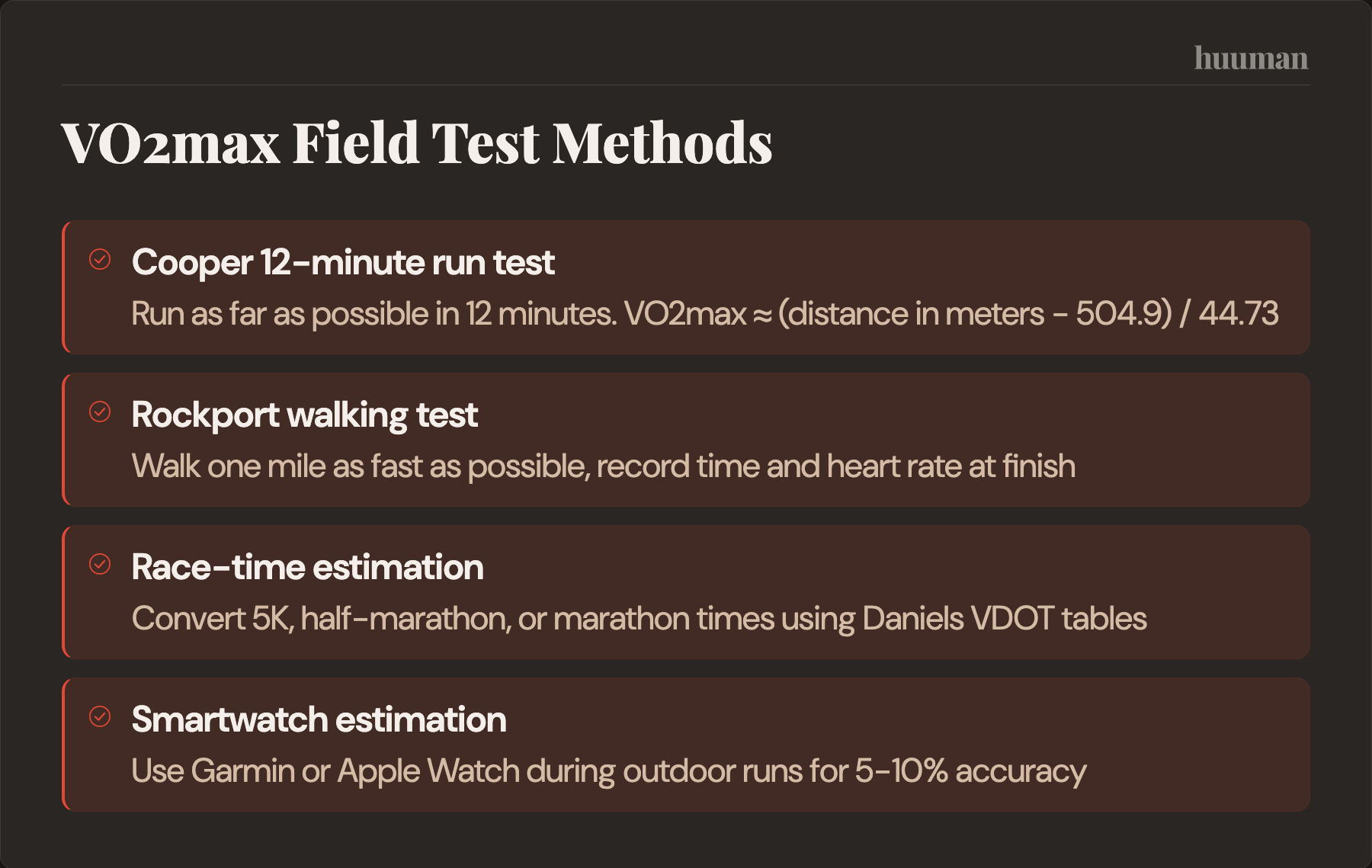
Cooper 12-minute run test: Run as far as possible in 12 minutes on a flat surface. Your VO2max ≈ (distance in meters − 504.9) / 44.73. A 2,400-meter result gives you a VO2max around 44.
Rockport walking test: Walk one mile as fast as possible. Record your time and heart rate immediately at finish. The Kline equation uses body weight, age, sex, walk time, and heart rate to estimate VO2max.
Race-time estimation: Your recent 5K, half-marathon, or marathon time converts to VO2max using the Daniels VDOT tables. A 25-minute 5K corresponds to a VO2max around 41.
Smartwatch estimation: Garmin, Apple Watch, COROS, and others estimate VO2max from running pace and heart rate data. They're most accurate during outdoor GPS running.
Want a quick baseline? Use huuman's health assessment tools to calculate your VO2max from any of these methods, then track improvement over time. The absolute number matters less than the trend. For a more precise assessment, try our VO2 max calculator which factors in your fitness level and recent performance data.
VO2max Norms by Age and Sex
The FRIEND registry provides population norms from 7,783 maximal exercise tests in adults without cardiovascular disease.
Men by age (ml/kg/min):
- 20–29 years: Poor (<37.1), Fair (37.1–44.1), Good (44.2–50.0), Excellent (>50.0)
- 30–39 years: Poor (<35.4), Fair (35.4–42.4), Good (42.5–47.4), Excellent (>47.4)
- 40–49 years: Poor (<33.0), Fair (33.0–38.4), Good (38.5–43.1), Excellent (>43.1)
- 50–59 years: Poor (<30.2), Fair (30.2–35.3), Good (35.4–40.1), Excellent (>40.1)
- 60–69 years: Poor (<26.5), Fair (26.5–31.3), Good (31.4–36.0), Excellent (>36.0)
- 70–79 years: Poor (<23.8), Fair (23.8–27.3), Good (27.4–31.4), Excellent (>31.4)
Women by age (ml/kg/min):
- 20–29 years: Poor (<31.6), Fair (31.6–36.6), Good (36.7–42.0), Excellent (>42.0)
- 30–39 years: Poor (<29.9), Fair (29.9–34.5), Good (34.6–39.6), Excellent (>39.6)
- 40–49 years: Poor (<28.0), Fair (28.0–32.2), Good (32.3–37.0), Excellent (>37.0)
- 50–59 years: Poor (<24.3), Fair (24.3–28.1), Good (28.2–32.3), Excellent (>32.3)
- 60–69 years: Poor (<22.1), Fair (22.1–25.7), Good (25.8–29.5), Excellent (>29.5)
- 70–79 years: Poor (<20.8), Fair (20.8–23.0), Good (23.1–26.6), Excellent (>26.6)
You can check your exact VO2max percentile ranking to see precisely where you stand.
If you're tracking multiple fitness metrics systematically, log your cardio sessions with huuman to monitor heart rate and RPE patterns across different training intensities. Seeing how your fitness responds to various workouts helps optimize your program over time.
Why VO2max Is the #1 Longevity Predictor
The Mandsager study's power comes from its size and duration. Following 122,007 patients revealed that cardiorespiratory fitness predicted mortality more powerfully than traditional risk factors like diabetes, smoking, or hypertension.
Elite fitness (top 2.3%) showed an 80% reduction in all-cause mortality compared to low fitness. But here's what matters: even modest improvements into the below-average range are associated with substantially lower mortality risk.
The ACSM exercise guidelines recommend 150 minutes of moderate or 75 minutes of vigorous aerobic exercise weekly. Improving VO2max requires pushing beyond maintenance. Both high-intensity interval training and continuous endurance training effectively improve VO2max.
For practical training, combine Zone 2 endurance work at your calculated heart rate with higher-intensity intervals. Zone 2 builds your aerobic base. Intervals push your ceiling higher.
How Accurate Is Your Smartwatch VO2max?
Consumer wearables estimate VO2max with meaningful error compared to laboratory testing. A lab test showing 45 ml/kg/min might read several points higher or lower on your watch. A lab test showing 45 ml/kg/min might read anywhere from 42–48 on your watch.
Outdoor running provides the best estimates. GPS data plus heart rate gives the algorithm both your speed and physiological response.
Indoor exercise is less accurate. Without GPS pace data, the algorithm relies only on heart rate patterns.
Consistency improves accuracy over time. The more you run with your watch, the better it calibrates to your personal physiology.
Chest straps beat wrist sensors. Optical wrist-based heart rate becomes less accurate during high-intensity intervals.
The absolute number might be off, but trends are reliable. If your watch shows VO2max increasing from 38 to 42 over six months, you've genuinely improved. If you're seeing your VO2max decreasing despite regular training, check for overtraining or poor recovery.
Frequently Asked Questions
How do you calculate your VO2max?
Without lab access, use the Cooper test. Run as far as possible in 12 minutes, then apply: VO2max ≈ (distance in meters − 504.9) / 44.73. For non-runners, try the Rockport walking test. Recent race times convert to VO2max using VDOT tables.
What is a good VO2max for my age?
"Good" sits at the 75th percentile for your age and sex. For a 40-year-old man, that's 43.1 ml/kg/min or higher. For a 40-year-old woman, it's 37.0 or higher.
Is the Apple Watch VO2max accurate?
Apple Watch VO2max estimates are reasonably close to laboratory values for outdoor running, though accuracy varies by individual. The watch performs best during steady-state outdoor runs lasting 20+ minutes.
How can I check my VO2max at home?
The Cooper test requires only a stopwatch and measured distance. Understanding how VO2max relates to your heart rate zones helps optimize training intensity.
Rather than guessing at training loads, let huuman Coach create weekly cardio plans that balance Zone 2 base-building with higher-intensity work. The app adjusts your program based on your current fitness and recovery status, taking the guesswork out of progression.
References
- Mandsager K et al. - Association of Cardiorespiratory Fitness With Long-term Mortality Among Adult... (2018)
- Kaminsky LA et al. - Reference Standards for Cardiorespiratory Fitness Measured With Cardiopulmona... (2015)
- ACSM Position Stand: Quantity and quality of exercise
- Milanović et al. - HIT vs Continuous Training for VO2max (2015)
- Kokkinos P et al. — A graded association of exercise capacity and all-cause mortality in males with high-normal blood pr... (2009)
- Kline G et al. — Estimation of VO2max from a one-mile track walk, gender, age, and body weight. (1987)
About this article · Written by the huuman Team. Our content is based on peer-reviewed research and clinical guidelines. We follow editorial standards grounded in scientific evidence.
This article is for educational purposes only and does not constitute medical advice. Health and training decisions should be discussed with qualified professionals.