"Sleep well" is one of the most common little phrases people use at the end of the day. You might send it in a WhatsApp message, say it on the phone, or murmur it before someone goes to bed. Still, people often wonder: Is "sleep well" the right thing to say? When is "good night" better? And what works in more formal situations?
The confusion is sometimes reinforced online because the term "Schlafgut" is also used for something entirely different: a brand name for bedding or product names for teas, drops, or fragrances. If you're simply trying to understand the meaning of the phrase or when to use it, it's easy to land on shop pages instead.
Key takeaways
1. "Sleep well" is the standard short expression people use before bedtime.
2. In more formal situations, a phrase like "Have a good night's rest" may sound more appropriate.
3. A neutral option that works almost everywhere is "Good night."
Context: language as a small evening ritual
From a linguistic perspective, "sleep well" is simply a wish for the night. In everyday life, though, it serves a slightly larger role: a small ritual that marks the transition from the active part of the day to rest.
These tiny rituals help many people mentally wind down. They close conversations, signal care or closeness, and mark the moment when recovery begins. If you're balancing training, work, and daily responsibilities, sleep often plays this role too. Topics like sleep and recovery explained show how closely good rest is linked to both physical and mental performance.
The phrase itself doesn't influence sleep quality, of course. It's simply part of the everyday social language around sleep.
Quick answer
"Sleep well" is a common, informal wish said before someone goes to bed. In essence, it simply means that you hope the person has a good, restful sleep.
- "Sleep well" is the standard short expression people use before bedtime.
- In more formal situations, a phrase like "Have a good night's rest" may sound more appropriate.
- A neutral option that works almost everywhere is "Good night."
- Warmer variations include "Sleep well and sweet dreams" or "Sweet dreams."
If you want to structure your routine and recovery more intentionally, it can help to review your basic sleep habits. You can sync your sleep data from Apple Health with the huuman app nightly to see patterns in your bedtime consistency and sleep efficiency.
Meaning and grammar of "sleep well"
Grammatically, "sleep well" functions as a short imperative wish. In English, it directly addresses someone and expresses a positive intention for their rest.
In everyday speech, people prefer short, natural phrases, so "sleep well" is much more common than longer alternatives. The emphasis is less on grammar and more on tone and context.
What matters most is the social setting. "Sleep well" feels personal and friendly, which is why people mostly use it with partners, friends, and family. When relationships become more formal or professional, many people choose a more neutral phrase instead.
When "sleep well" fits – and when it doesn't
Whether a phrase sounds natural depends largely on the relationship and context. "Sleep well" tends to signal familiarity and warmth, so it fits best with people you already know well.

- Partners or dating situations
- Family members
- Friends
- Children
- Casual chat conversations
The phrase can feel slightly inappropriate if the relationship is more formal. In a professional email or in communication with clients, for example, "sleep well" may sound overly personal. In those situations, neutral alternatives are usually safer.
Workplace culture matters too. In an informal evening chat with colleagues, "sleep well" may be perfectly normal. In a formal business relationship, however, a more neutral closing often works better.
Formal vs. informal tone: safe options
In English, the difference is less about grammar and more about tone.

- Sleep well → friendly and informal.
- Good night → neutral and widely appropriate.
- Have a good night's rest → more polite or formal.
- I wish you a restful night → very formal or distant.
If you're unsure what fits the situation, "Good night" is usually the safest and most neutral choice.
Alternatives depending on tone and situation
A bedtime wish can sound neutral, warm, humorous, or very polite. The following overview can help you pick the right phrasing quickly.
Quick overview: situation → phrase → tone
- Friends / partner → Sleep well → friendly, familiar
- Family / children → Sleep well and sweet dreams → warm, caring
- Colleagues (casual) → Good night → neutral
- Clients / formal → Have a good night's rest → polite
- Very formal message → I wish you a restful night → respectful
Copy‑and‑paste: examples for WhatsApp or chat
Many people aren't looking for grammar explanations, they just want quick phrases they can use. These versions work well in most chats.
Short chat versions
- Sleep well
- Good night!
- Sweet dreams
- GN, see you tomorrow
A bit warmer
- Sleep well and sweet dreams.
- Good night – get some good rest.
- Sleep well, tomorrow's going to be a busy day.
Formal or semi‑formal
- I wish you a good night.
- Have a restful night and a great start tomorrow.
Online confusion: brand, product, or phrase?
Some search results related to "sleep well" have nothing to do with language. So it helps to clarify the difference.
Quick clarification
- Schlafgut (written as one word) is often a brand name, for example for bedding or home textiles.
- "Sleep well" as a phrase is simply a common bedtime wish.
- Some products also use "Sleep Well" as a product name for teas, fragrances, drops, or supplements.
The expression itself isn't a product recommendation, it's just part of everyday language.
Evidence and limitations
Sleep itself, however, is a central part of recovery. Many connections are described in training and health literature. Recovery after intense exercise, for example, is strongly linked to sleep, as discussed in topics like recovery after running or when learning what a deload does.
Research consistently shows that adults need adequate sleep for optimal recovery. The American Academy of Sleep Medicine recommends 7-9 hours of sleep for healthy adults to support physical and mental well-being.
Sleep also affects many other systems. Guides such as why sleep matters for your heart or explanations of how muscle recovery begins during sleep illustrate the bigger picture.
Even so, the phrase itself remains a simple social wish. If sleep problems persist, small rituals or friendly phrases alone are usually not enough to address the underlying causes.
Timing of daily habits can significantly impact sleep quality - for instance, caffeine has a half-life of several hours, suggesting afternoon coffee may still affect bedtime rest.
For those experiencing persistent sleep difficulties, evidence suggests that melatonin supplements improve sleep quality based on meta-analysis findings.
Clinical research has examined melatonin doses ranging from 0.5 to 10 mg, with typical clinical doses between 1-5 mg for sleep support.
Research specifically examining insomnia disorder found melatonin is effective for both acute and long-term management in adults.
When "sleep well" really means recovery
Many people use this phrase as a signal that the day is over and recovery is beginning. A few simple habits can support that transition.
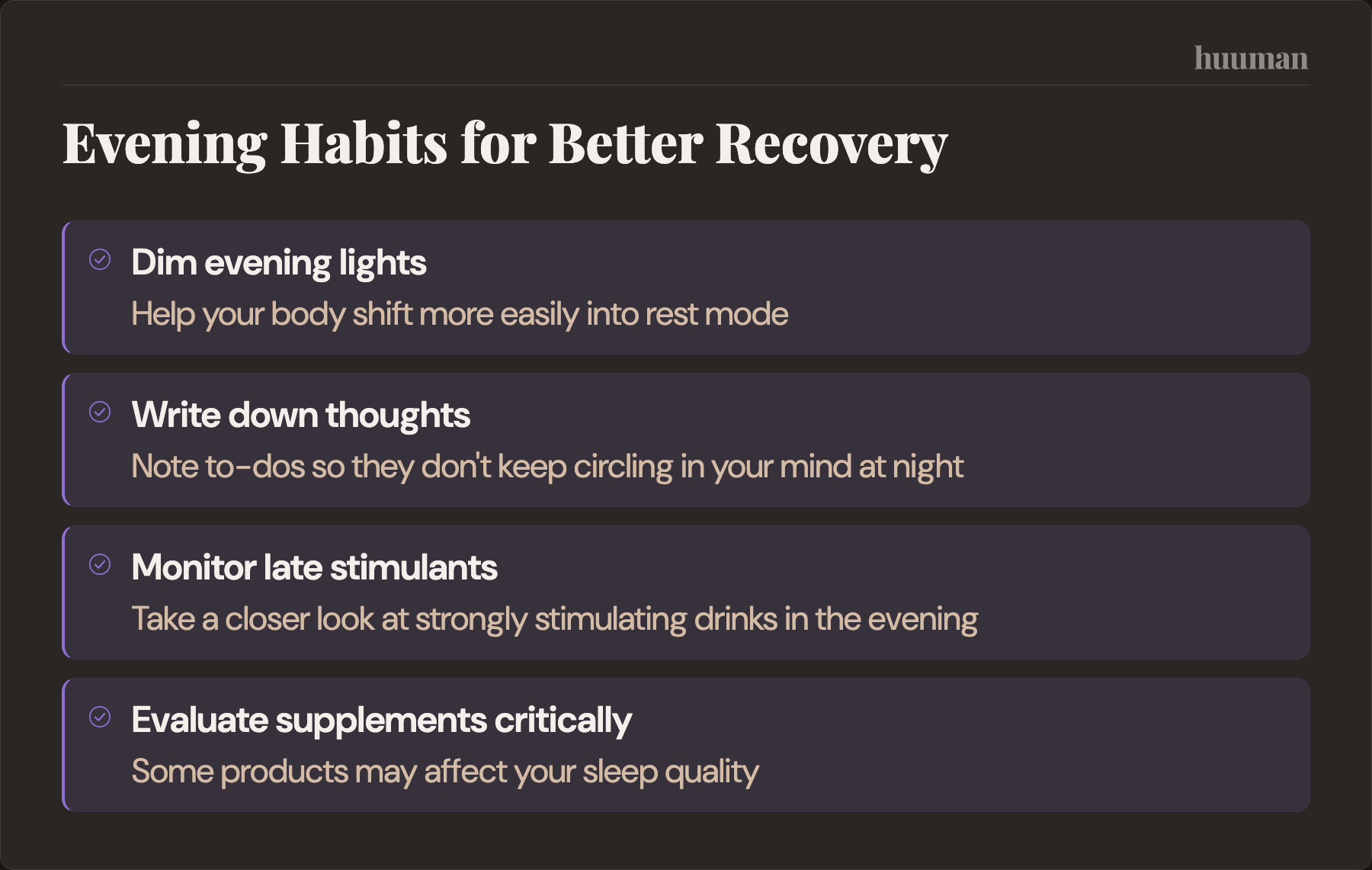
- Dim your lights in the evening so your body can shift more easily into rest mode.
- Briefly note down thoughts or to‑dos so they don't keep circling in your mind at night.
- Take a closer look at late‑evening consumption of strongly stimulating drinks, especially if you're exploring energy drinks and how they affect sleep.
- Evaluate supplements critically. Some products are marketed for focus but relate to sleep quality – for example when looking into focus pills and sleep quality.
- Treat recovery as seriously as training load – for example when programs discuss how often you should deload.
Tracking and interpreting progress
You don't need a gadget to get a rough sense of whether your sleep feels restorative.
- Ask yourself briefly each morning: do you feel refreshed or still exhausted?
- Occasionally note whether you wake up frequently during the night.
- Pay attention to how consistent your bedtime is across several days.
Frequently asked questions
How do you reply to "sleep well"?
Common responses include "Thanks, you too," "You too, good night," or simply "Sleep well too." In chats, a very short reply is often enough.
Is "sleep well" correct to say?
Yes. It's a normal and widely used way to wish someone a good night's sleep. In everyday conversation it sounds natural, friendly, and concise.
What is a more formal alternative to "sleep well"?
More formal options include "Have a good night's rest" or "I wish you a restful night."
What can you say instead of "sleep well"?
The safest and most universal option is "Good night." Warmer alternatives include "Sleep well and sweet dreams" or "Sweet dreams." In more formal contexts, "I wish you a good night" can work.
These simple observations often give you a surprisingly realistic picture of your recovery. When you understand your sleep patterns, your huuman Coach can build personalized weekly plans that adapt training intensity to your actual rest quality rather than guessing at your readiness.
Is it appropriate to say "sleep well" to a teacher or client?
Usually not. In those situations, "Good night" or another neutral closing tends to sound more appropriate and professional.
What's the difference between "good night" and "sleep well"?
"Good night" is neutral and universal. "Sleep well" feels more personal and usually implies a closer relationship.
More health topics to explore
- Sleep & Recovery – Overview
- Marathon Recovery: Your Plan from the First 48 Hours to Week 4
- Running Recovery: A Practical, Evidence-Aware Playbook for Runners
- How Long Should a Deload Last? Benchmarks, Decision Rules, and Example Weeks
References
- Fabbri M et al. — Measuring Subjective Sleep Quality: A Review. (2021)
- Watson et al. — Joint Consensus Statement of the American Academy of Sleep Medicine and Sleep Re (2015)
- Chan et al. — Efficacy of dietary supplements on improving sleep quality: a systematic review and meta-analysis (2022)
- Grant et al. — Controlling for caffeine in cardiovascular research: A critical review (2018)
- Maruani et al. — Efficacy of melatonin and ramelteon for the acute and long-term management of insomnia disorder in adults (2023)
- Harpsøe et al. — Clinical pharmacokinetics of melatonin: a systematic review (2015)