

Hard training works because it creates stress your body has to adapt to. But the same stress that drives progress also creates fatigue. If that fatigue accumulates for too long, performance stalls, motivation drops, and small aches begin to linger.
Key takeaways
1. There is no universal deload schedule. Beginners may train 4–6 weeks before needing one; advanced athletes with high volume may need one every 2–3 weeks.
2. Scheduled deloads (every X weeks) work best for beginners and intermediates. Autoregulated deloads (triggered by HRV, RPE, or performance data) suit experienced athletes who can read their own signals.
3. A deload reduces training stress by 40–60% for one week. If you need more than that, you may be dealing with overtraining — not just accumulated fatigue.
This is where deloads come in. A deload is not a "lazy week" and it is not quitting training. It is a temporary reduction in training stress designed to dissipate fatigue so that adaptation can catch up.
The challenge is knowing how often to deload. Many programs prescribe a rigid calendar. Real life rarely cooperates with that. Training stress, sleep, work pressure, travel, and nutrition all change how quickly fatigue builds.
This guide gives you a practical way to decide when to deload. You will see the typical frequency ranges, the signals that matter most, and three simple deload week templates for strength, hypertrophy, and mixed training.
Deloads and the bigger picture of recovery
Training progress comes from a repeating cycle: stress, recovery, adaptation. Without enough stress, your body has no reason to improve. Without enough recovery, fatigue masks the improvement you have already earned.
A deload sits between these two forces. Its job is to lower accumulated fatigue while maintaining the skill and routine of training. Instead of abandoning the gym for a week, you keep the movements but reduce training stress through changes in volume, intensity, frequency, proximity to failure, or exercise selection.
In resistance training literature, fatigue is usually described in several overlapping forms:
- Peripheral fatigue: fatigue in the muscle itself, often associated with soreness and reduced contractile efficiency.
- Central fatigue: nervous system fatigue that affects coordination, motivation, and force output.
- Connective tissue stress: irritation in tendons, joints, and soft tissues that accumulate over time.
Most deload discussions revolve around fatigue management during structured training blocks. Program design often uses phases such as accumulation, intensification, or peaking. Fatigue builds during the hard phases and a deload helps reset the system before the next block.
This idea connects closely with what coaches call functional overreaching, where short periods of heavy stress temporarily suppress performance but later lead to improvement. When fatigue accumulates too long without recovery, the result may shift toward non functional overreaching and eventually toward true overtraining syndrome. Fortunately, true overtraining is rare outside elite sport. Most recreational lifters are not overtrained but simply under recovered.
If you want a broader view of how recovery fits into overall performance, the Sleep & Recovery overview explains how sleep, stress, and training interact.
Quick answer: how often to deload
Most lifters do best with a deload roughly every 4 to 10 weeks, but the right timing depends on how much training stress you accumulate and how well you recover.
A simple rule works better than a rigid schedule:
- If performance is stable and sessions feel productive, keep training.
- If performance declines, soreness lingers, sleep worsens, or motivation drops for more than a week, consider a deload.
- Remember that a deload means reducing training stress, not stopping training entirely.
Many coaching guidelines and clinical fitness resources describe deload weeks as periodic reductions in training intensity or volume to allow the body to recover from heavy workloads and maintain long term progress. Cleveland Clinic notes that structured rest or lighter weeks are commonly used within resistance training programs to maintain performance and reduce accumulated fatigue.
Typical ranges often look like this in practice:
- Beginners: roughly every 8 to 12 weeks, because absolute loads and fatigue are still relatively low.
- Intermediate lifters: every 5 to 8 weeks when training volume and intensity increase.
- Advanced lifters: often every 4 to 6 weeks due to higher training stress.
These ranges are only starting points. Real timing should follow the signals your training produces.
If you want to track whether fatigue is actually building, you can log your training sessions and recovery signals with your huuman Coach to see patterns in performance, sleep, and readiness over time.
What a deload actually is (and what it is not)
A deload is a planned reduction in training stress. Stress in training is created by multiple variables that interact:
- Volume, usually measured as sets and reps
- Intensity or load
- Training frequency
- Proximity to failure
- Exercise selection and novelty
Adjusting even one of these can reduce overall stress enough to allow recovery.
What a deload is not:
- Not training at all for a week when you are still otherwise healthy
- Doing random workouts with no structure
- A punishment for a bad week of training
Instead, you preserve skill and habit while lowering fatigue. Many programs keep the main exercises but reduce the number of work sets or stop far from failure.
Why deload frequency varies so much
The biggest reason people struggle with the question "how often should you deload" is that fatigue accumulation varies widely between lifters.
Two athletes running similar programs can accumulate completely different fatigue depending on these factors.
Training stress
Programs that emphasize high volumes, frequent training near failure, or multiple conditioning sessions generate large fatigue loads. Hypertrophy programs with many hard sets may produce greater local muscle fatigue and soreness. Heavy strength blocks with maximal loads create strong nervous system demands.
Mixed training approaches add another variable. Athletes who combine heavy lifting with high intensity conditioning accumulate systemic fatigue faster than lifters who focus on one modality.
Recovery capacity
Your ability to absorb training stress depends on recovery inputs such as:
- Sleep duration and quality
- Total calorie and protein intake
- Work stress and mental load
- Travel or disrupted routines
- Illness or infection
- Age
For example, athletes training in a calorie deficit often need deloads slightly earlier because reduced energy availability affects recovery. Older lifters may also benefit from longer recovery windows. The article on why older athletes need more deload time explains how tissue recovery changes with age.
Life stress outside the gym
A training plan assumes stable sleep, nutrition, and workload. Real life rarely provides that. A demanding work project, travel, or reduced sleep can effectively increase training stress even if your program has not changed.
If you want to protect progress long term, fatigue management includes the entire recovery system, especially sleep. Improving the basics covered in optimizing sleep for better recovery often reduces the need for frequent deloads.
Overtraining vs. overreaching: when a deload is not enough
Not every performance dip can be fixed with a deload week. The distinction matters:
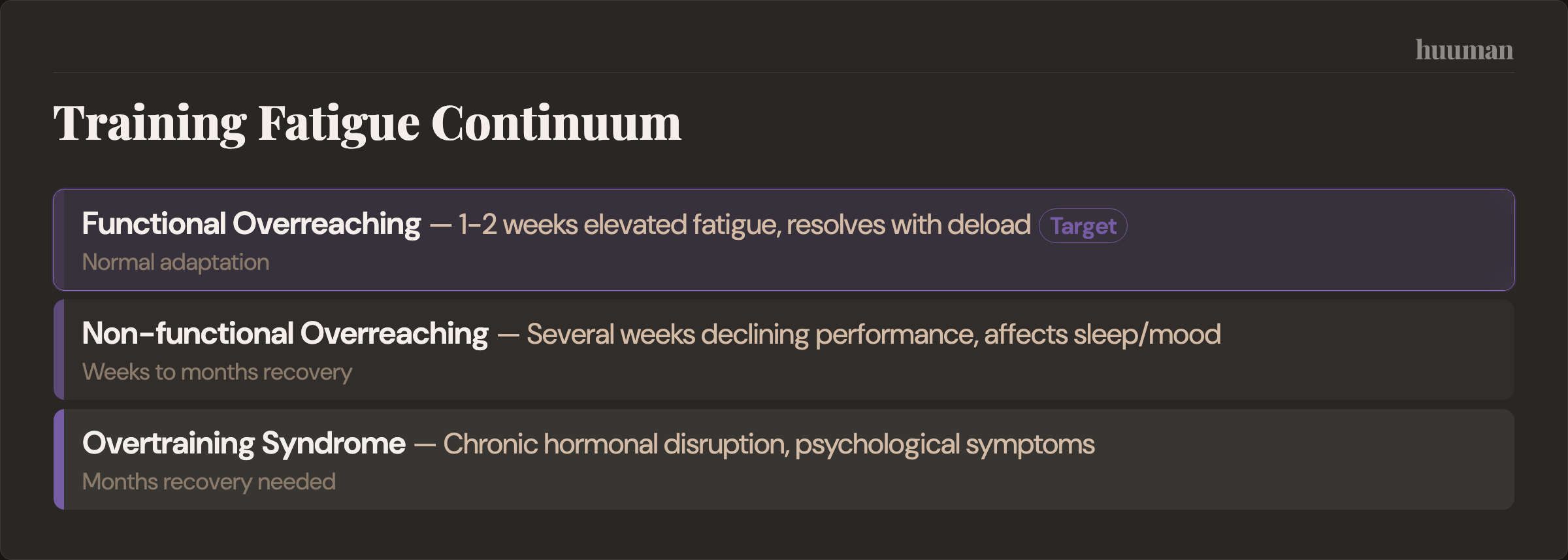
- Functional overreaching: 1–2 weeks of elevated fatigue that fully resolves with a deload. Performance often rebounds above baseline (supercompensation).
- Non-functional overreaching: Several weeks of stagnating or declining performance despite a standard deload. Sleep, mood, and appetite are affected. Recovery takes weeks to months.
- Overtraining syndrome: A chronic condition involving hormonal disruption, sustained performance decline, and psychological symptoms. Recovery can take months. A single deload week will not resolve it.
Warning signs that suggest something beyond normal overreaching: resting heart rate elevated by more than 10 bpm for weeks, HRV suppressed over multiple weeks, recurring infections or injuries, sleep disruption despite fatigue, persistent loss of motivation. In these cases, a sports medicine evaluation is more appropriate than another deload.
Two ways to schedule a deload
Most programs fall into one of two models.
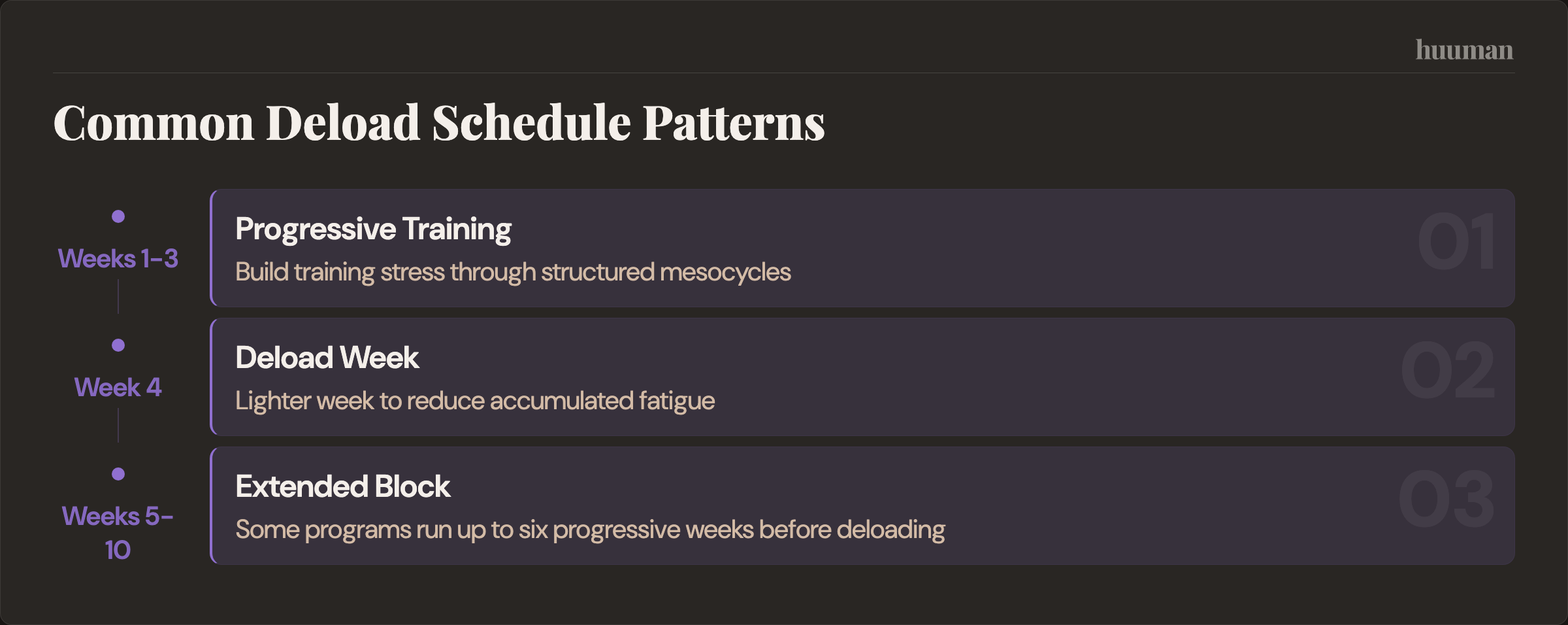
Planned deloads
Planned deloads occur at the end of a training block. A common structure is three to six progressive weeks followed by one lighter week. This approach is common in strength programs or structured mesocycles.
Advantages:
- Easy to plan around
- Reduces the risk of fatigue creeping up unnoticed
- Works well for structured programming cycles
The plan described in programming deloads into your training plan shows how deloads often appear between progressive blocks.
Reactive deloads
Reactive deloads happen when performance or recovery signals start drifting in the wrong direction.
This method works well for experienced lifters who track performance and know when fatigue is building. Instead of following a strict calendar, the deload responds to real feedback.
Both approaches can work. Many programs actually combine them: a planned deload window that can move slightly earlier if fatigue accumulates faster than expected.
The huuman Deload Triangle: Load × Recovery × Signals
A simple way to think about deload timing is to look at three moving parts simultaneously.
- Load: the amount of training stress you apply
- Recovery: the resources available to absorb that stress
- Signals: the feedback your body gives you
When two parts of this triangle drift in the wrong direction for about one to two weeks, fatigue is likely accumulating.
Examples:
- Training load increases while sleep decreases.
- Performance decreases while soreness and joint irritation increase.
- Training intensity increases while appetite and recovery markers deteriorate.
When two corners trend "red," a deload usually restores balance before fatigue becomes more disruptive.
Evidence and limits
Resistance training research strongly supports the idea of managing fatigue within structured training blocks. Reviews of periodization research describe cycles of higher stress followed by recovery phases to allow adaptation to emerge.
However, research does not provide a single standardized deload protocol. Programs vary widely in how they reduce training load and how often lighter weeks appear. Much of the practical guidance used by coaches comes from applied experience rather than fixed laboratory protocols.
Studies examining monitoring strategies also emphasize that performance trend, subjective recovery, and simple markers such as sleep or resting heart rate can help athletes detect accumulating fatigue. Monitoring tools like heart rate variability can provide context but should be interpreted carefully and never used as the only decision rule.
Research shows that cardiac
Research in elite female wrestlers found that HRV thresholds can detect nonfunctional overreaching, providing specific early-warning values for excessive fatigue.
Because of these limitations, the practical takeaway is simple: rigid calendar rules are less useful than observing performance and recovery trends.
Non‑prescriptive strategies for structuring a deload
Choose your deload style
Different athletes respond better to different deload structures. The goal is always the same: reduce stress while keeping movement patterns.
- Volume deload: keep moderate intensity but significantly reduce sets.
- Intensity deload: keep normal exercises but reduce load.
- Frequency deload: train fewer days during the week.
- Exercise swap: use joint friendly variations that reduce irritation.
- Technique week: practice lifts at low effort with perfect execution.
Many lifters simply cut the number of hard sets dramatically and stay far from failure.
If you want a step by step breakdown, a structured deload protocol outlines how many programs implement these adjustments.
How long should a deload last?
The most common options are:
Research on supervised resistance training found that reducing volume by 50-75% and load by 10-20% during a one-week deload period effectively manages training adaptations.
- 3 to 4 days when fatigue is minor and you intervene early
- 7 days when fatigue has accumulated across several intense weeks
A full week often makes sense after heavy accumulation blocks or intense life stress. Shorter deloads work well when you catch fatigue early.
Minimal effective dose for busy professionals
Time pressure often makes people skip deloads entirely. A minimal option keeps the habit of training while dramatically reducing stress.
- Two short full body sessions
- Focus on technique rather than load
- No sets near failure
- Light cardio such as walking or easy cycling
This style often fits well for people balancing demanding jobs or travel schedules.
Three practical deload week templates
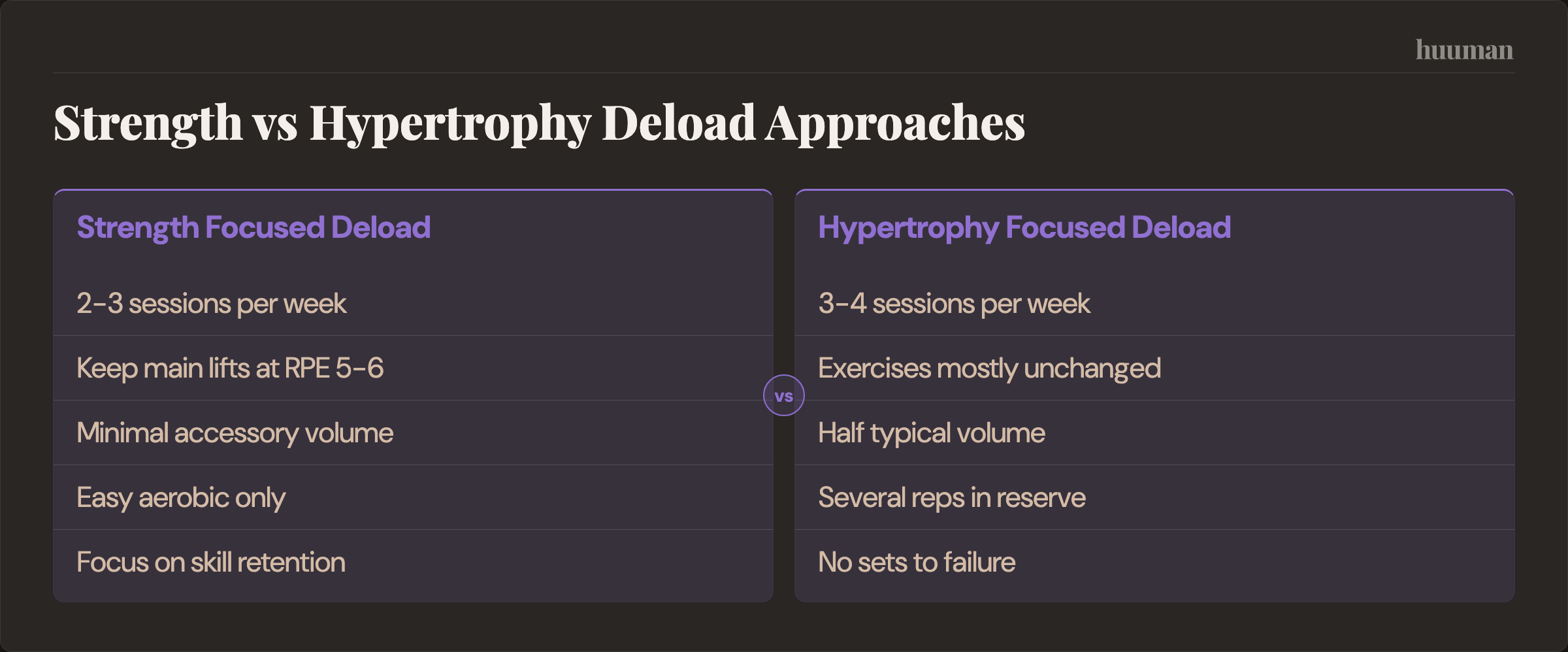
Strength focused deload
- Sessions: 2 to 3 per week
- Main lifts: keep them but reduce work sets
- Effort: roughly RPE 5 to 6, no grinding reps
- Accessory work: minimal volume
- Optional conditioning: easy aerobic only
The goal is skill retention. You practice the lifts without accumulating fatigue.
Hypertrophy focused deload
- Sessions: 3 to 4 sessions
- Exercises: mostly unchanged
- Work sets: roughly half the typical volume
- Effort cap: leave several repetitions in reserve
- No sets to failure
This approach reduces muscle fatigue while keeping movement patterns consistent. Many athletes notice sleep and appetite normalize quickly during this phase.
Mixed‑modal or CrossFit style deload
- Sessions: 2 to 3 moderate sessions
- Conditioning: mostly aerobic or tempo work
- Strength work: one moderate session
- Avoid maximal intervals or competitive workouts
- Focus on technique skills or mobility work
Athletes mixing conditioning and strength accumulate systemic fatigue quickly, so reducing high intensity intervals and dense workouts is often the most effective adjustment.
For runners or endurance athletes who also lift, combining these ideas with recovery strategies after running can help prevent cumulative fatigue from both modalities.
How to track and interpret changes
Deload decisions improve dramatically once you track a few consistent signals.
Effective monitoring can stay simple.
Quick daily signals
- Sleep duration and sleep quality
- Morning resting heart rate
- General soreness
- Mood and training motivation
Session level tracking
- Top set load and repetitions
- Rate of perceived exertion (RPE) or repetitions in reserve (RIR)
- Total sets
- Any joint irritation or unusual fatigue
Weekly review
- Trend in your key lifts
- Trend in sleep and recovery markers
- Bodyweight changes if dieting
A successful deload often produces subtle changes: warm ups feel easier, soreness decreases, sleep improves, and performance begins rising again in the next one or two weeks.
Signal vs noise when deciding to deload
- Signal: strength declines across two or more sessions on the same lift. Next step: consider a short deload rather than pushing heavier loads.
- Noise: one bad workout after poor sleep. Next step: wait for another session before changing your program.
- Signal: joint pain that worsens during warm up. Next step: reduce training stress and consider exercise variations.
- Noise: normal soreness from a new movement. Next step: maintain the program until adaptation occurs.
- Signal: rising resting heart rate along with worse sleep and irritability. Next step: treat it as systemic fatigue and plan a lighter week.
- Noise: one day of low HRV after poor sleep or alcohol. Next step: watch the trend instead of reacting immediately.
- Signal: needing increasing caffeine to complete normal training sessions. Next step: assess accumulated fatigue.
- Noise: temporary fatigue from a stressful workday. Next step: keep training but lower the session intensity.
- Signal: technique breaks down at loads that previously felt stable. Next step: consider a deload focused on skill and lighter loads.
Common questions
How often should you deload for strength vs hypertrophy?
Hypertrophy training often accumulates more local muscle fatigue due to higher set volume and training near failure. This can lead to slightly more frequent deloads. Strength programs typically maintain higher intensity but lower volume, so fatigue may accumulate more slowly. In practice, both styles usually fall somewhere within the 4 to 10 week range depending heavily on recovery capacity.
When should I deload if I am not making progress?
If strength has stalled for multiple sessions and training feels progressively harder despite similar loads, accumulated fatigue may be masking adaptation. A short deload frequently restores performance momentum.
How long should a deload last: three days or one week?
Short deloads of three to four days work well when you respond early to fatigue signals. If fatigue has been building for several weeks, a full week of reduced training stress is often more effective.
Should beginners deload?
Beginners usually accumulate fatigue slowly because loads and volumes are lower. Instead of scheduled deloads, beginners can simply take lighter weeks occasionally or reduce training stress when life becomes demanding.
What should a deload week look like in the gym?
Most lifters continue training but reduce volume, intensity, or frequency while avoiding failure. The sessions often feel easy. The goal is recovery, not pushing progress.
Can I do HIIT during a deload week?
High intensity intervals produce significant systemic fatigue. During a deload it is usually better to replace them with easy aerobic sessions or technique work.
What if I need deloads very frequently?
If you feel the need to deload every few weeks, the total training load may exceed your recovery capacity. Checking sleep, nutrition, and program structure can reveal the underlying issue. Systems such as balancing muscle building with recovery often adjust training stress across the week to reduce excessive fatigue.
For a structured approach to this timing, you can have the huuman app build weekly training plans that automatically adjust based on your performance trends and recovery signals rather than following a rigid calendar.
More health topics to explore
- Sleep & Recovery – Overview
- Deep Sleep Pillow Spray: What It Is, Whether It Works, and How to Choose Safely
- Deload Weightlifting: The Simple Way to Recover Without Losing Progress
- The “3 A.M. Wake-Up”: Causes, Quick Fixes, and When to Look Deeper
References
- Flatt & Esco — Heart Rate Variability Stabilization in Athletes (2016)
- Schoenfeld et al. — Resistance Training Volume Enhances Muscle Hypertrophy but Not Strength (2019)
- Stanley J et al. — Cardiac parasympathetic reactivation following exercise: implications for traini (2013)
- Cheng AJ et al. — Intramuscular mechanisms of overtraining. (2020)
- Tian et al. 2013 — Heart rate variability threshold values for early-warning nonfunctional overreac
- Jukic et al. 2023 — The Acute and Chronic Effects of Implementing Velocity Loss Thresholds During Re
- Cleveland Clinic — Progressive Overload
- Coleman M et al. — Gaining more from doing less? The effects of a one-week deload period during ... (2024)
About this article · Written by the huuman Team. Our content is based on peer-reviewed research and clinical guidelines. We follow editorial standards grounded in scientific evidence.
This article is for educational purposes only and does not constitute medical advice. Health and training decisions should be discussed with qualified professionals.

