Many people search for pills for concentration when their focus and mental endurance start slipping. Long hours in front of screens, constant multitasking, lack of sleep, or high stress can noticeably reduce attention. Grabbing something from a drugstore or online pharmacy can feel like a quick and easy fix.
The problem is that the term itself is vague. "Concentration pills" can refer to very different things. Some are dietary supplements such as caffeine, omega‑3 fat acids, or plant extracts. Others are prescription medications used for clearly diagnosed conditions like ADHD. Their effects, risks, and appropriate uses differ significantly.
Key takeaways
1. Dietary supplements: such as caffeine, B vitamins, omega‑3 fatty acids, or herbal extracts. In healthy adults, effects are often small, situation‑dependent, and not reliably noticeable.
2. Prescription medications: such as methylphenidate, atomoxetine, or lisdexamfetamine for diagnosed ADHD. These belong in medical treatment and are not intended for performance enhancement in healthy people.
3. What is your actual goal: alertness, sustained focus, or stress stability?
This guide helps you understand the landscape realistically. You'll get a clear overview of the main categories, common ingredients, practical decision criteria, and typical risks. You'll also learn how to track potential effects using simple focus metrics instead of relying only on marketing claims or gut feelings.
Focus Is a System, Not Just a Substance
Concentration is influenced by several layers at once. Brain chemistry matters, but it's only one part of the system. Sleep, stress levels, energy availability, and your environment all directly affect attention and mental stamina.
Many focus problems aren't caused by a lack of a specific compound, but by overload or poor conditions. If your brain is constantly switching between tasks or you're not recovering properly, a pill might temporarily increase alertness, but it won't address the underlying cause. In those cases the problem is postponed rather than solved.
A realistic look at concentration issues therefore includes several areas:
- Mind: managing attention and reducing distractions
- Recovery: sleep pressure and mental recovery
- Metabolism: stable energy and possible micronutrient deficiencies
- Heart: cardiovascular reactions to stimulants
If you want to understand how mental overload can undermine focus, see our background article on what happens when the brain is overloaded.
Quick Answer
Pills for concentration generally fall into two main categories:
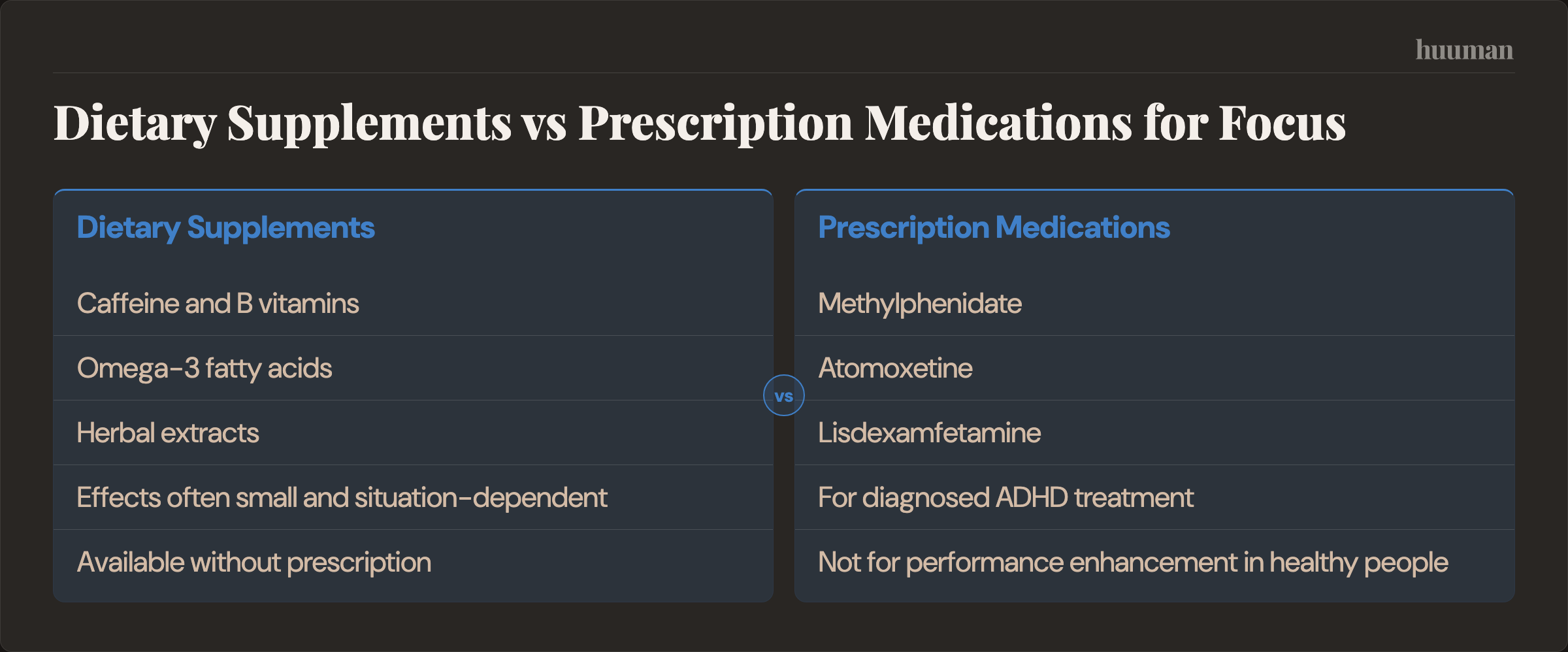
- Dietary supplements: such as caffeine, B vitamins, omega‑3 fatty acids, or herbal extracts. In healthy adults, effects are often small, situation‑dependent, and not reliably noticeable.
- Prescription medications: such as methylphenidate, atomoxetine, or lisdexamfetamine for diagnosed ADHD. These belong in medical treatment and are not intended for performance enhancement in healthy people.
A helpful decision filter includes three questions:
- What is your actual goal: alertness, sustained focus, or stress stability?
- What risks or interactions could matter in your case?
- How will you measure objectively whether it actually helps?
The most reliable approach starts with understanding your baseline patterns rather than guessing what might help. Track your focus levels and energy patterns with the huuman app for two weeks to identify when concentration naturally peaks and dips throughout your day.
What People Usually Mean by "Focus Pills"
In practice, the term mostly appears as a broad product category. Drugstores, online pharmacies, and supplement shops list dozens of products claiming to support concentration, memory, or mental energy.
These products typically include combinations of:
- caffeine or other stimulating compounds
- plant extracts such as ginkgo, ginseng, or rhodiola
- micronutrients like B vitamins or magnesium
- fatty acids such as omega‑3
There is also a separate category often referred to as "smart drugs" or "brain doping." This term describes prescription medications used outside medical indications. Research and prevention reports clearly classify this as a concerning trend and point to potential health risks and dependency risks.
Dietary Supplements
Most over‑the‑counter focus products fall into this category. They are intended to provide nutrients that theoretically support energy metabolism or nerve function.
Common examples include:
Evidence suggests that L-theanine combined with caffeine improves attention and alertness, with measurable benefits at 60 and 90 minutes after consumption.
A study in young adults found that 97 mg L-theanine with 40 mg caffeine improved cognitive performance.
Research also shows that higher doses of this combination can provide additional benefits. L-theanine (250 mg) with caffeine (150 mg) is associated with improved attention-switching and reduced distraction in memory tasks.
- Caffeine, sometimes combined with L‑theanine
- B vitamins such as B12 or folate
- Omega‑3 fatty acids (EPA/DHA)
- Plant extracts such as Ginkgo biloba, Rhodiola, or Panax ginseng
- Creatine
The key limitation is that supplements usually show measurable benefits only when there is an actual deficiency or a specific stress situation.
Medications
Drugs such as methylphenidate, atomoxetine, or lisdexamfetamine are used to treat ADHD. They influence neurotransmitters in the brain and can significantly improve concentration in ADHD in people with a confirmed diagnosis.
However, these medications belong within medical diagnosis and treatment. They are not a general solution for everyday work stress or fatigue.
Substances such as modafinil are sometimes associated with cognitive enhancement, but health information sources specifically warn about risks and misuse potential.
Ingredient Guide: Categories, Benefits, and Risks
Instead of searching for "the best product," a more useful question is: Which category actually fits my specific problem?
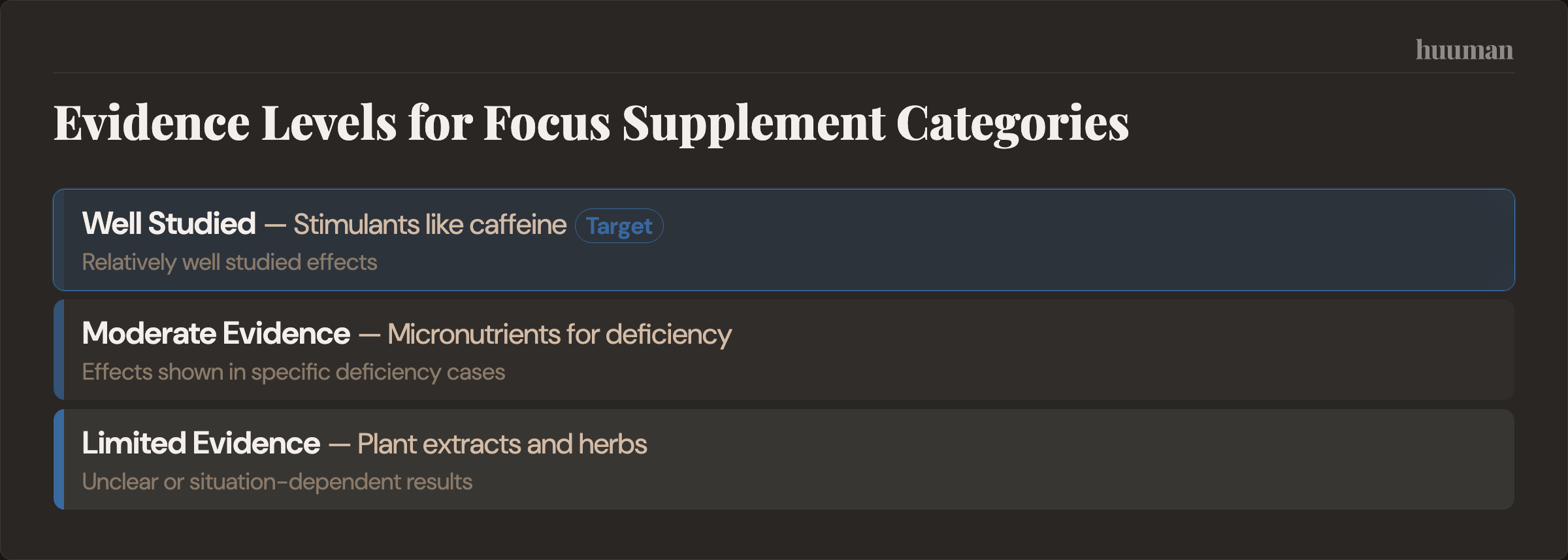
- Category: Stimulants (e.g., caffeine) — Possibly useful for: short‑term alertness during fatigue — Less suitable when: anxiety tendencies or sleep problems — Evidence level: relatively well studied — Typical risks: nervousness, sleep disruption, increased heart rate — Interaction check: blood pressure or other stimulants
- Category: Micronutrients (B12, iron) — Possibly useful for: diagnosed deficiency — Less suitable when: already balanced nutrient status — Evidence level: strong with deficiency, low otherwise — Typical risks: possible overdosing — Interaction check: existing medical conditions
- Category: Plant extracts (ginkgo, ginseng) — Possibly useful for: subjective mental fatigue — Less suitable when: expectation of strong effects — Evidence level: mixed evidence — Typical risks: digestive discomfort, headaches — Interaction check: e.g., blood thinners with ginkgo
- Category: Omega‑3 fatty acids — Possibly useful for: low fish intake — Less suitable when: acute focus needs — Evidence level: mixed — Typical risks: digestive effects, possible interactions — Interaction check: clotting and medications
- Category: Creatine — Possibly useful for: high mental load or low animal‑protein diet — Less suitable when: expectation of rapid mental effects — Evidence level: interesting in specific contexts — Typical risks: gastrointestinal discomfort — Interaction check: check kidney conditions
This overview highlights an important point: most categories target different underlying causes. Fatigue, stress, and nutrient deficiencies affect the brain through different mechanisms.
If you'd like to explore how nutrition influences brain performance more broadly, see our guide to nutrition, metabolism, and brain energy.
How to Read Labels Properly
Many focus supplements look similar but differ considerably in quality and transparency. Three simple checks help separate substance from marketing.
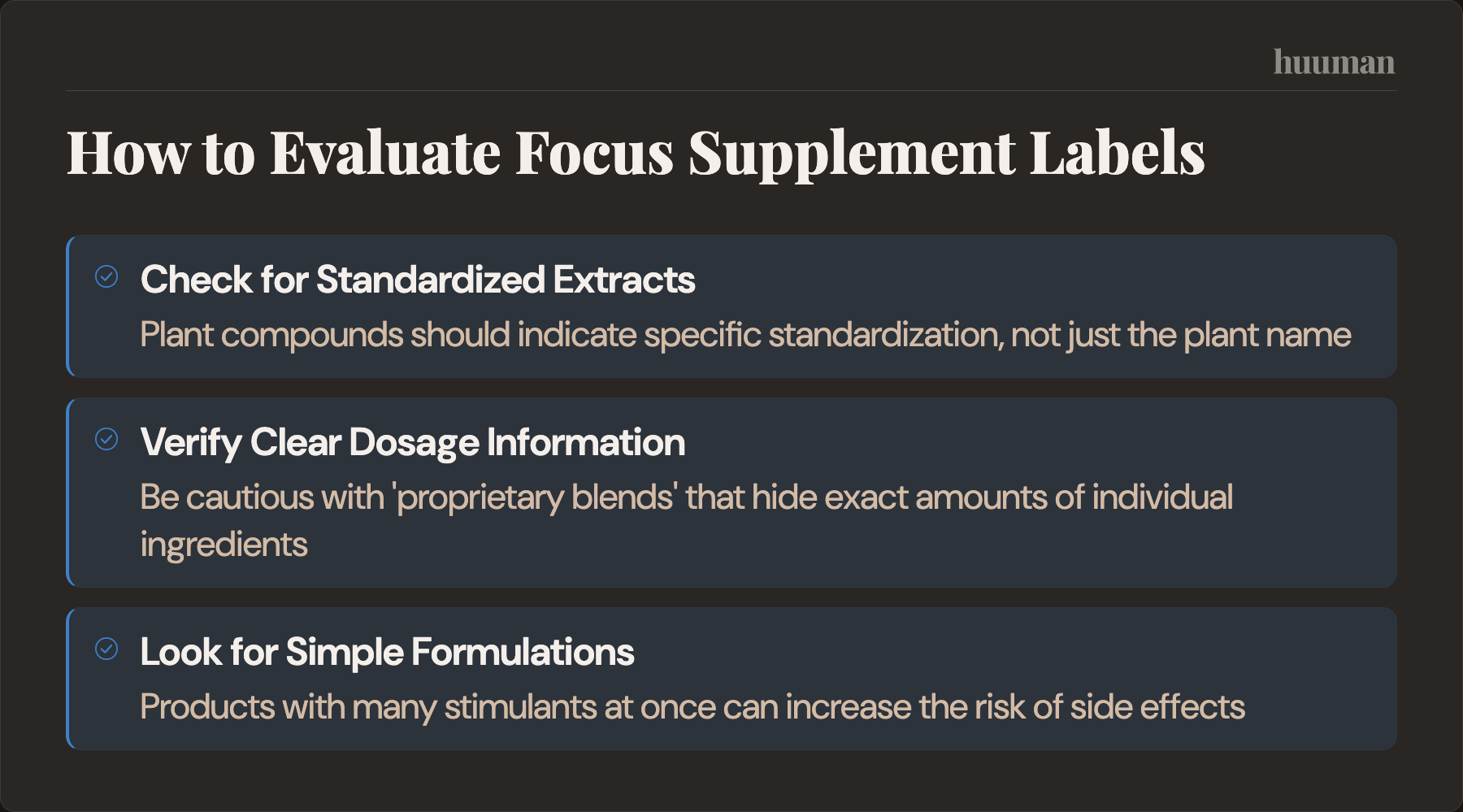
- Standardized extracts: plant compounds should indicate a specific standardization, not just the plant name.
- Clear dosage information: be cautious with "proprietary blends" that hide the exact amounts of individual ingredients.
- Simple formulations: products with many stimulants at once can increase the risk of side effects.
Some products combine several stimulants to amplify alertness. This may increase the perceived effect, but it can also intensify nervousness and sleep problems. Reviewing the ingredient list carefully helps prevent these mistakes.
Beyond combining stimulants, herbal supplements can interact with prescription medications. Evidence suggests that Ginkgo biloba is associated with bleeding risk when taken with anticoagulants like warfarin, highlighting the importance of checking for potential herb-drug interactions before adding any supplement.
Label Checklist
- Are the exact amounts of each ingredient listed?
- Are plant extracts standardized?
- Does the product promise unrealistic performance gains?
- Are multiple stimulants combined?
- Is the intended use realistic and clear?
- Are there signs of quality control or third‑party testing?
Evidence and Limitations
Why is the research on many focus products unclear? One reason is that concentration problems can have many causes. Sleep deprivation, stress, depressive episodes, infections, or micronutrient deficiencies can produce very similar symptoms.
When studies show effects, they often apply only to specific groups, for example people experiencing pronounced fatigue or sleep loss. The results cannot automatically be generalized to healthy, well‑rested adults.
Evidence suggests that creatine supplementation is associated with mixed cognitive benefits, with some positive effects on memory and intelligence in healthy individuals, though results vary between studies.
There is also a strong expectation effect. When people believe a focus product will work, many report feeling more concentrated. Without structured tracking, it's difficult to distinguish a real effect from placebo.
Health information sources also warn that using stimulating substances for performance enhancement carries risks, particularly when doses increase or multiple products are combined.
Strategies That Often Work Better Than a Pill
A common mistake is the order of interventions. Many people try supplements right away, even though environmental factors often have the strongest effect on concentration.
A more practical sequence typically looks like this:
- Environment: reduce distractions and define clear work blocks
- Behavior: structured focus periods and regular breaks
- Nutrition: stable energy and adequate nutrient intake
- Supplement testing: targeted trials when a category makes sense
- Medical evaluation: if problems are frequent or severe
Sleep, for example, is often underestimated. More stable sleep timing and better recovery can improve focus more than adding another product. Practical guidance can be found in our article on sleeping better to improve concentration.
Stress regulation also plays a major role. Practices such as breathing exercises or meditation can help reduce mental restlessness. A useful introduction is in our article on meditation for inner restlessness.
If you prefer drinks rather than tablets, you can also read this overview: energy drinks for concentration.
Measure Focus Instead of Guessing
If you test a product or strategy, tracking makes a big difference. Without simple measurements it's hard to tell whether a change actually helped or just happened by chance.
A simple A/B test can make effects easier to detect: compare two to four similar days with and without the product. Sleep duration, meals, and work hours should stay roughly comparable.
Rather than relying on supplements to force focus, a more sustainable approach involves building weekly routines that naturally support concentration through proper recovery and energy management. Work with your huuman Coach to build personalized weekly plans that optimize your training and recovery for sustained mental performance.
Signal vs. Noise in Focus Pills
- "Over the counter" doesn't automatically mean safe. Always review potential side effects and interactions.
- Natural doesn't mean risk‑free. Herbal compounds can interact with medications.
- More ingredients aren't necessarily better. Complex blends can increase side‑effect risk and make evaluation harder.
- Fatigue is often a sleep issue. Check sleep duration and quality first.
- Energy crashes after meals are often about timing. Review meal structure before turning to supplements.
- If focus only works under pressure, stress management may be the real leverage point.
- Heart palpitations or sleep problems are clear warning signs. Reduce stimulants and reassess.
- Constantly rotating products often replaces solving the root cause. Stabilize the basics first.
Frequently Asked Questions
Which medication actually improves concentration?
Medications such as methylphenidate or atomoxetine are used in the treatment of ADHD and can significantly improve concentration in people with a confirmed diagnosis. They require a prescription and are not intended for general cognitive enhancement. The German Federal Ministry of Research (BMBF) provides an overview of the risks and realities of pharmacological cognitive enhancement.
Are there over‑the‑counter focus pills that noticeably help adults?
Some ingredients may support alertness in the short term or help in cases of specific deficiencies. For healthy adults without deficiencies, the effects are often small and variable.
What can I do during exam periods without ruining my sleep?
Structured study blocks, regular breaks, adequate light exposure, and consistent sleep times are often more effective than additional stimulants. Excess caffeine can increase nervousness and disrupt sleep.
Are herbal focus pills supported by evidence?
The evidence for many plant extracts is mixed. Some effects have been studied in specific groups, such as people with cognitive impairment. Results cannot automatically be transferred to healthy adults.
What side effects occur most often?
The most common reactions to stimulant products are nervousness, increased heart rate, and sleep problems. Monitoring cardiovascular and sleep responses is therefore helpful when testing them.
When should concentration problems be medically evaluated?
If concentration issues appear suddenly, worsen rapidly, or occur together with symptoms such as persistent insomnia, depressive mood, heart symptoms, or neurological changes, medical evaluation is recommended. Concentration problems can stem from everyday factors like sleep debt, dehydration, or stress.
For a broader look at mental health and focus, see our overview on mindset and mental health. Nutrition and fasting approaches are also sometimes linked to mental clarity, as discussed in our article on how fasting may influence mental clarity. Another perspective on supplement strategies can be found in our article on supplements in the Blueprint protocol.
More health topics to explore
- Mindset, Stress & Mental Health – Overview
- Alone at the Holidays: A Calm, Practical Plan to Reduce Loneliness
- Anger and Meditation: A Practical Guide to Responding Instead of Reacting
- Concentration in Children: Causes, Quick Fixes, and Warning Signs
References
- EFSA — Scientific Opinion on Caffeine Safety (2015)
- Birks et al. — Ginkgo Biloba for Cognitive Impairment (2009)
- BMBF — Hirndoping: Kognitive Leistungssteigerung durch Pillen?
- Xu et al. — Creatine and Cognitive Function: Systematic Review (2024)
- Birks J et al. — Ginkgo biloba for cognitive impairment and dementia (2002)
- Owen GN et al. — The combined effects of L-theanine and caffeine on cognitive performance and ... (2008)
- Giesbrecht et al. — L-Theanine and Caffeine: Cognitive Performance (2010)
- Fugh-Berman A — Herb-drug interactions (2000)
- Haskell CF et al. — The effects of L-theanine, caffeine and their combination on cognition and mood (2008)
- Avgerinos KI et al. — Effects of creatine supplementation on cognitive function of healthy individu... (2018)
- Mizuno Y et al. — Methylphenidate remediates aberrant brain network dynamics in children with a... (2022)
- Cortese S et al. — Comparative efficacy and tolerability of medications for attention-deficit hy... (2018)
- Klein-Schwartz W — Abuse and toxicity of methylphenidate (2002)
About this article · Written by the huuman Team. Our content is based on peer-reviewed research and clinical guidelines. We follow editorial standards grounded in scientific evidence.
This article is for educational purposes only and does not constitute medical advice. Health and training decisions should be discussed with qualified professionals.