Many muscle-building training plans look convincing at first glance. They include long exercise lists, fixed rep counts, or rigid weekly schedules. What's often missing is the underlying logic. Why does a plan actually work, and when should you adjust it?
A good muscle-building training plan is less a rigid calendar and more a well-designed training stimulus. You combine training stress with sufficient recovery and a clear way to measure progress. If any one of these elements is missing, even a well-structured plan can stall.
Key takeaways
1. Enough hard working sets per muscle group, performed close to muscular failure.
2. Measurable progressive overload, for example through more reps or increased weight.
3. About 4–8 core exercises per session focused on major movement patterns.
This guide provides practical, ready-to-use templates for different time budgets and experience levels. You'll also get a simple progression system, tracking templates, and a decision framework to help you choose the right training split.
If you want to dive deeper into the physiology, you can find additional background in our muscle-building fundamentals and the overview of strength, muscles, and movement.
Context: Muscle building as long-term structural work
Muscle mass is more than aesthetics. It contributes to stability, metabolic health, and physical capacity in everyday life. In both training science and epidemiology, greater muscle strength is often associated with better functional ability and lower injury risk.
From the huuman perspective, a training plan is part of a larger system. You're building structural capacity: resilient joints, stable movement patterns, and durable tissue. Over years, this process creates a kind of physical capital that remains valuable later in life, for example when considering muscle building as you age.
A plan works only when three elements come together:
- Stimulus: sufficiently hard working sets close to muscular failure
- Structure: sensible exercise selection, frequency, and training organization
- System feedback: sleep, stress levels, performance trends, and recovery
In other words, you're not just performing exercises, you're designing training stress in a way that allows your body to adapt.
Quick answer: What an effective muscle-building training plan looks like
A functional muscle-building training plan typically meets five basic conditions:

- Enough hard working sets per muscle group, performed close to muscular failure.
- Measurable progressive overload, for example through more reps or increased weight.
- About 4–8 core exercises per session focused on major movement patterns.
- Intensity management using RPE or RIR instead of constantly training to absolute failure.
- Planned recovery through a sensible distribution of sessions across the week.
For most lifters, the following structures work reliably:
- Beginners: full-body training around 3× per week.
- Intermediate lifters with moderate time: upper/lower split 4× per week.
- Very experienced lifters with high volume needs: push/pull/legs 5–6× per week.
- Minimal plan: even 2 full-body sessions per week can drive progress.
The most important rule: train consistently close to muscular failure, increase performance over time, and evaluate progress through strength metrics, body measurements, and recovery markers.
Ready to put these principles into action? You can start a personalized strength session with your huuman Coach right now and get a workout tailored to your current capacity and available equipment.
What muscle building in training actually means
Muscle hypertrophy occurs as an adaptation to mechanical load. Training research often discusses three possible drivers: mechanical tension, metabolic stress, and muscle-damage-related signaling. Today, mechanical tension is generally considered the primary factor.
This tension arises primarily during challenging working sets, sets performed close to muscular failure in which a large portion of motor units are recruited.
Because of this, the quality of a set matters more than the number of exercises. A half-hearted set far from failure produces far less training stimulus than a well-executed working set performed with high tension.
Using RIR and RPE to manage effort
Instead of relying on complicated percentage calculations, many programs use RPE or RIR scales.
- RPE describes the perceived difficulty of a set.
- RIR means "reps in reserve," representing how many repetitions you could still perform before failure.
In many training programs, working sets fall around 1–3 RIR, meaning you stop the set with one to three repetitions left in reserve.
This buffer helps manage fatigue while still providing a strong stimulus for muscle growth.
The five building blocks of a good training plan

1. Exercise selection by movement patterns
Training programs are more effective when organized around movement patterns rather than individual muscles. This approach reliably covers large muscle chains.
- Squat pattern: squat, goblet squat, leg press
- Hip hinge pattern: Romanian deadlift, hip thrust
- Horizontal push: bench press or dumbbell press
- Vertical push: overhead press
- Horizontal pull: rowing variations
- Vertical pull: pull-ups or lat pulldown
- Unilateral work: split squat or step-up
- Stability and core: carries, planks
Compound lifts usually deliver the strongest stimulus per set. Isolation exercises are often used afterward to add work for smaller muscles or weaker areas.
2. Training volume
Training volume refers to the number of hard sets per muscle group per week. Meta-analyses suggest a typical dose–response relationship: higher volume is associated with greater muscle growth up to an individual plateau.
The key factor is individual capacity. Beginners often respond well to moderate volume, while advanced lifters may require more sets to create further adaptation.
3. Intensity and rep ranges
In practice, many programs use moderate rep ranges for main compound lifts and slightly higher rep ranges for accessory and isolation exercises.
4. Training frequency
How often you train a muscle group mainly affects how weekly volume is distributed. Research suggests frequency matters less when total weekly volume is similar. In practice, training each muscle group roughly twice per week has proven to be an efficient structure.
This is where training splits come into play.
5. Progressive overload
A training plan only works if it gradually becomes more demanding over time. Progressive overload means your body is challenged with increasing demands.
You can adjust several variables to achieve this:
- more weight
- more repetitions
- more working sets
- shorter rest periods
- greater range of motion
- cleaner technique
Many programs use so‑called double progression: you work within a rep range and increase weight only after consistently reaching the upper end of that range.
Which training split fits you?
Your ideal split depends on your available training time, experience level, and recovery capacity.
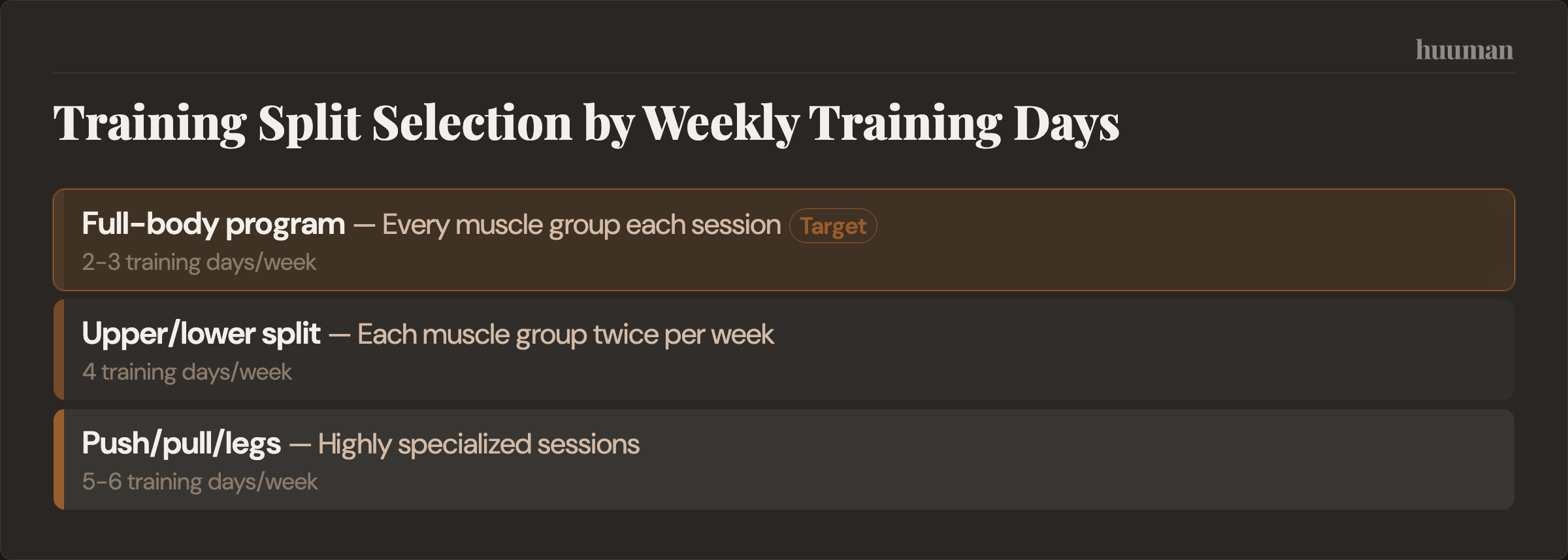
Comparison of common training splits
- Full-body training
Weekly time commitment: low to moderate
Frequency: every muscle group each session
Best suited for: beginners, people returning to training, limited time
Fatigue risk: relatively low
- Upper/lower split
Weekly time commitment: moderate
Frequency: each muscle group about twice per week
Best suited for: intermediate lifters with 3–4 training days
Fatigue risk: moderate
- Push/pull/legs
Weekly time commitment: high
Frequency: highly specialized sessions
Best suited for: very experienced lifters with high work capacity
Fatigue risk: higher if recovery is insufficient
Quick decision guide
- 2–3 training days per week → full-body program
- 4 training days with solid technique → upper/lower split
- Years of training and high volume tolerance → push/pull/legs
This kind of decision framework resembles structured systems such as the Blueprint Protocol training framework, where training load is planned and reviewed systematically.
Training templates: Three plans you can use immediately
1. Minimal plan: full body 2× per week
- Squat or leg press
- Bench press or dumbbell press
- Row variation
- Romanian deadlift or hip thrust
- Optional: lateral raises or biceps
Perform several working sets per exercise with a moderate buffer before failure. Supersets can help reduce total session time.
2. Standard plan: full body 3× per week
- Day A
Squat
Bench press
Row
Romanian deadlift
Lateral raises
- Day B
Leg press
Incline press
Lat pulldown
Hip thrust
Biceps
- Day C
Goblet squat
Overhead press
Row variation
Split squat
Triceps work
3. Upper/lower split 4× per week
- Upper Body A
Bench press
Row
Shoulder press
Lat pulldown
Arms
- Lower Body A
Squat
Romanian deadlift
Split squat
Calves
Core
- Upper Body B
Overhead press
Pull-ups
Incline press
Row variation
Arms
- Lower Body B
Heavy hip hinge movement
Leg press
Hamstring isolation
Carry or core
Many programs use longer rest periods between working sets, as research suggests sufficient rest can help maintain performance across multiple sets.
Evidence and limitations
Training research offers several reliable guidelines. Meta-analyses suggest that muscle hypertrophy can occur across a wide repetition range when sets are performed close to muscular failure.
Research also indicates a dose–response relationship between training volume and muscle growth, at least until an individual plateau is reached. Training frequency appears to function mainly as an organizational tool as long as total weekly volume remains similar.
Evidence is less clear when it comes to topics like the ideal timing of deload phases or optimal individual volume. Many recommendations here are based on a combination of research interpretation and coaching practice.
This makes feedback essential. A training plan only works if you observe and adjust it over time.
Strategies to discuss with a coach or professional
Minimal effective dose
Busy professionals often benefit from short, consistent sessions. Two full-body workouts per week can already produce progress if working sets are sufficiently challenging.
Progression system: double progression
- define a rep range
- progress within that range
- increase weight only after reaching the upper limit consistently
If progress stalls, it helps to check a few fundamentals:
- Are you sleeping enough?
- Are stress levels high?
- Are rest periods too short?
- Are sets too far away from muscular failure?
- Has training volume increased too quickly?
- Is exercise technique consistent?
Periods of reduced load can sometimes help when fatigue and declining performance persist. You can find more guidance in the article on when a deload makes sense.
Long-term planning also matters. Additional context is available in how often you should deload.
Recovery as a program variable
Training leads to adaptation only if sufficient recovery follows. Sleep quality, daily stress, and nutrition therefore indirectly influence training success.
Many athletes underestimate these factors. In practice, available recovery often determines how much training volume actually makes sense. That's why it's important to plan recovery deliberately.
Sport-specific needs may also play a role. Runners, for example, sometimes require a different balance between strength training and endurance. Examples can be found in the article on strength training for runners.
How to track and evaluate progress
The more precisely you track progress, the easier it becomes to see whether your training plan is working.
Training log
- exercise
- weight
- repetitions
- number of sets
- RPE or RIR
- rest time
Weekly performance markers
- 1–2 reference exercises per movement pattern
- performance trends across several weeks
Body measurements
- upper arm
- thigh
- waist
Body weight
Look for trends across several days rather than focusing on individual measurements.
Progress photos
One photo every four weeks with consistent light and the same pose.
Recovery score
- sleep duration
- stress levels
- muscle soreness
- motivation
Consistent data collection transforms scattered observations into clear patterns. The key is finding the signal that actually drives your progress, which means tracking your sessions and recovery with the huuman app to build weekly plans that respond to what your body is telling you each week.
Signal vs. noise in muscle-building training
- Signal: progressive overload in your training log. If weights or reps gradually increase, your plan is working. Review your log every four weeks.
- Signal: stable technique and full range of motion. Occasionally film your lifts to review execution.
- Signal: sufficient rest periods to maintain performance. If reps drop sharply between sets, increase rest time.
- Signal: good sleep and manageable stress. Monitor sleep duration over several days.
- Noise: constantly switching exercises without a progression strategy. Stick with core exercises for several weeks.
- Noise: chasing muscle soreness as a goal. Use performance and measurable volume instead.
- Noise: rigid percentage prescriptions that ignore RIR. Adjust intensity to daily readiness.
- Noise: treating daily body-weight fluctuations as meaningful progress. Focus on trends.
- Noise: social-media exercises that do not match your build or equipment. Choose movement patterns rather than trends.
Frequently asked questions
What's the best muscle-building plan if I can only train two to three times per week?
A full-body plan is often the most efficient structure. Each session trains all major movement patterns, allowing sufficient frequency for each muscle group even with limited weekly training.
Full body or split training: which is better for building muscle?
Both approaches can work well. Full-body training tends to be more practical when weekly training frequency is lower. Splits become useful when total training volume increases or sessions become longer.
How many exercises per muscle group do I need?
Two to three exercises per muscle group across the week are often enough. The quality of working sets usually matters more than the number of exercises.
How close to muscular failure should I train?
Many programs use roughly one to three reps in reserve. This range often provides a strong training stimulus while keeping fatigue manageable.
How long does muscle building realistically take?
Building muscle mass is a gradual process and depends heavily on training experience, nutrition, sleep, and genetics. Progress often shows up first in performance before visible changes appear.
Do I have to train every muscle group twice per week?
Not necessarily, but this frequency often makes it easier to distribute training volume. With very limited weekly sessions, a full-body plan usually fulfills this function.
Which compound exercises are most important for muscle growth?
Many programs combine squat variations, hip hinge movements, horizontal and vertical pressing, and horizontal and vertical pulling. Dumbbells, machines, or bodyweight movements can often cover the same movement patterns.
More health topics to explore
- Strength, Muscle & Mobility – Overview
- Greasing the Groove: A Practical, Everyday Plan for More Pull-Ups, Push-Ups, and Skills
- Dumbbell Strength Training: The Simple Full-Body Plan (2–3 Days/Week)
- Chest Day: A Shoulder-Healthy Blueprint for Upper Body Growth
References
- Pelland JC et al. — The Resistance Training Dose Response: Meta-Regressions Exploring the Effects... (2026)
- Carvalho L et al. — Muscle hypertrophy and strength gains after resistance training with differen... (2022)
- Schoenfeld BJ et al. — Dose-response relationship between weekly resistance training volume and incr... (2017)
- Schoenfeld BJ et al. — How many times per week should a muscle be trained to maximize muscle hypertr... (2019)
- Schoenfeld BJ — The mechanisms of muscle hypertrophy and their application to resistance trai... (2010)