

Hard training builds performance. But it also builds fatigue. When that fatigue accumulates over weeks, it can start to mask progress: weights feel heavier, your pace slows down, and motivation dips. That's exactly where a deload comes in.
Key takeaways
1. A deload is not rest — you still train, but reduce volume or intensity by 40–60% for one week. This lets accumulated fatigue clear while maintaining the movement patterns your body has adapted to.
2. Most intermediate lifters benefit from a deload every 3–4 weeks. If you wait until you feel burned out, you have already lost training quality for days or weeks before that point.
3. The clearest signal you need a deload: performance drops across multiple sessions while sleep and nutrition are normal. One bad workout is noise; a trend across a week is a signal.
A deload isn't a break from training, and it's not a sign of weakness. It's a planned phase where you intentionally reduce your training load. The goal is to shed accumulated fatigue, stabilize movement quality, and set the stage for the next phase of training.
Many strength and endurance programs regularly include these lower-load phases. They help make training sustainable over the long term instead of constantly stacking intensity.
In this guide, you'll learn what a deload really is, when it makes sense, and how to implement one in practice – for strength training, endurance training, and hybrid programs.
Where a Deload Fits in a Training System
Long-term training progress follows a simple mechanism: stimulus plus recovery leads to adaptation. Problems arise when training stress increases faster than recovery. Fatigue then accumulates faster than performance improves.
A deload is a deliberate phase designed to restore this balance. Instead of stopping training completely, you continue to move and train - just with a consciously reduced load. That's what separates a deload from a full break.
In the context of performance development, a deload serves two main purposes:
- Reduce fatigue in muscles, the nervous system, and mental load.
- Maintain quality, such as technique, movement feel, or running economy.
This kind of fatigue management becomes increasingly important during longer training blocks. Many strength and endurance programs schedule deloads after several intensive weeks or introduce them flexibly when training and recovery signals start to shift.
Quick Overview
A deload is a planned phase of reduced training stress. You intentionally reduce training volume, intensity, or frequency to lower accumulated fatigue and maintain movement quality.
A deload typically lasts about one week. In many training models it appears after several hard weeks - or when performance markers, motivation, or recovery clearly start to decline.
- You still train, but at a noticeably lower intensity.
- No maximal attempts or sets to failure.
- The focus is on technique, movement quality, and lighter effort.
There are two main approaches:
- Proactive: Deloads are scheduled within training blocks.
- Reactive: You respond to signals like performance drops, poor sleep, or unusual fatigue.
If you want to spot deload signals early, it helps to track patterns in sleep, HRV, and daily readiness over time. You can sync your sleep data and recovery markers with the huuman app automatically to build a clearer picture of when fatigue is accumulating before it impacts your training quality.
What a Deload Is - and What It Isn't
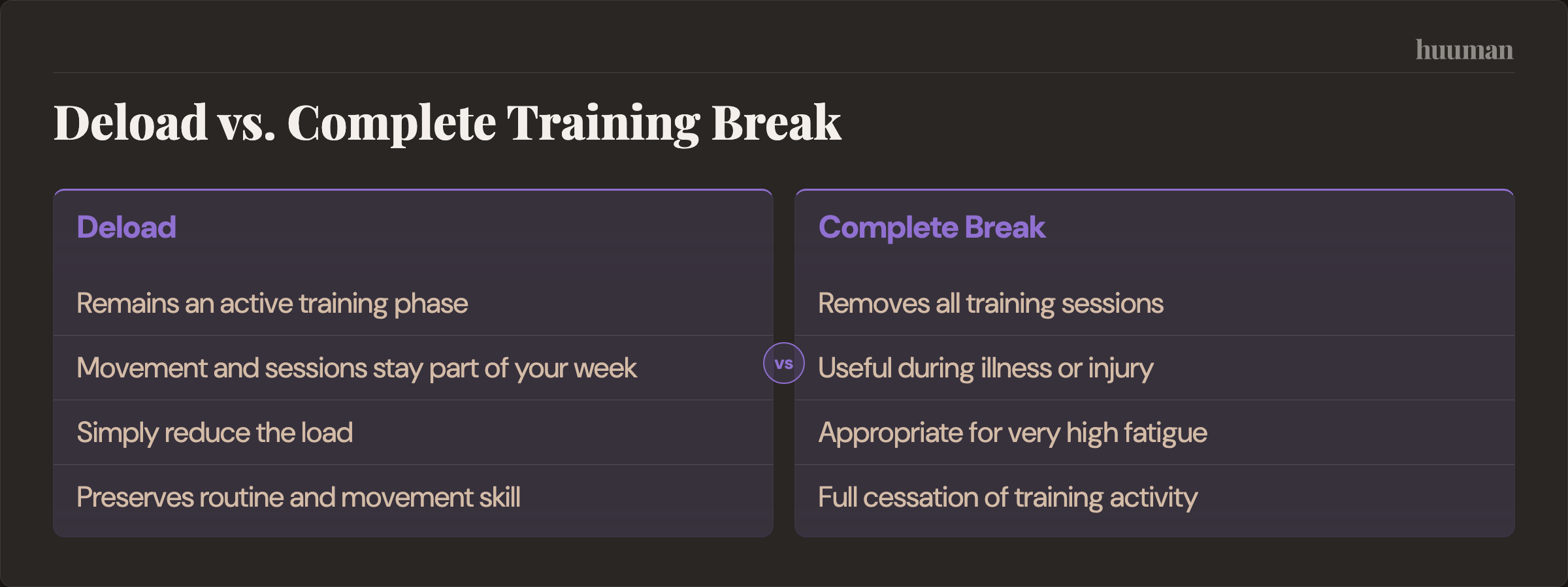
Deload vs. Complete Training Break
A deload remains an active training phase. Movement and sessions stay part of your week. You simply reduce the load.
A full break, on the other hand, removes all training sessions. That can be useful during illness, injury, or very high fatigue. In most training programs, however, a deload is used first because it preserves routine and movement skill.
Deload vs. Taper
A taper is a reduction phase before a competition. The goal is peak performance at a specific moment. Training volume drops, but intensity can remain relatively high.
A deload, in contrast, is fatigue management within a training program. It does not necessarily occur before competition and is mainly used to manage long-term training load.
Deload vs. Program Change
A deload is not a new training strategy. The general structure stays the same - you simply reduce load. A program change, on the other hand, modifies exercises, methods, or the overall system.
Why Deloads Work: Fatigue Can Mask Fitness
Performance development involves two parallel processes: fitness increases through training stimuli, while fatigue also accumulates. When fatigue becomes high, it can temporarily mask fitness.
A deload reduces that layer of fatigue. Training literature often describes how performance becomes more stable or easier to express after a reduction phase.
Research on 1-week deload intervals suggests they maintain muscle and endurance gains compared to continuous training, supporting their role in sustainable programming rather than accelerated progress.
This fatigue has multiple components:
- Peripheral fatigue: stress in muscle fibers, connective tissue, and metabolic processes.
- Central fatigue: nervous system strain from high intensity or high training volume.
- Psychological fatigue: declining motivation, focus, or desire to train.
Related but distinct are the terms overreaching and overtraining. Training literature describes functional overreaching as a temporary period of elevated fatigue that normalizes within days or weeks. Overtraining, by contrast, is discussed as a longer-lasting condition with more complex causes.
The Three Main Levers of a Deload
A deload usually modifies one or more key training variables. Three levers determine how much the total load actually decreases.
- Lever: Reduce volume - When It Makes Sense: When many sets or long endurance sessions were the main stress. - Common Mistake: Keeping weights equally heavy and creating new fatigue.
- Lever: Reduce intensity - When It Makes Sense: When heavy loads, hard intervals, or max attempts dominate training. - Common Mistake: Adding too many "light" sets and unintentionally increasing volume.
- Lever: Reduce frequency - When It Makes Sense: When training density or life stress is especially high. - Common Mistake: Filling rest days with additional hard sessions.
In practice, many programs combine several adjustments. One rule matters most: avoid training to the limit. RPE scales or RIR estimates help maintain moderate intensity even when daily readiness fluctuates.
When a Deload Makes Sense
Proactively Planned Deloads
Many training systems schedule deload weeks at regular intervals. The idea is simple: fatigue builds gradually. A planned reduction phase prevents it from accumulating too long.
A survey of strength and conditioning coaches found that unloading strategies every 4-6 weeks are common practice in periodized training programs.
If you train systematically, it helps to consider how often you should deload. The ideal frequency depends heavily on training volume, intensity, and life stress.
Reactive Deloads
Another common approach is signal-based. Here you observe trends in training and recovery. If several signals shift at the same time, a deload can make sense.
Quick 30-second checklist:
- Performance markers decline across multiple sessions.
- Resting heart rate is higher than your usual baseline.
- HRV shows a downward trend over several days.
- Sleep quality or duration noticeably worsens.
- Motivation or mood around training drops.
- Soreness or tendon irritation lingers unusually long.
The key is interpreting trends. A single bad night or one tough workout is normal.
Looking at HRV over several days is especially helpful. One value alone says little - consistent multi-day patterns are more informative. You can read more about why HRV can reflect training load.
The HUUMAN Deload Compass
A simple framework for making deload decisions:
- Load: What has increased in recent weeks - volume, intensity, training density, or life stress?
- Signals: What is shifting - performance, sleep, mood, HRV trend, or resting heart rate?
- Lever: Which training variable should you reduce first - volume, intensity, frequency, or exercise selection?
- Return: How will you rebuild afterward? Typically volume increases first, with intensity following later.
This logic is particularly useful in hybrid programs where strength and endurance training run in parallel. Loads can amplify each other. This often appears in athletes combining lifting and running, where the need for deloads may differ between training types.
Strategies for Deload Weeks
Deload in Strength Training
In strength training, deloads are commonly implemented by reducing sets or using lighter weights. The focus shifts to clean technique and controlled repetitions.
- No sets to muscular failure.
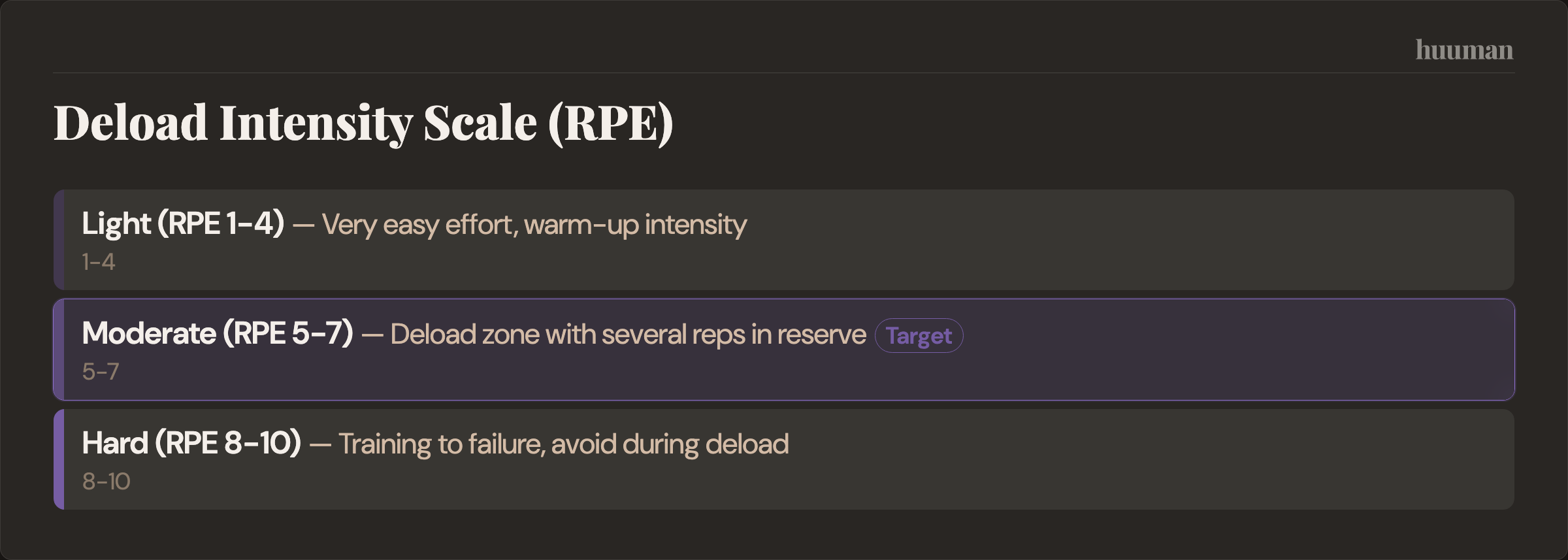
- Moderate intensity (estimated via RPE or RIR).
- Longer rest between sets.
- Optionally use slightly varied exercises with less axial load.
Many programs shorten sessions and focus on a few main lifts. This keeps movement patterns fresh while fatigue decreases.
Deload in Endurance Training
In endurance training, volume is usually reduced first. Long and intense sessions generate especially high cumulative fatigue.
- More easy sessions.
- Significantly less interval training.
- Optional short technique work or strides.
During short high-intensity intervals, heart rate often lags behind effort. Training practice therefore often recommends using RPE or pace alongside heart rate.
If running is a major part of your training, you can also focus on recovery after running sessions. Deload weeks are a good opportunity for that.
Hybrid Training
When strength and endurance training are combined, the limiting factor often isn't a single category but total systemic stress.
During these weeks it may help to keep one training type stable while reducing the other more aggressively - for example, maintaining easy runs while significantly lightening the strength sessions.
Protocol Card: Strength Deload (7 Days)
- 2-4 training sessions per week
- 2-4 main exercises per session
- 2-3 sets per exercise
- RPE around 5-7, several reps in reserve
Session Structure
- Warm-up: light cardio and mobility
- Main exercises with a focus on technique
- Few accessory exercises
- Short, relaxing cooldown
Protocol Card: Endurance Deload (7 Days)
- 3-6 sessions per week
- Mostly easy intensity
- Optional short technical stimulus
- Minimal: three easy sessions
- Standard: several easy runs plus short technique work
- No hard interval blocks
Protocol Card: Hybrid Deload (7 Days)
- 2 short strength sessions
- 2-3 easy endurance sessions
- At most one moderately demanding workout
Many athletes find this a good balance: your movement routine stays intact while systemic fatigue decreases.
Tracking and Interpreting Progress
A deload works best when you track trends rather than single data points. Patterns across several days are usually more meaningful.
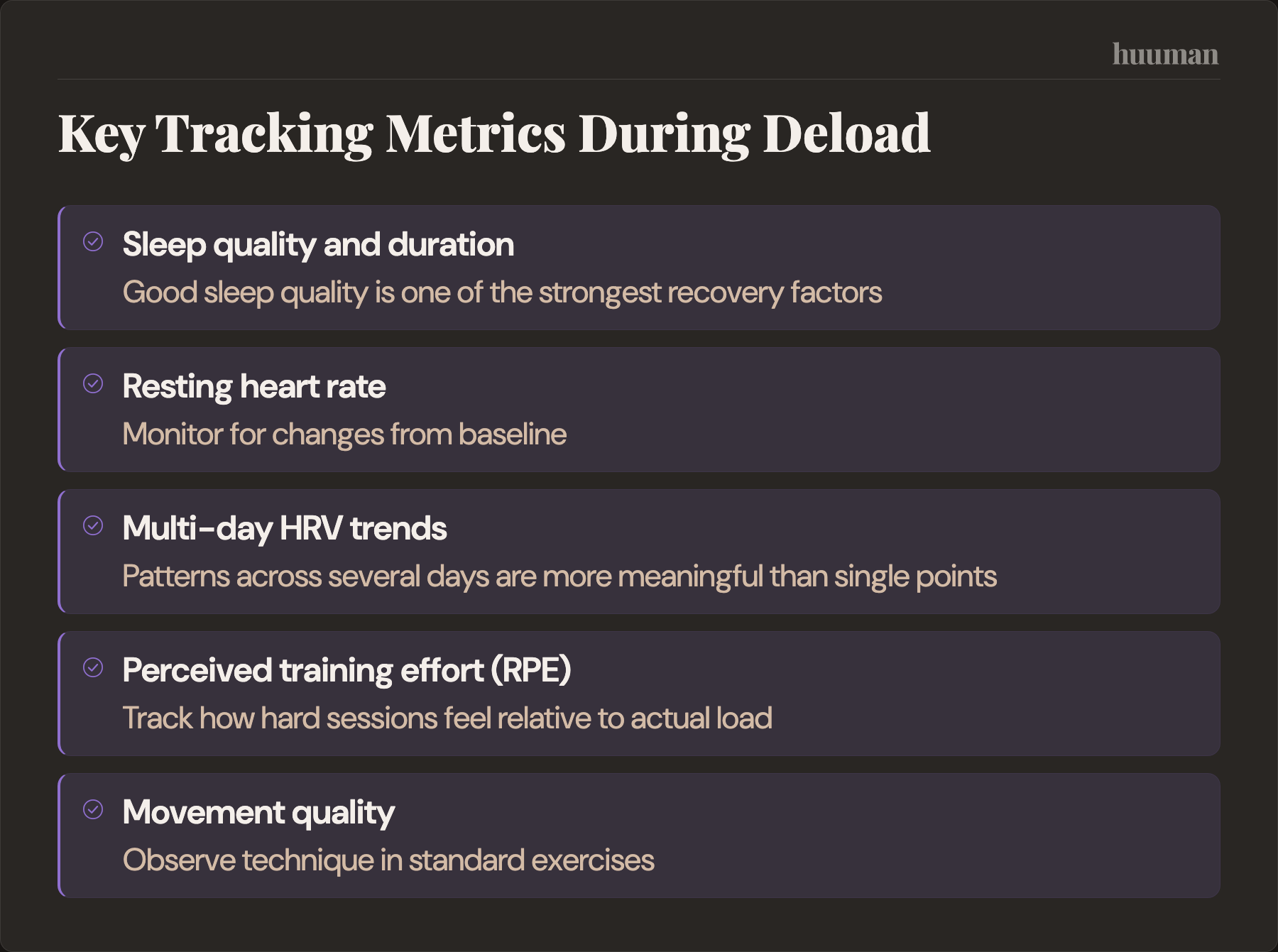
Many athletes pay particular attention to:
- Sleep quality and duration
- Resting heart rate
- Multi-day HRV trends
- Perceived training effort (RPE)
- Movement quality in standard exercises
Sleep is especially important. Good sleep quality is one of the strongest recovery factors. If you want to dive deeper, you'll find practical strategies for better sleep and faster recovery or an overview of sleep and recovery as a whole.
When multiple signals suggest you need a deload, the key is adjusting your training intelligently rather than guessing. Your huuman Coach can build personalized weekly plans that automatically reduce volume or intensity based on your current recovery state, ensuring you get the fatigue reduction you need while maintaining movement quality.
Evidence and Limitations
The concept and use of deload phases largely come from coaching practice, periodization models, and training literature. Textbooks and guidelines on progressive strength training and training periodization frequently describe phases of reduced load to manage cumulative fatigue.
A survey of 246 competitive strength and physique athletes found that deloading is commonly practiced among experienced competitors, with most incorporating regular deload phases into their training programs.
Research on training load and overtraining similarly highlights the importance of recovery phases. States of overload can often be influenced by adjusting training volume and recovery.
At the same time, the scientific evidence is heterogeneous. Deload strategies vary widely across sports, training levels, and individual factors. Nutrition, sleep, life stress, and energy availability also play a major role.
Signal vs. Noise
- A bad training day does not automatically mean you need a deload. Look for trends across several sessions.
- Cold or illness symptoms point more toward rest than a deload.
- A technical issue can look like fatigue. Check load and technique first.
- Insufficient energy intake can reduce performance - consider nutrition.
- Too many intense sessions without easy aerobic work can increase fatigue. Review your distribution.
- Alcohol, travel, or sleep loss can temporarily affect HRV - consider context.
- Muscle soreness is normal. Sharp tendon pain should be monitored more closely.
- A plateau can also come from missing progression - not every plateau is fatigue.
Frequently Asked Questions
Do beginners need a deload week?
Beginners often benefit from several months of consistent training without scheduled deloads. As training volume and intensity grow, structured reduction phases become more relevant.
Should I completely stop training during a deload?
Usually not. A deload is active recovery - you continue moving and training, but with a reduced load. Complete breaks serve different purposes.
How often should you deload?
There's no fixed rhythm. Training literature describes both planned deloads after several intensive weeks and signal-based approaches. Factors like volume, sleep, and life stress play a large role.
Should I reduce volume or intensity?
That depends on which stressor dominated your training. If your workload was driven by many sets, reducing volume helps. If it came from maximal loads, lowering intensity may be more effective.
Will I lose muscle or endurance during a deload week?
A short reduction phase does not typically lead to measurable losses. Movement continues, and the overall training structure stays similar.
Is a deload useful if I'm stuck on a plateau?
Sometimes. If a plateau is caused by accumulated fatigue, a reduction phase can help make your underlying fitness visible again.
If you're unsure, you can try a short minimal deload week and reassess your signals afterward. Often this small step already reveals how fatigued your system really was. A joint consensus statement by the ECSS and ACSM outlines the spectrum from functional overreaching to full overtraining syndrome.
More health topics to explore
- Sleep & Recovery – Overview
- Caffeine-Free Herbal Tea for Sleep: Ingredients, Safety, and What to Buy
- Sleep Duration at Age 3 : Guidelines, Naps & a Practical Reality Check
- 4-7-8 Breathing: How to Do It, What It Does, How Often to Use It, and Safer Variations
References
- Meeusen et al. — Overtraining Syndrome: Prevention, Diagnosis, Treatment (2013)
- Bosquet et al. — Effects of Tapering on Performance (2007)
- Frontiers — Tapering and Deloading in Strength Sports (2025)
- ACSM — Progression Models in Resistance Training (2009)
- Coleman et al. 2024 — Gaining more from doing less? The effects of a one-week deload period during sup
- Rogerson et al. 2024 — Deloading Practices in Strength and Physique Sports: A Cross-sectional Survey
- De Marco K et al. — Resistance Training Prescription During Planned Deloading Periods: A Survey o... (2024)
- Washif et al. 2025 — Current Periodization, Testing, and Monitoring Practices of Strength and Conditi
- Bell et al. 2023 — Integrating Deloading into Strength and Physique Sports Training Programmes: An
About this article · Written by the huuman Team. Our content is based on peer-reviewed research and clinical guidelines. We follow editorial standards grounded in scientific evidence.
This article is for educational purposes only and does not constitute medical advice. Health and training decisions should be discussed with qualified professionals.

