
A deload week example is only useful if it actually reduces fatigue without breaking your training rhythm. The goal is simple: keep the movements and habits, lower the stress, and come out of the week feeling sharper not drained.
This matters more than most people think. Accumulated fatigue from hard sets, poor sleep, or life stress quietly drags down performance, mood, and joint health. A well-executed deload is less about doing less and more about doing just enough to recover while staying consistent.
Evidence suggests that eccentric contractions cause muscle damage, contributing to the fatigue that accumulates between training sessions.
Evidence suggests that eccentric muscle contractions contribute to muscle damage and the accumulated fatigue that builds up during hard training phases.
Key takeaways
1. Strength deload (3 days)
Day 1: Squat, Bench, Row, 2–3 easy sets each, stop well before failure
Day 2: Deadlift, Press, Pull, same structure
Day 3: Technique + light accessories
Add: 1–2 short Zone 2 sessions2. Hypertrophy deload (4 days upper/lower)
Keep exercises, cut hard sets roughly in half
Stay far from failure (several reps in reserve)
Keep the pump, remove grinders3. Hybrid/endurance deload (5–6 easy days)
2 light full-body strength sessions
2–3 Zone 2 sessions (conversational pace)
Optional short skill or stride session if fresh
Below you will find three copy-paste deload week examples plus a decision system to adjust them to your situation. If you train hard, this is performance insurance.
Where a deload fits in your training
Deloads sit inside recovery, not outside training. They help manage fatigue while preserving skill and movement quality. For strength athletes, this protects joints and tendons under repeated loading. For hybrid or endurance athletes, it helps balance nervous system fatigue with connective tissue stress.
They also support consistency. Instead of stopping completely, you keep showing up while lowering the cost of each session. That's why deloads are different from full breaks.
If you want a broader view, this fits directly into a Sleep & Recovery – Overview and into longer-term planning like deload weeks in a longevity framework.
Quick answer: 3 copy‑paste deload week examples
Pick the version that matches your training style. Then apply the same rule: reduce hard sets, avoid failure, keep technique crisp.
- Strength deload (3 days)
Day 1: Squat, Bench, Row – 2–3 easy sets each, stop well before failure
Day 2: Deadlift, Press, Pull – same structure
Day 3: Technique + light accessories
Add: 1–2 short Zone 2 sessions - Hypertrophy deload (4 days upper/lower)
Keep exercises, cut hard sets roughly in half
Stay far from failure (several reps in reserve)
Keep the pump, remove grinders - Hybrid/endurance deload (5–6 easy days)
2 light full-body strength sessions
2–3 Zone 2 sessions (conversational pace)
Optional short skill or stride session if fresh
60-second chooser: If you mostly lift heavy → strength. High volume/bodybuilding → hypertrophy. Mix lifting with running/cycling → hybrid.
To know when you need a deload, track your sleep stages and morning readiness signals with the huuman app for 7 nights. The patterns will make your deload timing decisions much clearer than guessing.
Heart rate variability monitoring provides objective readiness data, as HRV changes are associated with training adaptation and fatigue status in athletes.
What a deload week is (and isn't)
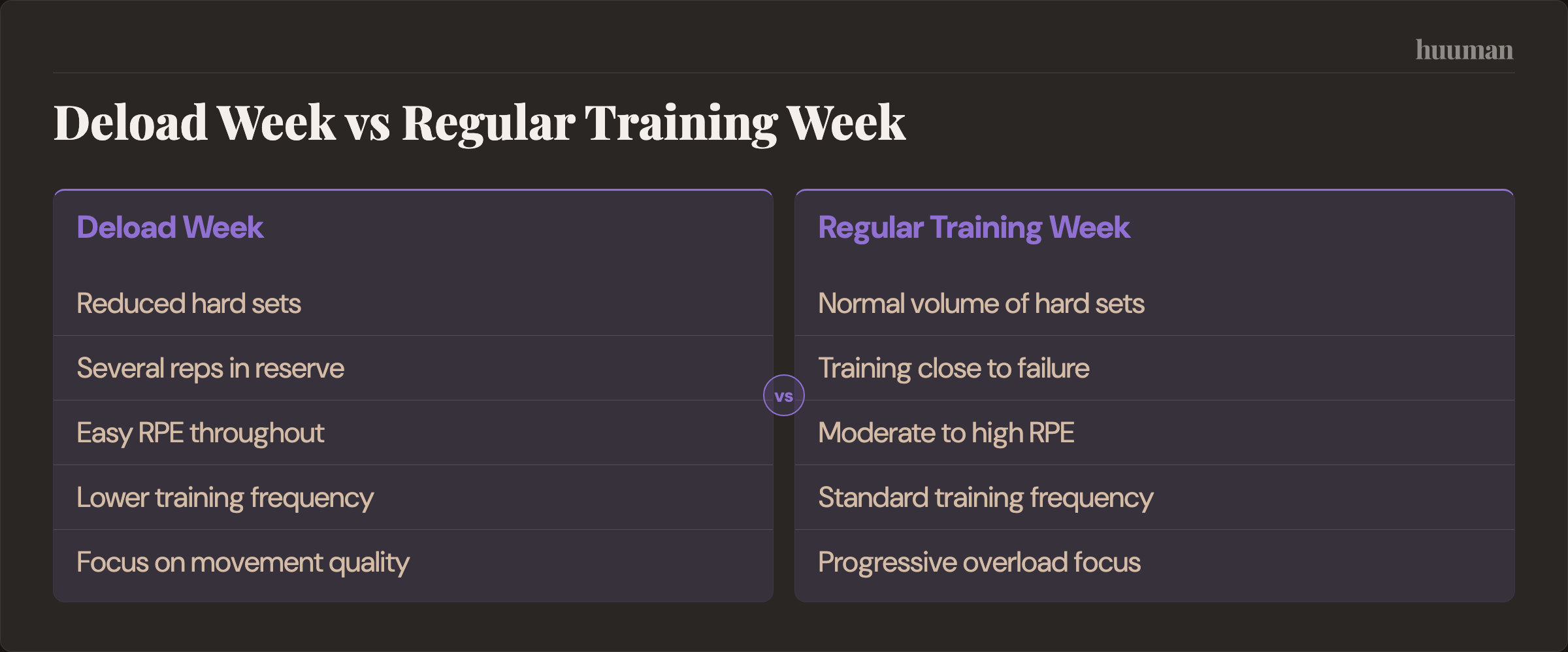
A deload week is a planned 5–7 day period where training stress is intentionally reduced. You still train, but you remove the main drivers of fatigue.
It is not the same as:
- Rest week: no structured training
- Taper: performance-focused reduction before competition
- Transition week: lighter return after time off
Sometimes you do not need a full week. "Deload days" can work:
- 1-day micro-deload after poor sleep or high stress
- 2–3 day mini-deload during travel
- Full week after a demanding training block
The huuman Deload Dial™
Instead of guessing percentages, adjust 1–3 of these dials:
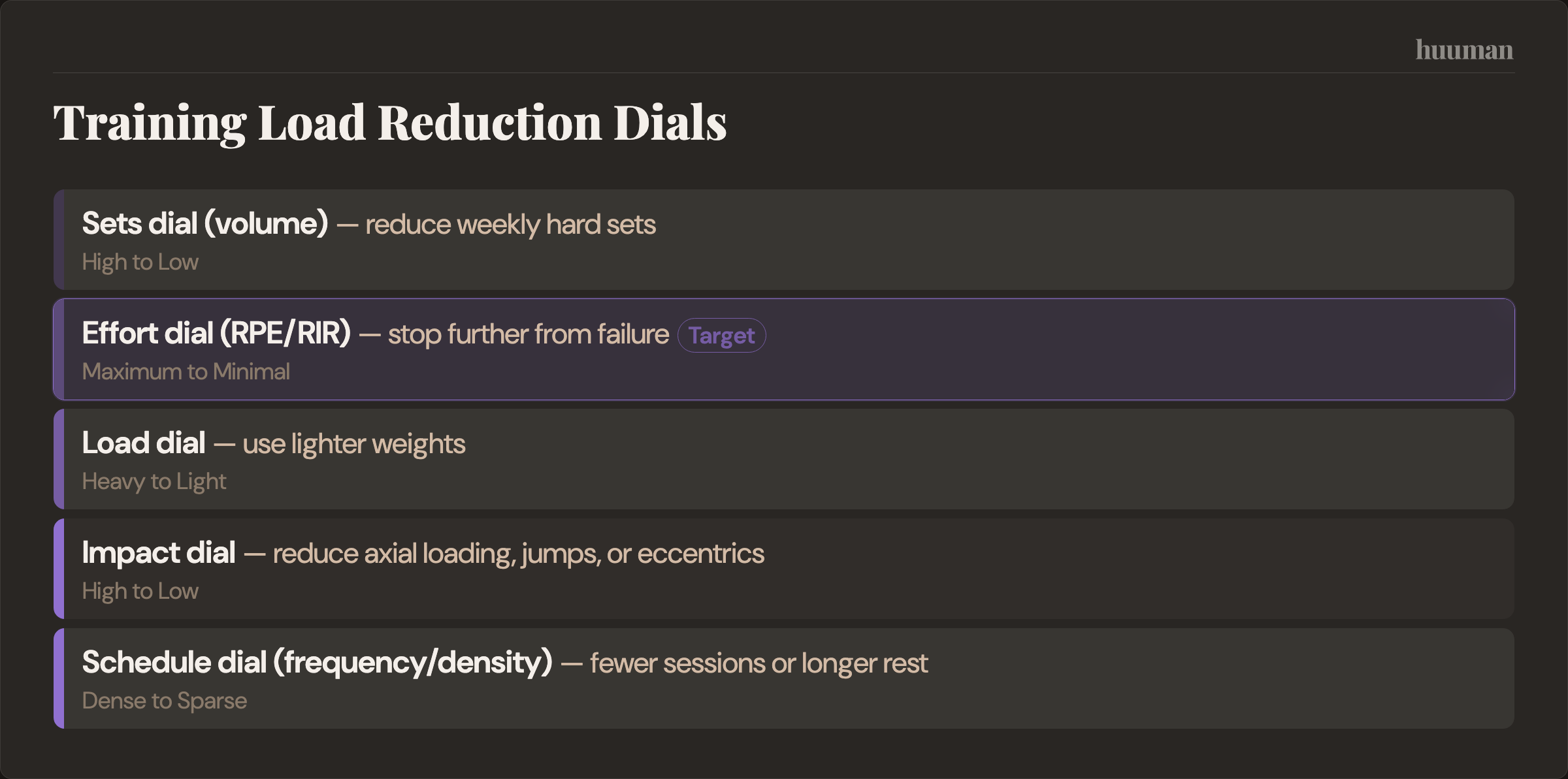
- Sets dial (volume): reduce weekly hard sets
- Effort dial (RPE/RIR): stop further from failure
- Load dial: use lighter weights
- Impact dial: reduce axial loading, jumps, or eccentrics
- Schedule dial (frequency/density): fewer sessions or longer rest
Hard sets matter because they drive both adaptation and fatigue. A "hard set" is one taken close enough to failure to meaningfully challenge the muscle. Cutting these is often the fastest way to reduce fatigue without losing skill.
How hard should a deload feel?
It should feel easy on purpose. Reps look clean, bar speed stays high, and nothing grinds.
Use simple effort guidance:
- RPE: how hard a set feels (1–10 scale)
- RIR: reps in reserve
Keeping several reps in reserve and avoiding failure entirely during a deload reduces fatigue without needing exact 1RM calculations.
Protocol Card 1 – Strength deload
Structure:
- Day 1: Squat + Bench + Row
- Day 2: Deadlift + Press + Pull
- Day 3: Technique + accessories
Intensity:
- Keep movements, reduce hard sets
- Cap effort at easy RPE, no grinding reps
- Optional: use a lighter load than usual working weights
Conditioning:
- Zone 2 cardio, conversational pace
Weekly options:
- Minimal: 2 sessions
- Standard: 3 sessions
- Advanced: +1 short Zone 2 session
Readiness check:
- Look at sleep, soreness, performance trend
- Use HRV/resting HR trends across several days
- HRV is a decision-support tool, not an oracle
Protocol Card 2 – Hypertrophy deload
Structure: 4-day upper/lower split
- Keep exercises the same
- Reduce hard sets significantly
- Avoid training to failure
- Stay several reps away from failure
- Maintain controlled tempo, reduce eccentric stress if needed
Weekly options:
- Minimal: 3 days
- Standard: 4 days
- Advanced: + light steps or Zone 2
This style benefits most lifters who train with high volume near failure. For more on preserving progress, see keeping gains during a deload week.
Protocol Card 3 – Hybrid / Endurance deload
- 2 light strength sessions
- 2–3 Zone 2 sessions
- Optional short skill or strides if fresh
- Cardio at conversational effort
- Strength far from failure
- HR lags on short intervals – use RPE or pace for HIIT
- Minimal: 4 sessions
- Standard: 5
- Advanced: 6 easy sessions
Volume reduction often matters more than intensity reduction for runners. For deeper context, see deload strategies for runners or recovery after a marathon.
Choosing the right deload in 2 minutes
- Joint or tendon irritation: reduce volume and swap high-impact lifts
- Flat performance + life stress: reduce frequency and effort
- Poor sleep and fatigue: cap intensity, increase rest days
- Returning after a break: use a transition week, not a strict deload
If you want a more structured version, see a full deload protocol or deloading for weightlifters.
Deload days and minimal effective dose
Not everyone needs a full week. For busy professionals, a minimal approach works well:
- 2 short full-body sessions
- 2 Zone 2 sessions
- Daily short mobility work
This maintains routine while lowering fatigue. On rest-heavy days, simple tools like recovery slides for rest days can help reduce unnecessary load.
What to do after the deload
Most people return directly to normal training. If you still feel slightly fatigued, ramp back over several days.
Avoid trying to "make up" missed volume. That usually cancels the benefit of the deload.
If you are unsure how often to use these, see how often you should plan a deload.
Evidence and limits
Deloading is widely used in periodized training, especially in strength and endurance sports. Research supports the broader concept of managing fatigue while maintaining movement and skill, particularly through structured variation in training stress.
Evidence suggests that periodized training programs are associated with greater strength gains compared to non-periodized approaches, supporting the structured variation that includes deload phases.
However, there is no single "best" way to deload. Studies use different definitions, populations, and training contexts, which makes direct comparison difficult. Much of practical programming comes from coaching practice layered on top of general training principles.
Research on velocity-based training found that reducing training volume while maintaining intensity is associated with similar strength gains and muscle adaptations but with less fatigue accumulation.
Tapering research in endurance and strength shows that reducing training stress while maintaining some intensity can help performance, but translating that into a weekly deload for general fitness requires judgment.
A key limit: a deload is not a solution for persistent pain, illness, or overtraining syndrome. Those require proper clinical evaluation.
How to track and interpret changes
Use simple signals across the week:
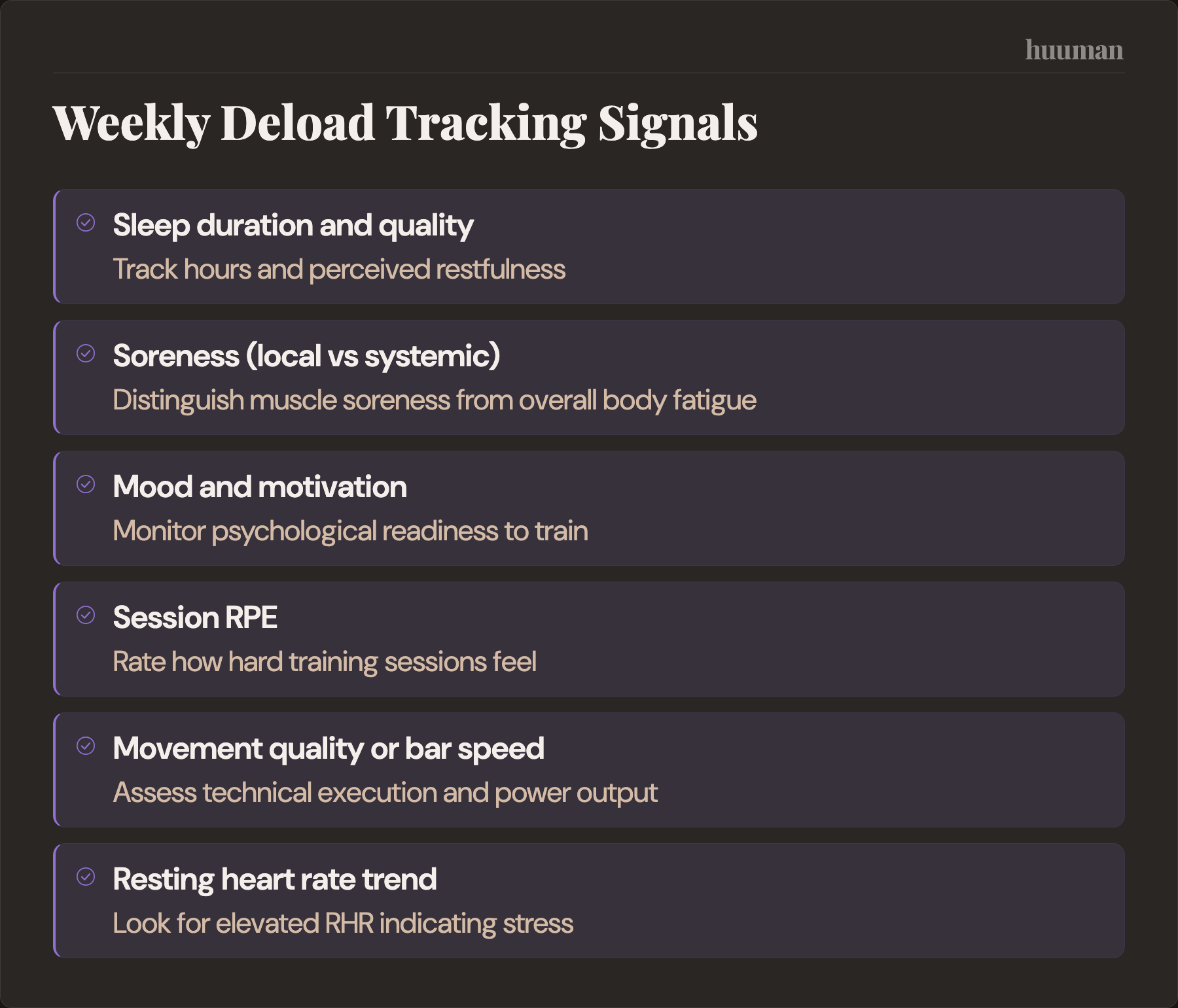
- Sleep duration and quality
- Soreness (local vs systemic)
- Mood and motivation
- Session RPE
- Movement quality or bar speed
- Resting heart rate trend
- HRV trend over several days
- Training monotony (same stress daily)
Readiness gate:
- Green: train normally
- Yellow: consider deload days
- Red: full deload week
Making these decisions gets easier when you have consistent data and coaching feedback. Your huuman Coach can build weekly plans that adjust deload timing based on your actual recovery patterns rather than rigid calendar scheduling.
Signal vs noise in deload decisions
- Performance dropping at the same effort → consider a deload week
- Persistent soreness and poor sleep → reduce volume and intensity
- Rising caffeine needs → examine accumulated fatigue
- One bad session after stress → ignore and reassess next workout
- Soreness with stable performance → maintain training, no deload needed
- Scale changes during travel → do not adjust training based on this
- Nagging tendon pain worsening → change exercise selection and reduce load
- Short HRV dips without other issues → watch trend, not single values
Common questions
What should a deload week look like for strength training?
Keep the main lifts, reduce hard sets, and avoid failure. Maintain movement patterns while lowering fatigue.
How often should you do a deload week?
It varies based on training stress, recovery, and life context. Some plans include them regularly, but readiness markers are more useful than fixed timing.
Are deload days enough?
Sometimes. Short fatigue spikes from travel or poor sleep often respond well to 1–3 lighter days instead of a full week.
Should I reduce weight or sets?
Both work. Reducing hard sets is often the simplest and most reliable option. Effort and proximity to failure are equally important.
Can I do cardio during a deload week?
Yes, especially easy Zone 2. It supports recovery without adding significant fatigue.
Will I lose muscle or strength?
Research suggests that short deloads do not cause meaningful reductions in muscle mass or strength. Maintaining some training stimulus helps preserve both.
What are signs I need a deload versus a full break?
If fatigue is training-related, a deload is appropriate. If symptoms persist despite reduced training, or include pain or illness, a full break and professional input may be needed.
More health topics to explore
- Sleep & Recovery – Overview
- Deep Sleep Duration: How Much Is Normal (1–2 Hours?) + Table by Total Sleep Time
- Caffeine-Free Herbal Tea for Sleep: Ingredients, Safety, and What to Buy
- Deload in Bodybuilding: A Practical Guide to Better Recovery
References
- Williams TD et al. — Comparison of Periodized and Non-Periodized Resistance Training on Maximal Stren (2017)
- Wang Z et al. — Effects of tapering on performance in endurance athletes: A systematic review... (2023)
- Hartmann H et al. — Short-term Periodization Models: Effects on Strength and Speed-strength Perfo... (2015)
- Coleman M et al. — Gaining more from doing less? The effects of a one-week deload period during ... (2024)
- Plews DJ et al. — Training adaptation and heart rate variability in elite endurance athletes: o... (2013)
- Peake JM et al. — Muscle damage and inflammation during recovery from exercise (2017)
- Clarkson PM & Hubal MJ — Exercise-induced muscle damage in humans (2002)
- Pareja-Blanco F et al. — Effects of velocity loss during resistance training on athletic performance, ... (2017)
- Rogerson D et al. — Deloading Practices in Strength and Physique Sports: A Cross-sectional Survey (2024)