A well-planned deload in bodybuilding isn't a step backward, it's what makes continued progress possible. If you train hard consistently, fatigue inevitably builds up. Without intentional relief, productive training quickly turns into a plateau.
What matters isn't whether you deload, but when and how. Many people push too long without a break or back off too early. Both can stall progress. This guide shows you how to use deloads as part of your system, not as a last resort.
Key takeaways
1. Typical duration: about one training week
2. Usually done by reducing volume, lowering intensity, and keeping more reps in reserve (RIR 3–5 is common)
3. No training to failure
You'll get a clear decision framework: when a deload makes sense, which variables actually matter, and how to implement it in practice.
Where Deload Fits Into the Big Picture
Training drives adaptation, but also fatigue. Progress comes from the balance between the two. Deloads sit within recovery, but they also influence joint health and technique (frame), energy availability (metabolism), and mental freshness (mind).
Many programs focus only on progressive overload. In reality, that only works if accumulated fatigue is regularly reduced. That's exactly where deloads come in.
If you want to better understand the relationship between training and recovery, check out this overview on recovery & sleep.
Quick Answer
A deload in bodybuilding is a planned reduction in training stress that allows fatigue to drop so you can resume progressive training in your next block.
- Typical duration: about one training week
- Usually done by reducing volume, lowering intensity, and keeping more reps in reserve (RIR 3–5 is common)
- No training to failure
- Common triggers: declining performance, poor sleep, persistent soreness, dropping motivation
Instead of guessing when fatigue is building, track your training RPE and recovery signals daily with the huuman app to spot the patterns that matter for your next deload decision.
What a Deload Is – and What It Isn't
Definition: A deload is a planned reduction in training stress, not a complete break. You stay active but deliberately reduce load.
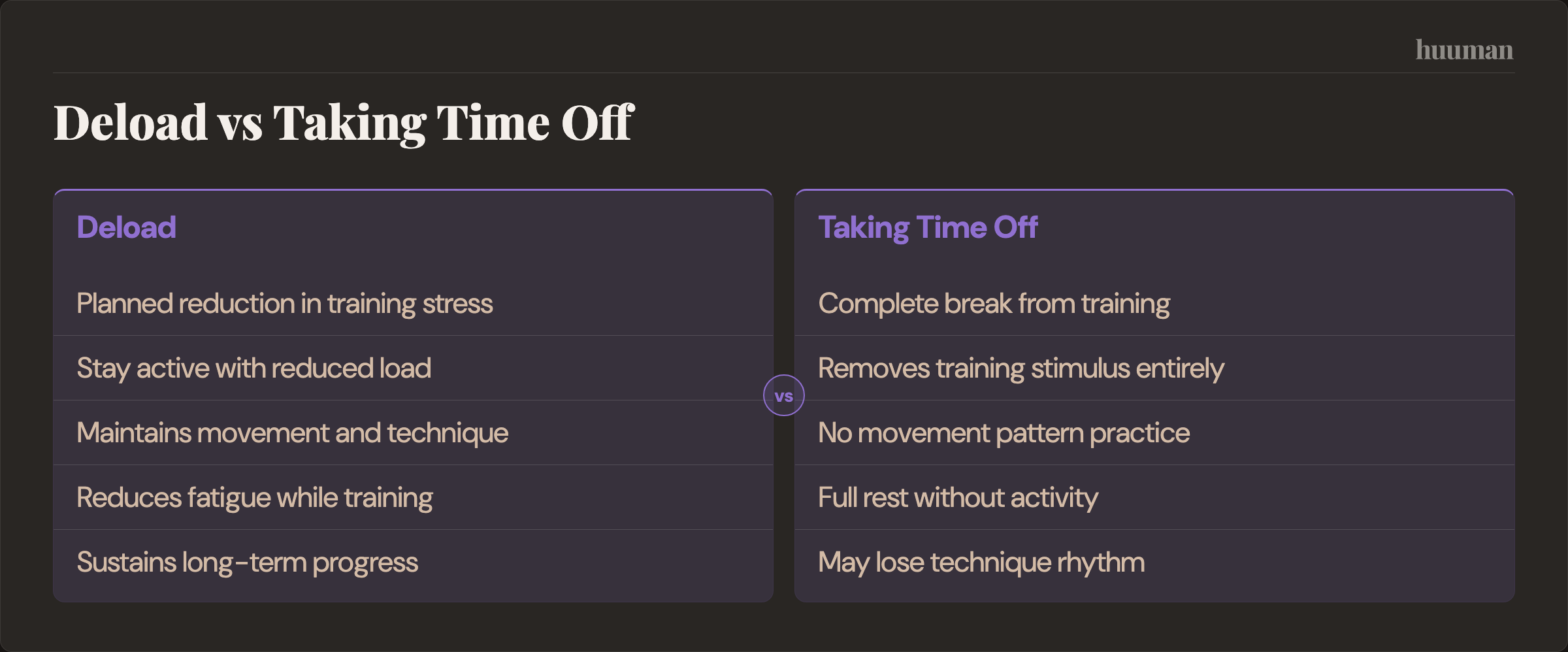
Vs. taking time off: A break removes the training stimulus entirely. A deload maintains movement and technique while reducing fatigue.
Vs. tapering: Tapering is typically used before competitions to maximize short-term performance. A deload is primarily about sustaining long-term progress.
For more context, see the deload guide and the detailed breakdown of deload weightlifting.
Why Deloads Work
Training creates not only adaptation but also fatigue, affecting muscles, the nervous system, and passive structures like tendons. If fatigue builds faster than adaptation, performance declines.
A common model describes performance as fitness minus fatigue. A deload reduces fatigue without fully losing fitness.
Important: a deload isn't magic. It simply creates the conditions that allow progress to resume.
The 4 Key Levers of a Deload
Training stress comes from four main variables. A deload adjusts one or more of them: The ACSM resistance training guidelines emphasize systematic progression across these variables for optimal adaptation.
- Lever: Volume - What Changes: Fewer sets - When It's Useful: When overall training load is high - Trade-off: Less stimulus
- Lever: Intensity - What Changes: Lighter weights - When It's Useful: With joint stress or technique issues - Trade-off: Reduced strength stimulus
- Lever: Proximity to failure - What Changes: More reps in reserve (RIR) - When It's Useful: With systemic fatigue - Trade-off: May feel "too easy"
- Lever: Frequency - What Changes: Fewer sessions - When It's Useful: During time or life stress - Trade-off: Less practice
Rule of thumb: reduce volume first, then increase distance from failure, then lower intensity. Only adjust frequency if needed.
When a Deload Makes Sense
Instead of rigid schedules, a signal-based approach is usually more reliable. Look for combinations of the following over several days:

- Performance drops despite high effort
- Sleep quality declines
- Joint or tendon irritation
- Noticeable drop in motivation
- Soreness lasts unusually long
If two or more of these persist for about a week, a deload is likely a good idea.
Checklist: Do I Need a Deload Right Now?
- Training performance is flat or declining
- Weights feel heavier than usual
- Sleep is worse than normal
- Resting heart rate is trending up
- HRV is trending down
- Motivation is dropping
- More aches and pains than usual
- Higher life stress
- Inconsistent nutrition
- Training feels mentally draining
The goal isn't perfect timing, it's responding early enough that productive training doesn't turn into a problem.
Functional Overreaching vs. Overtraining
Training intentionally builds fatigue. In the short term, this can be useful, often referred to as functional overreaching.

If high stress is sustained too long, it can turn into non-functional overreaching, where both performance and recovery decline.
Overtraining syndrome is a rare and complex condition, not something you can easily self-diagnose. The practical takeaway: manage fatigue before it becomes an issue.
Deload Strategies
Volume Deload
The most common approach. You significantly reduce the number of sets while keeping moderate intensity.
Ideal for high-volume training and hypertrophy-focused programs. See a detailed example in this deload week breakdown.
Intensity Deload
Here, you lower the load more substantially and focus on controlled, high-quality movement.
Useful when joints feel stressed or your technique has deteriorated.
Frequency or Lifestyle Deload
Fewer training days or shorter sessions, especially relevant during high life stress.
Similar principles apply as in recovery after running or recovery after marathon, where total load matters.
Adjustments by Athlete Type
- High-volume lifters: significantly reduce volume
- Busy professionals: keep sessions short and simple
- Cutting phase: deload earlier, as fatigue builds faster
- Returning after a break: build up gradually to avoid excessive fatigue
Example Protocols
Standard Deload – Volume First
- Duration: about 5–7 days
- Main lifts: 2–3 exercises, 2 sets each
- Accessories: 1–2 exercises, 1–2 sets
- Intensity: RPE 6–7, RIR 3–5
- Optional: light movement
Maintain Intensity, Reduce Fatigue
- Focus on technique and movement quality
- Short, clean sets far from failure
- Strong reduction in accessory work
Auto-Deload (3-Day Reset)
- Same exercises, minimal sets
- No maximal effort
- Then return to your normal plan
More variations are covered in the how often to deload guide.
Evidence and Limitations
Deloads are widely used in practice and embedded in periodization models. There are consistent frameworks in sports science around overreaching and fatigue management.
What's less clear: exact numbers for volume reduction, intensity, or timing. Many practical recommendations come from coaching experience rather than tightly controlled studies.
Markers like HRV are associated with stress and recovery at the population level, but individual interpretation matters, they should always be viewed in context.
Strategies to Discuss with a Professional
- Keep movement patterns, simplify exercise variations
- Maintain protein intake; overall energy needs may drop
- Prioritize sleep
- Actively reduce life stress
The goal remains the same: reduce fatigue without losing your training rhythm.
How to Track and Evaluate Progress
A deload works best if you track trends:
- Training log: performance and RPE
- Subjective: fatigue and motivation
- Sleep: duration and quality
- Resting heart rate and HRV trends over several days
A good sign: after a deload, weights feel more controlled again and progression becomes possible.
Rather than following rigid deload schedules that ignore your individual recovery patterns, let your huuman Coach build weekly training plans that automatically adjust based on your sleep trends, performance drops, and fatigue signals.
Signal vs. Noise in a Bodybuilding Deload
- Performance drops across multiple sessions → compare with your log
- Recurring joint pain → adjust volume or exercise selection
- Sleep worsens → prioritize recovery over intensity
- Motivation drops sharply → temporarily reduce training stress
- Soreness lasts longer → review volume and proximity to failure
- One bad workout → ignore it and watch the trend
- A stressful day → wait a few days before reacting
- Weight fluctuations → focus on performance, not the scale
- Single HRV drop → look at 3–7 day trends instead
FAQ
What exactly is a deload in bodybuilding?
A planned phase of reduced training stress to lower fatigue and allow future progress.
How often should you deload?
Many use multi-week intervals, but in practice, a signal-based approach is often more effective than a fixed schedule.
How do I structure a deload week properly?
Primarily reduce volume, stay well away from failure, and focus on clean execution.
Should I stop training completely during a deload?
Usually not necessary. Staying active helps maintain technique and makes returning to full training easier.
Deload while in a calorie deficit?
A deload may be needed sooner, as fatigue builds faster. Nutrition should remain stable, major adjustments aren't automatically required.
How do I know if I need a full break instead?
If exhaustion is severe or pain is increasing, a complete break may be more appropriate than a deload.
Deload vs. tapering?
Deloading supports long-term training; tapering prepares you for peak short-term performance before competition.
If you want a more structured training approach, it also helps to explore muscle building and build muscle fast in a broader context.
This article is for general information only and does not replace medical advice. For individual decisions, especially in cases of pain or persistent fatigue, consult a qualified professional.
More health topics to explore
- Sleep & Recovery – Overview
- Best Recovery Slides (2026): A Stability-First Buying Guide
- How Much Sleep Do Babies Need? Age Guide + Practical Tips for Parents
- After a Marathon: The huuman Recovery Timeline (0–24h to 4+ Weeks)
References
- Meeusen et al. — Overtraining Syndrome: Prevention, Diagnosis, Treatment (2013)
- Wang Z et al. — Effects of tapering on performance in endurance athletes: A systematic review... (2023)
- Moesgaard L et al. — Effects of Periodization on Strength and Muscle Hypertrophy in Volume-Equated... (2022)
- Carrard J et al. — Diagnosing Overtraining Syndrome: A Scoping Review (2022)
- ACSM — Progression Models in Resistance Training (2009)
- Vrijkotte S et al. — The Overtraining Syndrome in Soldiers: Insights from the Sports Domain (2019)
- Vermeire KM et al. — The Influence of Different Training Load Quantification Methods on the Fitnes... (2021)
- Bell et al. — "You can't shoot another bullet until you've reloaded the gun": Coaches' perceptions, practices and experiences of deloading in strength and physique sports. (2022)
- NSCA and CSCCA Announce Safe Return to Training Guidelines
- Refalo et al. — Influence of Resistance Training Proximity-to-Failure on Skeletal Muscle Hypertrophy: A Systematic Review with Meta-analysis (2023)