

Sleep Stages Explained: Your Guide to Sleep Architecture
You're trying to figure out why you wake up exhausted despite spending 8 hours in bed. Or maybe your sleep tracker shows hardly any deep sleep and you're wondering if that's normal. The answer lies in understanding how your brain cycles through different sleep stages each night.
Sleep isn't just one state. It's a precisely orchestrated sequence of brain activity that repeats in roughly 90-minute cycles throughout the night. Each cycle contains four distinct stages that serve different biological functions.
Key takeaways
1. You cycle through 4 sleep stages every 90 minutes: N1, N2, N3 (deep), and REM
2. Deep sleep dominates early night (physical recovery), REM dominates late night (memory/emotions)
3. 3. Adults need 7-9 hours for adequate amounts of both deep sleep (~2 hours) and REM (~2 hours)
The 4 Stages of Sleep
Your brain doesn't simply switch off at night. It transitions through four distinct stages, each with specific electrical patterns and biological functions.

N1 (Light Sleep, ~5%): The doorway between waking and sleeping. This transition stage lasts 1-5 minutes per cycle. Your muscles relax, but you're still easily roused. Brain waves shift from beta to slower alpha and theta waves. You might experience hypnic jerks.
N2 (Light Sleep, ~45%): The workhorse of sleep, occupying nearly half your night. Your brain produces sleep spindles (12-14 Hz bursts) and K-complexes. Sleep spindles help transfer information to long-term memory. Body temperature and heart rate decrease as your body settles into deeper rest.
N3 (Deep/Slow-Wave Sleep, ~25%): The restoration powerhouse. Your brain produces large delta waves (0.5-4 Hz). Growth hormone surges, triggering tissue repair. Your immune system produces infection-fighting cytokines. Disrupting deep sleep is linked to reduced insulin sensitivity. Most deep sleep happens in the first 3-4 hours. Athletes who track their recovery metrics often see deep sleep increase after hard training days.
REM (Rapid Eye Movement, ~25%): The dream factory. Your brain becomes almost as active as when awake, but your body is paralyzed except for diaphragm and eye muscles. This stage consolidates emotional memories and supports creative problem-solving. REM increases with each cycle, dominating the final 2-3 hours of sleep. Antidepressants often suppress REM sleep, which might explain some side effects.
If you want to track these stages systematically, sync your sleep data from Apple Health to the huuman app to see your nightly architecture patterns and how they respond to lifestyle changes.
How Much of Each Stage Is Normal?
For a healthy adult sleeping 8 hours, normal sleep stage distribution looks like this:
- N1: ~24 minutes (5%)
- N2: ~216 minutes (45%)
- N3: ~120 minutes (25%)
- REM: ~120 minutes (25%)
Don't treat these as rigid targets. Some people naturally get 30% REM while others hover around 20%. Elite athletes might hit 30% deep sleep after intense training. What matters more is getting sufficient total sleep.
Your sleep tracker might show different numbers. ncbi.nlm.nih.gov/31778122/" target="_blank" rel="noopener noreferrer">Consumer devices estimate stages from heart rate variability and movement patterns rather than brain waves. They're useful for spotting trends but can be off on any given night.
What Is Core Sleep?
Core sleep refers to the minimum sleep duration that preserves basic cognitive function. It's typically the first 4-5 hours of sleep, capturing about 80-90% of your nightly deep sleep.
Here's the critical distinction: functioning isn't thriving. The REM-rich cycles you miss by stopping at 5 hours are essential for emotional regulation and metabolic health. Consistently sleeping 5-6 hours is associated with higher mortality risk compared to getting 7-8 hours.
The National Sleep Foundation recommends 7-9 hours for adults aged 18-64. This ensures adequate deep sleep for physical recovery AND sufficient REM for cognitive function. Understanding core sleep patterns helps explain why shift workers struggle with health issues despite getting "enough" fragmented sleep.
How Sleep Architecture Changes with Age
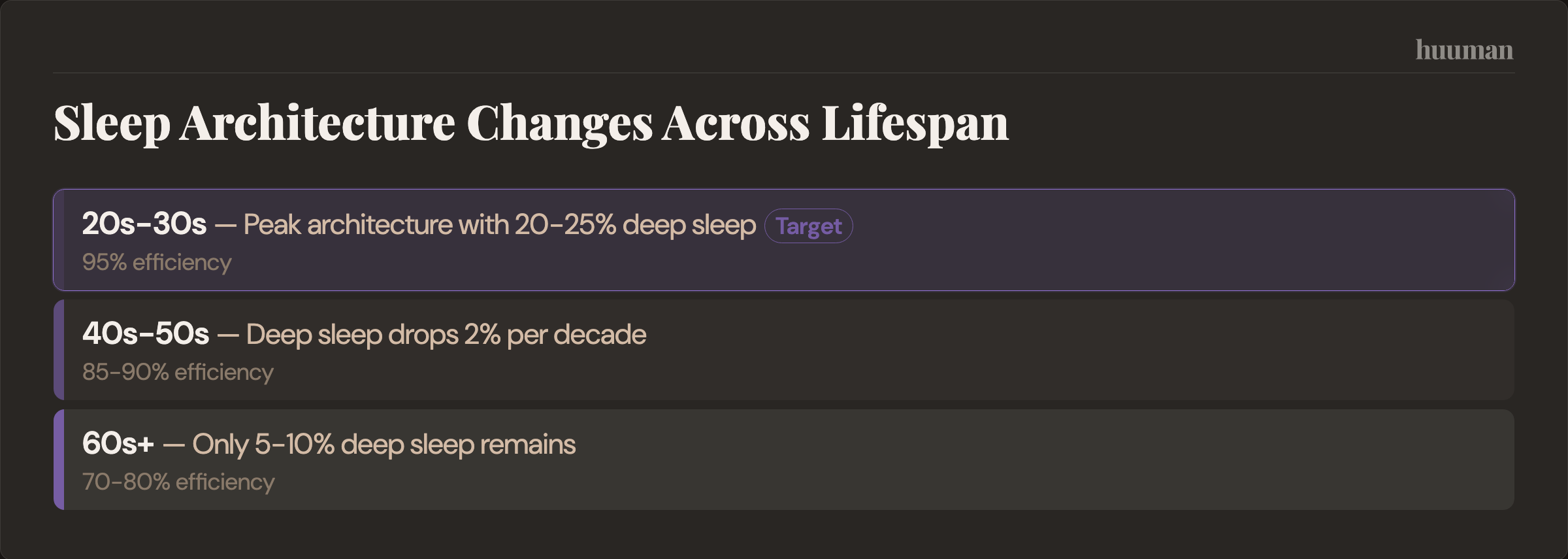
Your sleep architecture shifts predictably across your lifespan:
20s-30s: Peak sleep architecture. Young adults show the highest proportion of slow-wave sleep, typically around 20-25%. Sleep cycles are robust and efficient. You recover quickly from all-nighters because your sleep pressure system is highly responsive.
40s-50s: Deep sleep gradually declines while lighter N2 sleep expands to fill the gap. Sleep becomes more fragmented with more frequent brief awakenings, and sleep efficiency begins to drop from its young-adult peak.
60s+: Deep sleep might constitute only 5-10% of total sleep time. REM remains relatively stable at 20-25%. Sleep efficiency drops to 70-80%. Total sleep need doesn't decrease, but achieving quality sleep becomes harder.
This decline isn't entirely inevitable. Regular aerobic exercise can increase deep sleep duration even in older adults.
How to Get More Deep Sleep
Deep sleep responds predictably to specific controllable inputs:
Exercise timing: Afternoon and early evening workouts may enhance deep sleep more than morning sessions for some people. Avoid intense training within 1-2 hours of bedtime, as it can delay sleep onset.
Temperature control: Keep your bedroom 65-68 F (18-20 C). A warm shower 1-2 hours before bed helps by triggering subsequent cooling.
Alcohol timing: Even 2-3 drinks can disrupt sleep architecture, suppressing REM sleep and fragmenting the second half of the night. Stop drinking at least 3 hours before bed.
Sleep consistency: Same bedtime nightly (within 30 minutes) helps maintain sleep pressure and architecture. Weekend sleep-ins can disrupt circadian alignment and reduce deep sleep early in the following week.
Caffeine clearance: With a 5-7 hour half-life, that 2pm coffee still has 25% active caffeine at 9pm. Calculate your personal clearance time to protect deep sleep.
Rather than optimizing everything at once, let your huuman Coach create weekly plans that balance training, recovery, and sleep optimization based on your actual sleep architecture data and recovery patterns.
Sleep Tracking Devices and Accuracy
Consumer wearables estimate sleep stages using proxy measures. Here's their typical accuracy compared to medical-grade polysomnography:
- Total sleep time: 85-95% accurate
- Sleep efficiency: 80-90% accurate
- Deep sleep detection: 65-80% accurate
- REM detection: 60-75% accurate
Leading devices (Oura Ring, WHOOP, Apple Watch) use similar algorithmic approaches. They excel at identifying trends over weeks but struggle with single-night precision.
Focus on weekly averages rather than absolute numbers. If your tracker shows deep sleep declining from 25% to 15% over a month, that signal matters even if the percentages aren't perfect. Use trackers to identify which behaviors affect your architecture. A "bad" night might still provide adequate recovery if sleep efficiency stays above 85%.
Frequently Asked Questions
How much of each stage of sleep should you get?
In 8 hours, aim for approximately 5% N1, 45% N2, 25% deep sleep, and 25% REM — roughly 24 minutes, 3.6 hours, 2 hours, and 2 hours respectively. These vary naturally. The key is getting 7-9 hours total sleep rather than targeting specific percentages.
Which sleep stage is better, REM or deep sleep?
Neither is "better" because they serve different functions. Deep sleep handles physical recovery: tissue repair, growth hormone, immune strengthening. REM manages cognitive processing: memory consolidation, emotional regulation, creativity. You need both, which requires 7-9 hours of sleep.
How many hours are in each sleep stage?
For 8 hours of sleep: N1 takes ~24 minutes, N2 takes ~3.6 hours, deep sleep claims ~2 hours concentrated in the early part of the night, and REM fills ~2 hours concentrated in the later part of the night, per normative sleep stage data across adulthood. Cutting sleep short disproportionately reduces REM, since REM-rich cycles cluster in the final hours.
References
- Ohayon MM et al. — Meta-analysis of quantitative sleep parameters from childhood to old age in h... (2004)
- Hirshkowitz M et al. — National Sleep Foundation's updated sleep duration recommendations: final report (2015)
- Le Bon O et al. — Sleep ultradian cycling: Statistical distribution and links with other sleep variables, depression, ... (2019)
- Feriante J et al. — REM Rebound Effect (2026)
- Kumral D et al. — Spindle-dependent memory consolidation in healthy adults: A meta-analysis. (2023)
- Tasali E et al. — Slow-wave sleep and the risk of type 2 diabetes in humans — (2008)
- Malinowski JE & Horton CL — Dreams reflect nocturnal cognitive processes: Early-night dreams are more continuous with waking life, and late-night dreams are more emotional and hyperassociative (2021)
- Mayers AG et al. — Antidepressants and their effect on sleep — (2005)
- Haghayegh S et al. — Before-bedtime passive body heating by warm shower or bath to improve sleep: A systematic review and... — (2019)
About this article · Written by the huuman Team. Our content is based on peer-reviewed research and clinical guidelines. We follow editorial standards grounded in scientific evidence.
This article is for educational purposes only and does not constitute medical advice. Health and training decisions should be discussed with qualified professionals.