Zone 2 training plan is everywhere right now, but most people either overcomplicate it or turn it into another hard workout. That misses the point. The real value of Zone 2 is simple: it lets you build a large aerobic base with minimal fatigue so you can stay consistent.
It often feels "too easy." That is exactly why it works. Done correctly, it supports endurance, recovery, and long-term capacity without burning you out. Done incorrectly, it becomes just another moderate session that adds fatigue without clear benefit.
Key takeaways
1. 2 to 5 sessions per week, depending on time and experience
2. Start around 20 to 30 minutes per session and build toward 45 to 90 minutes
3. Keep intensity "conversational" using the talk test, supported by heart rate or pace
This guide gives you what actually matters: how to set the right intensity today, how to structure a week that fits a real life, and how to progress using signals that change decisions.
Where Zone 2 fits in your training
Zone 2 sits at the center of sustainable training. It is low-friction volume. You can repeat it frequently, recover from it quickly, and build capacity without constantly digging into fatigue.
In a broader Heart & Cardio overview, this is the layer that supports everything else: higher-intensity work, strength training, and even recovery between sessions. It also connects to metabolism and durability, especially for people who want performance without living like a full-time endurance athlete.
Quick answer: what a Zone 2 training plan looks like
A Zone 2 training plan is a weekly schedule built around steady, easy-to-moderate aerobic work:
- 2 to 5 sessions per week, depending on time and experience
- Start around 20 to 30 minutes per session and build toward 45 to 90 minutes
- Keep intensity "conversational" using the talk test, supported by heart rate or pace
- Progress by adding minutes first, not by pushing intensity
- Include 0 to 2 harder sessions per week only if recovery supports it
Intensity is guided by feel first, data second. You should be able to speak in full sentences, breathing controlled, with heart rate acting as a ceiling rather than a target.
Start testing your intensity today by logging your cardio sessions with talk test and heart rate through the huuman app to see where you actually land versus where you think you should be.
What "Zone 2" actually means (and why people argue about it)
The confusion starts with definitions. In a 5-zone model, Zone 2 is often described as roughly 60 to 70 percent of max heart rate. In a 3-zone model, it maps to "low intensity below the first threshold." These are not identical systems, which is why numbers and advice often clash.
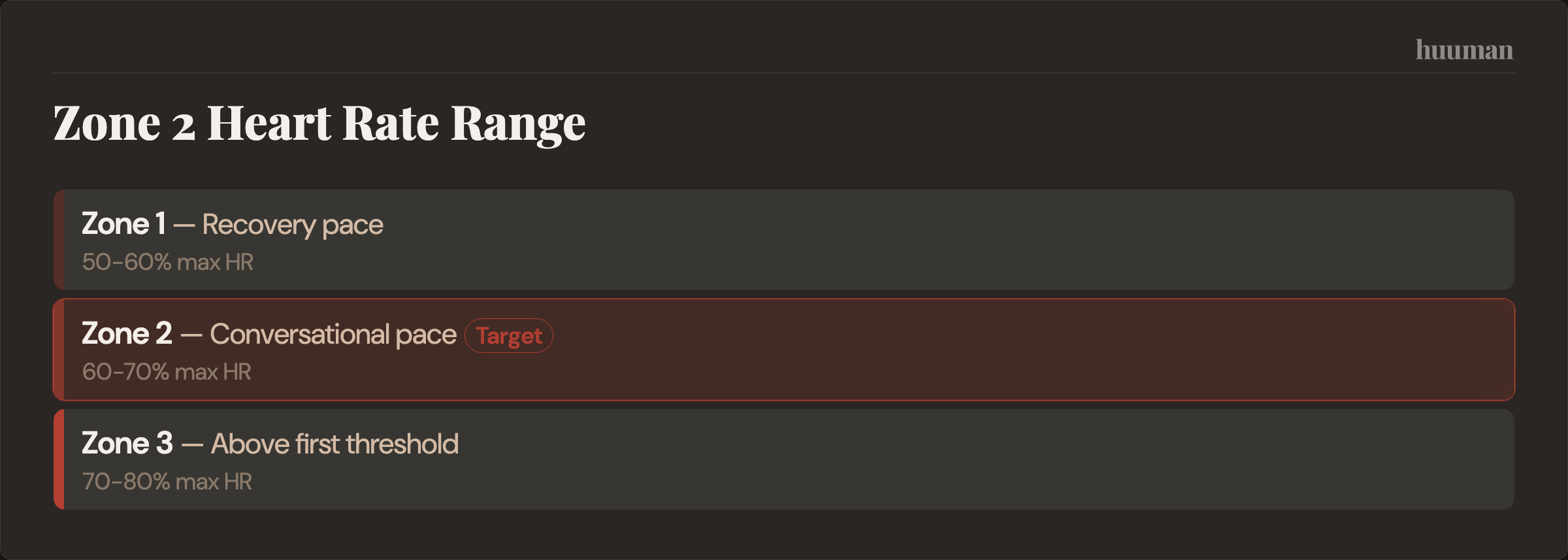
Under the hood, Zone 2 is about staying below your first meaningful threshold. This is often described as the aerobic threshold or VT1. At this intensity, your body relies primarily on aerobic metabolism and can sustain the effort for long durations.
People also mix up threshold terms:
- VT1 / aerobic threshold: where breathing first noticeably increases but is still controlled
- Lactate threshold (LT) / VT2: where effort becomes hard and unsustainable for long
- Anaerobic threshold: often used interchangeably with LT, adding to confusion
Zone 2 sits clearly below that "hard" threshold. But where exactly it falls depends on the model, the sport, and the individual.
That is why a fixed heart rate number rarely works. Your Zone 2 while running will differ from cycling. Heat, fatigue, dehydration, caffeine, and poor sleep all shift your heart rate response on a given day.
Medications can also significantly alter heart rate zones, with beta-blockers reducing exercise heart rate at submaximal intensities.
How to find your Zone 2 today (no lab required)
You do not need lab testing to get this right. You need layered signals.
Step 1: Talk test
You can speak in full sentences without gasping. Breathing is steady, not strained. This is your primary anchor.
Step 2: RPE (perceived effort)
This should feel easy to moderate. Sustainable for a long time. RPE monitoring helps you maintain the right intensity based on how your body feels.
Step 3: Heart rate guardrail
Use heart rate as a ceiling, not a target. Many general endurance references place Zone 2 around 60 to 70 percent of max heart rate, but formulas like 220 minus age are often inaccurate at the individual level.
Medications like beta-blockers further complicate zone calculations, as they're associated with reduced heart rate and increased perceived exertion during exercise.
Wrist-worn heart rate monitors show 1-10% error during exercise, with accuracy decreasing during movement compared to chest straps.
If you want to go deeper, use finding your exact Zone 2 heart rate as a refinement step rather than a starting point.
Optional: Pace or power
Pick a steady output. On a bike, power is the easiest way to stay consistent. Running pace works on flat terrain but breaks down on hills. Rowing and elliptical favor controlled output over chasing heart rate.
Zone 2 intensity checklist
- You can speak in full sentences
- Breathing is controlled, mostly nasal if comfortable
- Effort feels sustainable, with RPE monitoring helping you maintain the right intensity
- Heart rate stays below a personal ceiling rather than climbing steadily
- Heart rate drift (rise at same pace) is limited
How Zone 2 fits with higher intensity and strength
Zone 2 works best when it is not competing with everything else. It supports higher-intensity work, not replaces it.
A conservative structure for most busy adults:
- 2 to 3 Zone 2 sessions per week
- 2 to 3 strength sessions
- 0 to 1 high-intensity session if recovery is solid
More advanced athletes may handle 1 to 2 high-intensity sessions, but spacing matters. Keep at least 24 to 48 hours between hard days.
If your week is already intense, replace intensity before adding volume.
There is solid support for an "easy volume plus a little intensity" approach. Polarized or 80/20-style training distributes most time in low intensity and a smaller portion at high intensity, and is associated with improved endurance outcomes compared to intensity-heavy distributions, based on endurance training research and summaries like 80/20 Endurance.
When adding intensity, remember: heart rate lags behind effort in short intervals. Use pace or power and perceived effort instead. For structure ideas, see adding HIIT to your Zone 2 plan.
4-week Zone 2 progression (choose your track)

- Track: MED (Minimal effective dose) - Sessions/week: 2 - Session duration: 25–40 min - Weekly total: 50–80 min - Notes: Add one longer session every other week
- Track: Standard - Sessions/week: 3 - Session duration: 30–60 min - Weekly total: 90–180 min - Notes: Mix one longer session weekly
- Track: Advanced - Sessions/week: 4–5 - Session duration: 45 - 90 min - Weekly total: 180–400+ min - Notes: Requires strong recovery and structure
Progression order matters:
- First: increase minutes per session
- Then: increase frequency
- Then: adjust terrain or resistance
- Only rarely: adjust intensity
A lighter week every few weeks can help manage fatigue, especially as volume increases.
Choose your modality

- Modality: Running - Best for: Time-efficient, high carryover - Key adjustment: Use run-walk or incline walking to control impact
- Modality: Cycling - Best for: Low joint stress, steady output - Key adjustment: Set a HR ceiling and hold consistent power
- Modality: Rowing - Best for: Full-body conditioning - Key adjustment: 24-28 spm is recommended for steady state to maintain good technique
- Modality: Walking/Hiking - Best for: Low barrier, recovery-friendly - Key adjustment: Use incline or load to adjust intensity
Running requires careful impact management. Cycling offers low joint stress and is often the easiest way to stay truly steady. Rowing benefits from technical consistency, which you can explore with rowing machine workouts for Zone 2.
Evidence and limits
There is consistent support for accumulating a large amount of low-intensity aerobic work to build endurance and support long-term progress. Observational and experimental work in endurance athletes shows that distributing most training at low intensity with some high intensity is associated with strong outcomes.
That said, Zone 2 is a heuristic, not a universal constant:
- Heart rate formulas can be wrong at the individual level
- Wearable accuracy varies. Wrist-based sensors are generally less reliable during movement than chest straps
- Environmental factors like heat and dehydration shift heart rate upward
- Medication such as beta blockers can blunt heart rate response
Lab testing can refine thresholds, but it is not required for most people. Field-based methods like talk test and drift analysis are often sufficient for practical training.
Alternative approaches, including HRV-adjusted zones, exist but are debated and not universally accepted, as seen in resources like Morpheus Zone 2 workshop.
For many readers, especially those focused on longevity rather than racing, consistency and adherence matter more than precision.
Non-prescriptive strategies to discuss with a professional
Different contexts benefit from different emphasis:
- Busy professionals: prioritize consistency and minimal effective dose. Think 2 sessions per week you never miss.
- Returning athletes: rebuild volume gradually and avoid jumping into intensity.
- Strength-focused: add Zone 2 to support recovery without interfering with lifting.
- Experienced endurance athletes: improve discipline by keeping easy days truly easy.
In broader frameworks like Zone 2 in a longevity protocol or how the Blueprint protocol uses Zone 2, it acts as a stable base layer rather than a performance peak tool.
How to track and interpret changes
Tracking turns this from guesswork into a feedback loop.
Weekly dashboard:
- Total Zone 2 minutes
- Average heart rate
- Pace or power at that heart rate
- Heart rate drift (first half vs second half)
- Sleep quality
- Soreness and fatigue
Two simple field checks:
- Repeat the same route and compare pace at the same heart rate
- Look at drift. If heart rate climbs significantly at the same output, fatigue or conditions may be affecting you
Readiness signals like HRV can add context, but HRV is a decision-support tool, not an oracle.
You can estimate your broader fitness context using tools like calculate your current VO2max and compare against VO2max reference values by age, but day-to-day training decisions should rely on trends, not single numbers.
Signal vs noise in a Zone 2 training plan
- Signal: You can speak in full sentences comfortably. Continue building duration.
- Signal: Pace or power improves at the same heart rate over weeks. Maintain progression.
- Signal: Heart rate drift decreases across sessions. Consider extending duration slightly.
- Signal: You finish sessions feeling better than you started. Keep consistency high.
- Noise: Chasing a specific BPM from a formula. Use talk test to reset your ceiling.
- Noise: Treating Zone 2 as a fat-loss shortcut. Refocus on total lifestyle and consistency.
- Noise: Turning easy days into moderate effort. Pro cyclists keep easy workouts truly easy, crawling up hills if needed to stay in zone 1.
- Noise: Overreacting to a single HRV dip. Look at 3 to 7 day trends before adjusting.
- Noise: Comparing Zone 2 heart rate across sports. Define zones per modality instead.
Common questions
How long should Zone 2 training be per session?
Many programs start around 20 to 30 minutes and build toward 45 to 90 minutes as capacity improves. The key is repeatability, not hitting a specific duration.
Is 150 bpm too high for Zone 2?
It depends entirely on your physiology. For some, that could be above Zone 2. For others, it might be within it. Use the talk test and perceived effort to validate, not just heart rate.
Is Zone 2 training actually effective?
Yes, when used correctly. It supports aerobic base, durability, and recovery. It becomes ineffective when it drifts into moderate intensity or replaces all other training.
Does Zone 2 increase VO2 max?
It can contribute indirectly by building the base that supports higher-intensity work. Direct VO2 max improvements typically require targeted higher-intensity efforts, explored in how to increase your VO2max with Zone 2 and complementary methods.
How many days per week should I do Zone 2 if I also lift weights?
Start with 2 to 3 sessions per week. Adjust based on recovery and goals. If strength is the priority, keep Zone 2 supportive rather than excessive.
Why is my heart rate high at an easy pace?
Common reasons include poor sleep, heat, dehydration, stress, or starting too fast. Lower the pace and reassess under better conditions before changing your plan.
Should I use talk test, heart rate, pace, or power?
Use at least two. Talk test and perceived effort set the baseline. Heart rate or pace helps you stay consistent and track trends.
Rather than guessing at weekly volume or chasing perfect heart rate numbers, work with your huuman Coach to build personalized weekly plans that balance Zone 2 volume with your recovery capacity and adjust based on real feedback from your sessions.
More health topics to explore
- Heart & Cardio – Overview
- Understanding HRV: Charts, Normal Ranges, and What "Good" Really Means
- HIIT for Cardio: How to Do It Safely, Effectively, and Without Burning Out
- HIIT on an Elliptical: 3 Repeatable Workouts + How to Progress
References
- Morpheus — Zone 2 Workshop
- Foster C et al. — Polarized Training Is Optimal for Endurance Athletes (2022)
- Sitko S et al. — What Is "Zone 2 Training"?: Experts' Viewpoint on Definition, Training Method... (2025)
- Casado A et al. — Does Lactate-Guided Threshold Interval Training within a High-Volume Low-Inte... (2023)
- Van Baak MA — Beta-adrenoceptor blockade and exercise. An update (1988)
- Zhang Y et al. — Validity of Wrist-Worn photoplethysmography devices to measure heart rate: A ... (2020)
- Zuluaga-Cabrera AM et al. — Defining the Heart Rate Zone Corresponding to the Lactate Threshold in Colomb... (2025)
- Kenneally M et al. — The Effect of Periodization and Training Intensity Distribution on Middle- an... (2018)
- Tesch PA — Exercise performance and beta-blockade (1985)
- Wonisch et al. — Influence of beta-blocker use on percentage of target heart rate exercise prescription. (2003)
- Cleveland Clinic — Rated Perceived Exertion (RPE) Scale
- Gymshark — What is LISS Cardio?
- British Rowing — Designing an Elite Rowing Training Programme 2: Training Intensity
- Fast Talk Labs — Polarized Training
- Source