When people want to improve their endurance, one metric almost always comes up: VO2max. It describes the maximum amount of oxygen your body can take in and use during intense exercise. The higher this value, the larger your aerobic "engine."
Yet many people plateau even though they train regularly. Common reasons include too much intensity, not enough aerobic base work, or a training plan without clear progression. Others rely heavily on a single wearable metric and miss more meaningful signals such as pace, power output, or how hard a given effort feels at the same heart rate.
Key takeaways
1. What to train: A combination of 1–2 high‑intensity sessions per week (intervals near VO2max) plus regular low‑intensity aerobic training in Zone 2.
2. How often: For many people, 3–5 total sessions per week are enough. Adding more intensity rarely helps if recovery is insufficient.
3. How to assess progress: Track trends over several weeks – pace or power at the same heart rate, standardized field tests, and wearable VO2max estimates as trend indicators.
This guide explains how to improve your VO2max without falling into the typical "more HIIT solves everything" mindset. You'll get a simple weekly structure, practical interval formats, clear ideas for progression, and a tracking system that helps you recognize real progress.
Where VO2max fits into the bigger fitness picture
VO2max measures your maximum oxygen uptake. It's typically expressed in milliliters of oxygen per kilogram of body weight per minute (ml/kg/min). The value reflects two core abilities: how effectively your cardiovascular system transports oxygen, and how efficiently your muscles use that oxygen.
Several factors influence this value:
- Cardiac output: How much blood your heart can pump per minute, including both stroke volume and heart rate.
- Blood volume and hemoglobin: These determine how much oxygen can be transported.
- Capillary density: More small blood vessels improve oxygen delivery to muscles.
- Mitochondrial enzymes: They regulate how efficiently muscles convert oxygen into energy.
- Movement economy: How efficiently you use energy while running, cycling, or rowing.
Important: VO2max is not the same as endurance performance. Two people with similar VO2max values may run at very different speeds. Factors such as lactate threshold, technique, and efficiency play a major role.
If you want a broader overview of cardiovascular training topics, explore our hub: Heart & Endurance – complete topic overview.
Quick answer: how to improve VO2max
Most training plans designed to improve VO2max follow a relatively simple structure:
- What to train: A combination of 1–2 high‑intensity sessions per week (intervals near VO2max) plus regular low‑intensity aerobic training in Zone 2.
- How often: For many people, 3–5 total sessions per week are enough. Adding more intensity rarely helps if recovery is insufficient.
- How to assess progress: Track trends over several weeks – pace or power at the same heart rate, standardized field tests, and wearable VO2max estimates as trend indicators.
The biggest lever is not a single interval protocol but consistent training over several weeks combined with progressive overload. Many training programs report adaptations after about 6–12 weeks of consistent training.
If you want to implement this structure right away, you can simply copy the workouts below into your calendar.
If you're serious about tracking your cardio progress, log your VO2max intervals and Zone 2 sessions through the huuman app to monitor pace improvements and RPE trends over your training block.
What VO2max is – and what it isn't
The VO2max value reflects physiological capacity, not your actual race performance. Two factors strongly influence the number:
- Body weight, because VO2max is reported relative to weight (ml/kg/min).
- Measurement method, such as treadmill testing, cycling ergometer testing, or wearable estimates.
Laboratory testing using spiroergometry is considered the most precise measurement. Many wearables estimate VO2max based on heart rate, pace, and personal data. These estimates are better interpreted as trends rather than exact measurements and can differ from laboratory values, as manufacturers themselves explain (Polar Blog). Population-level norms from the FRIEND Registry confirm these age-related benchmarks.
Another important point: running VO2max, cycling VO2max, and rowing VO2max often differ substantially because different muscle groups are involved.
Why VO2max improves physiologically
Training can increase VO2max because it triggers both central and peripheral adaptations.
Central adaptations
These primarily involve your cardiovascular system. Regular endurance training is associated with stronger cardiac output, increased blood volume, and more efficient oxygen delivery throughout the body.
High‑intensity intervals create especially high oxygen demand. As a result, your body spends time close to maximal oxygen uptake. This "time near VO2max" is considered an important training stimulus.
Peripheral adaptations
Changes also occur in the muscles. Endurance training can be associated with more mitochondria, increased capillary density, and more efficient metabolic processes.
Zone 2 training supports aerobic adaptations that can contribute to improved endurance performance. Many training programs combine easier sessions with higher-intensity work for comprehensive development.
Training types that influence VO2max
Research suggests that interval duration affects training outcomes, with longer intervals often achieving higher sustained oxygen uptake levels. The total time at high intensity and adequate recovery between sessions are key factors for adaptation.
Zone 2 training
Zone 2 training refers to steady, relatively easy effort. You can usually hold a conversation and maintain a moderate intensity. In training literature, this type of work is often described as the aerobic base that supports harder efforts.
Learn more about this foundation in the article Zone 2 training as a foundation for VO2max progress.
Threshold or tempo sessions
Training near your lactate threshold mainly improves your ability to sustain faster speeds for longer periods.
These efforts do not necessarily increase VO2max directly, but they can significantly improve performance at a given VO2max level.
VO2max intervals
These intervals typically last 3 to 8 minutes and are performed hard enough to push oxygen uptake close to its maximum. Many programs target very high cardiorespiratory load, often around roughly 90–95% of maximum heart rate according to sports science literature.
The American College of Sports Medicine guidelines recommend target intensities of 40-85% of VO2max for different training adaptations, with higher intensities reserved for specific interval work.
You can find an overview of these workouts in HIIT training for improving VO2max.
Short intervals
Short intervals such as 30/15 or 40/20 sessions combine short hard efforts with short recovery periods. Because heart rate rises over repeated efforts, these sessions are often paced by speed, power, or perceived exertion rather than heart rate.
Strength training
Strength training can contribute to improved running economy and stability. While it does not directly increase maximal oxygen uptake, these improvements may support overall endurance performance.
A practical introduction is available in strength training to complement endurance training.
Which type of session fits you?
The right session depends on your goals, available time, and recovery capacity.
- Minimal plan: limited time, focus on efficiency
- Standard plan: balanced mix of intensity and base work
- Advanced plan: higher overall volume but still limited intensity
- Goal: VO2max stimulus — Time: 30–45 min — Session type: Long intervals — Intensity (RPE): 8–9/10 — Example: 4–6 × 4‑minute intervals
- Goal: High aerobic load — Time: 30–50 min — Session type: Short intervals — Intensity (RPE): 8–9/10 — Example: 30/15 blocks
- Goal: Aerobic base — Time: 45–90 min — Session type: Zone 2 session — Intensity (RPE): 3–4/10 — Example: 60 min easy running
- Goal: Support — Time: 20–30 min — Session type: Strength training — Intensity (RPE): moderate — Example: Lower body + core
Weekly structure: three commonly used training models
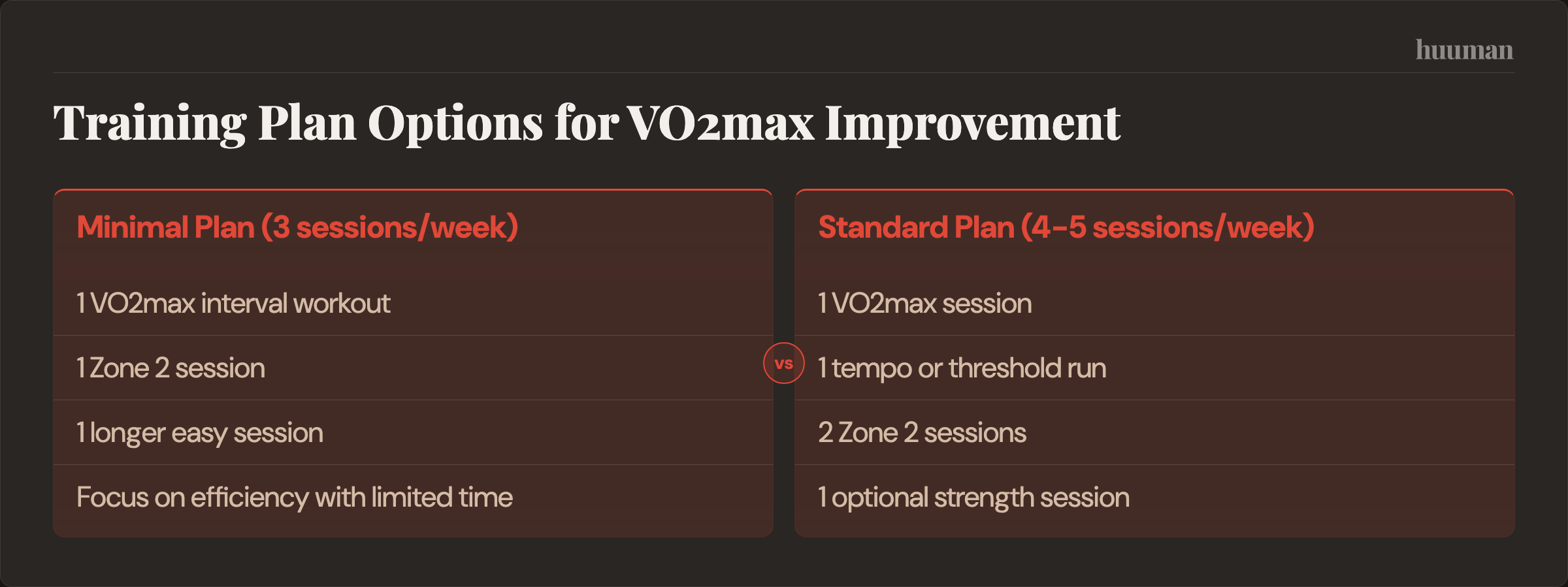
Minimal plan (3 sessions per week)
- 1 VO2max interval workout
- 1 Zone 2 session
- 1 longer easy session
Standard plan (4–5 sessions)
- 1 VO2max session
- 1 tempo or threshold run
- 2 Zone 2 sessions
- 1 optional strength session
Advanced plan (5–6 sessions)
- maximum of 2 high‑intensity sessions
- 2–3 easy sessions
- 1 longer endurance session
- 1–2 strength workouts
Many training approaches describe an intensity distribution similar to a polarized model, where most training time remains easy and only a small portion is performed at very high intensity.
A systematic review found that polarized training, with its emphasis on easy and hard efforts while minimizing moderate intensity, is associated with VO2max improvements in endurance athletes.
Progression over a 6‑week training block
The most common reason for stagnant VO2max is either missing progression or intensity that is too aggressive.

A common multi‑week progression pattern looks like this:
- Weeks 1-2: Entry phase focusing on technique and controlled intensity.
- Weeks 3–4: More time near VO2max through additional repetitions.
- Week 5: Highest interval quality.
- Week 6: Reduced volume plus a repeat test.
If fatigue increases, a training block can include a lighter week. Learn more in the article when a deload week makes sense.
Protocol cards (copy‑and‑paste workouts)
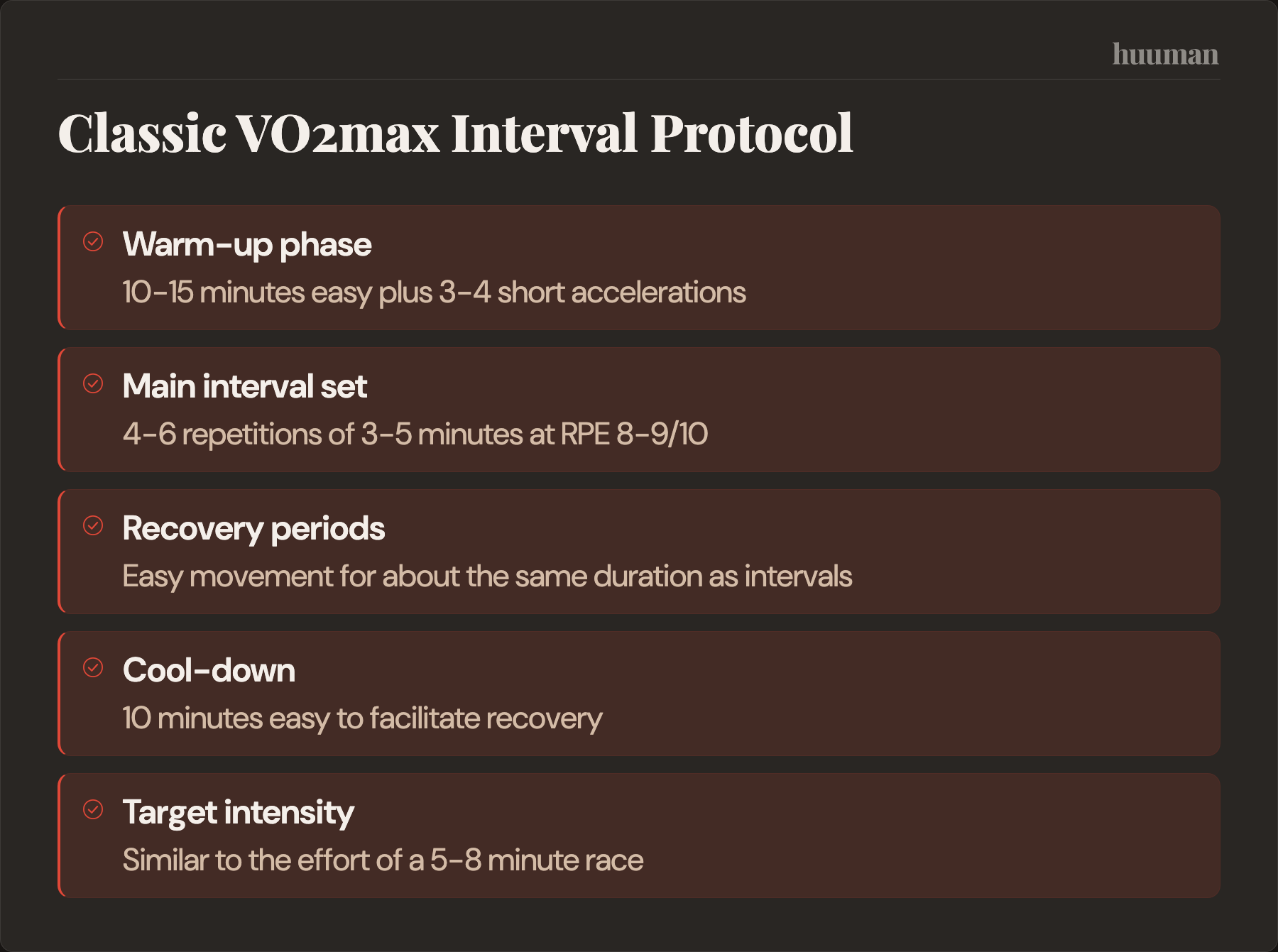
Protocol card 1 – classic VO2max intervals
- Warm‑up: 10–15 minutes easy plus 3–4 short accelerations
- Main set: 4–6 repetitions of 3–5 minutes
- Recovery: easy movement for about the same duration
- Cool‑down: 10 minutes easy
- RPE: 8–9/10
- Pace/power: similar to the effort of a 5–8 minute race
Protocol card 2 – 30/15 intervals
- Warm‑up: 15 minutes easy
- Main set: 2–3 blocks of 10 minutes (30 seconds hard, 15 seconds easy)
- Rest between blocks: 3–5 minutes easy
- Cool‑down: 10 minutes easy
- RPE near the end of each block: 8–9/10
Protocol card 3 – Zone 2 long session
- 45–90 minutes steady effort
- RPE: 3–4/10
- Intentionally conservative pace
If signs of excessive fatigue appear, it may make sense to reduce intensity and add an easier session instead. Recovery guidance is available in how to recover properly after hard intervals.
Evidence and limitations
Research on endurance training shows fairly consistent patterns. Studies and reviews suggest that both high-intensity intervals and endurance training can be associated with improvements in maximal oxygen uptake.
Which interval format works best remains debated in the literature. Different protocols can produce similar stimuli as long as sufficient time is spent at high intensity.
Wearable VO2max estimates depend on heart rate measurement quality and can vary based on multiple factors. Manufacturers note that these estimates should be viewed as trends rather than absolute values.
Nitrate‑rich foods such as beetroot are also frequently discussed in relation to endurance performance. Some studies suggest they may influence certain performance markers in specific contexts. However, effects depend strongly on context, and exact protocols are best discussed in individualized counseling.
Strategies to discuss with a professional
- Combine 1–2 high‑intensity sessions with several easy workouts.
- Include at least one full rest day or very light day per week.
- Add strength training to support stability and movement efficiency.
- Prioritize sleep and stress management.
- Avoid training during infections or fever.
Warning symptoms such as chest pain, unusual shortness of breath, fainting, or persistent heart palpitations should always be evaluated medically.
Measuring and interpreting progress
The most important rule: a single number tells you very little. Trends matter.
- Resting heart rate trends
- HRV trends over several days
- Pace or power at the same heart rate
- Subjective perception of effort
If you track HRV, this overview can help interpret trends more clearly: Understanding HRV values and training readiness.
Signal vs noise in VO2max
- A single wearable VO2max value is just one data point. Look at trends over several weeks rather than single days.
- The specific interval format rarely determines progress. First check whether you're getting enough time near maximal oxygen uptake.
- Adding more intensity often doesn't solve plateaus. Review sleep, nutrition, and recovery first.
- Heat, dehydration, or stress can raise heart rate. Repeat tests under similar conditions.
- Weight changes affect ml/kg/min without necessarily reflecting real performance changes. Track absolute performance too.
- Running VO2max does not fully transfer to cycling. Test in the specific sport.
- Plateaus often come from monotonous training. Vary interval duration or rest structure.
- When experiencing persistent exhaustion, spreading out exercise days and reducing intensity can help avoid overtraining and support recovery.
Frequently asked questions
How quickly can VO2max improve?
Improvements vary widely and depend on your starting level. In training studies, adaptations often appear after several weeks of consistent training.
What is a good VO2max value?
Reference values vary widely by age and sex. Tables from sports and exercise science literature show broad ranges, which is why your personal trend often matters more than comparison with population averages.
How reliable are Garmin or Polar VO2max values?
Wearables estimate VO2max based on training data and heart rate signals. They can be helpful for tracking trends but are not exact measurements and may differ from lab results (Polar).
Is Zone 2 training enough?
Zone 2 training supports aerobic adaptations that can contribute to improved endurance performance. Many training programs combine easier sessions with higher-intensity work for comprehensive development.
Which intervals are most effective?
Research suggests that interval duration affects training outcomes, with longer intervals often achieving higher sustained oxygen uptake levels. The total time at high intensity and adequate recovery between sessions are key factors for adaptation.
Why isn't my VO2max improving despite training?
Common causes include repetitive training patterns, excessive overall intensity, poor sleep, or inconsistent measurement conditions. Training breaks or insufficient recovery can also mask progress, as wearable manufacturers note in their analyses (Garmin).
Can strength training improve VO2max?
Strength training can contribute to improved running economy and stability. While it does not directly increase maximal oxygen uptake, these improvements may support overall endurance performance.
If you feel stuck, use a simple plateau checklist: sleep, stress, training distribution, nutrition, standardized testing, and change only one variable every two weeks.
Rather than guessing when to push harder or back off based on noisy data, have your huuman Coach build weekly training plans that respond to your actual recovery signals and adapt intensity based on how your body is responding week to week.
More health topics to explore
- Heart & Cardio – Overview
- HIIT for Cardio: How to Do It Safely, Effectively, and Without Burning Out
- Zone 2 Heart Rate Calculator: How to Verify Your True Zone 2
- VO2max and Longevity: What the Science Says
References
- Milanović et al. — HIT vs Continuous Training for VO2max (2015)
- Nøst et al. — Polarized Training and VO2max in Endurance Athletes (2024)
- Swain DP et al. — Target heart rates for the development of cardiorespiratory fitness (1994)
- Casado A et al. — Training Periodization, Methods, Intensity Distribution, and Volume in Highly... (2022)
- Carrier B et al. — Validation of Aerobic Capacity (VO2max) and Pulse Oximetry in Wearable Techno... (2025)
- Bassett et al. — Limiting factors for maximum oxygen uptake and determinants of endurance perform (2000)
- Poon et al. — Dietary Nitrate Supplementation and Exercise Performance: An Umbrella Review of (2025)
- Myers J et al. — A Reference Equation for Normal Standards for VO(2) Max: Analysis from the Fi... (2017)
- Meeusen et al. — Prevention, diagnosis and treatment of the overtraining syndrome (2013)
- Polar Fitness Test — Cardiovascular fitness assessment through HRV analysis
- Interval training protocols and VO2max adaptations — Frontiers in Sports and Active Living
About this article · Written by the huuman Team. Our content is based on peer-reviewed research and clinical guidelines. We follow editorial standards grounded in scientific evidence.
This article is for educational purposes only and does not constitute medical advice. Health and training decisions should be discussed with qualified professionals.