Your zone 2 pace is not a permanent number. It is the running pace that keeps you at an easy, sustainable aerobic intensity on a specific day, in specific conditions, with your current fitness and recovery state.
Key takeaways
1. Estimate: use a measured maximum heart rate if you have one. If not, an age-based estimate can be used as a rough starting point, not a precise personal value.
2. Validate: after warming up, check whether you can speak in full sentences, keep breathing controlled, and rate the effort as easy steady rather than moderate hard.
3. Track: repeat a 30-minute steady Zone 2 field check under similar conditions and look for pace improving at the same average heart rate over several weeks.
That is why a calculator can only give you a starting point. The useful answer comes from combining heart rate, the talk test, perceived exertion, and a repeatable field check. Pace is the output. Effort is the input.
This guide gives you a practical calculator method, treadmill guidance, a field-check protocol, and a way to track whether your aerobic base is improving without chasing noisy data from a single run.
Where Zone 2 pace fits in performance and health
Zone 2 training sits in the low-to-moderate endurance range. It is usually easy enough to repeat, demanding enough to create an aerobic stimulus, and controlled enough to support other training rather than compete with it. For a broader view of cardiovascular training priorities, the heart and cardio training guide explains how endurance work fits into long-term capacity.
For heart and performance, Zone 2 is mainly about building aerobic capacity with relatively low cardiovascular strain. For metabolism, it is associated with long-duration fuel use and metabolic flexibility, although claims about “fat burning” are often overstated online. For recovery, easy endurance can be useful when it is dosed appropriately, because it usually carries less neuromuscular cost than harder intervals or race-pace work.
The key is not to make Zone 2 mystical. It is an intensity domain. Running pace is just how that intensity expresses through your body, terrain, temperature, shoes, stride mechanics, and fatigue.
Quick answer
Zone 2 pace is the pace you can hold while staying at an easy, conversational effort, typically around a moderate aerobic heart-rate range, on that day. Many beginner calculators estimate Zone 2 at roughly 60 to 70% of maximum heart rate, but that range depends on the zone system and is imprecise without testing.
- Estimate: use a measured maximum heart rate if you have one. If not, an age-based estimate can be used as a rough starting point, not a precise personal value.
- Validate: after warming up, check whether you can speak in full sentences, keep breathing controlled, and rate the effort as easy steady rather than moderate hard.
- Track: repeat a 30-minute steady Zone 2 field check under similar conditions and look for pace improving at the same average heart rate over several weeks.
If you want to make the estimate useful, track your Zone 2 field check in the huuman app with pace, heart rate, RPE, and notes on conditions so the number becomes a trend instead of a guess.
Zone 2 pace calculator
This is a transparent, mobile-friendly calculator you can run manually. It gives a starting heart-rate range and then tells you how to translate that range into a real running pace.
Inputs
- Age: optional, used only if you do not have a measured maximum heart rate.
- Measured maximum heart rate: preferred if it comes from a valid hard effort or test, but still not perfect.
- Method: choose either the HRmax-percentage method or your own threshold-heart-rate zones from a test or trusted platform.
- Resting heart rate: useful context for recovery, but not required for this simple calculator.
- Recent easy-run pace or 5K pace: optional. Use it only as a starting guess, not as the definition of Zone 2.
- Environment: treadmill or outdoors, plus a simple note on heat, hills, wind, or altitude.
Output 1: Zone 2 heart-rate range
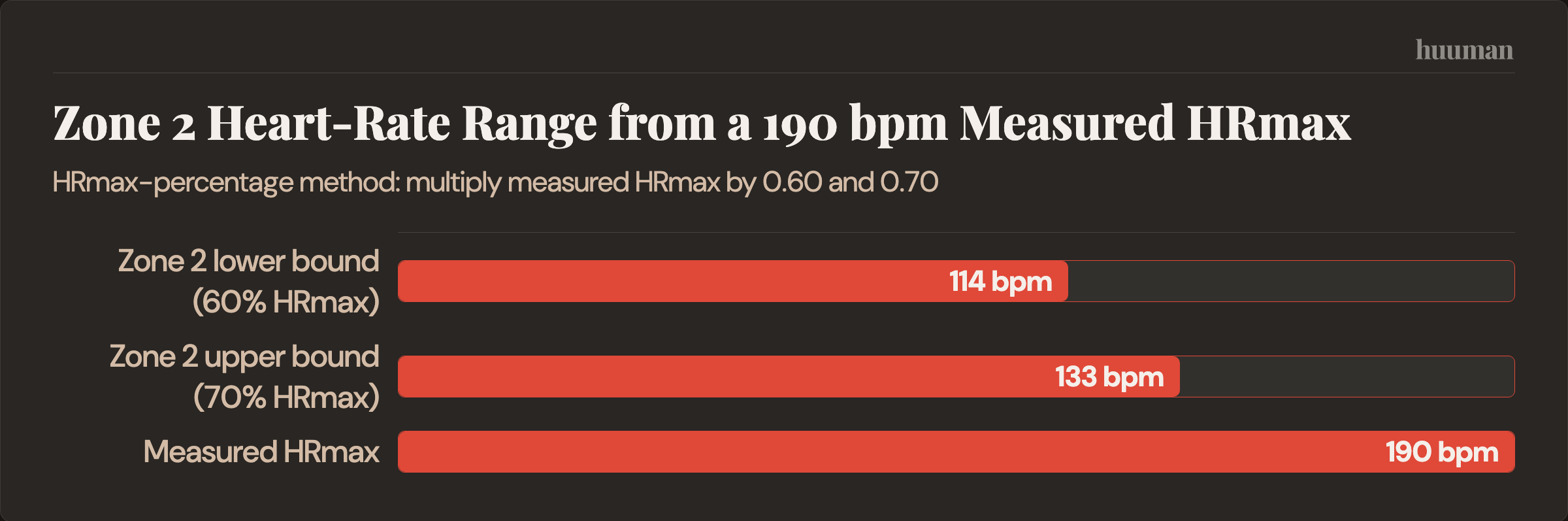
If you have measured HRmax: multiply that number by 0.60 and 0.70. Example: if measured HRmax is 190 bpm, a common HRmax-based Zone 2 estimate would be about 114 to 133 bpm.
If you do not have measured HRmax: age-based formulas such as 220 minus age are commonly used, but they can be meaningfully wrong for individuals. Treat the result as a first estimate only. If the calculated zone disagrees with the talk test, RPE, and repeatable field data, do not blindly obey the.
If you use threshold heart rate: use the Zone 2 range already defined by your testing platform or coach. Threshold-based systems and HRmax-based systems do not always line up, which is one major reason social media arguments about Zone 2 become confusing.
Output 2: Start-here pacing guidance
- Outdoors: start slower than your normal easy run for the first 10 to 15 minutes. Once heart rate stabilizes, adjust pace until you are inside your estimated range while still passing the talk test.
- Treadmill: start at a speed that feels almost too easy, then adjust gradually. Use a small incline only if it helps the run feel more like your normal outdoor mechanics, but do not assume any single incline perfectly converts indoor pace to outdoor pace.
- If using recent pace: begin near your recent easy-run pace, then slow down if heart rate, breathing, or RPE says it is too hard. If using 5K pace, do not apply a fixed pace offset as a rule. Race-to-Zone-2 conversions vary heavily by fitness and experience.
Output 3: Validation checklist
- You can speak in full sentences without needing to pause for air.
- Your RPE is easy steady, roughly low on a 0 to 10 scale or clearly below “somewhat hard” on a 6 to 20 scale.
- Your breathing is controlled. Nasal breathing may be possible for some people, but it is optional and anatomy-dependent.
- You can sustain the effort for 30 to 60 minutes without feeling like you are racing the final third.
- Your heart rate does not climb rapidly unless heat, hills, dehydration, fatigue, or cardiac drift explains it.
What “Zone 2 pace” actually means
A good Zone 2 pace is the pace that keeps the session truly easy. For an experienced runner on a cool flat route, that might look like continuous running. For a new or returning runner, it may be run-walk. For someone training in heat, on hills, or under heavy life stress, it may be much slower than expected.
This is not a failure of fitness. It is the difference between pace and intensity. Pace is affected by running economy, cadence, stride length, surface, wind, shoes, terrain, and fatigue. Effort is the target. Pace is the expression.
Running economy matters because two athletes can run at the same heart rate with different speeds. Even the same athlete can change pace at the same heart rate by improving mechanics, relaxing excess upper-body tension, or choosing a flatter route. That does not mean you should micromanage cadence. It means you should avoid treating pace alone as proof that the session was easy.
Why Zone 2 definitions differ
The internet often treats Zone 2 like one universal zone, but different systems define zones differently. HRmax-percentage zones are simple and beginner-friendly. Threshold-based zones use a harder physiological marker, often tied to lactate threshold or a similar field-test estimate. Lab concepts such as first ventilatory threshold, often called VT1, describe the point where breathing begins to shift from very easy toward more noticeably aerobic work.
These methods can point to similar territory, but they are not interchangeable. A runner using a watch’s HRmax zones, a cyclist using threshold zones, and an endurance athlete using lab ventilatory data may all say “Zone 2” while referring to slightly different ranges.
The practical fix is to triangulate. Estimate a heart-rate range, then anchor it with full-sentence conversation and easy-steady RPE. If you want a deeper heart-rate-specific guide, read the companion article on zone 2 heart rate. If you are comparing intensities, comparing zone 2 and zone 3 training explains why drifting just a little too hard can change the.
Why your Zone 2 pace changes day to day
Heart rate is responsive, not fixed. Heat, dehydration, poor sleep, illness, caffeine, emotional stress, and accumulated training fatigue can all raise heart rate at a pace that normally feels easy. Other factors such as altitude, fueling, and menstrual cycle phase may also play a role for some people. Hills and wind change the cost of running, so your flat-route Zone 2 pace may not transfer cleanly to a rolling course.
Heart rate also lags behind pace changes. If you speed up for 30 seconds, your heart rate may not show the full cost immediately. If you slow down, it may take time to settle. That is why instantaneous heart rate is a poor steering wheel, especially early in a run. Use pace and RPE for short adjustments, and use heart rate once it has stabilized.
Cardiac drift is another reason pace changes within the same session. During steady exercise, heart rate can gradually rise even if pace stays the same, especially in heat. If the goal is Zone 2, the usual adjustment is to slow slightly; cooling the environment when possible or shortening the bout may also help rather than forcing the original pace.
Zone 2 Field Check
This is the practical validation step. It turns your calculator result into a field-tested pace range.
Zone 2 Field Check: Warm up for 10 to 15 minutes. Then run or run-walk for 30 minutes on a flat route or treadmill. Keep effort conversational. Record average heart rate, average pace, RPE, temperature, terrain, wind, treadmill speed or incline, and whether heart rate drifted upward in the final third.
- Choose controlled conditions: use a familiar flat loop, track, or treadmill. Avoid steep hills if the purpose is benchmarking.
- Warm up patiently: ignore the first few minutes of heart-rate data because the cardiovascular response is still catching up.
- Settle into easy steady: once warm, adjust pace until heart rate, breathing, and RPE agree.
- Protect the intensity: if heart rate rises above range and talking becomes choppy, slow down or insert short walking breaks.
- Record the session: the benchmark is useful only if you can compare it with similar future sessions.
Treadmill guidance
Treadmills make Zone 2 easier to control because speed and grade are stable. They also remove wind, change cooling, and may alter stride mechanics, so treadmill Zone 2 pace is not automatically the same as outdoor Zone 2 pace.
Start with a slow ramp. Pick a comfortable speed, run for several minutes, then adjust in small steps. Do not chase every heart-rate fluctuation. Wait until your breathing, RPE, and heart rate have settled before deciding whether the speed is right.
If the room is warm, use a fan if available and expect heart rate to climb sooner. If you add incline, treat it as a load change, not a required conversion. The correct treadmill setup is the one that lets you hold a repeatable easy effort while collecting consistent data.
For indoor cycling or virtual rides, Zone 2 logic is similar but the output changes from running pace to power, speed, or heart rate. The guides on cycling zone 2 and zwift zone 2 training cover that translation more directly.
If Zone 2 is a walk
For new runners, returning athletes, and larger athletes, Zone 2 may initially require walking breaks. That is common. The body does not care whether the session looks like “running” on paper. It responds to the cardiovascular and muscular demand you actually create.
A run-walk approach can keep the session aerobic while letting you accumulate time on feet. Flat terrain helps. So does slowing earlier than your ego wants. If your heart rate is high even at a gentle walk, check heat, illness, sleep debt, stress, recent alcohol, dehydration, and device accuracy before assuming something is wrong with your fitness.
If unusually high heart rate or severe exercise intolerance persists, or if you have chest pain or pressure, fainting or near-fainting, unusual shortness of breath at easy effort, palpitations with dizziness, leg swelling, or known heart disease symptoms, stop the session and seek appropriate medical care.
Evidence and limits
There is strong practical and physiological support for building aerobic capacity with low-to-moderate endurance work. What is less exact is the boundary of Zone 2 for any one person outside a lab. HRmax formulas are rough. Wrist heart-rate sensors can be wrong. Threshold estimates vary by testing method. Pace heuristics based on race times are baseline-dependent and should not be treated as rules.
The evidence is clearest when the claim is broad: easy endurance training can support aerobic base development when matched to the athlete and placed within a sensible training week. The evidence is weaker when someone claims a precise Zone 2 heart rate from a generic formula, a universal treadmill conversion, or specific metabolic outcomes from one intensity label.
Wearable data adds convenience and noise. Optical wrist sensors can struggle with motion, loose fit, darker pigmentation, or rapid changes in intensity, and some users also report issues with cold skin or tattoos. If your watch says you are at a very high heart rate while you are speaking comfortably, confirm with a better fit, a different device, or a chest strap before reorganizing your training around that number.
People taking beta blockers or other heart-rate-altering medications, people with arrhythmias, and people with cardiovascular conditions may need clinician-guided intensity targets. For them, pace-by-feel, talk test, and professionally set zones may be more useful than a standard calculator.
Strategies to discuss with a professional
- Add minutes before intensity: many programs build easy duration first, then add harder work only when the base is tolerated well.
- Use run-walk intentionally: alternating short jogs and walks can keep effort in range when continuous running pushes heart rate too high.
- Control hills: slow down, shorten stride, or power hike climbs rather than forcing flat-road pace uphill.
- Shorten sessions when drift is high: if heart rate climbs despite easy breathing early on, heat, fatigue, or hydration may be limiting the day.
- Coordinate with strength training: time-crunched athletes often benefit from keeping easy endurance truly easy so it does not compromise lifting quality.
If you are also tracking performance across other modalities, our vo2 max calculator connects aerobic fitness estimates to broader endurance capacity, while vo2 max for swimming shows why modality matters when interpreting fitness numbers.
How to track and interpret changes
The cleanest benchmark is average pace at a similar average heart rate under similar conditions. Repeat the same field check every 2 to 4 weeks, not every day. A single run can be distorted by heat, poor sleep, stress, device error, or terrain. A 3 to 4 week rolling average is more useful than one impressive or disappointing session.
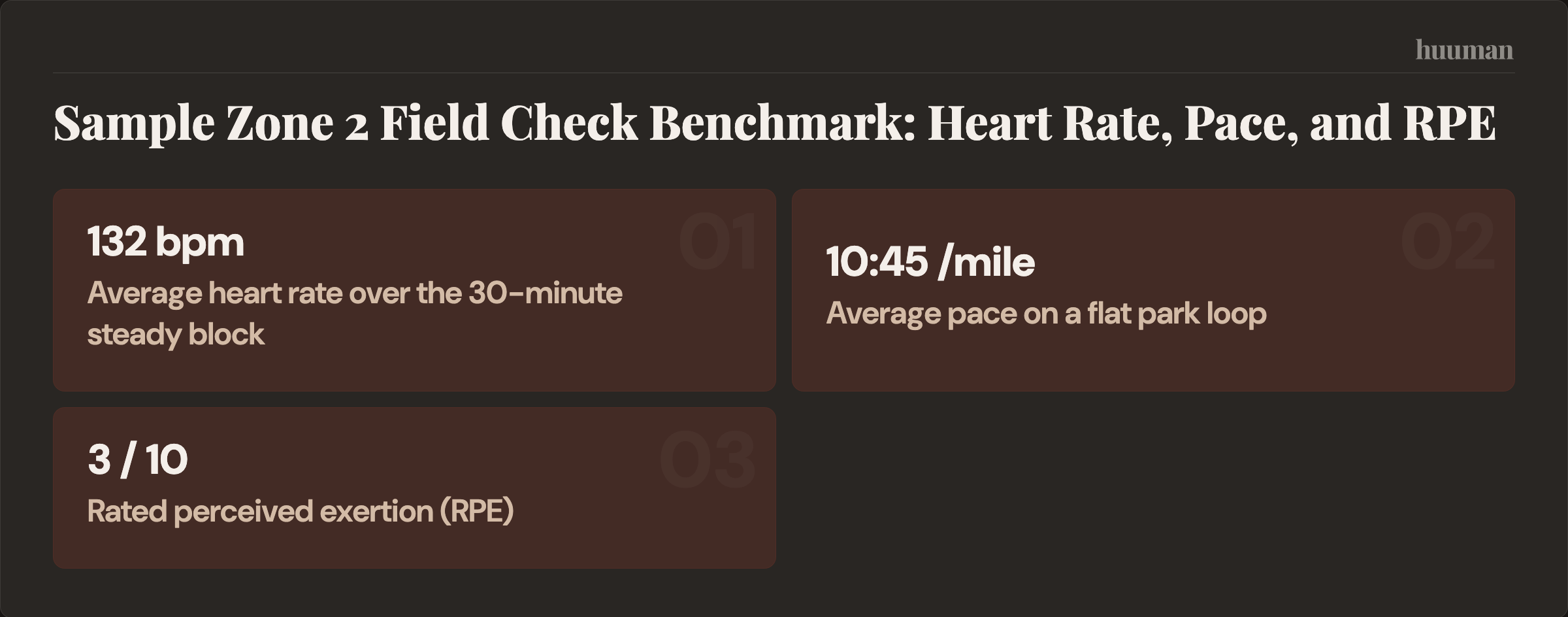
Use one filled example as your model: 10-minute warm-up, 30-minute steady Zone 2 on a flat park loop, average heart rate 132 bpm, average pace 10:45 per mile, RPE 3 out of 10, cool weather, slight wind, mild drift in the final 10 minutes. The next time, compare against that context, not against someone else’s screenshot.
The broader value is seeing how heart, recovery, and metabolism interact. Waist measures, blood markers, and glucose-related metrics tell a different part of the story than running pace. If you track those areas, the guides on our waist and hip circumference calculator, the triglyceride to HDL ratio, our HbA1c to blood sugar calculator, and the Dr. Boz ratio explain context beyond endurance training. Some people also explore methods such as intermittent hypoxia, but those should not replace the basics of consistent training.
For a plan that adjusts around your real schedule, your huuman Coach can adapt weekly cardio and strength plans based on recovery signals, preferences, availability, and the training data you are already collecting.
Why your Zone 2 pace is slower today

- Heat: heart rate rises sooner and drift increases. Choose shade, reduce speed, or move the session indoors.
- Hills: pace becomes misleading because the energy cost changes. Walk or shorten your stride uphill and judge by effort.
- Poor sleep: easy pace may feel less easy. Keep the session conversational and avoid turning it into a test.
- Stress: elevated arousal can raise heart rate before you start. Extend the warm-up and compare RPE with heart rate.
- Dehydration: drift may appear earlier. Slow down, cool down, and review fluid patterns around training.
- Device error: wrist sensors can lock onto cadence or misread motion. Tighten the watch or confirm with a chest strap.
- Low running economy: extra tension or overstriding can increase cost. Relax posture and use flatter terrain for benchmarks.
- Accumulated load: strength work or hard intervals can make easy running slower. Separate benchmark days from heavy training when possible.
Decision tree for adjusting pace
- If heart rate is high but breathing is easy: give it time after the warm-up, check the sensor fit, and avoid overreacting to the first few minutes.
- If heart rate is high and talking is broken: slow down to a more comfortable pace, and consider walking briefly or moving to flatter terrain.
- If pace feels embarrassingly slow: try run-walk and measure consistency over several weeks, not pride.
- If heart rate drifts late: improve cooling, and consider reducing speed slightly or shortening the steady block.
- If every easy session feels hard: review sleep and training load, consider whether illness might be a factor, and seek professional input if it persists.
Signal vs noise
- Signal: you can speak in full sentences at steady effort. Use that as your first confirmation before chasing exact bpm.
- Noise: heart rate spikes in the first few minutes. Give the warm-up time before changing the session.
- Signal: your pace improves at the same average heart rate over several weeks. Compare controlled benchmarks, not random runs.
- Noise: comparing your Zone 2 pace to another runner’s. Use your own field checks as the reference point.
- Signal: similar conditions produce similar readings. Repeat on the same route or treadmill setup when testing.
- Noise: believing one age-based HRmax formula is precise. Treat it as a starting estimate and validate with feel.
- Signal: a chest strap confirms suspicious wrist readings. Upgrade measurement only when the data changes decisions.
- Noise: forcing Zone 2 pace on steep hills. Adjust speed or walk so the intensity stays easy.
Common questions
How do I find my Zone 2 pace without a lab test?
Estimate a heart-rate range, warm up for 10 to 15 minutes, then run or run-walk for 30 minutes at a conversational effort. Your Zone 2 pace is the pace that keeps heart rate, talk test, and RPE aligned during the steady portion.
Is Zone 2 pace the same as easy run pace?
Often, but not always. Some runners do easy runs too hard, especially when they follow pace instead of effort. A true Zone 2 run should feel controlled, repeatable, and conversational.
Why is my Zone 2 pace so slow that I have to walk?
Because your current aerobic capacity, running economy, terrain, heat, or fatigue may push heart rate up quickly during continuous running. Walking breaks are a valid way to keep the session in the intended intensity range.
What is Zone 2 pace on a treadmill?
It is the treadmill speed that keeps you in easy steady effort after a warm-up. Start slower than expected, adjust gradually, and treat incline as an added load rather than a mandatory conversion to outdoor running.
How long should I be able to hold Zone 2?
Zone 2 should feel sustainable. For validation, a 30 to 60 minute steady effort is commonly used because it reveals whether the pace is truly easy and whether heart rate drifts upward. Your appropriate duration depends on training history and health status.
Should I use heart rate, pace, or RPE?
Use all three, but give them different jobs. Heart rate estimates intensity, pace tracks your speed on the day, and RPE plus the talk test keep you honest when devices or conditions distort the numbers.
Why does my heart rate drift upward during an easy run?
Heart rate can rise during steady exercise because of heat, dehydration, fatigue, and normal cardiovascular drift. If the goal is Zone 2, slow slightly, improve cooling, or shorten the bout instead of forcing the original pace.
Your Zone 2 pace is useful only when it helps you make better training decisions. Estimate it, validate it, control the conditions, and watch the trend. The number matters less than the repeatable relationship between pace, heart rate, and easy effort.
About this article · Written by the huuman Team. Our content is based on peer-reviewed research and clinical guidelines. We follow editorial standards grounded in scientific evidence.
This article is for educational purposes only and does not constitute medical advice. Health and training decisions should be discussed with qualified professionals.
More health topics to explore
- Heart & Cardio – Overview
- Intermittent Hypoxia: Benefits, Risks, and a Conservative Protocol
- VO2max: what it means, what counts as a good value, and how to interpret it properly
- Understanding HRV: Charts, Normal Ranges, and What “Good” Really Means