Lower body training is planned strength work for your legs and hips across squat, hinge, lunge, bridge, carry, and calf-raise patterns. The goal is not just a harder “leg day.” It is a stronger lower body that can produce force, absorb load, keep joints resilient, and support the way you want to move for decades.
Key takeaways
1. Train the main patterns: squat, hinge, lunge or split squat, hip thrust or bridge, calf raise, and carry.
2. Use 2 to 4 hard sets per exercise: enough to practice and challenge the target muscles without turning every session into a recovery debt.
3. Keep most sets around RPE 7 to 9: hard, but usually with 1 to 3 reps in reserve.
Most people do not need a complicated split to make progress. They need a short list of repeatable exercises, enough hard work to create adaptation, and clear rules for when to add load, hold steady, or back off. That matters even more if you train around work stress, running, limited equipment, knee history, or low-back sensitivity.
This guide gives you a practical lower body training structure for the gym or home: how to choose exercises, how many sets and reps to use, how to progress without chasing fatigue, and how to read your readiness signals before they become a setback.
Where lower body training fits in long-term performance
Strong legs and hips are a foundation for strength, mobility, gait, sport, and daily capacity. Squats, hinges, lunges, hip thrusts, calf raises, and carries load the muscles and tissues that help you stand up, climb, accelerate, decelerate, and stay confident under weight. That is why lower body work sits naturally inside a broader build strength and mobility strategy.
The main muscles are straightforward, but their roles overlap. The quadriceps extend the knee and contribute heavily to squat and step-up patterns. The glute max drives hip extension in hinges, bridges, hip thrusts, and sprint-like actions. The glute med helps control pelvis position and knee tracking, especially in single-leg work. Hamstrings extend the hip and flex the knee, which is why both Romanian deadlifts and leg curls can earn a place. Adductors stabilize and produce force in wide-stance or single-leg positions. Calves, including the gastrocnemius and soleus, support ankle stiffness, push-off, and lower-leg durability. Spinal erectors help maintain torso position under load.
Lower body sessions also create more systemic fatigue for many people than upper body work. Heavy squats, deadlifts, leg presses, and lunges can challenge breathing, bracing, grip, coordination, and tissue tolerance at the same time. Recovery, sleep, energy availability, and stress are not side issues. They directly affect the quality of the next session.
Conditioning belongs in the picture, but it should not constantly compete with strength. If you run, ride, row, or use mixed cardio, place hard endurance work with some respect for heavy lower body days. For a conditioning complement that does not require impact, rowing machine workouts can be useful, but they still load the legs and back enough to count as stress.
Quick answer
For most healthy adults, a commonly used lower body training structure is 2 sessions per week. Each session uses 4 to 6 exercises: one squat pattern, one hinge pattern, one single-leg pattern, and 1 to 2 accessories such as a hip thrust, leg curl, calf raise, adductor drill, or carry. This is not a medical prescription or a guarantee. It is a practical starting point that many people can recover from and repeat.

- Train the main patterns: squat, hinge, lunge or split squat, hip thrust or bridge, calf raise, and carry.
- Use 2 to 4 hard sets per exercise: enough to practice and challenge the target muscles without turning every session into a recovery debt.
- Keep most sets around RPE 7 to 9: hard, but usually with 1 to 3 reps in reserve.
- Progress one variable at a time: add reps first, then load, then sets when recovery is clearly strong.
- Use swaps by pattern: if a back squat does not fit your body or equipment, a goblet squat, front squat, hack squat, or leg press can still train the squat pattern.
- Let readiness shape the day: sleep, soreness, resting heart rate trend, HRV trend, and recent performance all help decide whether to push, maintain, or reduce.
Once you choose a two-week version below, log lower-body sessions with RPE in the huuman app so the first decision is based on reps, load, and recovery rather than memory or soreness alone.
What lower body training actually includes
Lower body training is planned strength work for legs and hips across squat, hinge, lunge, and related patterns. The pattern matters more than the famous exercise name. A back squat, goblet squat, hack squat, and leg press are different tools, but they all emphasize knee and hip extension with a squat-like shape. A deadlift, Romanian deadlift, trap-bar deadlift, and cable pull-through all train hip extension through a hinge pattern.
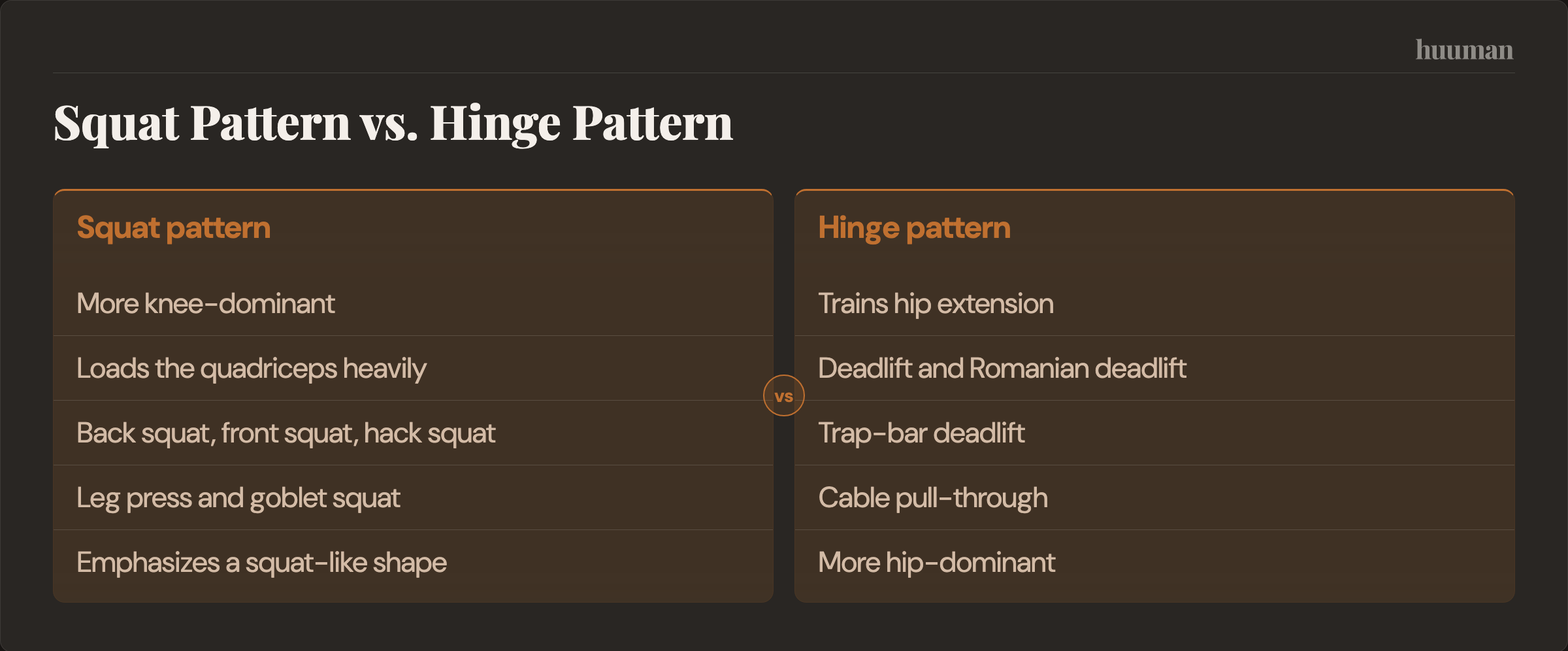
The squat pattern is more knee-dominant. It usually loads the quadriceps heavily while still involving glutes, adductors, trunk bracing, and ankle mobility. The hinge pattern is more hip-dominant. It asks you to push the hips back, maintain a stable torso, and load the glutes, hamstrings, spinal erectors, and upper back. A good lower body plan usually includes both because they train different force angles and tissue demands.
Single-leg work is not just “extra.” Split squats, Bulgarian split squats, step-ups, and reverse lunges expose side-to-side differences and train pelvic control. They often use less external load than bilateral lifts, but they can create a strong training effect because stability and range of motion are more demanding.
Hip thrusts and bridges bias hip extension with less spinal loading than many hinge variations. Knee-flexion work such as leg curls or hamstring slider curls trains the hamstrings in a way that hinges do not fully cover. Calf raises train the lower leg through standing and seated variations, which can emphasize the gastrocnemius and soleus differently. Carries connect lower body force to grip, trunk bracing, and gait.
Pick your anchors: a practical exercise matrix
Use this matrix as a copyable exercise menu. Choose one option from each essential category, then add accessories only if they solve a clear problem. The aim is not variety for its own sake. The aim is measurable repetition with enough swaps to fit your body, equipment, and recovery.
- Squat anchor:
- Gym options: back squat, front squat, hack squat, leg press.
- Home options: goblet squat, dumbbell front squat, heel-elevated squat, box squat to a stable surface.
- Use when: you want quads, glutes, adductors, trunk bracing, and knee-dominant strength.
- Hinge anchor:
- Gym options: Romanian deadlift, trap-bar deadlift, conventional deadlift, cable pull-through, good morning for advanced lifters with strong technical control.
- Home options: dumbbell Romanian deadlift, single-leg Romanian deadlift with support, banded hinge, hip hinge patterning drill.
- Use when: you want glutes, hamstrings, spinal erectors, lats, and posterior-chain strength.
- Single-leg stabilizer:
- Gym options: split squat, Bulgarian split squat, step-up, reverse lunge, sled push if available.
- Home options: bodyweight split squat, rear-foot-elevated split squat, stair step-up, reverse lunge.
- Use when: you want knee tracking, hip control, balance, and side-to-side feedback.
- Accessory options:
- Hip thrust or bridge: barbell hip thrust, dumbbell hip thrust, glute bridge, cable pull-through.
- Knee flexion: lying or seated leg curl, stability-ball curl, hamstring slider curl.
- Calves: standing calf raise, seated calf raise, single-leg calf raise.
- Adductors and abductors: machine, cable, side plank variation, Copenhagen-style progressions only if appropriate to your level.
- Carry: farmer carry, suitcase carry, front rack carry, loaded march.
If you train mostly at home, the same pattern logic applies. A progressive home plan can work with dumbbells, kettlebells, bands, sliders, stairs, and tempo. For more home-specific options, especially if a squat rack is not available, see strength training at home for women. If you are newer to resistance training, strength training for beginners explains the broader starting point without assuming gym experience.
Exercise swaps for knee-sensitive and back-sensitive lifters
Pain is not a badge of effort. It is information. This section is not rehab advice and cannot diagnose your situation, but it can help you avoid the common mistake of abandoning the whole pattern when only one version of the pattern is a poor fit.
- If squats bother your knees: try a box squat, goblet squat, leg press with controlled range, step-up to a lower height, or split squat with a stance long enough to keep pressure through the full front foot. Reduce depth temporarily if symptoms appear only at the bottom range, then rebuild range slowly if tolerated.
- If lunges bother your knees: try reverse lunges instead of forward lunges, split squats instead of walking lunges, or step-ups where you can control height and descent. Watch knee tracking rather than forcing the knee into an artificial line.
- If hinges bother your back: use trap-bar deadlifts, dumbbell Romanian deadlifts with a shorter range, hip thrusts, cable pull-throughs, or machine options. Keep the load close, brace before the rep, and stop the set when spinal position changes.
- If ankle dorsiflexion is limited: use heel elevation, goblet squats, front-loaded squats, split squats, or leg press setups that allow a controlled path. Mobility work can help, but exercise selection should not wait for perfect ankles.
- If time is limited: keep one squat, one hinge, one single-leg move, and one accessory. A shorter plan done consistently beats a perfect plan skipped twice a week.
Mobility standards are useful only when they improve decisions. If depth, ankle motion, or hip position is limiting your choices, expert standards for mobility can help you separate a true movement limitation from a programming issue.
Programming basics that actually move results
RPE means rating of perceived exertion, or how hard a set feels. RIR means reps in reserve, or how many good reps you believe you had left before form broke down. An RPE 8 set usually means you had about 2 good reps left. These are estimates, not laboratory measurements, but they are useful because they connect load to daily readiness.
Progressive overload means gradually increasing challenge through load, reps, sets, range of motion, tempo, or exercise difficulty. It does not mean adding weight every session forever.
Training volume is how much hard work you do. In practice, sets taken closer to failure produce more muscle growth per set than sets stopped well short of it. Very easy warm-up sets are useful, but they are not the same as challenging work sets. Your personal volume landmarks are the levels where you can recover, progress, and maintain joint quality. They change with sleep, stress, nutrition, age, sport load, and training.
Many lower body programs use moderate rep ranges for the main lifts and slightly higher reps for accessories. Heavy low-rep work is more specific to maximal strength. Moderate and higher-rep work can support muscle growth when the set is challenging enough. Treat those as common programming conventions from strength training practice rather than precise rules.
Rest periods should protect set quality. If you rush heavy squats or Romanian deadlifts, the next set may be limited by breathing or bracing rather than the target muscles. Accessories can usually tolerate shorter rest because the skill and systemic demand are lower. A simple rule: begin the next set when you can brace, control the first rep, and reproduce the intended range of motion.
Tempo is a tool, not a virtue signal. A controlled lowering phase can improve position, reduce bouncing, and make lighter loads more useful. Excessively slow reps can limit load so much that the session becomes conditioning rather than strength. Use tempo when it fixes a problem, not because every rep must look dramatic.
Deloads are planned reductions in training stress. They can be useful when performance stalls, joints feel irritated, motivation drops, or readiness signals are off for several sessions. For deeper context, compare bodybuilding deload, how a deload week works, and deloading in weightlifting. The common thread is not laziness. It is keeping adaptation ahead of accumulated fatigue.
Technique standards that keep the plan honest
Good technique is not one universal shape. Femur length, hip structure, ankle mobility, torso length, and training goal all change what a strong rep looks like. Standards should focus on control, intent, and repeatability rather than forcing every person into the same stance.
- Squat cues: keep a tripod foot with pressure through the heel, big toe, and little toe. Let the knees track in the same general direction as the toes. Brace the torso before descent. Use a depth that fits your anatomy, goals, and current control.
- Hinge cues: keep the spine neutral enough that the pelvis and ribcage move together. Push the hips back. Keep the lats tight. Keep the bar, dumbbells, or kettlebells close instead of letting the load drift forward.
- Split squat and lunge cues: use a stance long enough to feel stable. Keep the pelvis controlled instead of twisting or hiking one side. Maintain pressure through the front foot and avoid collapsing into the inside edge.
- Trunk bracing cues: brace as if preparing to receive contact around the midsection, then keep breathing controlled. Bracing is not the same as sucking the stomach in. If you want broader context on trunk training and aesthetics, sixpack women covers the difference between visible abs and useful core function.
Stop a set when pain changes the movement, when range of motion collapses, when you cannot brace, or when the target exercise becomes a different exercise. A hard set should look like a stronger version of the first rep, not a negotiation with gravity.
Three lower body training structures you can run for two weeks
These are commonly used program structures, not individualized prescriptions. Pick the version that matches your schedule and current recovery, run it for two weeks, track six sessions if you are using the three-day version or four sessions if you are using the two-day versions, then adjust based on the log rather than impulse.
Plan A: Minimal effective dose, 2 days per week, 35 to 45 minutes
- Day 1: goblet squat or leg press, Romanian deadlift, split squat, calf raise or hamstring curl, optional suitcase carry.
- Day 2: front squat or box squat, hip thrust or bridge, step-up or reverse lunge, hamstring slider curl or leg curl, optional farmer carry.
- Effort: most work sets at RPE 7 to 8, with 2 to 3 reps in reserve.
- Best for: busy professionals, beginners returning to training, or runners who need strength without excessive soreness.
Plan B: Standard lower body builder, 2 days per week plus optional micro-session
- Day 1: squat anchor, hinge accessory, single-leg move, calf raise, carry.
- Day 2: hinge anchor, squat accessory, single-leg move, knee-flexion hamstring work, hip thrust or bridge.
- Optional micro-session: light calves, mobility, easy sled, carries, or technique practice that does not create heavy soreness.
- Effort: anchors at RPE 7 to 9, accessories mostly controlled and repeatable.
- Best for: someone who wants strength and muscle without building life around the gym.
Plan C: Advanced strength and hypertrophy, 3 days per week
- Day 1: heavier squat pattern, moderate hinge, single-leg control, calves.
- Day 2: heavier hinge pattern, hip thrust or bridge, hamstring curl, carry.
- Day 3: moderate squat or leg press, unilateral work, adductors or abductors, calves, trunk bracing.
- Effort: some hard sets may approach RPE 9, but frequent failure is not required and may increase fatigue cost.
- Best for: intermediate lifters who already recover well and can keep technique consistent under load.
If you use barbells, treat them as tools, not identity markers. A barbell workout can be efficient because load is easy to progress, but machines, dumbbells, kettlebells, cables, and bodyweight variations can still train the same patterns.
Warm-up, ramp sets, and deload logic
A useful warm-up prepares the first hard set without stealing time or energy. Many programs use a short general warm-up, a few ramp sets for the first main lift, and one targeted drill if a specific joint needs attention. Lower body warm-ups often benefit from ankle, hip, and trunk preparation. The principle is similar to a good chest warmup: raise temperature, rehearse the pattern, then increase load gradually.
Ramp sets are not random. If your first main lift is a squat, start with an easy version of the same movement, then gradually increase load while keeping reps low enough that you do not fatigue before the work sets. The first hard set should feel familiar, not shocking.
Deload decisions should come from a pattern, not a bad mood. Consider reducing training stress when performance drops across several sessions, soreness no longer resolves normally, sleep is consistently poor, motivation is unusually low, or joints feel more irritated than muscles. A deload can mean fewer sets, lighter loads, easier variations, shorter range temporarily, or technique-only sessions. The point is to regain quality.
Evidence and limits
Resistance training is broadly supported in exercise science as a way to improve strength, muscle function, and physical capacity. The most practical conclusions are also the least glamorous: consistency matters, challenging sets matter, progressive overload matters, and recovery determines whether the stress becomes adaptation.
Although some claims reference individual studies, specific numeric recommendations should be interpreted as common strength training conventions rather than clinical prescriptions. Two lower body sessions per week, 2 to 4 hard sets per exercise, and most work at roughly 1 to 3 reps in reserve are practical starting points, not universal laws. A trained lifter, a beginner, an endurance athlete, and someone returning after surgery may need very different volumes and progressions.
The evidence and coaching literature generally support a wide range of rep schemes when effort is sufficient, but the trade-offs differ. Lower reps with heavier loads are more specific to maximal strength and require more technical consistency. Moderate reps often balance load, skill, and muscle stimulus. Higher reps can build muscle and tolerance but may create more burning discomfort and local fatigue. None is automatically superior outside the context of the person using it.
Machines versus free weights is another false binary. Free weights demand more balance, bracing, and path control. Machines can make it easier to load a target pattern without as much skill or spinal demand. For long-term training, the better tool is often the one that lets you train the intended tissue hard, recover well, and progress without recurring irritation.
Training to failure is also context-dependent. Occasional near-failure sets can teach effort and help accessories work. Taking heavy squats, deadlifts, or good mornings to technical failure tends to bring higher neuromuscular fatigue and session RPE. Leaving 1 to 3 reps in reserve for most lower body work is a conservative way to build capacity while preserving next-session quality.
Non-prescriptive strategies to discuss with a professional
If you have a history of knee pain, low-back sensitivity, pregnancy or postpartum considerations, known osteoporosis, uncontrolled hypertension, recent surgery, or a complex medical history, discuss heavy lower body training with a qualified clinician or coach. The goal is not to avoid loading forever. The goal is to choose the right entry point and progression.
Red flags deserve prompt professional attention: acute swelling after injury, inability to bear weight, severe night pain, numbness, tingling, radiating pain, sudden loss of strength, chest pain, or dizziness during exertion. Those are not programming puzzles to solve with a new split.
Beginners returning to training usually need fewer hard sets, more technical practice, and less novelty. Busy professionals often need a minimal effective dose with a limited exercise menu. Intermediate lifters plateaued on lower body work may need clearer progression, better weak-link exercise selection, and planned deloads. Endurance athletes adding strength should manage interference by placing hard lower body sessions away from key runs or rides when possible.
Older adults can often benefit from strength training, but the entry point should match balance, bone health, confidence, and medical context. For a broader age-specific discussion, see strength training for older adults.
How to track and interpret changes
Tracking turns lower body training from guesswork into feedback. A useful log does not need to be complicated, but it should capture the variables that explain progress and fatigue.

- Session fields: exercise, sets, reps, load, RPE or RIR, rest time, range of motion notes, pain or discomfort notes, and any technique cue that mattered.
- Weekly review: top set performance, total hard sets by pattern, single-leg stability, soreness, sleep duration and quality, resting heart rate trend, HRV trend over the last 3 to 7 days, and whether performance is rising, flat, or falling.
- Example log row: front squat, 3 sets of 6 reps, 70 kg, RPE 8, full controlled depth, 2 to 3 minutes rest, knees tracked well, mild quad soreness next day.
A good two-week review asks better questions than “Was it hard?” Did you add one rep at the same load without form breakdown? Did depth or control improve? Did soreness stay mild to moderate? Did your single-leg work feel more stable? Did sleep or stress explain a poor session? These answers tell you whether to add reps, add load, hold steady, reduce a set, or deload.
Use this traffic-light check before lower body sessions:
- Green: sleep is normal for you, soreness is manageable, resting heart rate and HRV are near your recent baseline, motivation is acceptable, and recent performance is stable. Train as planned.
- Yellow: one major signal is off, such as poor sleep, unusual soreness, elevated resting heart rate compared with your baseline, suppressed HRV compared with your recent trend, or low motivation. Keep the same load, reduce one set, or stop farther from failure.
- Red: multiple signals are off, performance has dropped, or pain changes your movement. Use technique-only work, choose easier variations, or skip the session and reassess.
HRV is a decision-support tool, not an oracle. A single bad number should not control your training day, but a 3 to 7 day trend that matches poor sleep, heavy soreness, and falling performance deserves attention.
If your logs show inconsistent readiness or stalled progress, your huuman Coach can adapt weekly strength and cardio planning around sleep, recovery, equipment, preferences, and the time you actually have.
Signal vs noise in lower body training
- Signal: you can add one rep or a small load most weeks without form breakdown. Keep the exercise and progress the same variable until the trend slows.
- Signal: soreness is mild to moderate and performance remains stable. Stay with the plan instead of adding more exercises just because you recovered well once.
- Signal: single-leg stability improves and knee tracking feels controlled. Increase range, load, or difficulty gradually rather than jumping to a harder variation immediately.
- Noise: copying influencer rep schemes without matching load, recovery, equipment, or training age. Translate the idea into your current pattern menu before using it.
- Noise: chasing sweat or burn as proof of effectiveness. Judge the session by progressive work, quality reps, and recovery cost.
- Noise: changing exercises every week because the session feels stale. Keep anchors stable long enough to measure progress, then rotate when a clear reason appears.
- Noise: using heart rate alone to gauge lifting intensity. Add RPE, load, reps, rest, and technique notes so the signal reflects strength work.
- Noise: assuming pain is normal and must be pushed through. Modify the pattern, reduce load or range, and seek professional input when symptoms are sharp, persistent, or neurological.
Common questions
What exercise is best for the lower body?
No single exercise is best for everyone. The better question is which squat, hinge, and single-leg variations you can perform with control, progress over time, and recover from. A back squat may be excellent for one lifter and a poor fit for another. A leg press, goblet squat, trap-bar deadlift, split squat, or hip thrust can be just as useful when it matches the goal and constraints.
Is four exercises enough for leg day?
Yes, four exercises can be enough if they cover the main patterns and are trained with intent. A squat pattern, hinge pattern, single-leg pattern, and accessory can create a complete lower body session. Adding more exercises only helps if it improves the stimulus without exceeding your recovery or reducing the quality of the main work.
What is the 3-3-3 rule in the gym, and does it work?
The phrase is used in different ways online, but it often refers to simple structures such as 3 exercises, 3 sets, and 3 rounds or 3 workouts per week. It can work as a simplicity tool, but it is not a special physiological rule. If it helps you cover squat, hinge, and single-leg work consistently, it may be useful. If it forces poor exercise selection or too little recovery, adjust it.
What is the 6-12-25 workout method?
The 6-12-25 method usually combines three exercises for the same muscle group or pattern with descending loads and higher fatigue: 6 heavier reps, 12 moderate reps, and 25 lighter reps. It can create a strong pump and high local fatigue. It is better suited to experienced lifters and accessory work than to beginners learning squats or hinges, especially if joint control is still inconsistent.
How many days per week should I train lower body for strength?
Many people start with 2 lower body days per week because it gives enough practice while leaving recovery space. Three days can work for intermediate lifters if volume is distributed intelligently. One day can maintain momentum when life is crowded, but progress may be slower. The right frequency is the one that lets performance trend upward without accumulating unresolved fatigue.
Can I build strong legs at home without a squat rack?
Yes, within the limits of available load and progression. Goblet squats, split squats, step-ups, dumbbell Romanian deadlifts, hip thrusts, hamstring sliders, calf raises, tempo work, pauses, and loaded carries can all be effective. The main challenge is not exercise variety. It is creating enough progressive challenge as you get stronger.
How do I progress weights without getting injured or wrecked?
Use a conservative ladder: add reps first, then load, then sets only if recovery is strong. Keep most sets at 1 to 3 reps in reserve. Avoid changing exercises weekly. Watch for yellow and red readiness signals. If pain changes your movement or performance drops across sessions, reduce stress before forcing progression.
If you want the next block shaped by your actual pattern, the huuman Coach can interpret your recent training trends conversationally and help you turn four weeks of logs into clearer priorities.
Lower body training works best when it is simple enough to repeat and flexible enough to adapt. Choose the patterns, track the work, respect recovery, and let progress come from better decisions rather than harder suffering.
About this article · Written by the huuman Team. Our content is based on peer-reviewed research and clinical guidelines. We follow editorial standards grounded in scientific evidence.
This article is for educational purposes only and does not constitute medical advice. Health and training decisions should be discussed with qualified professionals.
More health topics to explore
- Strength, Muscle & Mobility – Overview
- Chest Day: A Shoulder-Friendly Chest Workout Guide
- Body Fat Percentage: Normal Ranges, Charts & How to Interpret (Women/Men)
- Beginner Strength Training: A Clear 8-Week Starter Plan (Home & Gym)
References
- Schoenfeld BJ et al. — Effects of Resistance Training Frequency on Measures of Muscle Hypertrophy: A... (2016)
- Stevens BM et al. — Muscle Activation Patterns of the Proximal Medial and Distal Biceps Femoris... (2022)
- Zourdos MC et al. — Novel Resistance Training-Specific Rating of Perceived Exertion Scale Measuri... (2016)
- Robinson ZP et al. — Exploring the Dose-Response Relationship Between Estimated Resistance Trainin... (2024)
- Campos GE et al. — Muscular adaptations in response to three different resistance-training... (2002)
- Schoenfeld BJ et al. — How many times per week should a muscle be trained to maximize muscle hypertr... (2019)
- Resistance training proximity-to-failure, neuromuscular fatigue, and adaptations to strength and hypertrophy (2025)