Workouts with a rowing machine look simple on paper, but the difference between "just rowing" and actually getting fitter comes down to structure and intensity. The indoor rower rewards good timing, consistent pacing, and restraint on easy days.
This guide gives you ready-to-use sessions, clear intensity cues, and weekly routines you can follow without guessing. You'll also see how to set effort using stroke rate, pace, and perceived effort when heart rate isn't telling the full story.
Key takeaways
1. Easy aerobic (Zone 2): conversational effort to build base and efficiency.
2. Intervals (short, hard): brief, repeatable efforts for power and VO₂-style stimulus.
3. Technique or strength-support: slower, controlled strokes that improve timing and mechanics.
Expect three things: a short menu of workouts that cover most needs, a way to choose the right intensity for each, and a simple weekly setup that fits into a busy life.
Where rowing fits in a performance plan
Rowing sits in the overlap between cardio and strength. It challenges your aerobic system while demanding coordinated work from the legs, trunk, and upper body. Rowing involves almost all muscles during the stroke and requires a large oxygen uptake. See Concept2 training guidance for practical technique context.
That dual nature makes rowing useful if you want to improve conditioning without stacking more impact on joints, or if you want one tool that builds work capacity and reinforces hip hinge and trunk stiffness. In broader planning, it complements a Heart & Cardio overview approach and can slot into rowing in a longevity training plan alongside strength work.
Quick answer
If you want effective workouts with a rowing machine, rotate three modes:
- Easy aerobic (Zone 2): conversational effort to build base and efficiency.
- Intervals (short, hard): brief, repeatable efforts for power and VO₂-style stimulus.
- Technique or strength-support: slower, controlled strokes that improve timing and mechanics.
Start with 2–4 sessions per week. Keep most of your time easy, and add one hard interval or threshold session when recovery is good. Use RPE (1–10), split pace (/500 m), watts, and stroke rate (SPM) to set effort. Heart rate is useful for steady rows, but it often lags during short intervals.
Once you find your steady Zone 2 pace and start building interval sessions, log your rowing splits and stroke rates with the huuman app to see which intensities feel sustainable week to week.
The three rowing workout modes (and why you need all three)
Easy aerobic (Zone 2) builds the base your harder sessions rely on. It improves efficiency so a given split pace feels easier over time. Many programs emphasize "most work easy, a little work hard" to keep fatigue manageable. In practice, that means your weekly mix is dominated by low-intensity time, with limited high-intensity sessions.
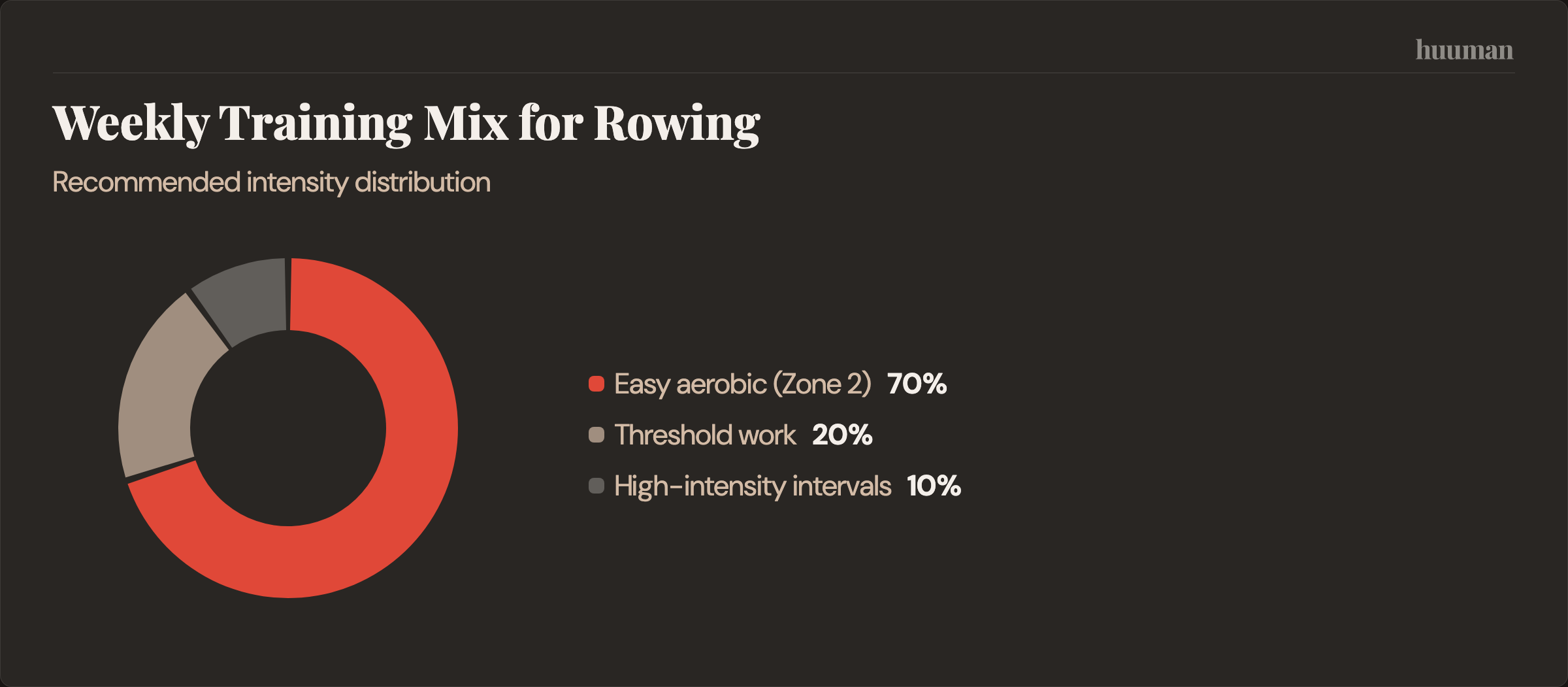
Threshold work sits in the middle. It feels "comfortably hard" and teaches you to hold a strong pace without burning out. This is where pacing discipline matters most.
Short intervals (HIIT) target the top end. They are time-efficient but costly. Doing them too often flattens progress because fatigue erodes technique and pacing.
The trap is turning every row into a moderate grind. You get tired, but you don't clearly develop any one system. Keep the days distinct.
How to set intensity on a rowing machine (without guessing)
Metrics that matter:
- Split pace (/500 m) or watts: primary output. Choose one and be consistent.
- Stroke rate (SPM): cadence. Helps you match the day's goal.
- Time or distance: sets structure. Time is simpler; distance is useful for repeatability.
Intensity anchors:
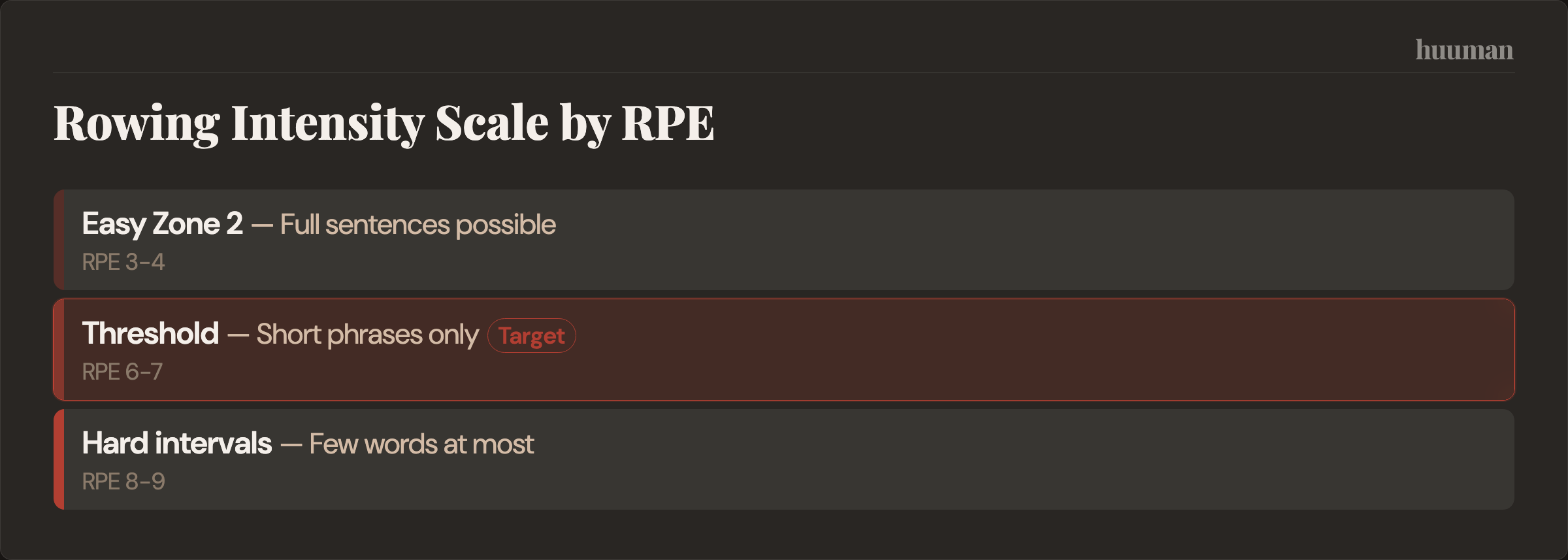
- RPE (1–10): reliable across fitness levels. Easy = 3–4, threshold = 6–7, hard intervals = 8–9.
- Talk test: full sentences for easy, short phrases for threshold, few words at most during intervals.
- Heart rate: helpful for steady work; for intervals it rises late, so don't chase it rep to rep.
Practical rule: define the purpose of today's session, then pick the metric that best reflects it. For Zone 2, HR + RPE works well. For intervals, use RPE + pace/watts and keep the first reps controlled so you can sustain quality.
Technique that keeps workouts effective (and your back happier)
Stroke sequence: legs → body → arms on the drive, then arms → body → legs on the recovery. This rhythm is your baseline.
Phases:
- Catch: shins near vertical, neutral spine, shoulders relaxed.
- Drive: push through the legs first, then open the hips, then pull with the arms.
- Finish: handle to lower ribs, elbows back, trunk tall.
- Recovery: arms away, body hinges forward, then knees bend.
Breathing and bracing: think ribcage stacked over pelvis, light abdominal brace, no collapse through the lower back. Breathe rhythmically with the stroke.
Damper vs drag factor: the damper lever changes how the machine feels, not your fitness. Higher is not automatically better. What matters is a consistent feel (drag factor) that lets you maintain timing without yanking the handle.
Common errors and quick fixes:
- Early arm bend: keep arms long until legs are almost done.
- Shooting the slide: don't let hips shoot back ahead of the shoulders; connect legs to trunk.
- Overreaching at the catch: avoid rounding; sit tall and hinge.
- Collapsing posture: maintain a neutral spine and light brace.
- Yanking the handle: build pressure through the legs; acceleration should feel smooth.
Workout menu: 9 sessions you can use immediately
Pick based on your goal and time. Keep the intensity cues consistent week to week.
- 1) 20-min Zone 2 · Duration: 30–35 min · Main set: 20 min continuous · Intensity cues: RPE 3–4, conversational, steady split · SPM: 18–22 · Best for: Busy days, base · Watch-outs: Drifting faster over time
- 2) 3 × 10 min Zone 2 · Duration: 35–40 min · Main set: 3 × 10 min, 2 min easy · Intensity cues: RPE 3–4, even pacing · SPM: 18–22 · Best for: Beginners · Watch-outs: Turning last block into threshold
- 3) 10 × 1:00 / 1:00 · Duration: 30–35 min · Main set: 10 reps, equal rest · Intensity cues: Hard reps RPE 8–9, repeatable splits · SPM: 26–34 · Best for: Time-efficient HIIT · Watch-outs: Going out too hard
- 4) 6 × 2:00 / 2:00 · Duration: 35–40 min · Main set: 6 reps, equal rest · Intensity cues: RPE 7–8, controlled · SPM: 24–30 · Best for: Bridge to threshold · Watch-outs: Technique breakdown late
- 5) 8 × 500 m · Duration: 40–45 min · Main set: 8 repeats, 2 min easy · Intensity cues: RPE 8, even or slight negative split · SPM: 26–32 · Best for: Advanced · Watch-outs: Chasing HR
- 6) 3 × 8 min threshold · Duration: 40–50 min · Main set: 3 × 8 min, 3 min easy · Intensity cues: RPE 6–7, short phrases · SPM: 22–28 · Best for: Sustainable speed · Watch-outs: Turning it into HIIT
- 7) 4 × 5 min threshold · Duration: 40–45 min · Main set: 4 × 5 min, 3 min easy · Intensity cues: RPE 6–7, steady splits · SPM: 22–28 · Best for: Pacing practice · Watch-outs: Split variability
- 8) Technique day · Duration: 30–40 min · Main set: Pick drill + easy row · Intensity cues: RPE 2–3, focus on rhythm · SPM: 16–20 · Best for: Skill building · Watch-outs: Rushing recovery
- 9) Strength-support row · Duration: 25–35 min · Main set: Low-rate power strokes in sets · Intensity cues: Firm drive, controlled return · SPM: 16–20 · Best for: Lifters · Watch-outs: Yanking with arms
For additional structure ideas, see British Rowing indoor plans. Lower stroke rates can help teach better technique that translates to higher rates.
Three weekly routines (choose your lane)
Minimal effective dose (2 days/week):
- Day 1: Zone 2 (20–30 min continuous or 3 × 10 min)
- Day 2: Intervals (10 × 1:00 / 1:00 or 6 × 2:00 / 2:00)
Standard (3 days/week):
- Day 1: Zone 2
- Day 2: Threshold (3 × 8 min)
- Day 3: Intervals (short)
Advanced (4–5 days/week): 2–3 easy rows, 1 threshold, 1 interval. Keep hard sessions capped at one, occasionally two if recovery is solid. Mix in a technique day.
Combining with strength: if you lift, keep hard rowing away from heavy hinge or pull days. A practical pairing is pairing rowing with dumbbell work on separate days or doing easy rowing after strength sessions.
Research evidence suggests that training intensity distribution matters when combining endurance and strength work, with structured approaches outperforming random intensity mixing.
Protocol cards (copy and use)
Zone 2 Base Builder (Aerobic)
- Goal: aerobic base and efficiency with low recovery cost.
- Structure (45 min): 8 min warm-up (easy + pick drill), 30 min continuous or 3 × 10 min (2 min easy), 5–7 min cool-down.
- Intensity: RPE 3–4, conversational; SPM ~18–22; pace you could hold for a long time.
- Weekly use: 1–3× depending on schedule.
- Readiness gates: stable HRV trend, resting HR not elevated, adequate sleep, low soreness.
HIIT Power Intervals (Short)
- Goal: high-end power and tolerance to hard efforts.
- Structure (30–35 min): 10 min warm-up with a few short bursts; 10 × 1:00 hard / 1:00 easy or 8 × 500 m; 5–8 min cool-down.
- Intensity: RPE 8–9 on hard reps; SPM ~26–34; prioritize repeatable splits.
- Weekly use: about 1×/week for most people.
- Readiness gates: no major sleep debt, low soreness, HRV and resting HR not suppressed.
Threshold "Comfortably Hard"
- Goal: improve sustainable pace.
- Structure (40–50 min): warm-up; 3 × 8 min with 3 min easy; optional 10-stroke technique bursts; cool-down.
- Intensity: RPE 6–7; SPM ~22–28; short phrases possible.
- Weekly use: 1×/week, alternating with HIIT if needed.
- Readiness gates: same as above; watch lower-back fatigue from lifting.
Technique micro-checklist (keep this near your machine)

- 5 cues: legs first; arms last; tall finish; smooth handle path; patient recovery.
- 5 mistakes: early arm bend; hips shooting back; overreach and round at the catch; collapsing trunk; jerky pulls.
- Simple fix loop: 10 strokes arms-only → 10 arms+body → 10 half-slide → full strokes. Repeat when form slips.
Evidence and limits
Rowing training is associated with improvements in cardiorespiratory fitness and overall work capacity. Polarized training may lead to greater improvements in endurance sport performance than threshold training alone. Research comparing interval and continuous methods generally shows both can improve aerobic capacity, with variability based on baseline fitness and adherence; short intervals are time-efficient but more fatiguing.
Heart rate zones are commonly used to guide steady work, but they are estimates and vary across individuals. During short intervals, heart rate frequently lags behind effort, which is why RPE and pace or watts are practical anchors.
The American Heart Association guidelines suggest moderate-intensity exercise corresponds to 50-70% of maximum heart rate, providing a widely-recognized framework for aerobic training zones.
Evidence suggests that Zone 2 training occurs at 63-76% of HRmax depending on intensity within the zone.
Limits matter. Rowing has a learning curve, and poor technique can stress the lower back or forearms. Grip fatigue can cap sessions before your aerobic system is challenged. Equipment differences mean split paces are not perfectly comparable across machines, especially if drag feels different.
Non-prescriptive strategies to discuss with a professional
If your goal is to how rowing helps increase VO2max, consider emphasizing consistency in Zone 2 with one weekly interval session rather than stacking multiple hard days. If you are returning from injury or have back sensitivity, prioritize technique sessions and low-rate work before adding intensity. For a simple add-on, use rowing-based HIIT for cardio sparingly on weeks where sleep and stress are favorable.
How to track and interpret changes
Log a few variables every session:
- Duration and total distance
- Average split pace or watts
- Stroke rate (SPM)
- RPE and a one-line note on technique
Weekly, look at trends rather than single sessions: resting heart rate, HRV (3–7 day trend), sleep, soreness, and motivation. For performance checks, pick one method and repeat it under similar conditions:
- 10-minute best sustainable effort (submax, even pacing)
- 2k test (advanced; avoid if new or if symptoms are present)
You can also calculate your VO2max and compare to VO2max benchmarks by age to contextualize changes over time. For recovery, simple trends like tracking heart rate after training can flag when to hold or deload.
Rather than guessing whether today calls for easy rowing or hard intervals, let your huuman Coach build weekly plans that adapt rowing intensity based on your sleep quality, soreness levels, and recent session data.
Signal vs noise in workouts with a rowing machine
- "Damper 10 is best." It only changes feel, not fitness. Pick a setting that lets you keep timing clean and repeat it.
- Heart rate stays low on intervals. That is normal due to lag. Use RPE and pace; review HR as a post-session trend.
- More HIIT equals faster progress. Often the opposite. Cap hard sessions; protect quality on easy days.
- Sweat equals fat loss. Sweat reflects heat and hydration. Focus on consistent training volume and diet quality.
- Technique will fix itself. It improves only if you practice it. Add a short drill block each week.
- All machines are comparable. Splits vary with drag and calibration. Track progress on the same machine when possible.
- Push to failure daily. Save maximal efforts for testing days. End sessions with repeatable quality.
- Pain equals progress. Sharp back pain or chest symptoms are stop signs. Switch to technique work or rest and check it.
Common questions
Is 20 minutes of rowing a day enough for fitness or longevity?
It can be a useful minimum if most of it is easy and you're consistent. Progress tends to be better when at least one session per week introduces a higher intensity stimulus and total weekly time gradually increases.
How long should I workout on a rowing machine as a beginner?
Start with 20–30 minutes including warm-up and cool-down, using short blocks like 3 × 5–8 minutes at easy effort. Build duration once you can keep technique stable.
What is a good rowing machine routine without overtraining?
Two to three sessions per week with one easy aerobic day and one harder session is a stable baseline. Add a third easy or technique day before adding more intensity.
What stroke rate should I use for Zone 2 versus intervals?
Zone 2 commonly sits around 18–22 SPM, emphasizing control. Intervals often rise to the high 20s or low 30s, depending on ability, while maintaining clean sequencing.
Should I row for time or meters?
Time is simpler and reduces pacing anxiety. Distance is useful for repeatability in intervals like 500 m reps. Pick one method for a block and stay consistent.
What exercises pair well with rowing for a balanced week?
Strength work that covers squats, hinges, presses, and pulls complements rowing. Keep heavy hinge days separate from hard intervals and use easy rows for recovery.
Why does my heart rate stay low during short rowing intervals?
Heart rate responds with a delay. Short repeats can finish before HR peaks, so use RPE and pace during the set and review HR afterward.
Use the huuman ROW idea as a quick audit: Rhythm (clean sequence), Output (pace that matches the goal), Workload (mostly easy, a little hard). If one is off, adjust the next session rather than forcing today's numbers.
More health topics to explore
- Heart & Cardio – Overview
- Understanding HRV: Charts, Normal Ranges, and What "Good" Really Means
- HIIT for Cardio: How to Do It Safely, Effectively, and Without Burning Out
- HIIT on an Elliptical: 3 Repeatable Workouts + How to Progress
References
- Concept2 — Training and Education
- Britishrowing — British Rowing Training Plans
- Laursen PB — Training for intense exercise performance: high-intensity or high-volume trainin (2010)
- Rosenblat et al. — Polarized vs. Threshold Training Intensity Distribution on Endurance Sport Performance (2019)
- Swain DP et al. — Target heart rates for the development of cardiorespiratory fitness (1994)
- American Heart Association — Target Heart Rates
- Varela-Sanz et al. — Does Concurrent Training Intensity Distribution Matter? (2017)
- Volianitis S et al. — The physiology of rowing with perspective on training and health (2020)
- Concept2 — Low Stroke Rates: Rowing Faster by Going Slower