Tabata training is appealing: minimal time, maximum intensity. That's exactly what makes it effective, and also easy to get wrong. Many "Tabata workouts" online are just short HIIT videos without clear structure. That difference determines whether you make progress or drift toward overload.
This isn't a random list of exercises. It's a clear framework for decision-making and execution: how the 20/10 protocol actually works, how to regulate intensity, which exercises fit, and how to integrate Tabata into your weekly routine without undermining recovery.
Key takeaways The American College of Sports Medicine recommends appropriate warm-up and cool-down periods for high-intensity training.
1. A solid Tabata workout includes: warm-up, 1–4 blocks, and a cool-down.
2. Warm-up: usually 5–10 minutes. Cool-down: about 3–8 minutes.
3. Intensity: guided primarily by RPE (8–9 out of 10) and a consistent pace, not just heart rate.
If you want to understand when Tabata makes sense, and when it doesn't, you're in the right place.
Where Tabata Fits in the Bigger Picture
Tabata sits within high-intensity interval training (HIIT) as a very strict format. It places a strong demand on your cardiovascular system while also challenging your anaerobic capacity. In practice, that mainly targets your "heart" system, cardiovascular performance, with additional effects on metabolism and clear implications for recovery.
As a complement to low-intensity sessions like Zone 2 training for recovery between Tabata days, Tabata can provide an efficient peak stimulus. But it's not a replacement for aerobic base training, and it shouldn't be the foundation of your program.
If you need the broader context, this overview of heart health and endurance shows how Tabata fits into a complete system.
Quick Answer
Tabata is a fixed interval protocol: 20 seconds of very high effort, 10 seconds of rest, repeated for 8 rounds (4 minutes total). It was originally studied at intensities near or above VO2max.
- A solid Tabata workout includes: warm-up, 1–4 blocks, and a cool-down.
- Warm-up: usually 5–10 minutes. Cool-down: about 3–8 minutes.
- Intensity: guided primarily by RPE (8–9 out of 10) and a consistent pace – not just heart rate.
- Exercises: technically stable and repeatable.
- Frequency: typically 1–2 sessions per week for recreational athletes.
The classic structure, "20 seconds work, 10 seconds rest, 8 rounds = 4 minutes", defines the Tabata protocol. Multiple sources describe this format consistently, including general overviews and training plans (AOK overview), (University of Münster training plan).
The best way to know if you're hitting that 8-9 RPE consistently is to log your Tabata intervals with pace and perceived effort through the huuman app after each session, so you can see if your output stays steady across all 8 rounds.
What Tabata Is – and What It Isn't
Tabata is not just any 20/10 workout. It's a specific subset of HIIT with a defined structure and a high intensity requirement. The original research used very demanding efforts, not moderate full-body circuits.
In practice, you'll see two versions:
- True Tabata: high intensity, measured through pace, power, or consistent output across all 8 intervals.
- "Tabata-style": same timing, but much lower intensity. Often useful – but physiologically a different stimulus.
Tabata is part of HIIT, but not all HIIT is Tabata. For broader programming, see this beginner HIIT workout plan.
Why 20/10 Feels So Demanding
Twenty seconds is too short to ease in, but long enough to rapidly stress your energy systems. The combination of short effort and minimal rest quickly drives up breathing rate, metabolic stress, and fatigue.
Key point: your technique usually breaks down before your conditioning does. Once movement quality drops, you're no longer training the intended system, and your risk goes up. That's where control matters: choose an intensity that lets you maintain good form across all 8 intervals.
Tabata vs. HIIT vs. Zone 2
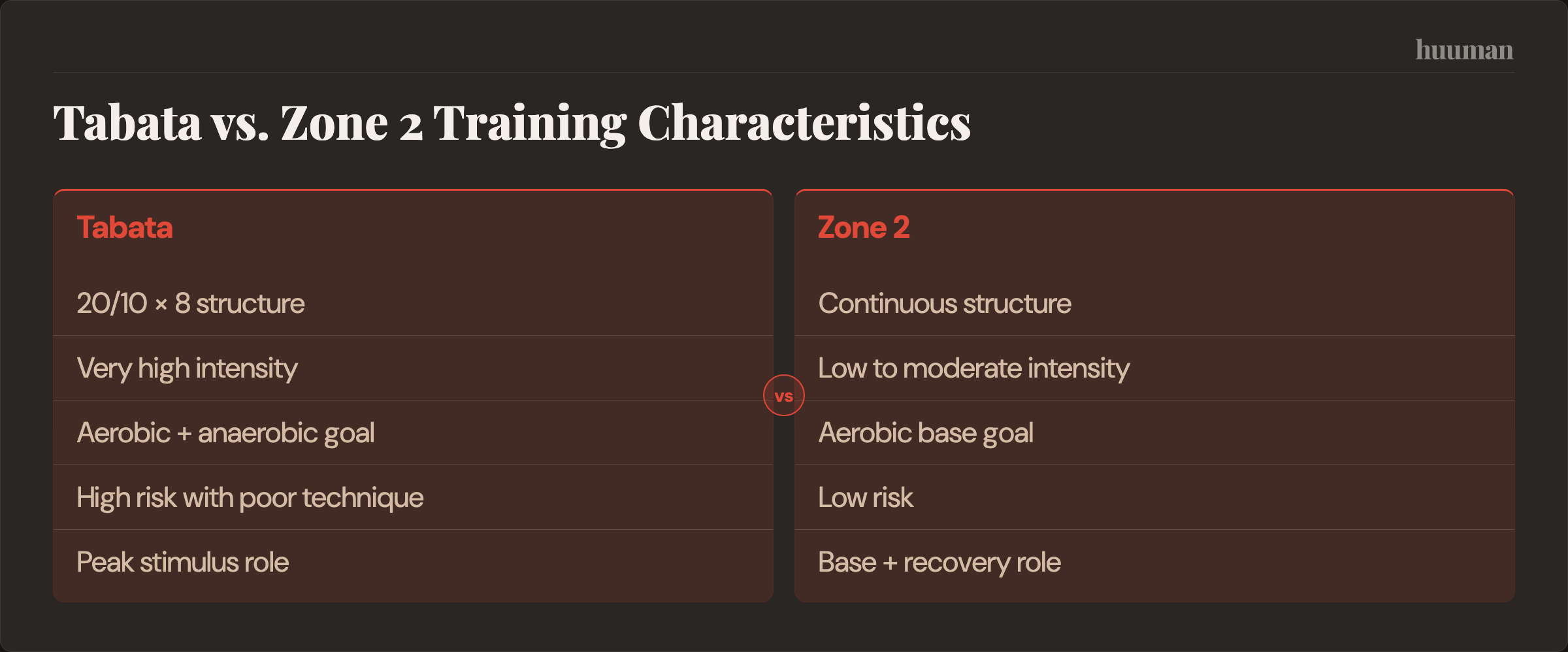
- Format: Tabata - Goal: Aerobic + anaerobic - Structure: 20/10 × 8 - Intensity: Very high - Risk: High with poor technique - Typical Role: Peak stimulus
- Format: HIIT - Goal: Cardiovascular - Structure: Flexible (e.g. 1:1) - Intensity: High exercise intensity loads - Risk: Medium - Typical Role: Structured intervals
- Format: Zone 2 - Goal: Aerobic base - Structure: Continuous - Intensity: Low to moderate - Risk: Low - Typical Role: Base + recovery
Tabata can improve both aerobic and anaerobic capacity, but it's best used selectively, not as your training foundation.
How to Control Intensity
RPE is your main tool. Aim for 8–9 out of 10 during work intervals: hard, but controlled.
Heart rate lags. In very short intervals, it rises after the effort, not instantly. That makes it less useful for real-time control, but helpful for tracking trends over time.
Pace or power works well. On a bike or rower, output is easy to track. The goal: only a moderate drop-off across all 8 intervals.
For practical examples, see Tabata on the air bike or Tabata intervals on the rowing machine.
Exercise Selection: Prioritize Safety Over Ego
Good Tabata exercises are technically stable, easy to scale, and allow consistent repetition.
- Type: Low-impact - Examples: Bike, rowing - Best for: Anyone new to exercise or easing back into a routine, people with joint pain
- Type: High-impact - Examples: Burpees, jump squats, mountain climbers - Best for: Advanced athletes with solid technique
If your knees or Achilles tendon are sensitive, cyclical machines are often a better choice. Alternatively, consider structured options like treadmill intervals as a Tabata-style alternative.
Practical Protocols
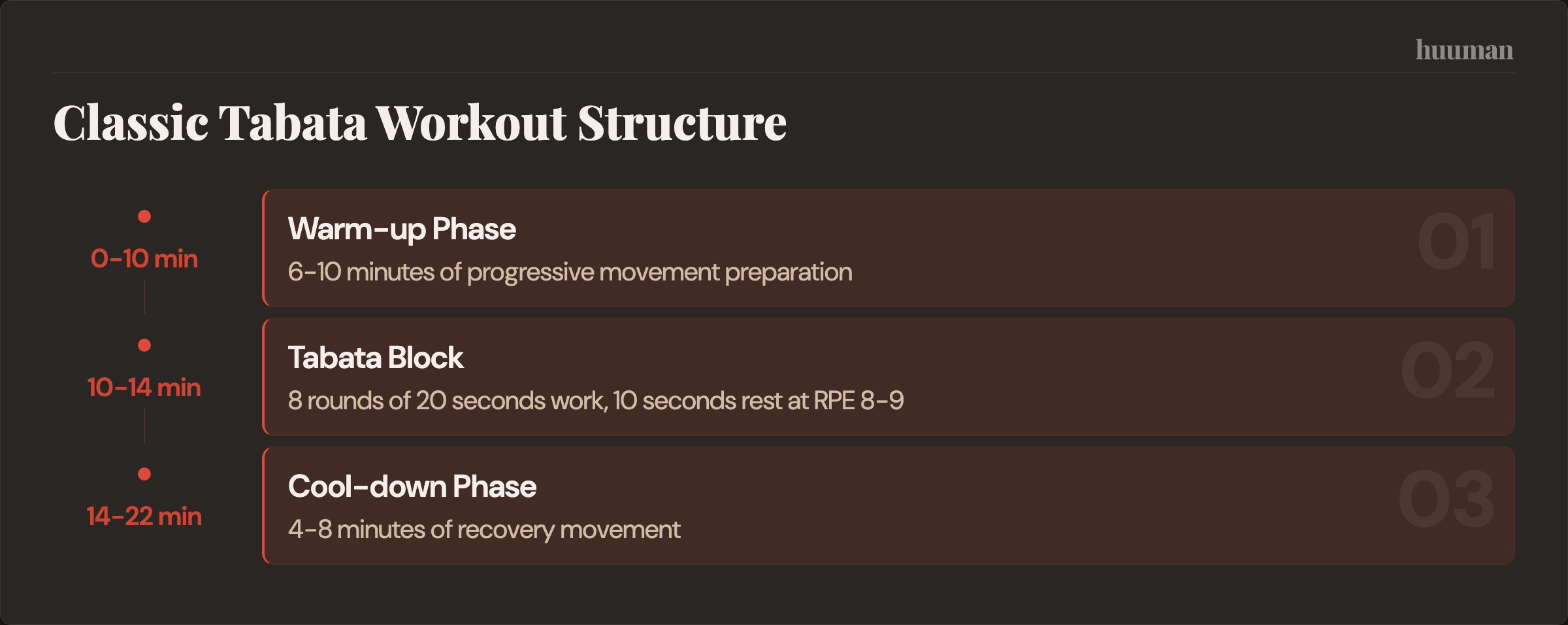
Classic: 1 Exercise, 1 Block
- Warm-up: 6–10 minutes
- 8 × 20/10
- Cool-down: 4–8 minutes
- RPE: 8–9
2–3 Blocks
- Warm-up: 8–12 minutes
- 2–3 blocks with 2–3 minutes rest between
- Different exercises per block
Tabata Light
- RPE: 7–8
- 2 blocks
- Progress by increasing volume before intensity
Evidence and Limitations
Tabata training was originally studied under very high-intensity conditions. Research suggests these protocols can improve both aerobic and anaerobic performance. At the same time, real-world application is limited, most people don't reach or sustain the same intensity or control.
Much of the popular content simplifies the method. Overviews and training plans show structure, but rarely explain how to execute it properly. In practice, how you train matters more than the format itself.
Claims about afterburn (EPOC) or fat loss are often overstated. The effect exists, but its real impact depends on your overall training and energy balance.
Strategies to Discuss with a Professional
A common approach for busy people: one short Tabata session per week plus two moderate endurance sessions. More advanced individuals may handle two Tabata sessions, if recovery stays solid.
Progression typically starts by adding more blocks, then increasing intensity. Doing Tabata right after heavy strength sessions or during periods of poor sleep often leads to lower quality.
As part of a broader system, Tabata can complement plans like HIIT for cardiovascular health or longer-term approaches such as using exercise to support longevity.
Tracking and Interpreting Progress
Trends matter more than individual sessions:
- Output per interval
- Performance drop across 8 rounds
- Perceived exertion
- Resting heart rate and HRV over multiple days
- Recovery and muscle status after 24–48 hours
As you improve, the drop-off decreases, or you sustain higher intensity at similar effort. For more, see improving VO2max with Tabata intervals.
Am I Ready for Tabata Today?
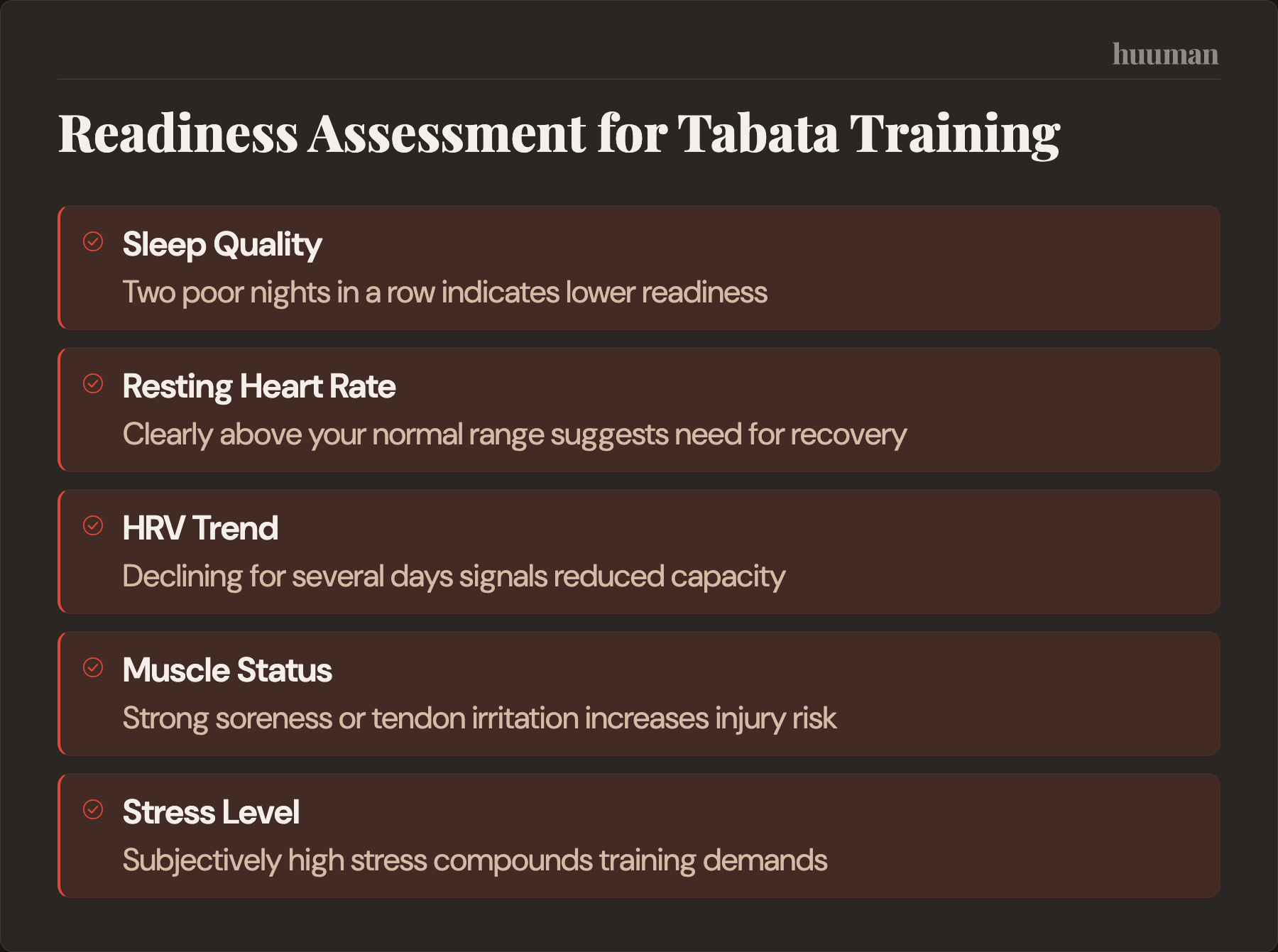
- Sleep: two poor nights in a row
- Resting heart rate: clearly above your normal range
- HRV trend: declining for several days
- Muscle status: strong soreness or tendon irritation
- Stress: subjectively high
If several apply, a moderate session is usually the better choice. For recovery, see also recovery after intense interval training.
Signal vs. Noise
- "4 minutes is always enough" ignores context – look at your overall training.
- "The more HIIT, the better" neglects recovery – reduce volume if performance drops.
- "Max heart rate every interval" isn't realistic – use RPE as your primary guide.
- "Burpees are mandatory" isn't true – choose technically stable exercises.
- "Tabata is ideal for beginners" only partly – start with reduced intensity.
- "Music replaces structure" is misleading – measure your intervals.
FAQs
Is Tabata really high-intensity training?
Yes, if done correctly. Many real-world versions are closer to moderate intervals in a Tabata format.
How many blocks are effective?
One to four blocks are typical. Quality matters more than duration.
What's harder: Tabata or traditional HIIT?
Tabata is often more intense per minute, but shorter. Traditional HIIT is more flexible.
Can Tabata help with fat loss?
It can be part of the system. Long-term energy balance remains the key factor.
Which exercises are safest?
Low-impact options like cycling or rowing are generally more stable and easier to scale.
How often per week?
Typically 1–2 sessions. More only if your recovery is consistently strong.
When should I stop?
If you experience chest pain, dizziness, shortness of breath, or illness. Stop training and get medical advice.
Rather than guessing whether you're ready for high-intensity work on any given day, your huuman Coach can build weekly plans that schedule Tabata sessions based on your sleep trends, resting heart rate, and recovery signals from previous sessions.
More health topics to explore
- Heart & Cardio – Overview
- Zwift Zone 2 Training: Dial In the Right Intensity, Build Duration, Track Progress
- Cardio Load: Meaning, Target Ranges, and How to Tell If Yours Is "Good"
- VO2max: what it means, what counts as a good value, and how to interpret it properly
References
- AOK — Tabata Hochintensives Training in Vier Minuten
- Milanović et al. — HIT vs Continuous Training for VO2max (2015)
- Batacan RB Jr et al. — Effects of high-intensity interval training on cardiometabolic health: a syst... (2017)
- Tabata I — Tabata training: one of the most energetically effective high-intensity inter... (2019)
- Tabata I et al. — Effects of moderate-intensity endurance and high-intensity intermittent train... (1996)
- Domaradzki J et al. — Effects of Tabata Training During Physical Education Classes on Body Composit... (2020)
- Unknown — American College of Sports Medicine Position Stand. The recommended quantity ... (1998)
- Atakan MM et al. — Six high-intensity interval training sessions over 5 weeks increase VO2max, endurance capacity, and sub-maximal exercise fat oxidation as much as 6 high-intensity interval training sessions over 2 weeks (2024)
- Baylor Scott & White Health — Low-Impact Exercises: Joint-Friendly Workouts to Try