Strokes per minute is your stroke rate: how many full stroke cycles you complete in 60 seconds. On a rowing machine, strokes per minute can be useful because it gives you a simple rhythm target, but it becomes misleading when you treat it as the same thing as effort, speed, or quality.
Key takeaways
1. If you are warming up or doing easy aerobic work, start lower and focus on rhythm, length, and relaxed recovery.
2. If you are doing steady moderate work, use a rate that lets pace rise without turning the stroke frantic.
3. If you are doing intervals, let rate climb only if power and form climb with it.
That is where most confusion starts. You can rate higher and still go slower if your stroke shortens, your sequence breaks down, or each stroke produces less power. You can also sit at a lower SPM and move the machine faster if the stroke stays long, connected, and well timed.
This guide gives you practical benchmarks for indoor rowing, explains how to choose an SPM by workout goal, and shows what to pair it with: pace or watts, RPE, heart rate trends, and a few technique checks. It also briefly clarifies how "stroke rate" differs in on-water rowing, SkiErg work, and swimming.
If you want better context for where rowing fits into cardiorespiratory training, the Heart & Cardio overview helps connect stroke rate choices to the bigger picture.
Why SPM matters in training
SPM is best understood as an intensity dial with limits. It helps you dose rhythm and metabolic demand, but it does not tell you whether the work is efficient. The useful question is not "What is the best stroke rate?" It is "At what stroke rate can I produce the right pace or power for this session, with technique that still looks repeatable and a recovery cost I can absorb?"
That matters for more than short-term performance. A higher stroke rate can increase cardiorespiratory stress on the Heart side, but it can also increase technical error and loading on the Frame side if you start rushing the slide, yanking with the arms, or losing hip control. It changes Metabolism because higher rates often make fuel cost rise faster. It affects Recovery because a session that looks fine on paper can leave you flat the next day if the autonomic load is higher than expected. It also challenges Mind, because staying relaxed and disciplined at a chosen rate is partly a pacing skill.
Evidence suggests that cardiorespiratory fitness assessment provides important clinical insights beyond traditional risk factors.
For longevity-minded athletes, SPM is useful because it helps you apply enough stress without guessing. For performance-focused athletes, it helps you separate "working hard" from "rowing well."
Quick answer
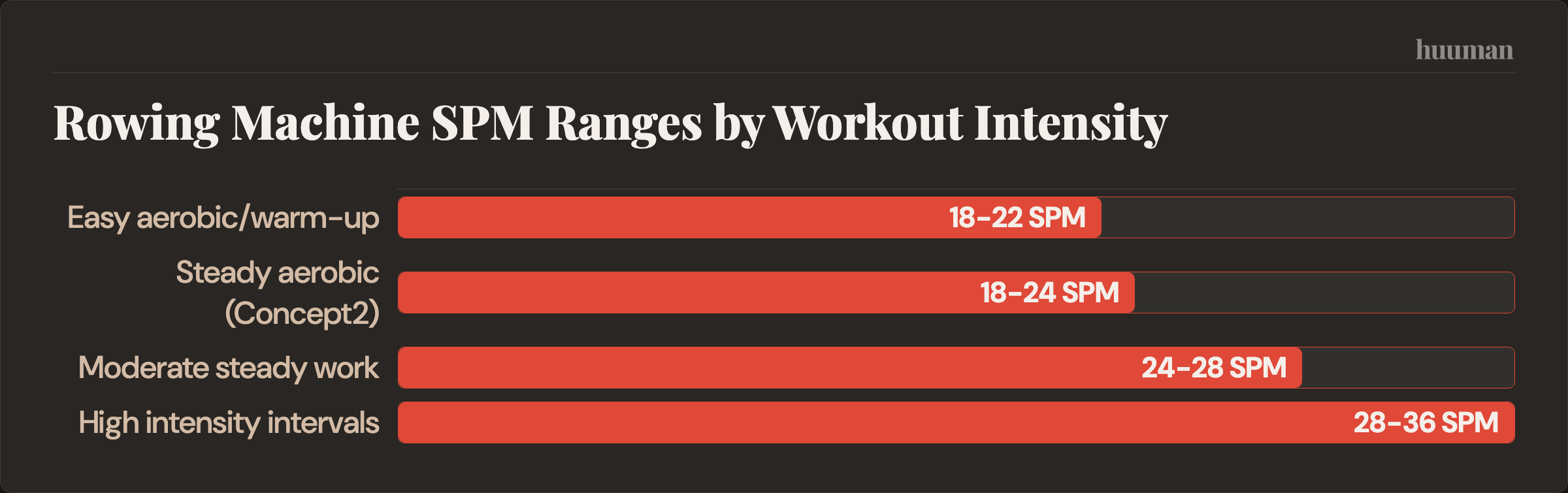
On rowing machines, a practical benchmark is that easy to steady aerobic work often sits around 18 to 24 SPM, moderate steady work around 24 to 28 SPM, and harder interval or race-focused rowing moves above that, depending on the session and the athlete. Those are benchmarks, not prescriptions. The practical rule is simple: rate is the metronome, power is the engine, and technique is the limiter. Pick your SPM by workout goal, then confirm it with pace or watts, RPE, and whether your stroke still looks long and controlled.

- If you are warming up or doing easy aerobic work, start lower and focus on rhythm, length, and relaxed recovery.
- If you are doing steady moderate work, use a rate that lets pace rise without turning the stroke frantic.
- If you are doing intervals, let rate climb only if power and form climb with it.
- If your SPM rises while pace stalls and technique degrades, your target rate is probably too high for that session.
If you want to test this instead of guessing, log your next rowing session with SPM, pace, and RPE in the huuman app and run a 10-minute check at your planned rate.
What strokes per minute means, and what it does not
On an erg, strokes per minute, stroke rate, strokes/min, and s/m all refer to the same thing: how many complete rowing strokes you take each minute. Most rowing machine displays show it clearly. On a Concept2 Performance Monitor, you will see stroke rate alongside split and other training data. Hydrow and Peloton also use stroke rate as part of their beginner-facing coaching language, though presentation and metrics may differ by platform.
What SPM does not tell you is how effective those strokes are. Two people can both row at 26 SPM while producing very different split times, watts, and fatigue. That is why you need to connect rate to three other variables.
- Split or pace: how fast the monitor says you are moving for a set distance.
- Watts or power: how much work each stroke contributes.
- Distance per stroke: not always displayed directly, but still useful conceptually because it reflects how much speed you get from each cycle.
A useful mental model is a simple triangle: stroke rate sets the rhythm, power per stroke drives the machine, and form determines whether that power transfers cleanly. Readiness then filters the whole decision. If sleep is poor, soreness is high, or your trend markers look off, the same rate may cost more than usual. That is where broader markers like HRV as a training readiness indicator, resting heart rate in trained athletes, and heart rate during sleep as recovery signal can add context.
Beginners often rate too high because higher cadence feels like harder work. In practice, that usually means rushing the recovery, shortening the stroke, or trying to create speed by moving faster rather than pushing effectively through the legs and hips.
Benchmarks: practical rowing machine SPM ranges
The most usable benchmarks come from rowing coaching heuristics and manufacturer guidance, not from one universal physiological law. They are best used as starting bands. Your actual sweet spot depends on technique, body size, strength, training age, drag setting, and session goal.
- Drive-to-recovery ratio matters. Efficient rowing usually looks like a firm drive followed by a calmer recovery, not a rushed return.
- Drag factor on Concept2 reflects how the machine feels in motion and is the meaningful equipment variable. The damper lever only changes airflow into the flywheel housing. It is not the same as drag factor, and the same damper number can produce different drag factors across machines.
- On-water rowing can use different rates because balance, boat class, water conditions, and crew timing change the picture.
Table 1: Rowing machine SPM ranges by workout intent
- Easy aerobic, warm-up, technique-focused: 18-22 SPM. RPE: easy to comfortable. HR zone: roughly Z1-Z2. Feel: you should be able to talk in phrases, stay relaxed, and keep the stroke long. Common failure modes: rushing the slide, over-gripping, pulling early with the arms.
- Steady to moderate aerobic: 22-26 SPM. RPE: comfortable to moderately hard. HR zone: roughly Z2-Z3. Feel: controlled breathing, repeatable rhythm, stable posture. Common failure modes: shortening the finish, collapsing at the catch, breaking at the hips too early.
- Threshold-ish, hard steady pieces: 24-28 SPM. RPE: hard but sustainable for the planned interval. HR zone: roughly Z3-Z4. Feel: breathing deeper, focus required, but stroke still organized. Common failure modes: early arm bend, recovery gets hurried, loss of suspension and connection.
- Intervals, short to medium: 28-36 SPM. RPE: hard to very hard. HR zone: roughly Z4-Z5, though HR can lag on shorter work. Feel: aggressive but still sequenced, with pace or watts clearly responding. Common failure modes: rating high but going slower, shortening the stroke, flinging the body through the finish.
- Race or sprint efforts: often 30+ SPM depending on athlete and context. RPE: very hard to maximal. HR zone: Z5 if sustained long enough to register. Feel: high urgency with preserved length and timing. Common failure modes: panic rhythm, loss of recovery control, technical collapse before the interval ends.
The lower and middle parts of that table are directly aligned with Concept2 stroke rate guidance, while RP3 similarly places steady work at 18 to 24 and intervals at 28 to 36. Harder race-rate details vary more by athlete and event, so treat the top end as context-dependent rather than fixed.
How to choose your target SPM
Start with the purpose of the session, not the number you hope looks impressive on the monitor. If the goal is aerobic base, your rate should let you accumulate work without form drift or disproportionate fatigue. If the goal is interval conditioning, your rate should support target power and rhythm under fatigue. If the goal is performance over 2k or 5k, your target band needs to look specific to that demand, but still sustainable for the piece.

Table 2: Choose your SPM
- Technique and aerobic base: Starting SPM 18-22. How to progress: extend duration first, then nudge rate only if stroke length and rhythm stay intact. What to watch: stable pace or watts, easy talk test, low HR drift, clean sequencing.
- Fat-loss-oriented aerobic work: Starting SPM 18-24. How to progress: build repeatable sessions before chasing higher rate. What to watch: pace consistency, talk test, whether effort remains sustainable enough to repeat across the week. If energy-expense comparisons interest you, context from waist circumference and cardiovascular risk is more useful than treating SPM as a calorie shortcut.
- Time-efficient conditioning: Starting SPM 24-30 depending on interval length and skill. How to progress: increase repeat quality before increasing rate. What to watch: pace or watts first, then RPE, because HR may lag on short intervals. For background, see understanding cardio load metrics.
- 2k or 5k performance focus: Starting SPM around the demands of your event-specific work, often above steady-state rates. How to progress: practice holding form as rate rises rather than jumping straight to max cadence. What to watch: split stability, technical checkpoints, whether rate changes actually improve speed.
- Rehab or return to training: Starting SPM lower and controlled, often in an easy aerobic band if exercise tolerance allows. How to progress: raise exposure only when symptoms, soreness, and next-day fatigue remain manageable. What to watch: relaxed grip, hip and back comfort, breathing response, recovery markers, and clinician guidance when relevant.
A practical decision rule: if pace is not improving and form is shortening, lower the rate and rebuild power per stroke. If pace improves at the same perception of effort and your stroke still looks long, you may have room to rate up.
How SPM interacts with power, technique, and readiness
The cleanest way to think about rowing intensity is this: SPM changes how often you apply force, power shows how much useful work you create, and form determines how much of that work reaches the machine. A higher rate can help when it lets you distribute force smoothly and keep the flywheel moving. It hurts when it turns the stroke into a series of rushed, shallow pulls.
Technique failures tend to follow recognizable patterns. Rushing the slide means you return too quickly on the recovery, so the next catch feels unstable. Early arm bend shifts work away from the legs. Breaking at the hips too early wastes sequencing. Over-gripping increases upper-body tension and often shows up as neck and forearm fatigue rather than better pace. These errors matter because they reduce distance per stroke and often increase local tissue stress, especially in the posterior chain, hips, back, elbows, and hands.
Readiness affects what rate you can use productively on a given day. If sleep is poor or accumulated fatigue is high, a rate that usually feels controlled may suddenly feel frantic. Athletes who track broader fitness markers sometimes pair rowing data with trends in what VO2max tells you about fitness, VO2max reference values by age, and cardio recovery and stroke efficiency, but for individual sessions the highest-value inputs are still pace or watts, RPE, and whether technique remains stable.
Evidence and limits
The evidence base for exact SPM targets is mixed. Practical rowing ranges are mostly drawn from coaching practice, manufacturer education, and federation-style guidance rather than from large clinical trials establishing one optimal stroke rate. That is why benchmark language matters more than prescription language.
For indoor rowing, the strongest practical sources are coaching-oriented references. They are helpful because they match how real rowers and coaches structure sessions, even though they are not the same thing as peer-reviewed dose-response evidence.
Peer-reviewed work helps more with interpretation than with universal ranges. Research in trained rowers suggests that stroke rate and intensity are closely linked, with athletes tending to select higher rates as intensity rises. That supports the coaching reality many athletes see on the erg, but it does not mean a higher SPM is inherently better. Context still matters.
The limits are important:
- Height, strength, and technical skill can shift your efficient band.
- Machine feel changes with drag factor, and damper position alone does not define that feel.
- Heart rate can be useful in steady rows, but on short intervals it lags behind the actual work rate. Use RPE and pace or watts first in those efforts.
- On-water rowing differs from erg rowing because balance, crew coordination, and environmental conditions alter stroke mechanics.
- Swimming and SkiErg use the idea of stroke rate differently. In SkiErg, the cadence concept is familiar but movement mechanics are not the same as rowing. In swimming, "stroke" depends on style and counting method. Reviews of front crawl and sprint swimming identify stroke rate as an important performance factor, including in front crawl biomechanics and sprint swimming performance factors, but those findings should not be transferred directly to rowing benchmarks.
That is the big limit to keep in mind: there is no single ideal SPM. The useful outcome is pace or power at an acceptable RPE, with stable technique and manageable recovery cost.
Non-prescriptive strategies to discuss with a professional
Build efficiency at lower rates first
A common approach in the training literature is to spend a lot of time at lower to moderate rates building stroke length, sequencing, and rhythm. That can be helpful because lower rates give you more time to organize the recovery, connect the catch, and feel whether the legs are initiating the drive. Common cues include patient recovery, relaxed hands, and a long finish without collapse.
Raise rate from the recovery, not by rushing the drive
When experienced coaches ask an athlete to raise rate, they usually are not asking for a more frantic pull. The cleaner change is often a slightly quicker recovery while preserving drive quality and stroke length. A simple rate ladder can help: move through small rate steps and check whether pace improves while form stays recognizable.
Pair the right metric with the right session
For steady work, combine SPM with talk test, RPE, and heart-rate trend. Broadly, Z1 to Z2 work should feel conversational, while Z3 to Z5 work becomes progressively harder to sustain. For hard intervals, rely more heavily on split or watts and RPE because heart rate may not reflect short efforts in real time. If you are trying to manage cumulative strain, context from how long a deload should last can help you frame rate choices inside the wider week.
A simple 6-minute step-up self-test
One commonly used structure is a short rate ladder to find your efficient band for the day. Spend two minutes at a lower steady rate, two minutes at a middle rate, and two minutes at a slightly higher rate, without chasing maximal effort. Record average SPM, average split or watts, RPE, optional heart rate, and one form note. The goal is not to prove toughness. It is to identify the highest rate at which pace improves without obvious technical decay.
- Example row 1: 20 SPM, steady split, RPE 4, breathing easy, felt long and relaxed.
- Example row 2: 24 SPM, split improved, RPE 5, still controlled.
- Example row 3: 28 SPM, split barely improved, RPE 7, recovery rushed and arms bent early.
That pattern suggests 24 SPM may be a more efficient working rate than 28 SPM for that day and that purpose.
How to track and interpret changes
The simplest useful log has five items: average SPM, average pace or watts, RPE, optional max or average heart rate, and one short technique note. For longer steady rows, add whether heart rate drifted upward while pace stayed the same. For interval days, note whether the same rate still produced the target split late in the session.
The best progress markers are not flashy. They are signs of improved efficiency and repeatability:
- Same pace at lower RPE.
- Same SPM with higher watts.
- Less heart-rate drift at similar pace during steady work.
- Higher sustainable rate without shortening the stroke.
- Better next-day recovery at similar training load.
That last point matters. If an aggressive rate strategy drives more soreness, poorer sleep, or a worse readiness trend, it may not be the best choice for long-term progress. That is one reason broader health-literate athletes often track rowing inside the same system as recovery, body metrics, and other cardio sessions. Cross-sport comparisons can be useful too, whether you are comparing rowing with calories burned during aqua running, the energy cost of treading water, or your usual run or bike sessions.
Table 3: Signal checks
- Increase SPM when pace improves at similar RPE and form still looks long. Watch for stable recovery timing and clean catches.
- Increase SPM when you can finish intervals at the planned split without panic breathing or technical unraveling. Confirm by checking that the last reps still resemble the first.
- Hold SPM and add power when rate is already rising but split is flat. Focus on better connection and leg drive instead of more cadence.
- Hold SPM and add power when heart rate drifts mildly in longer rows but technique remains stable. Let efficiency improve before changing rhythm.
- Reduce SPM when the stroke shortens, hands tense up, or you start yanking the handle. Rebuild distance per stroke first.
- Reduce SPM when higher rate creates a much bigger recovery cost than the session warrants. Review sleep, soreness, and readiness before the next hard day.
If you want a cleaner picture of your own efficient band, your huuman Coach can help compare three rowing sessions across SPM, power, and perceived effort so you can see where pace stays solid and form holds up.
Signal vs noise
- Signal: pace improves at the same SPM and similar RPE. Next step: keep that rate band and try to repeat it on another day before moving higher.
- Signal: you can hold a longer stroke at a slightly higher rate. Next step: progress rate in small jumps rather than jumping straight into race cadence.
- Signal: heart-rate drift decreases during steady rows at a similar pace. Next step: treat that as improved aerobic repeatability, not a reason to force harder sessions immediately.
- Noise: SPM rises but pace does not. Next step: lower rate and focus on power per stroke and sequencing.
- Noise: you only feel "fit" when the monitor shows a high stroke rate. Next step: anchor effort to RPE, split, and talk test instead of cadence alone.
- Noise: you shorten the stroke to maintain a target SPM. Next step: abandon the rate target for that session and restore length first.
- Noise: changing the damper is used as a shortcut to force speed gains. Next step: check drag factor and choose a machine feel you can row well, then reassess pace at the same form quality.
- Noise: comparing your steady-state SPM to an elite rower's race rate. Next step: match the benchmark to your goal, event, and training level.
- Signal: you recover better from the same weekly rowing load. Next step: consider whether better pacing discipline, not just fitness, is improving your sessions.
Common questions
What is strokes per minute on a rowing machine?
It is the number of full stroke cycles you complete in one minute. On most rowing machine monitors, it is shown as stroke rate, strokes/min, or s/m. It is useful for setting rhythm, but it needs context from pace, watts, and technique.
What is a good stroke rate for beginners?
For many beginners, a lower to moderate range is more useful because it leaves room to learn timing and stroke length. The lower end of commonly cited steady-work ranges, such as the 18 to 24 SPM band described by Concept2 and RP3, is often a better place to build efficiency than jumping straight to high rates.
Is 35 SPM good for rowing?
It can be appropriate in harder intervals or race-like work, but it is not automatically good. If 35 SPM comes with better pace, sustained power, and recognizable form, it may fit the workout. If it comes with shorter strokes and a slower split, it is just more motion, not better rowing.
What SPM should I use for steady state cardio?
For steady aerobic work, many athletes do best in the lower to mid part of the common steady-state bands, often around 18 to 24 SPM, sometimes a bit higher if they are technically sound and the session is meant to be moderate rather than easy. Use talk test, RPE, and heart-rate trend to confirm that the effort matches the goal.
Why does my SPM go up when I get tired?
Fatigue often makes people seek speed by moving faster instead of applying force well. Recovery gets rushed, the stroke shortens, and the handle starts moving before the body is set. That is why tired athletes often rate higher while going slower.
How do I increase SPM without losing power?
Increase rate gradually and preserve sequence: legs first, then body, then arms, with a controlled recovery. If pace stops improving or your form note gets worse, you have probably moved past your efficient band for that day.
Does a higher damper setting mean a higher SPM?
No. Damper position changes airflow and influences machine feel, but on Concept2 the more meaningful measure is drag factor. Higher damper does not guarantee a better stroke rate or better performance. It can even make technique worse if it encourages yanking rather than smooth power.
How is SPM different in swimming or SkiErg?
SkiErg uses a cadence concept that resembles rowing in some ways, but the movement pattern and limiting muscles differ. In swimming, stroke rate is even more context-dependent because style and counting method change what one "stroke" means. Reviews suggest stroke rate matters for swimming performance, especially in front crawl and sprint contexts, but those findings should be interpreted inside the specific swim style rather than borrowed directly for rowing.
If you want to turn this into a repeatable practice instead of another one-off benchmark, the huuman Coach can build weekly training plans that adapt to your recovery signals and help you decide when to push rate versus when to hold it and row better.
More health topics to explore
- Heart & Cardio – Overview
- Understanding HRV: Charts, Normal Ranges, and What "Good" Really Means
- How to Improve VO2max: Interval and Zone 2 Training Plan with Tracking
- HIIT Workout Plan: The 4-Week Plan (Home or Gym)
References
- Concept2 — Erklärung zur Schlagzahl beim Rudern (Blog, 2017)
- Ettema G et al. — The role of stroke rate and intensity on rowing technique (2025)
- Yu Kwok W et al. — A Systematic Review and Meta-Analysis: Biomechanical Evaluation of the Effect... (2021)
- Ruiz-Navarro JJ et al. — Factors Relating to Sprint Swimming Performance: A Systematic Review (2025)
- Ross et al. — Cardiorespiratory Fitness as Clinical Vital Sign (2016)
- RP3 Rowing — Ideal stroke rate for different fitness goals