A strength training plan only works if it fits your life and moves you forward over weeks, not just days. Most plans don't fail because of the exercises, but because of poor structure: the wrong frequency, no clear progression, and no adjustment for stress or fatigue.
This guide gives you exactly that: simple templates for 2–4 days per week, clear decision rules, and practical ways to manage load, volume, and recovery.
Key takeaways
1. 2×/week (30–35 min, full body): minimal, efficient, ideal when time is tight
2. 3×/week (45–60 min, full body): balanced for strength and muscle growth
3. 4×/week (60 min, upper/lower): more volume without marathon sessions
You'll learn which structure fits your schedule and equipment, how to track progress, and when to scale back instead of pushing blindly.
Where this fits in
Strength training is about more than building muscle. It improves movement quality, strengthens tendons and joints, and can positively impact body composition. Progress comes from the combination of training and recovery. Sleep, stress, and weekly planning aren't "extras", they determine how much training your body can actually handle.
If you want a broader overview: Strength & Movement overview breaks down the key components.
Quick answer
A good strength training plan is one you can stick to, execute well, and progressively improve. For many healthy adults, 2–3 full-body sessions per week work well. With 4 days, an upper/lower split often becomes more practical. What matters most: clear progression, enough rest, and predictable recovery. Guidelines consistently emphasize that multiple weekly sessions and progressive overload are key.
- 2×/week (30–35 min, full body): minimal, efficient, ideal when time is tight
- 3×/week (45–60 min, full body): balanced for strength and muscle growth
- 4×/week (60 min, upper/lower): more volume without marathon sessions
Your exercise selection should cover the key movement patterns: squat, hinge, pushing (horizontal/vertical), pulling (horizontal/vertical), core, and carries. Work across a range of reps and train close to muscle failure to support hypertrophy. For heavy compound lifts, allow longer rest so your performance stays consistent.
The best plan is one you actually execute week after week. Track your strength sessions and progression with the huuman app, your Coach learns what works for your schedule and energy patterns.
Choosing a plan based on time & frequency

- Your week: 2 days - Structure: Full body A/B - Session: 30–35 min - Best for: Beginners and those maintaining strength - Gym: Barbell/dumbbell/machines - Home: Dumbbells/bands/bodyweight
- Your week: 3 days - Structure: Full body A/B/C - Session: 45–60 min - Best for: Intermediate trainees seeking consistent progress - Gym: Full setup - Home: Dumbbells, bands, pull-up bar
- Your week: 4 days - Structure: Upper/lower - Session: ~60 min - Best for: More volume without long sessions - Gym: Recommended - Home: Works with good alternatives
What your plan needs to do
Your plan should give you three things: a clear structure (which days, which movement patterns), a progression system (when to increase weight or reps), and simple load management (what to do when you're tired). It shouldn't be reinvented every week.
Full body vs. split
Your training frequency determines the structure. With 2–3 days per week, full-body training allows you to train major muscle groups at least twice weekly and keeps planning simple. With 4 days, an upper/lower split distributes volume better, so sessions stay manageable while each muscle group still gets enough stimulus.

Exercise selection by movement pattern
Choose exercises so all major patterns are covered each week:
- Squat: back squat, goblet squat, split squat
- Hinge: deadlift, RDL, banded hip hinge
- Push (horizontal/vertical): bench press, push-ups, overhead press
- Pull (horizontal/vertical): rows, pull-ups/lat pulldown
- Core: anti-extension, anti-rotation (planks, Pallof press)
- Carry: farmer's carry, suitcase carry
You can replicate most of this at home. See also Guide: Strength training with dumbbells and Guide: Building muscle at home.
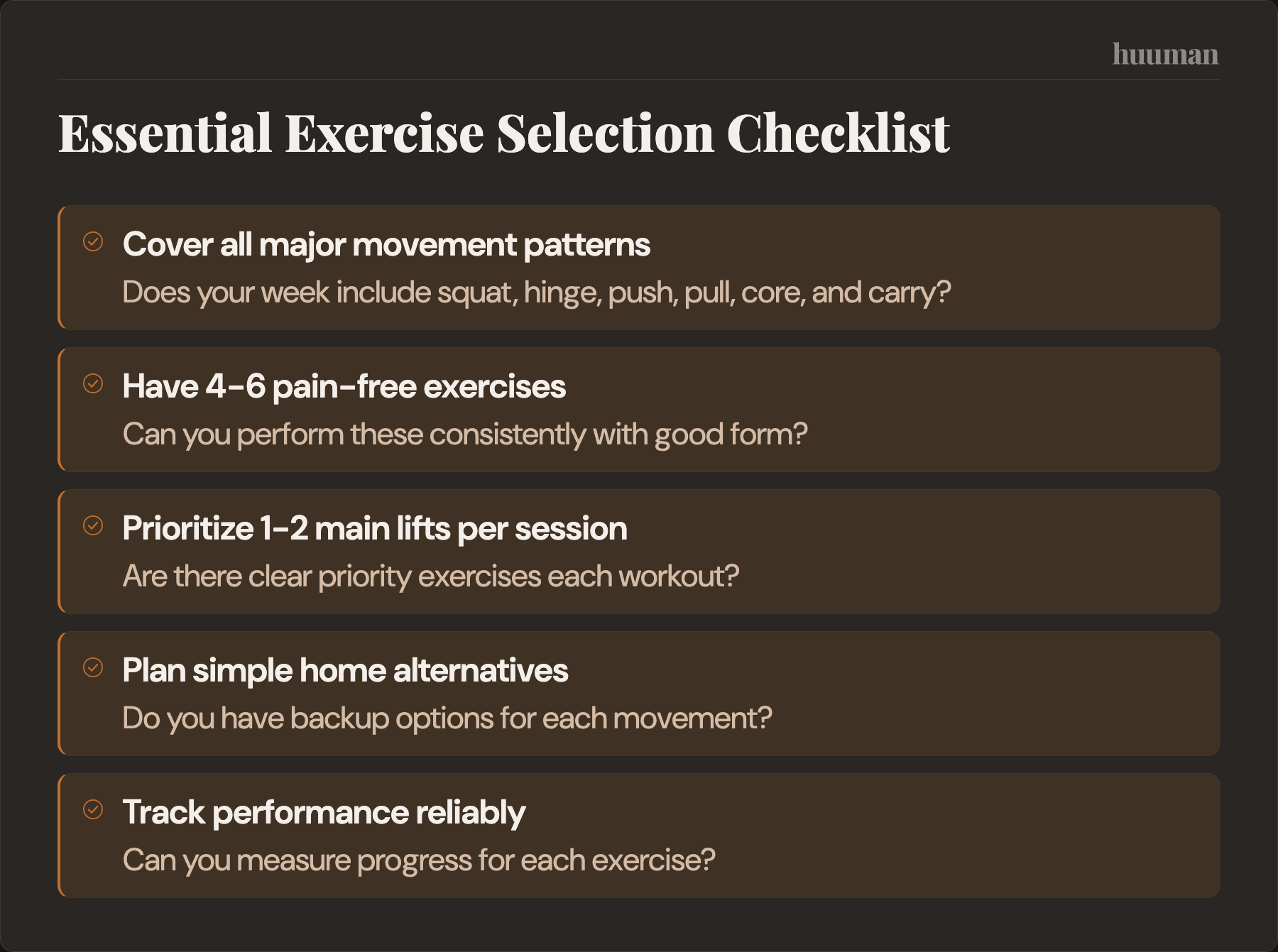
Checklist: choosing exercises in 5 steps
- Does your week cover all major movement patterns?
- Do you have 4–6 exercises you can perform pain-free and consistently?
- Are there 1–2 priority lifts per session?
- Do you have simple alternatives for home?
- Can you track performance reliably for each exercise?
Sets, reps, rest
Think in ranges, not rigid rules:
- Strength focus: lower reps, higher intensity, longer rests
- Muscle growth: a wide rep range works if sets are close to failure
- General fitness: moderate reps with consistent technique
Use RPE/RIR to guide effort: often train around RPE 7–9 (a few reps left in reserve). Take longer rests for big lifts to maintain performance.
Progression: three simple systems
- Double progression: increase reps within a target range first. Once you hit the top in all sets, increase the weight slightly.
- Top set + back-off: one heavy set followed by 1–3 lighter sets for volume.
- Rep PRs: perform more reps with the same weight over time.
Progressive overload is the core of progress. If performance and technique stall, check sleep, stress, and execution before increasing volume or intensity. Persistent fatigue may call for a planned reduction. See Deload in strength training and the deload overview.
Printable plan templates
2×/week full body (A/B, 30–35 min)
- Session A: Squat variation - Sets x reps: 3 × 5–8 - Session B: Hinge variation - Sets x reps: 3 × 5–8
- Session A: Push - Sets x reps: 3 × 6–10 - Session B: Push (variation) - Sets x reps: 3 × 6–10
- Session A: Pull - Sets x reps: 3 × 6–10 - Session B: Pull (variation) - Sets x reps: 3 × 6–10
- Session A: Carry/core (optional) - Sets x reps: 2 sets - Session B: Carry/core (optional) - Sets x reps: 2 sets
3×/week full body (A/B/C, 45–60 min)
- Day: A - Main lift: Squat 3–5 × 3–6 - Secondary: Pull 3 × 6–10 - Accessory: 2 exercises, each 2–3 × 8–15 - Core: 2 sets
- Day: B - Main lift: Hinge 3–5 × 3–6 - Secondary: Push 3 × 6–10 - Accessory: 2 exercises, each 2–3 × 8–15 - Core: 2 sets
- Day: C - Main lift: Press 3–5 × 3–6 - Secondary: Pull 3 × 6–10 - Accessory: 2 exercises, each 2–3 × 8–15 - Core: 2 sets
4×/week upper/lower (60 min)
- Day: Mon - Focus: Lower (squat) - Examples: Squat, split squat, hamstrings, core
- Day: Tue - Focus: Upper (horizontal) - Examples: Bench/push-up, row, shoulders/triceps
- Day: Thu - Focus: Lower (hinge) - Examples: Deadlift/RDL, hip thrust, quads, carries
- Day: Fri - Focus: Upper (vertical) - Examples: OHP, pull-ups/lat pulldown, rear delts/biceps
Evidence and limitations
Guidelines and textbooks consistently show: multiple sessions per week, sufficient intensity, and progressive overload are effective for strength and muscle growth. Hypertrophy can occur across a wide rep range as long as sets are performed close to failure. Rest periods depend on the exercise and goal, and tend to be longer for heavy compound lifts. These principles are well supported in research and practice. Exact "optimal" set counts or frequencies vary by individual.
Limits come from technique, pain, existing conditions, and recovery capacity. If performance drops despite good technique and fatigue is high, adjustment is usually more productive than pushing harder.
Strategies to discuss with a professional
Start minimal and build
Begin with 2×/week if your schedule is tight. Move to 3× when you've trained consistently for 4–6 weeks, soreness no longer limits you, and performance is improving.
The 30-minute rule
Prioritize 3 key lifts, use push/pull supersets, and limit accessories. Quality over variety.
Home vs. gym
Cover the same movement patterns. Examples: goblet squat instead of back squat, dumbbell RDL instead of deadlift, band rows instead of cable rows. For specific setups, see Strength training at home guide.
Stall or fatigue
Quick check: technique solid? sleeping enough? stress high? increased volume too quickly? Adjust one or two variables or add a lighter week. See how often to deload.
Nutrition and goals
Your goal affects the details, not the structure. For body composition, strength training is a key lever, see strength training for fat loss. For specific goals, explore muscle-building plans. For faster progress without overdoing it: guide to building muscle efficiently.
Tracking progress
Simple tracking (1 page)
- Week: 1 - Exercise: Squat
- Week: 2 - Exercise: Squat
- Week: 3 - Exercise: Squat
- Week: 4 - Exercise: Squat
Focus on trends: rep PRs, stable technique, perceived recovery. Re-test every 4–8 weeks using the same exercises. You can optionally track resting heart rate, sleep quality, or HRV as context, not as the sole decision driver.
Remember: the perfect plan on paper means nothing if it doesn't fit your life. Your huuman Coach builds weekly strength plans that adapt to your recovery signals, whether you're fresh or need to dial back intensity.
Flowchart: choosing a plan & handling plateaus
- Do you have 2, 3, or 4 days? → choose full body (2–3) or upper/lower (4)
- Sessions too long? → reduce accessories or switch to a split
- Performance improving? → stick with the plan and use double progression
- No progress for 2 weeks?
- Check technique → video or coach
- Check sleep/stress → run a lighter week
- Adjust volume → 1–2 sets less or more depending on fatigue
- Tune intensity → slightly lower or increase RPE
- Still stuck → vary the exercise, address any pain
Signal vs. noise in a strength training plan
- Signal: consistency beats the "perfect plan." Next step: commit to one template for 8 weeks.
- Signal: progressive overload with solid technique. Try: double progression on 3 exercises.
- Signal: enough rest for heavy lifts. Watch: stable performance across sets.
- Signal: balance push/pull and squat/hinge. Check: your weekly overview for gaps.
- Signal: volume that still allows progression. Reduce: sets if fatigue dominates.
- Noise: "muscle confusion" as a requirement. Ignore: constant program changes.
- Noise: maxing out daily. Use: RPE 7–9 instead of all-out effort.
- Noise: only machines or only free weights. Combine: based on availability.
- Noise: changing plans every 2 weeks. Stay: consistent for 4–8 weeks.
- Noise: soreness as proof. Measure: performance, not pain.
Frequently asked questions
What's a good strength training plan for beginners?
2–3 full-body sessions with a few well-learned exercises. Focus on technique, moderate volume, and simple progression. Add complexity only once consistency is built. See also beginner strength training exercises.
Full body or split: which is better?
With 2–3 days, full body is usually more efficient. At 4 days, a split becomes more practical to distribute volume. "Better" depends on your schedule and recovery.
Are 2 training days per week enough?
Yes, for getting started and making progress. What matters is taking those sessions seriously and planning progression. Move to 3 days when you have time and can handle more volume.
How many sets and reps should I do?
There's no universal number. Use ranges: multiple sets per exercise and a rep range that brings you close to muscle failure. Adjust based on performance and recovery.
How long should I rest between sets?
Long enough to perform well in the next set. Generally longer for heavy compound lifts, shorter for accessories. Let your performance guide you.
How do I apply progressive overload without overtraining?
Use clear if–then rules: increase reps first, then weight, and include lighter weeks when needed. If fatigue rises and performance drops, reduce volume short term.
Can I follow a plan at home without equipment?
Yes. With dumbbells, bands, and bodyweight you can cover all movement patterns. Prioritize exercises you can progress consistently and with control.
If you're unsure, start with 2× full body and scale based on recovery. Methods like Greasing the Groove can help you practice technique more frequently with less fatigue.
More health topics to explore
- Strength, Muscle & Mobility – Overview
- Muscle-Building Workout Plan for Women: 2–4 Days, Progression, Examples
- Beginner Strength Training: A Clear 8-Week Starter Plan (Home & Gym)
- Strength Training for Women: A Practical Plan for Strength, Muscle, and Longevity
References
- ACSM — Progression Models in Resistance Training (2009)
- Polar — Trainingsplan für Anfänger:innen — Übungen fürs Krafttraining
- Schoenfeld BJ et al. — Effects of Resistance Training Frequency on Measures of Muscle Hypertrophy: A... (2016)
- NSCA — Determination of Resistance Training Frequency
- Westcott WL et al. — Prescribing physical activity: applying the ACSM protocols for exercise type,... (2009)
- Zourdos MC et al. — Novel Resistance Training-Specific Rating of Perceived Exertion Scale Measuri... (2016)
- Schoenfeld BJ et al. — Strength and Hypertrophy Adaptations Between Low- vs. High-Load Resistance Tr... (2017)
- Mangine GT et al. — Effect of the Repetitions-In-Reserve Resistance Training Strategy on Bench Pr... (2022)
- Havers T et al. — Partial Range, Full Gains? The Effect of 8 Weeks of Partial Range of Motion T... (2025)