

The promise of the one and done workout is simple: spend just a few minutes pushing hard and reap benefits that supposedly rival much longer training sessions. For busy professionals juggling work, family, and limited energy, that message is understandably appealing.
Key takeaways
1. A single 7–10 minute high-intensity session can improve VO2max and cardiovascular fitness — research shows significant aerobic adaptations from protocols as short as 4 minutes of hard effort.
2. The key is intensity, not duration: work intervals at 85–95% of maximum heart rate. If you can talk comfortably during the hard part, the intensity is too low to trigger meaningful adaptation.
3. One-and-done works best as a minimum effective dose for busy weeks — not as a permanent replacement for varied training. Two to three sessions per week yields substantially better long-term results.
But the reality behind these short, intense workouts is more nuanced. Some versions are rooted in legitimate exercise science. Others are mostly marketing language layered over real physiology. Short bursts of high intensity can trigger meaningful cardio‑metabolic adaptations, but they also place higher strain on muscles, joints, and the recovery system.
This guide separates what the one and done workout actually does from the hype surrounding it. You will see how short all‑out intervals differ from standard HIIT circuits, what happens physiologically during those few minutes, and how to build a safer 7‑minute protocol that still respects recovery and long‑term fitness.
The goal is not to reject short workouts. It is to use them intelligently so they contribute to staying fit, confident, and capable for decades.
Where short intense workouts fit in performance and longevity
High‑intensity intervals sit at the intersection of metabolism, heart health, and recovery capacity. When people talk about tiny workouts producing big effects, they are usually referring to adaptations in cardiorespiratory fitness and energy metabolism.
Cardiorespiratory fitness is commonly estimated through VO2max, a measurement associated in population research with overall health and longevity risk patterns. Improvements in VO2max generally reflect a cardiovascular system that can deliver oxygen to working muscles efficiently. That matters not only for athletes but for everyday resilience and energy capacity. A recent systematic review found that both continuous and interval training effectively improve VO2max in women.
Short intervals can contribute to those adaptations because they push the heart, lungs, and muscles near their limit. Repeated exposure to that demand can signal changes inside muscle cells that support better energy production over time.
At the same time, these sessions produce a disproportionate recovery cost compared with moderate training. That is why most training literature frames interval work as a tool within a broader training week, not the entire plan.
If you zoom out, the real objective is simple: accumulate enough stimulus across metabolism and cardiovascular systems without overwhelming your ability to recover. Resources like the Metabolism & Energy overview or guidance on boosting VO2max for better energy show how these pieces fit together in a larger fitness picture.
Quick answer
The phrase "one and done workout" usually describes a very short high‑intensity interval session, often based on Sprint Interval Training. These workouts typically involve a handful of near‑maximal bursts lasting a few seconds to half a minute with controlled recovery periods.
- Typical total work time: about 7–10 minutes of intervals
- Intensity: near‑max effort during work periods
- Main benefit: efficient stimulus for cardiorespiratory fitness
- Main limitation: high recovery demand and injury risk if repeated too often
In practice, these sessions work best as supplements. They are useful for time‑crunched people, especially those already doing strength training, but they rarely replace easier aerobic sessions that build a broader fitness base.
Before jumping into any intense protocol, establish a baseline by tracking morning heart rate, sleep quality, and one simple performance metric for seven days. You can sync your sleep data automatically with the huuman app through Apple Health to see how your recovery responds to short, intense sessions.
What the one and done workout actually is
The term appears in two main forms. One is a branded program marketed online. The other is a broader fitness concept describing extremely short interval workouts.
These workouts draw from a training style called Sprint Interval Training (SIT). SIT involves brief bursts of very high effort followed by longer recovery periods. In exercise physiology studies, this style of training is often used to explore how short maximal efforts affect aerobic and metabolic adaptations.
It helps to distinguish three related formats:
- SIT: very hard, near‑maximal bursts with longer recovery.
- HIIT: hard intervals but usually slightly below maximal effort.
- 7‑minute circuits: bodyweight exercises performed continuously, often alternating muscle groups.
All three compress training into a short window, but the stimulus is different. Sprint intervals stress metabolic pathways that tolerate high lactate and high power output. Bodyweight circuits create a moderate cardiovascular load combined with muscular endurance.
Marketing often blends these together under a single label, even though the training demands and recovery costs are not the same.
The physiology in plain English
During a short all‑out effort, the body relies heavily on fast energy pathways that do not depend on oxygen in the moment. These pathways rapidly break down fuel through processes related to glycolysis, which produces lactate as a byproduct.
Lactate itself is not just a fatigue signal. It can also act as a metabolic messenger. High‑intensity intervals tend to activate cellular pathways associated with energy regulation, including signals involving AMPK and PGC‑1α. In research settings, these signals are associated with increased mitochondrial activity inside muscle cells.
What matters for everyday training is simpler. Repeated intense efforts teach muscles and the cardiovascular system to deliver and use energy more efficiently when demand spikes.
That does not mean these sessions replace lower‑intensity aerobic training. Easy aerobic work tends to accumulate much larger volumes of oxygen‑supported metabolism and supports long‑duration endurance capacity. Most durable training plans rely on both.
A recent analysis found that high-intensity intervals showed superior cardiometabolic improvements compared to moderate-intensity continuous training in adults with metabolic syndrome.
Many marketing claims also mention the "afterburn effect," known scientifically as excess post‑exercise oxygen consumption (EPOC). After intense exercise, the body continues consuming slightly more oxygen while restoring energy stores and repairing tissues. The effect is real, but the long‑term calorie impact is commonly overstated.
The tradeoffs marketing often skips
The appeal of a seven‑minute workout is convenience. The cost is that those minutes are usually extremely demanding.

Three practical constraints appear quickly.
Recovery cost
Hard intervals create a larger stress signal than moderate activity. That signal does not only involve muscles. The nervous system, connective tissue, and hormonal stress response are involved as well. Poor sleep, high work stress, or nutritional deficits can make repeated maximal sessions difficult to sustain.
Musculoskeletal load
True all‑out efforts amplify mechanical forces on tendons and joints. Sprinting, jumping, or explosive bodyweight work can expose weak spots in the knees, hips, or lower back. Without a warm‑up or gradual progression, injury risk increases. The ACC/AHA guidelines for exercise testing emphasize pre-exercise screening for individuals with cardiovascular risk factors.
ACSM's preparticipation screening guidelines establish specific contraindications for high-intensity exercise, including uncontrolled hypertension above certain thresholds.
The consistency trap
Many people try extremely intense workouts daily for a few weeks, then stop training altogether because they feel exhausted or sore. Sustainable progress usually grows from workouts that are challenging but repeatable.
Legit vs hype: how to interpret common claims
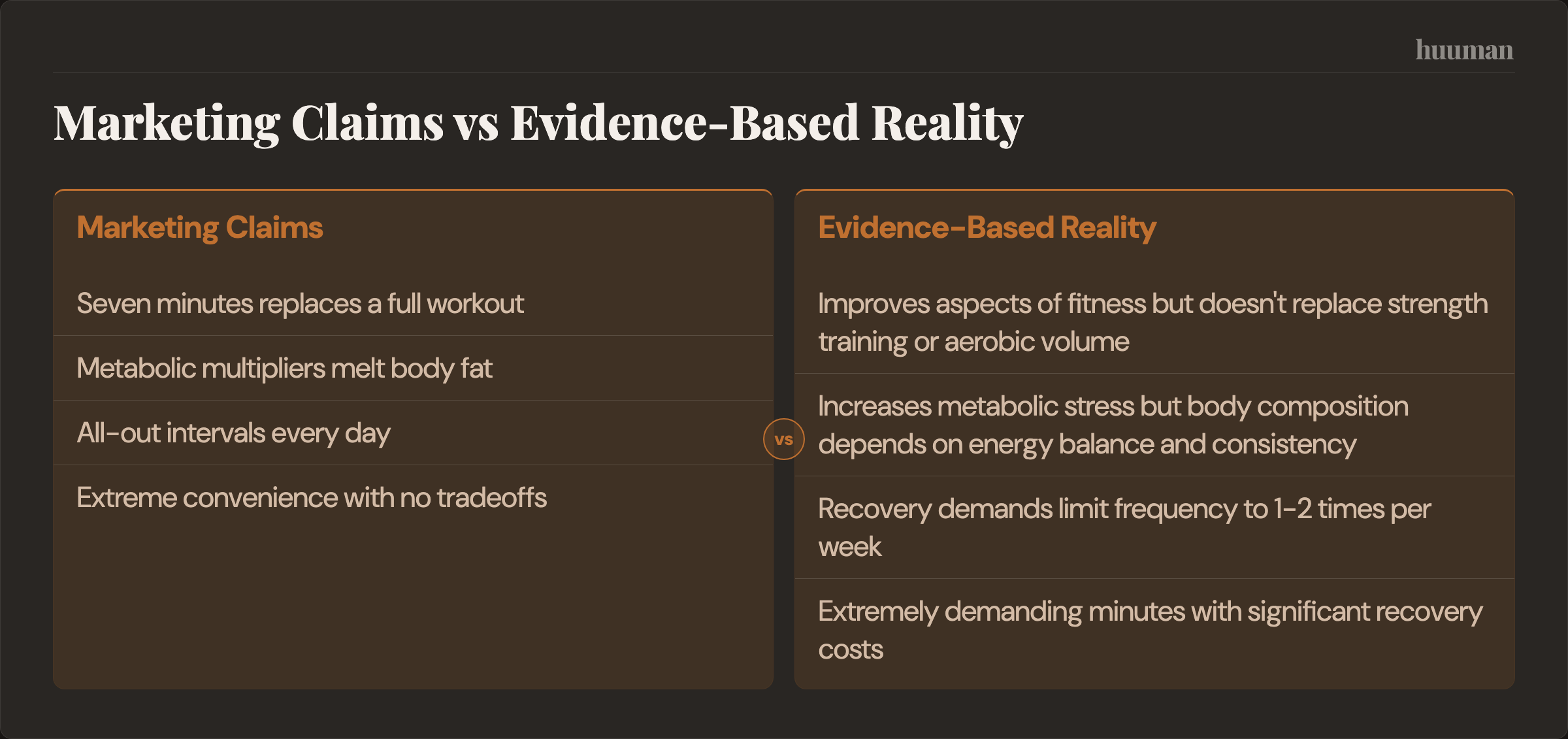
- Marketing claim: "Seven minutes replaces a full workout" — Evidence-aware interpretation: Very short interval sessions can improve aspects of fitness but they do not replace strength training or aerobic volume.
- Marketing claim: "Metabolic multipliers melt body fat" — Evidence-aware interpretation: Intense exercise increases metabolic stress, but long‑term body composition changes depend mostly on energy balance and training consistency.
- Marketing claim: "All‑out intervals every day" — Evidence-aware interpretation: Most training literature limits true maximal efforts to a small number each week due to recovery demands.
- Marketing claim: "Afterburn keeps calories burning for hours" — Evidence-aware interpretation: EPOC exists but usually contributes less additional energy expenditure than marketing implies.
- Marketing claim: "Anyone can do it immediately" — Evidence-aware interpretation: Individuals with health conditions, very low fitness, or joint limitations may need modified approaches.
Some versions of the popular seven‑minute routine combine strength and cardio with short rest periods rather than pure sprint intervals, which can make them more accessible to beginners according to general explanations of the 7‑minute workout.
Strategies for using the one and done idea intelligently
Use it one to two times per week
Many training programs separate intense intervals from low‑intensity aerobic sessions. This spreads stress across the week and supports recovery capacity.
Warm up like an athlete
A short session still needs a warm‑up. A few minutes of light movement followed by two or three gradually faster bursts helps prepare joints and muscles. Skipping warm‑ups is one of the most common injury triggers in short high‑intensity workouts.
Choose a joint‑friendly modality
Cycling, rowing, or using stairs tends to reduce joint impact compared with sprinting or jumping. Bodyweight circuits can also work if movements are scaled appropriately, such as incline push‑ups or supported lunges.
Progress the stimulus slowly
If every workout is the same seven minutes at the same effort, adaptation usually plateaus. Many programs increase the number of rounds first before asking for greater intensity. Recovery weeks also play a role. Approaches like scheduling deloads around training or learning how often you really need to deload help manage cumulative fatigue.
Protocol cards: practical ways to implement a short workout

SIT‑lite (safer entry)
- Segment: Warm-up — Structure: 6–8 minutes easy movement and a few short accelerations
- Segment: Main intervals — Structure: 6 rounds: 20 seconds hard effort paired with 70–100 seconds easy recovery
- Segment: Cool-down — Structure: 3–5 minutes very easy movement
Hard efforts feel close to maximal, roughly an RPE of 8–9 out of 10. Heart rate usually approaches the highest training zones by later repetitions, but heart rate responds slowly during such short bursts, so perceived effort and pace are better guides.
7‑minute bodyweight power circuit
- Round: 1 — Movement options: Squat to stand
- Round: 2 — Movement options: Incline push-up
- Round: 3 — Movement options: Reverse lunge
- Round: 4 — Movement options: Hip hinge or good morning
- Round: 5 — Movement options: Plank variation
- Round: 6 — Movement options: Fast step-ups
- Round: 7 — Movement options: Shadow boxing or low‑impact conditioning move
Each movement lasts about 30 seconds followed by 30 seconds of recovery. The target effort is challenging but technically controlled, roughly RPE 7–8.
Polarized micro-week structure
- Schedule: Minimal — Structure: 1 interval session plus two easy aerobic sessions
- Schedule: Standard — Structure: 2 interval sessions, two easy aerobic sessions, and two strength workouts
- Schedule: Advanced — Structure: 2 interval sessions, multiple aerobic sessions, and two or more strength sessions with regular recovery weeks
This structure protects recovery while still preserving the "one and done" efficiency on hard days.
How to track and interpret changes
The effectiveness of a short workout depends less on the stopwatch and more on adaptation over time. That requires simple tracking.
- Metric: Resting heart rate — What to watch: Morning values over several days, looking for stable or gradually improving trends
- Metric: HRV trend — What to watch: Multi‑day patterns rather than single readings
- Metric: Session RPE — What to watch: How hard the workout felt compared with previous sessions
- Metric: Performance marker — What to watch: Consistency of pace, power, or repetitions across intervals
Tracking only body weight misses most fitness improvements. Cardiorespiratory capacity, recovery speed, and repeatability of hard efforts provide more accurate signals.
Signal vs noise in tiny workouts
- "Metabolic multiplier" language: the real signal is training stimulus. Focus on effort consistency rather than marketing terminology.
- Daily maximal intervals: persistence matters more than extremes. Scale back and add easy aerobic sessions instead.
- Skipping warm‑ups: treat them as mandatory even for short workouts. A few minutes dramatically lowers joint stress.
- Scale weight obsession: evaluate fitness changes through performance and recovery markers.
- Technique breakdown: when movement quality collapses, reduce intensity or choose an easier regression.
- Heart rate confusion: short intervals cause delayed heart rate responses. Use perceived effort as the primary guide.
- Poor sleep or high stress: swap interval sessions for easy movement during those periods.
- Heavy strength programs: if lifting already stresses your nervous system, hard cardio days may need to be limited.
When to consult a professional
- Chest pain, pressure, or unusual shortness of breath during exercise
- Fainting or dizziness associated with exertion
- Uncontrolled blood pressure or known cardiovascular disease
- Sudden neurological symptoms
- Acute joint injuries or swelling that limit movement
- Pregnancy or postpartum situations with unanswered health questions
Common questions
What is the one and done workout, and is it the same as the 7-minute workout?
The phrase typically refers to short high‑intensity interval sessions inspired by Sprint Interval Training. Some programs also label bodyweight circuits lasting around seven minutes as one and done workouts. They overlap but are not identical since sprint intervals are usually closer to maximal intensity.
Is the One and Done Workout science‑based?
Short interval formats studied in exercise physiology research show that small doses of intense effort can improve certain aspects of cardiovascular fitness. Marketing programs sometimes extend these findings beyond what research actually demonstrates, which is why context and recovery planning matter.
Can a 7-minute workout really improve metabolism and fat loss?
Very short workouts can contribute to improved metabolic health if performed consistently alongside other physical activity. Long‑term changes in body composition also depend on nutrition, overall activity levels, and recovery habits.
Is it safe to do all‑out intervals every day?
For most people, daily maximal sessions create excessive recovery demands. Many training frameworks place intense interval workouts only once or twice in a weekly schedule.
How many times per week should I do a one and done workout for longevity?
A common structure described in training literature combines a few intense workouts with easier aerobic sessions that accumulate more total movement time.
What is the best low‑impact version if I have knee or back pain?
Cycling, rowing, elliptical training, or step‑ups often provide lower joint impact compared with sprinting or jumping. Movements can also be regressed, such as using incline push‑ups instead of floor push-ups.
How do I warm up for a short HIIT session if I am short on time?
Spend a few minutes gradually increasing heart rate with easy movement, then perform a couple of brief accelerations that approach workout intensity. This prepares muscles and connective tissues for harder efforts. The ACSM exercise guidelines recommend both aerobic and resistance training for comprehensive fitness.
If you want to integrate short intervals into a complete training structure rather than relying on them exclusively, your huuman Coach can build personalized weekly plans that balance intense sessions with recovery based on your sleep patterns, stress levels, and training readiness.
More health topics to explore
- Strength, Muscle & Mobility – Overview
- Body Fat Percentage: Normal Ranges, Charts & How to Interpret (Women/Men)
- Dumbbell Strength Training: The Simple Full-Body Plan (2–3 Days/Week)
- Building Muscle in Old Age: Strategies After 50
References
- Lindner et al. — MICT vs HIIT for VO2max in Women (2023)
- Gibbons et al. — ACC/AHA Guidelines for Exercise Testing (1997)
- WebMD — The 7-Minute Workout
- Jelleyman et al. 2015 — The effects of high-intensity interval training on glucose regulation and insuli
- Weston et al. 2014 — Effects of low-volume high-intensity interval training (HIT) on fitness in adult
- Swain DP et al. — Target heart rates for the development of cardiorespiratory fitness (1994)
- Thompson et al. — ACSM's new preparticipation health screening recommendations from ACSM's guideli
- Poon et al. 2024 — High-intensity interval training for cardiometabolic health in adults with metab
About this article · Written by the huuman Team. Our content is based on peer-reviewed research and clinical guidelines. We follow editorial standards grounded in scientific evidence.
This article is for educational purposes only and does not constitute medical advice. Health and training decisions should be discussed with qualified professionals.

