Zone 2 heart rate is the intensity most people use to build an aerobic base: steady work that feels controlled and sustainable. You are moving with purpose, but you can still talk in full sentences. Because the exact number varies from person to person, people often search for a fast calculator to estimate their Zone 2 heart rate range.
Key takeaways
1. Zone 2 sits at roughly 60–70% of your maximum heart rate, the intensity where you can hold a conversation but would struggle to sing. A quick estimate: (208 minus 0.7 × your age) × 0.60 to 0.70.
2. Training in Zone 2 builds mitochondrial density and fat oxidation capacity, the aerobic base that supports every other type of training. Most elite endurance athletes spend 75–80% of their training time here.
3. The talk test is more reliable than heart rate formulas for finding your personal Zone 2. If you can speak in full sentences but feel like you are working, you are likely in the right zone.
The challenge is that several different methods exist. One approach uses a percentage of maximum heart rate. Another uses heart rate reserve. Endurance athletes sometimes define zones relative to lactate threshold. Each can produce a different number.
This guide gives you a simple way to calculate a starting Zone 2 range, explains why methods disagree, and shows how to verify the result with real-world cues like the talk test, breathing, and heart rate drift.
Where Zone 2 fits in the bigger health picture
Zone 2 sits in the middle of the easy aerobic spectrum. It is commonly used to build cardiovascular capacity while staying sustainable session after session. In the huuman perspective, this sits mainly in the Heart and Metabolism areas: improving aerobic efficiency and the ability to produce steady energy.
Steady aerobic work is often discussed together with other signals that shape long-term performance. Your cardiovascular system responds to consistent aerobic work, similar to how strength affects structural resilience and bone health. A good overview of how these elements fit together appears in the Heart & Cardio overview.
Zone 2 also interacts with recovery and lifestyle. If fatigue is high, heart rate tends to drift upward at the same effort. If sleep improves, the same workout can feel easier. Metrics such as resting heart rate and heart rate variability, often discussed in guides like HRV benchmarks by age, can help you interpret those changes.
Quick answer
Zone 2 heart rate is typically described as about 60 to 70 percent of your maximum heart rate. A meta-analysis of maximum heart rate found that: HRmax ≈ 208 − 0.7 × age
Your starting Zone 2 estimate is therefore:
Zone 2 ≈ HRmax × 0.60 to HRmax × 0.70
This is only a rough estimate derived from population averages. In practice, verify the range with the talk test, breathing comfort, and how repeatable the effort feels the next day.
If you take medications or have conditions that alter heart rate, perceived effort and clinician guidance should guide intensity more than formulas.
Once you have calculated your Zone 2 range, consistency matters more than perfect numbers. You can track your Zone 2 sessions with heart rate and RPE through the huuman app to build a clear picture of how different intensities feel across weeks and months.
Calculator: Estimate your Zone 2 heart rate range
Inputs
- Age (required for HRmax estimate)
- Resting heart rate (optional, for Heart Rate Reserve method)
- Measured maximum heart rate (optional override if you know it)
- Lactate threshold heart rate (LTHR) (optional for threshold-based models)
- Preferred method: %HRmax, Heart Rate Reserve (Karvonen), or LTHR-based
Outputs
- Estimated Zone 2 lower and upper heart rate (beats per minute)
- A confidence note: "estimate" or "better estimate" depending on inputs
- A validation checklist: talk test, breathing comfort, steady effort for extended duration
- Reminder: heart rate responds slowly during short intervals, so use pace or perceived effort during sprint work
How the calculations work
Max heart rate estimate
HRmax ≈ 208 − 0.7 × age. This is a population approximation based on meta-analysis of over 18,000 subjects. If you have measured your maximum heart rate during testing, that value can replace the estimate.
%HRmax method
Zone 2 ≈ HRmax × 0.60 to HRmax × 0.70.
Heart Rate Reserve (Karvonen) method
HRR = HRmax − HRrest.
Zone 2 = HRrest + HRR × 0.60 to HRrest + HRR × 0.70.
LTHR-based method
Some endurance training systems define zones relative to lactate threshold heart rate. Zone boundaries vary depending on the model. Educational explanations from companies such as Polar show that threshold-based systems typically place Zone 2 below the first ventilatory or lactate threshold, making it comfortably sustainable aerobic work. Recent research suggests that heart rate variability-derived thresholds may provide alternative methods for determining these exercise intensity boundaries.
Example A: age-only estimate
- Age: 40
- HRmax estimate: 208 − 0.7 × 40 = 180 bpm
- Zone 2: about 108 to 126 bpm
- Confidence: rough estimate
Example B: age plus resting heart rate
- Age: 40
- Resting HR: 60 bpm
- Estimated HRmax: 180 bpm
- Heart rate reserve: 120 bpm
- Zone 2 using HRR: about 132 to 144 bpm
- Confidence: better estimate
Example C: measured max heart rate override
- Measured HRmax: 192 bpm
- Using 60 to 70 percent method
- Zone 2: roughly 115 to 134 bpm
- Confidence: better estimate than age formula
What Zone 2 actually feels like
Zone 2 is often described as "conversational aerobic work." It sits just above very easy movement (Zone 1) but below moderately hard efforts (Zone 3).
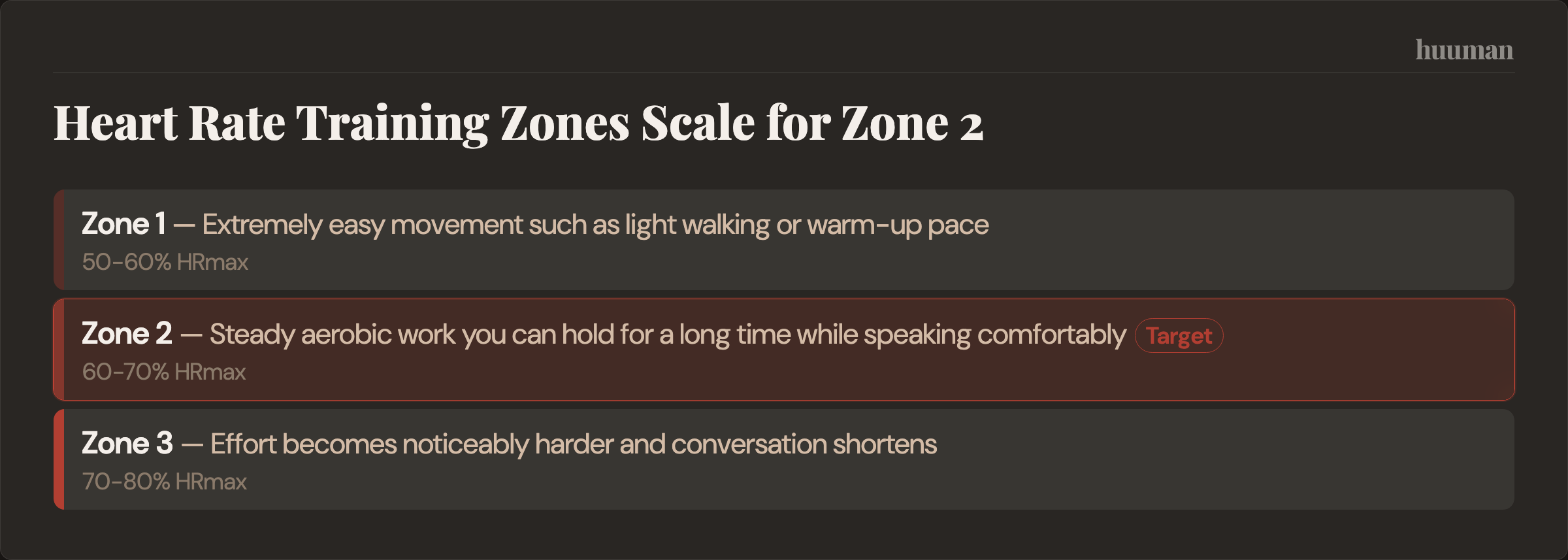
- Zone 1: extremely easy movement such as light walking or warm-up pace
- Zone 2: steady aerobic work you can hold for a long time while speaking comfortably
- Zone 3: effort becomes noticeably harder and conversation shortens
Clinical explanations emphasize that Zone 2 should feel controlled, not exhausting. The point is repeatability. Sessions should leave you able to train again soon.
Why different methods produce different numbers
Three common systems define training intensity using different anchors.
- % of max heart rate
Requires only your age. Quick and simple but based on population averages. - Heart Rate Reserve (Karvonen)
Accounts for resting heart rate, which varies widely among individuals. Often closer to perceived effort than %HRmax. - Threshold-based systems
Used by experienced endurance athletes. Zones are defined relative to physiological thresholds such as lactate threshold or ventilatory thresholds.
These approaches disagree because they reference different physiology. Maximum heart rate describes your absolute ceiling. Heart rate reserve incorporates your resting state. Threshold systems anchor to metabolic changes during harder exercise.
Without laboratory testing, none of them is perfectly precise. That is why real-world validation matters.
Zone 2 for different populations
Zone 2 heart rate ranges are not one-size-fits-all. How the zone feels and what it achieves depends heavily on your starting point:

- Sedentary beginners: Your Zone 2 may feel surprisingly easy — often just brisk walking. That is correct. Do not push harder because it "doesn't feel like exercise." Adaptation happens at this intensity. Zone 2 heart rate ranges can vary widely based on individual fitness.
- Recreational athletes (30–45): Zone 2 often involves a pace where you can hold a conversation with occasional pauses. If you cannot speak in full sentences, you are likely above Zone 2.
- Older adults (55+): Lower maximum heart rate with age means a narrower Zone 2 range. Formula-based estimates become less reliable with age. If available, a lactate threshold test or a talk test provides better guidance than any formula.
- People on beta-blockers: These medications lower heart rate independent of effort. Standard heart rate zones do not apply. RPE (rating of perceived exertion) or a supervised exercise test is the only reliable guide.
The universal principle: Zone 2 should feel sustainable. If you could not maintain it for 45–60 minutes, you are probably too high.
How to verify you are actually in Zone 2
Heart rate alone does not define Zone 2. Combine your calculated number with simple observational cues.
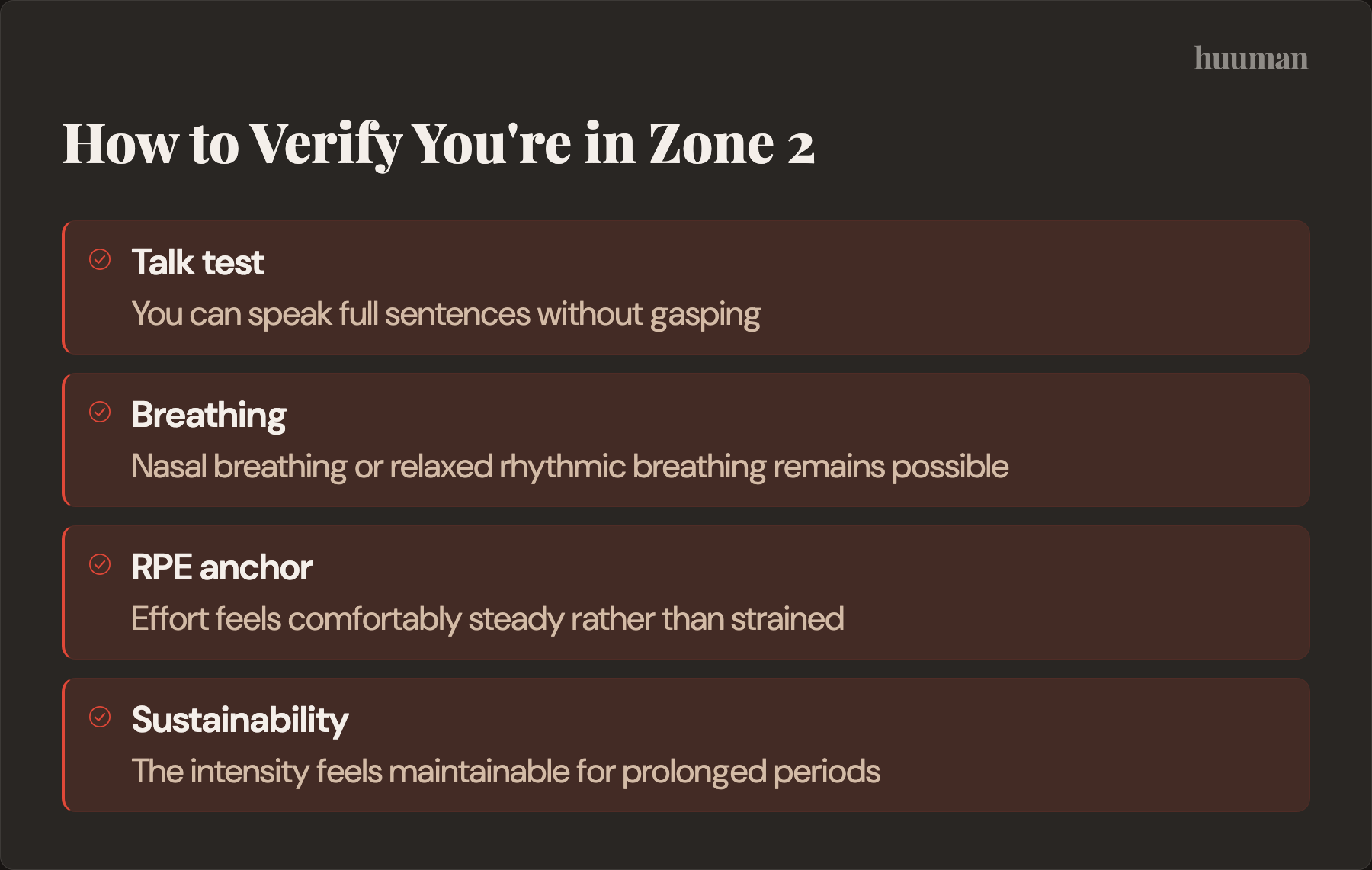
- Talk test: you can speak full sentences without gasping.
- Breathing: nasal breathing or relaxed rhythmic breathing remains possible.
- RPE anchor: effort feels comfortably steady rather than strained.
- Sustainability: the intensity feels maintainable for prolonged periods.
Many coaches monitor heart rate drift to judge aerobic efficiency. During long steady work, fatigue, heat, or dehydration can cause heart rate to rise even when pace stays unchanged. Seeing less drift over time generally suggests improved aerobic conditioning.
You can connect these cues using the huuman Zone 2 Triangle.
- Number: your calculated heart-rate band.
- Feel: talk test and perceived effort.
- Output: pace, cycling power, or rowing split.
Use at least two corners during every session. Check all three once a month.
Wearables and heart rate accuracy
Most fitness watches measure heart rate with optical sensors at the wrist. These rely on small light-based signals called photoplethysmography.
They work well for steady exercise but can struggle with motion artifact, cold skin, or rapid intensity changes. Chest strap monitors usually track electrical signals from the heart directly during exercise and tend to provide more stable readings in endurance sessions.
Common issues that cause unusual readings include:
- Loose wrist strap or poor contact
- Cadence lock when wrist movement syncs with running stride
- Cold environments reducing blood flow to the skin
- Abrupt accelerations or downhill running
If the number looks wrong, rely on effort cues first.
Evidence and limits
Heart rate zones are approximations. They come from population-level observations and laboratory measurements of physiological thresholds.
Guides from cardiology and sports medicine organizations show that moderate aerobic intensities typically fall within a percentage band of maximum heart rate, which is why the 60 to 70 percent range is widely used for introductory Zone 2 estimates. Educational resources like Cleveland Clinic's explanation of Zone 2 cardio and the Polar heart rate zones guide describe this intensity as sustainable aerobic work.
The formulas that estimate maximum heart rate also have large individual variation. The meta-analysis equation of 208 − 0.7 × age is based on over 18,000 subjects but can still differ substantially from a person's measured maximum heart rate. This uncertainty means that formulas alone should not define your training intensity. Research on wrist-based optical sensors across skin tones has examined how heart rate accuracy can vary during exercise.
Several conditions also change heart rate response. Medications such as beta blockers lower heart rate during exercise. Stimulants can increase it. Thyroid disorders, anemia, infection, pregnancy, and dehydration may all alter heart rate behavior. In these situations, perceived effort and clinician guidance are more reliable anchors than numeric targets.
Non-prescriptive strategies to use Zone 2 effectively
Picking your method
- Start with the simple percentage of max heart rate.
- If you know a reliable resting heart rate, the Karvonen method often aligns better with perceived effort.
- If you train seriously for endurance sports, threshold testing may refine zone boundaries further.
Minimal effective dose for busy schedules
Some people use shorter intervals of steady aerobic work because time is limited. Sessions of around twenty to forty minutes a few times per week are often discussed as a practical starting point for busy professionals. Approaches that prioritize efficiency are described in training ideas like the one-and-done workout approach.
Foundational aerobic base
Endurance programs frequently include multiple steady sessions each week lasting thirty to sixty minutes or longer. The goal is consistent aerobic exposure without drifting into harder intensities too often.
Balancing intensity
Zone 2 does not replace every other type of training. Understanding where Zone 2 sits within the bigger picture of longevity and cardiovascular health is explored in depth in how VO2max predicts mortality risk. Many weekly plans include occasional higher-intensity intervals such as those described in HIIT for cardio. Those sessions are usually limited because they require longer recovery.
Modalities that work well
- Incline walking or hiking
- Running or run-walk intervals
- Cycling outdoors or indoors
- Rowing ergometer
- Elliptical trainer
- Swimming or pool running
- Rucking with a light pack
Broader metabolic context
Some people combine aerobic training with metabolic experiments such as fasting protocols or tracking ketosis markers. Guides like understanding the Dr. Boz ratio or explorations of what happens during an 84-hour fast show how metabolic signals interact with training decisions. These approaches remain highly individual and should be interpreted alongside overall recovery.
Longevity-oriented routines
Long-term health approaches such as Bryan Johnson's Blueprint protocol often include consistent aerobic training together with strength work and sleep tracking. The core theme remains sustainability.
How to track changes over time
Instead of chasing a perfect Zone 2 number, look for trends.
- Your pace or cycling power at the same Zone 2 heart rate gradually increases.
- Your heart rate during the same route or power output trends slightly downward.
- Long steady sessions show less upward heart rate drift.
- Recovery signals such as resting heart rate, sleep quality, and perceived soreness stay stable.
Heart rate variability can also provide context. It reflects nervous system balance and recovery state, but it should be interpreted cautiously. HRV is a decision-support tool, not an oracle.
Signal vs noise in Zone 2 training
- Signal: you can speak full sentences comfortably. Next step: confirm that breathing stays controlled as duration increases.
- Signal: the effort feels repeatable the next day. Check whether fatigue accumulates across multiple sessions.
- Signal: pace or power improves at the same heart rate over weeks. Keep conditions consistent when measuring.
- Noise: chasing one exact bpm as the only true Zone 2 number. Treat ranges as bands, not single values.
- Noise: comparing your Zone 2 heart rate with other people. Focus on individual physiology instead.
- Noise: assuming wrist heart-rate readings are perfect during hills or intervals. Validate with perceived effort.
- Noise: forcing Zone 2 to feel hard. Controlled aerobic intensity should not feel like a race.
- Noise: believing Zone 2 alone replaces strength or speed training. Consider broader capacity goals such as how to increase your VO2max.
The real value of Zone 2 training emerges from consistent application over months, not individual sessions. Rather than guessing at the right weekly volume and recovery balance, let your huuman Coach build personalized weekly plans that adapt Zone 2 work to your sleep quality, training history, and readiness signals.
Common questions
How do I know my Zone 2 heart rate without a lab test?
Start with the estimated range from the calculator and validate it with the talk test. If conversation becomes difficult or breathing becomes strained, intensity may be entering Zone 3.
Is Zone 2 best for fat loss?
Energy balance, nutrition, and total training volume matter more than any single intensity. Zone 2 can support consistent activity because it feels sustainable, which may help adherence.
Can my Zone 2 really be 160 bpm?
It can be possible, especially if your true maximum heart rate is higher than the age-based estimate. Testing or observing breathing cues often clarifies whether the effort truly sits in an aerobic zone.
Is Zone 2 walking effective?
Yes. Brisk walking, incline walking, or hiking can place many people in Zone 2. Adjust for hills and heat, which lift heart rate at the same pace.
Should I use % max heart rate or heart rate reserve?
The percent of max method is the simplest starting point. If you know a reliable resting heart rate, heart rate reserve often provides a closer match to perceived effort.
Why does my heart rate drift upward at the same pace?
Cardiovascular drift occurs when fatigue, dehydration, or rising body temperature increase cardiovascular strain during prolonged exercise. Observing less drift over time often indicates improved aerobic efficiency.
More health topics to explore
- Heart & Cardio – Overview
- Cardio Recovery (Heart Rate Recovery): What's "Good" and How to Calculate It
- Heart Rate Variability Chart by Age (HRV): Ranges, Sex Differences, and How to Use Them
- HIIT on an Elliptical: 3 Repeatable Workouts + How to Progress
References
- Hung et al. — Wrist HR Monitor Validity Across Skin Tones (2025)
- Cleveland Clinic — Zone 2 Cardio Overview
- Wright — Health Education Human Services.Wright.Edu
- Tsai et al. — Influence of β-blockers on heart rate recovery and rating of perceived exertion when determining training intensity for cardiac rehabilitation. (2015)
- Bretonneau Q et al. — Parameters Influencing the Accuracy of a Wrist Photoplethysmography Heart-Rat... (2023)
- Navalta et al. — Concurrent heart rate validity of wearable technology devices during trail running (2020)
- American Heart Association — Target Heart Rates
- Zhang Y et al. — Validity of Wrist-Worn photoplethysmography devices to measure heart rate: A ... (2020)
- Tanaka H et al. — Age-predicted maximal heart rate revisited (2001)
- Hung et al. — Validity of heart rate measurements in wrist-based monitors across skin tones during exercise. (2025)
- Coyle et al. — Cardiovascular drift during prolonged exercise and the effects of dehydration. (1998)
- Roy et al. — Validity of the 220-age equation in predicting maximal heart rate. (2018)