A deload is not quitting training. It is a temporary reduction in training stress meant to let fatigue drop while keeping enough routine and skill practice to return to productive work. If you are asking how long to deload, the useful answer is not one fixed number. It depends on how run-down you are, what kind of training you do, and whether the problem is mostly muscle fatigue, joint and tendon irritation, or broader systemic stress.
Key takeaways
1. 2 to 4 days: useful when you feel stale rather than wrecked. Performance is slightly flat, soreness is present but not escalating, and sleep and mood are mostly stable.
2. 5 to 10 days: the common middle option when fatigue is clearly accumulating across several sessions. Sleep quality, motivation, soreness, or bar speed are drifting in the wrong direction.
3. 10 to 14 days: worth considering when multiple signals are down at once, performance has been slipping for more than a week, or joint and tendon irritation is becoming the limiting factor.
This article gives you a practical benchmark: when 2 to 4 days can be enough, when 5 to 10 days makes more sense, and when 10 to 14 days is worth considering. You will also see what to change during a deload, how to separate a deload from a taper or a full rest week, and how to track whether it actually worked.
The goal is consistency. A good deload helps you regain training quality, not prove toughness by squeezing in more fatigue. That fits the broader recovery picture covered in the Sleep & Recovery overview: the point is to stay fit, confident, and capable by managing stress before it snowballs.
Where deloads fit in a training plan
Deloads sit between normal hard training and a true interruption. They are most useful when fatigue has accumulated enough to blur performance, movement quality, or recovery, but not so severely that complete rest or medical evaluation is the real issue. In practice, that makes a deload a recovery tool inside a mesocycle or training block, not a sign that the block failed.
Planned deloads are scheduled in advance because a block is getting denser, heavier, or more stressful. Reactive deloads happen when life stress, travel, poor sleep, illness, soreness, or unexpected performance decline changes the picture. Both are valid. The better choice depends on whether your program is predictable or your recovery is more variable from week to week.
It also helps to separate a deload from a taper. A taper is designed to sharpen performance for competition or testing. A deload is meant to reduce accumulated fatigue and restore training quality. They can look similar because both cut training load, but the purpose is different. A taper aims to peak. A deload aims to reset enough recovery to train well again.
A deload is also not the same as complete rest. Full rest can make sense when you are sick, acutely injured, or clearly not recovering. Most of the time, though, keeping movement patterns and routine is useful. Light exposures preserve technique, coordination, and the habit of training.
Quick answer
For most people asking how long to deload, the clearest benchmark is this: a short deload lasts 2 to 4 days, a standard deload lasts 5 to 10 days, and a longer deload lasts 10 to 14 days. A week is often a practical middle ground because it is long enough to let fatigue drop without losing rhythm.
- 2 to 4 days: useful when you feel stale rather than wrecked. Performance is slightly flat, soreness is present but not escalating, and sleep and mood are mostly stable.
- 5 to 10 days: the common middle option when fatigue is clearly accumulating across several sessions. Sleep quality, motivation, soreness, or bar speed are drifting in the wrong direction.
- 10 to 14 days: worth considering when multiple signals are down at once, performance has been slipping for more than a week, or joint and tendon irritation is becoming the limiting factor.
If performance and sleep are stable, keep the deload short. If several signals are down together, go longer and ramp back more carefully.
If you want a fast reality check before changing your week, run a 60-second deload check with your huuman Coach by looking at symptoms and your last two weeks of performance together.
Why deload length varies
The main reason deload duration varies is that fitness and fatigue are not the same thing. You can still be fit enough to do the work while being too fatigued to express it well. That is why an athlete can feel strong in theory but see slower bar speed, messy reps, unusually hard easy runs, or a lower load at the same RPE in practice.
Not all fatigue is the same. Muscle fatigue after a demanding block is different from tendon irritation, and both differ from systemic fatigue driven by poor sleep, calorie shortfalls, travel, or work stress. DOMS alone can improve quickly. Tendon or joint irritation often needs a more conservative deload because the issue is not just readiness, but tolerance to repeated loading. If you are unsure whether soreness is routine or a warning sign, compare it with patterns described in when soreness means you need more rest.
The distinction between functional overreaching and non-functional overreaching also matters. Functional overreaching is a short period of hard training that may temporarily depress performance but can be part of a productive block if recovery follows. Non-functional overreaching means the fatigue cost is no longer buying useful adaptation and recovery takes longer.
Skill demands matter too. Strength athletes and skill-heavy athletes often want to keep some exposure to familiar movement patterns so technique does not feel rusty. Endurance athletes may need to preserve easy aerobic rhythm while pulling back on harder efforts. Hybrid trainees often get into trouble by deloading lifting while keeping cardio hard, which leaves total stress too high for the deload to do its job.
Deload duration benchmark table
The table below is a coaching benchmark, not a medical protocol. Use it to match the length of the deload to the depth of fatigue and your training type.

- Decision tree: If only one signal is modestly off and performance is still mostly stable, start with 2 to 4 days. If several recovery and performance signals are trending down, use 5 to 10 days. If your decline has persisted, aches are building, and normal warm-up does not improve things, consider 10 to 14 days and a slower return.
Benchmark by fatigue level and training type
- Mild fatigue, strength: 2 to 4 days. Slightly flat bar speed, normal motivation, mild soreness. Keep main lifts light and crisp, reduce total work, leave well before failure. Good endpoint: technique feels clean and usual warm-ups feel normal again. Deloading practices in strength athletes typically involve reducing volume while maintaining movement patterns.
- Mild fatigue, hypertrophy: 2 to 4 days. Pumps and soreness linger more than usual, but sleep and mood are okay. Keep exercises familiar, cut hard sets, avoid chasing burn. Good endpoint: less residual soreness and better session energy.
- Mild fatigue, endurance: 2 to 4 days. Easy pace feels a little harder, but no major drop in recovery. Keep easy work, trim harder intervals first. Good endpoint: easy sessions feel easy again.
- Mild fatigue, mixed training: 2 to 4 days. One mode feels worse than the other. Reduce total stress across both modes instead of protecting one and hammering the other. Good endpoint: less mismatch between legs, lungs, and motivation.
- Moderate fatigue, strength: 5 to 10 days. Rep quality is slipping across sessions, loads feel heavier at the same RPE, irritation is building. Keep movement patterns, lower volume first, use a few lighter exposures. Good endpoint: bar speed and confidence improve without strain.
- Moderate fatigue, hypertrophy: 5 to 10 days. Lingering soreness, poor pumps, reduced motivation, joints feeling beat up. Cut total sets sharply, simplify exercise selection, avoid novelty. Good endpoint: less inflammation-like heaviness and better recovery between sessions.
- Moderate fatigue, endurance: 5 to 10 days. Pace at a fixed HR or RPE is worse, legs feel stale, sleep is worse. Keep easy aerobic work, reduce or remove hard sessions. Good endpoint: stable easy pace and less systemic strain. Recovery from overreaching can take several days to weeks, with aerobic work recovering faster than high-intensity adaptations.
- Moderate fatigue, mixed training: 5 to 10 days. Both lifting and endurance feel compromised. Reduce both rather than compensating with extra conditioning. Good endpoint: one performance marker starts moving back in the right direction. Concurrent training interference can lead to insufficient recovery when both modalities remain demanding.
- High fatigue, strength: 10 to 14 days. Performance has been dropping for more than a week, soreness does not resolve, joints or tendons are talking back. Use a conservative deload with low-stress exposures only. Good endpoint: everyday readiness improves before loading rises.
- High fatigue, hypertrophy: 10 to 14 days. Everything feels costly, exercise motivation is low, appetite or sleep may be off. Simplify training and reduce tissue stress. Good endpoint: normal training desire returns without dread. Recovery from overreaching can occur within a few days or up to two weeks with adequate recovery intervention.
- High fatigue, endurance: 10 to 14 days. Easy work feels hard, pace is down, irritability is up. Keep movement gentle, strip out demanding work, watch recovery signals. Good endpoint: easy efforts stop feeling disproportionately expensive.
- High fatigue, mixed training: 10 to 14 days. Systemic fatigue dominates. A longer reset is often better than a fake deload where one mode stays demanding. Good endpoint: recovery trends improve before you rebuild load. Successful recovery from overreaching can occur within a few days or up to two weeks.
A recent survey of competitive strength and physique athletes confirms that deloading is commonly used in the real world and sheds light on how athletes structure it in real-world deloading practices [1]. That is useful context, but it does not create a universal rule for every athlete, sport, or life situation.
What to change during a deload
If you only remember one thing, let it be this: volume is usually the first lever to reduce. Fatigue is often driven more by the amount of hard work than by the mere presence of training. That means you can often keep some familiar movements and even some moderate intensity, provided total work drops enough.
Volume, intensity, frequency, and exercise selection
- Volume deload: Reduce total sets, reps, or hard efforts while keeping familiar lifts or sessions. Pros: often preserves skill and confidence best. Cons: not enough on its own if joints or tendons are irritated.
- Intensity deload: Lower load or effort, usually by keeping more reps in reserve and avoiding grindy work. RPE and RIR are useful here because they keep the session honest without forcing rigid percentages. Pros: lowers strain and improves rep quality. Cons: if volume stays high, fatigue may linger.
- Frequency deload: Keep fewer sessions, or keep the same number of sessions but make them shorter and easier. Pros: useful for busy weeks, travel, or high overall life stress. Cons: some lifters feel rusty if frequency drops too much.
- Exercise variation deload: Temporarily swap fatiguing or irritating exercises for lower-cost variations. Pros: helpful when specific movements are inflaming joints or tendons. Cons: too much novelty can defeat the point of preserving skill.
The principle is to keep the pattern while reducing the cost. Squat, hinge, push, pull, carry, easy aerobic work, and technical rhythm can stay in some form. The deload should feel easier, not alien.
For strength-focused athletes, a common approach is to keep some intensity exposure but substantially reduce volume. For hypertrophy blocks, dropping hard sets and proximity to failure is often the biggest win. For endurance athletes, the first cut is usually high-intensity work, while easy aerobic movement stays. For mixed training, reduce both sides at once. Do not deload lifting and then replace the fatigue with hard intervals.
Velocity loss can be useful if you already track it, because it reflects how much fatigue is building within a set. But if you do not use it already, a deload is not the time to add complexity. Simpler markers like RPE, rep quality, bar speed feel, or run pace at a fixed easy effort are enough.
Red flag versus normal fatigue
Normal fatigue is expected in training. The question is whether the pattern still looks productive. Use this checklist to decide whether you need the longer end of the how long to deload range.
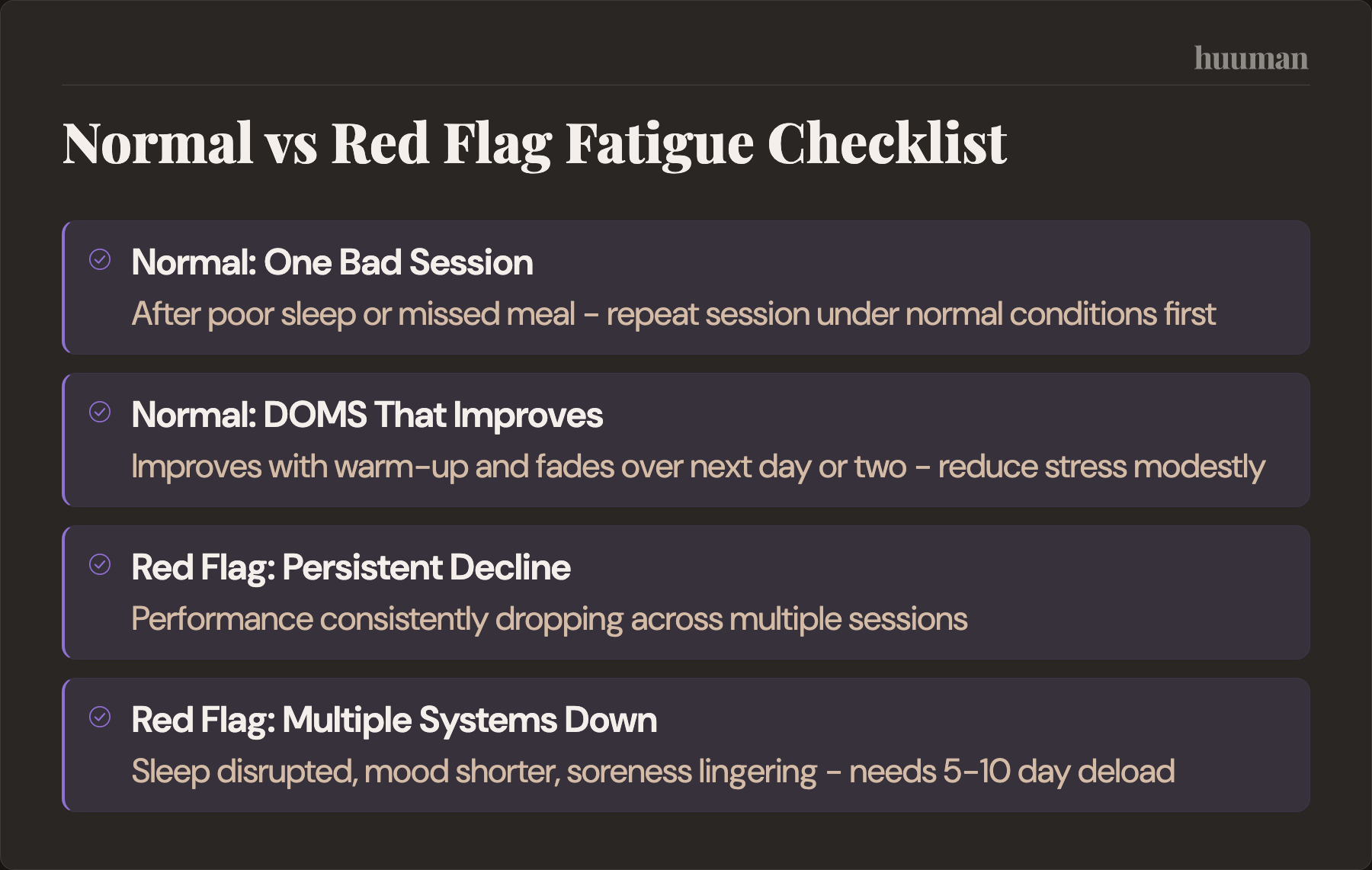
- More likely normal fatigue: one bad session after poor sleep or a missed meal. Next step: repeat the session conditions more normally before changing the week.
- More likely normal fatigue: DOMS that improves with warm-up and fades over the next day or two. Next step: reduce stress modestly and watch whether performance stays intact.
- More likely a red flag: performance drops across repeated sessions, not just one. Next step: move to a standard deload and track a clear performance marker.
- More likely a red flag: soreness is joined by escalating joint or tendon irritation. Next step: reduce exercise stress and consider simpler variations.
- More likely a red flag: sleep quality, irritability, appetite, libido, and motivation are all drifting down together. Next step: use a longer deload and examine life stress and energy intake, not just training.
- More likely a red flag: warm-ups do not restore movement quality the way they usually do. Next step: abandon the idea of testing readiness with hard work that day.
Example scenarios and the minimal effective deload
Scenario A: You feel stale, not broken. A short 2 to 4 day deload can be enough. This often fits the end of a hard stretch when you are slightly flat but still functioning. Keep movement patterns, reduce total work, and avoid hard finishers.
Scenario B: You are run-down. If sleep is down, mood is shorter, soreness lingers, and performance is slipping, 5 to 10 days is usually more realistic. This is the common case where one week works well because it removes enough training stress to let recovery catch up.
Scenario C: You feel crushed. If performance has been down for more than a week, aches are escalating, and normal warm-up no longer restores snap, use the longer end of the range. Ten to fourteen days is not laziness in this context. It may be the difference between returning ready and dragging fatigue into the next block.
Scenario D: You are a hybrid athlete. If you lift and run or cycle, systemic fatigue can hide behind local signals. Legs may feel okay for lifting while your aerobic work has become abnormally costly, or the reverse. Deload both modes together. During a deeper deload, many programs would keep conditioning very easy and limit or remove harder touches.
Scenario E: Busy professional with inconsistent sleep or travel. The minimal effective deload can be 3 to 4 days of maintenance training with reduced total work, extra walking, and more sleep opportunity. The goal is not to optimize the perfect deload. It is to stop digging the hole deeper while keeping the habit intact. Articles on what counts as good sleep efficiency, deep sleep needs during a deload, and how sleep score relates to deload quality can help you interpret the recovery side more realistically.
Evidence suggests that sleep duration is associated with mortality risk, highlighting why prioritizing adequate sleep during deload periods supports both immediate recovery and long-term health.
Evidence and limits
The evidence base for deloading is mixed. There is useful practice data, broad training theory, and stronger literature on tapering than on deloads specifically. That matters because many claims online sound precise but rest on coaching convention more than direct head-to-head trials.
The survey of strength and physique athletes is helpful because it shows deloading is a real and common practice, not just internet folklore survey of 246 athletes. But it is still self-reported practice. It tells you what athletes do, not what is optimal for every case.
Tapering research is more robust, especially for the general principle that reducing training load can maintain or improve performance when fatigue falls. A meta-analysis on tapering supports the idea that a period of reduced training load can improve readiness and performance expression reduced training load can enhance performance. Still, tapering and deloading are not identical. A taper targets peaking. A deload targets recovery and restored training quality inside ongoing training.
Evidence is also stronger for the concepts of overreaching than for exact deload formulas. The line between functional overreaching and non-functional overreaching is conceptually useful, but in real life it is messy. Athletes differ in training age, work capacity, sleep, energy availability, and skill demands. That is why rigid calendar rules are weaker than trend-based decision-making.
Two specific limitations are worth stating clearly. First, there is limited direct evidence pinning down one ideal deload duration for all lifters or endurance athletes. Second, popular tracking signals like RHR, HRV, sleep, mood, and libido are informative only in context. They are not diagnostic on their own, and HRV in particular should be treated as a trend signal rather than proof that you are overtrained. Because the supplied sources do not directly cover all tracking claims, the practical guidance below should be understood as evidence-aware coaching heuristics, not a medical protocol.
Non-prescriptive strategies to discuss with a professional
If you are deciding how long to deload, a useful conversation with a coach or clinician usually starts with the bottleneck. Is the problem local tissue stress, systemic fatigue, or poor program fit? The answer changes the solution.
- If the issue is mostly muscle fatigue: a shorter deload with preserved movement skill may be enough.
- If joints or tendons are the limiter: exercise selection and loading pattern may matter more than simply taking a few easy days.
- If life stress is high: frequency and session length may need to drop, even if gym intensity looks modest on paper.
- If energy availability seems low: review nutrition, because a deload cannot fully compensate for chronically under-supported training. Context from calorie expenditure during deload weeks and even temporary body fat changes during a deload can help interpret normal fluctuations more calmly.
- If your training is strength or physique focused: compare your plan with sport-specific ideas in deload strategies for bodybuilders.
If symptoms are persistent, unusual, or getting worse despite backing off, that moves beyond normal deload decision-making.
How to track and interpret changes
Do not judge a deload only by how you feel on one day. Use a small dashboard and look for trend reversal. For most people, three recovery signals and one performance marker are enough.
- Recovery signal 1: sleep. Watch duration and perceived quality. If you use wearables, also consider stage consistency and recommended sleep duration by age as general context. The toddler and baby sleep pages in the internal library are not relevant to adult deloading, so focus on adult recovery interpretation instead.
- Recovery signal 2: resting heart rate. Compare it with your normal pattern, not someone else's number.
- Recovery signal 3: HRV trend. Interpret it as a rolling pattern, not a verdict from a single morning. For broader context, see HRV trends that signal readiness to train and monitoring HRV during deload periods.
- Performance marker: pick one repeatable sign. Examples include load at a given RPE, rep quality and bar speed feel, jump height if you already use it, or run pace at a fixed easy HR or RPE.
What counts as success? Not perfection. You want to see easier warm-ups, better rep crispness, more normal motivation, and at least one objective marker drifting back toward baseline. For interval work, remember heart rate often lags during short repeats, so pace and RPE are often more useful execution guides than trying to force HR targets in the moment.
If you want to make this easier to read over time, set a 7-day baseline in the huuman app for sleep, RHR, and session markers so deload decisions are based on trends instead of guesswork.
7-day ramp-back example microcycle
A deload is only half the decision. The other half is how you return. The common mistake is to feel better on day one and immediately chase max effort.
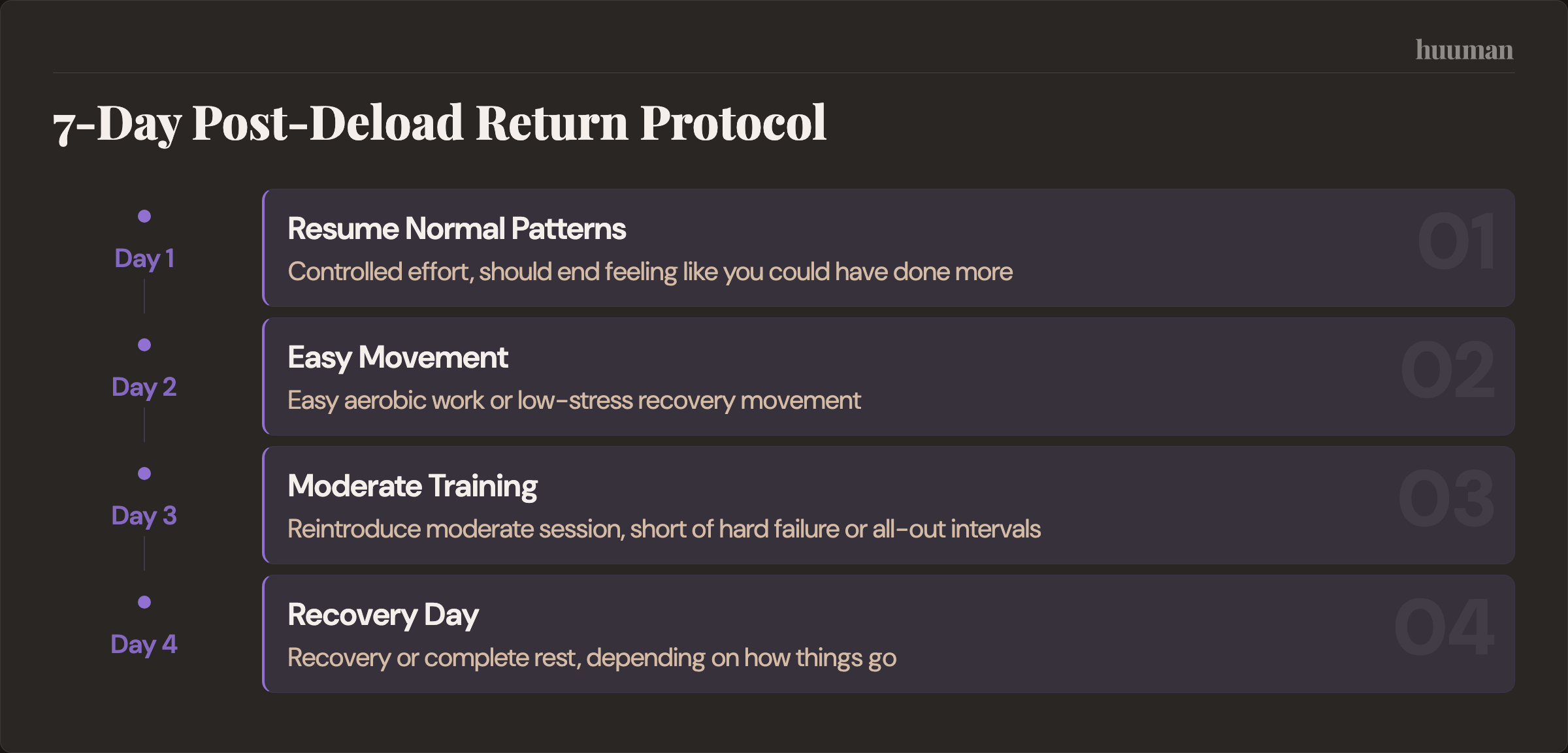
Standard ramp-back
- Day 1: Resume normal movement patterns with controlled effort. Session should end feeling like you could have done more.
- Day 2: Easy aerobic work or low-stress recovery movement.
- Day 3: Reintroduce a moderate training session, still short of hard failure or all-out intervals.
- Day 4: Recovery or complete rest, depending on how the first two exposures felt.
- Day 5: Return to a more typical session if recovery markers and performance are stable.
- Day 6: Low-stress aerobic work, technique, mobility, or rest.
- Day 7: Resume the next week based on what the last three sessions actually showed, not what the program said on paper.
Conservative ramp-back
- Day 1 to 2: Two easy exposures only, focused on movement quality.
- Day 3: Rest or low-intensity cardio.
- Day 4: Moderate session with strict RPE control.
- Day 5: Recovery day.
- Day 6: Second moderate session.
- Day 7: Decide whether the next week should still be slightly under normal load.
If you needed a 10 to 14 day deload, the conservative version is often the smarter choice. Better to rebuild momentum than test it recklessly.
Signal vs noise
- Repeated performance drops across sessions are a signal. One sloppy workout can be random. Three in a row usually means something changed. Track the same lift or pace next week before you assume motivation is the only issue.
- A rising resting heart rate versus your usual pattern is a signal. Do not obsess over one morning. Compare several days and see whether it matches poorer sleep or heavier perceived exertion.
- An HRV slide for several days alongside poor sleep is a signal. HRV alone is noisy. Pair it with sleep and performance, then adjust the next few days rather than forcing a hard session.
- One bad session after poor sleep or poor fueling is noise. Recreate more normal conditions first and then reassess.
- DOMS alone is often noise. Soreness can be a normal response to novelty or high volume. Judge it by whether movement quality and output are also down.
- Joint pain that increases as the session goes on is a signal. That suggests a loading or exercise-tolerance issue. Swap the movement or ease the stress instead of trying to push through.
- Scale weight fluctuations are usually noise. Glycogen, sodium, travel, and stress can move body weight quickly. Watch trends, not single weigh-ins.
- Motivation collapse plus irritability is a signal. When psychology and performance decline together, treat it as recovery information, not a character flaw. Shorten the week and monitor the bounce-back.
- Technique breakdown at loads that used to feel routine is a signal. When skill falls apart early, fatigue may be masking fitness. Keep the pattern light and tidy rather than grinding.
Common questions
How long does a deload last for most people?
In practice, about a week is the most common simple answer because it fits normal weekly structure and is often enough to reduce fatigue without losing rhythm. But the more useful rule is to match duration to fatigue severity: a few days for mild staleness, closer to one week for clear accumulated fatigue, and up to two weeks when multiple recovery and performance signals are down.
Is a 3-day deload enough, or do I need a full week?
A 3-day deload can be enough if the issue is mild and recent. It is less likely to be enough if performance has been slipping across several sessions, sleep has worsened, or aches are building. The shorter option works best when you are still functioning well and just need fatigue to drop slightly.
When should a deload be 2 weeks?
Two weeks becomes more reasonable when you are not just tired, but clearly not recovering. Examples include persistent performance drop, poor motivation, worsening joint or tendon irritation, and a sense that even easy work feels expensive. The longer option also makes more sense if the return will be ramped conservatively rather than jumping straight back to full load.
Should I deload by reducing weight, sets, or days in the gym?
Usually start by reducing volume, because total hard work is often the main fatigue driver. Then reduce intensity or frequency if needed. If a specific movement is irritating, change exercise selection while keeping the broader pattern. The right combination depends on whether your limiter is muscle fatigue, tissue irritation, or life stress.
Can I still do cardio during a deload?
Usually yes, but make sure it actually supports the deload. Easy aerobic work often fits well. Hard conditioning is different. If you are highly fatigued, aggressive HIIT usually undermines the point of deloading. For hybrid athletes, this is the most common trap.
Should beginners deload, and how often?
Beginners may need formal deloads less often because absolute loading and total volume are lower, and simple progress can continue for a while. They still benefit from easier weeks when life stress is high, soreness is excessive, or technique is degrading. Frequency is less about a fixed calendar and more about what the recovery and performance trends are showing.
How do I know my deload worked, and when do I ramp back up?
A useful deload usually shows up as improved warm-ups, better rep quality or pace at the same effort, less irritability, and more normal sleep or motivation. Ramp back once you see trend improvement, not because the calendar says the deload is over. If objective and subjective markers are still poor, extend the easier period or return more slowly.
If you want help matching your fatigue signals to a practical next step, share your training week with your huuman Coach for non-medical decision support and use your recent sessions, sleep, and recovery trends to choose the next move.
More health topics to explore
- Sleep & Recovery overview
- Sleep Duration at Age 3: Guidelines, Naps & a Practical Reality Check
- How Often to Deload: Frequency, Triggers, and 3 Deload Week Templates
- Deep Sleep Pillow Spray: What It Is, Whether It Works, and How to Choose Safely
References
- Rogerson D et al. — Deloading Practices in Strength and Physique Sports: A Cross-sectional Survey (2024)
- Bosquet et al. — Effects of Tapering on Performance (2007)
- Cappuccio FP et al. — Sleep duration and all-cause mortality: a systematic review and meta-analysis... (2010)
- Bellinger P — Functional Overreaching in Endurance Athletes: A Necessity or Cause for Concern? (2020)
- Rogerson D et al. — Deloading Practices in Strength and Physique Sports: A Cross-sectional Survey (2024)
- Physiopedia — Overtraining Syndrome
- Cleveland Clinic — Overtraining Syndrome: Symptoms, Causes & Treatment Options
- NSCA — Overtraining