Greasing the Groove is an unusually simple idea: practice a movement often, but always while fresh. No exhausting sets, no long workouts, just many small reps spread throughout the day. That's exactly what makes this method appealing if you have a busy schedule or feel stuck in a plateau.
If you're stuck on pull-ups, want cleaner push-ups, or are trying to stabilize a skill like a handstand, this approach can be surprisingly effective. Not because it's "harder," but because it's more targeted.
Key takeaways
1. Stay far from failure: usually with about 3–5 reps in reserve (RIR).
2. Spread it throughout the day: several mini-sessions instead of one long workout.
3. One exercise per block: focus keeps quality high.
Here's what's behind Greasing the Groove, how to choose your set size, how to fit it into your day, and how to track progress without constantly pushing to your limit.
Where Greasing the Groove fits in
Greasing the Groove (often abbreviated GtG), popularized by Pavel Tsatsouline, is closer to "practicing a movement" than traditional strength training. While many programs emphasize volume and training close to failure, GtG focuses on repetition quality and frequency.
The approach emphasizes better muscle recruitment. You're training your nervous system to perform the movement more efficiently and consistently.
Within the broader context of Strength & Movement overview, GtG is a tool for specific sticking points: one exercise you want to improve without dramatically increasing your overall training volume.
Quick answer
Greasing the Groove (GtG) means performing a single exercise multiple times per day in very easy, submaximal sets to improve technique and neural efficiency without building significant fatigue.

- Stay far from failure: usually with about 3–5 reps in reserve (RIR).
- Spread it throughout the day: several mini-sessions instead of one long workout.
- One exercise per block: focus keeps quality high.
Common heuristics from practice and popular guides suggest roughly 40–70% of your maximum per set, often simplified as "about half your max reps", and multiple mini-sets per day with plenty of rest between them.
If you're serious about tracking your progress without constantly testing your max, log your daily GtG sessions and technique quality with the huuman app to see patterns in your strength gains over weeks, not just individual workouts.
Why Greasing the Groove works
The key driver is neural efficiency. Your body learns to activate the involved muscles more effectively, both in how muscles work together and how precisely each muscle is controlled.
High frequency with low fatigue is ideal for this. Once you get tired, technique breaks down and you start reinforcing sloppy reps. GtG flips that: every rep should look the same.
It also explains the specificity. You get better at exactly what you practice. More pull-ups come from doing pull-ups, not primarily from general pulling exercises.
Who it works best for
GtG is especially useful if you:
- have a clearly defined goal exercise (e.g., your first pull-up or 10+ reps)
- don't have time for extra workouts but can fit in short sessions during the day
- want to break through a plateau in a specific movement
Use caution if you have existing shoulder or elbow issues, persistent tendon pain, or unexplained discomfort. High frequency may irritate these conditions.
Exercise selection: One movement per block
The best candidates are movements that are easy to standardize, require minimal setup, and can be repeated consistently:
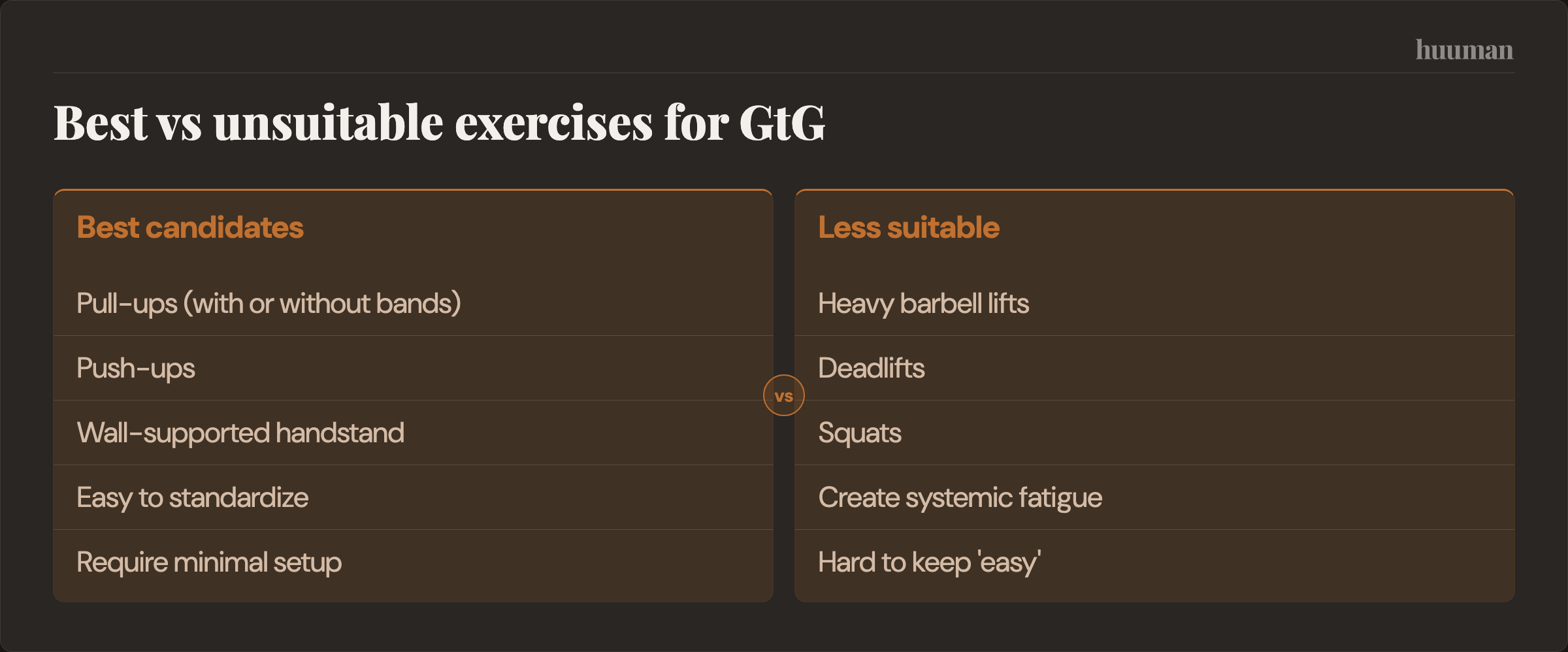
- Pull-ups (with or without bands)
- Push-ups
- Wall-supported handstand
Conditionally suitable are dips or kettlebell swings, if your technique is solid and your tissues tolerate the load. Heavy barbell lifts like deadlifts or squats are less suitable, as they create systemic fatigue and are hard to keep "easy."
If you're unsure how to apply Greasing the Groove at home, simple setups like a pull-up bar or rings go a long way.
Evidence and limitations
Direct studies on Greasing the Groove are limited. Its plausibility comes from well-established principles: motor learning, neural adaptations, and the link between training frequency and technique quality.
Training with light loads (40-55%) produces better strength gains when fatigue is minimized, aligning with GtG's emphasis on staying fresh.
Popular guides and real-world experience provide consistent heuristics for intensity, rest, and frequency. These are practical guidelines, not precise prescriptions.
One important limitation: GtG is specific. It mainly improves the movement you practice. For muscle growth or overall strength, traditional training structures still matter.
How to implement it

Choose the right set size (without failing)
The most important decision is your set size. Too big leads to fatigue; too small limits the stimulus.
- Start conservatively: leave about 3–5 reps in reserve (RIR 3–5).
- Watch your technique: if it breaks down, the set is too large.
General guidelines (adjust individually):
- Max 3 pull-ups: use 1 rep per set
- Max 5–8: use 2–3 reps
- Max 10–15: use 4–6 reps
Frequency and rest
Most approaches use multiple mini-sessions per day with sufficient spacing. Rest periods can range from several minutes to several hours between sets.
In practice: tie your mini-sessions to existing habits like coffee breaks, calls, or short pauses in your day.
Progression over weeks
A common approach:
- Week 1: start very conservatively
- Weeks 2–4: increase the number of mini-sessions first, then slightly increase set size
- Week 5: reduce volume or take a break
For context on why this matters, see why regular deloads are important to help prevent overload.
Integrating with your strength training
GtG doesn't replace training, it complements it. If you're also doing pulling or pushing workouts, it can help to slightly reduce volume in your main sessions.
If you're unsure how to build a solid training plan, think in movement patterns: pulling, pushing, hip extension.
Protocol card 1: Pull-ups
- RPE 5–7, RIR 3–5
- 3–8 mini-sessions per day
- Perfect form, optionally slow eccentrics
Protocol card 2: Push-ups
- Stable core, controlled movement
- Multiple daily practice sessions
- Progress via variations
Protocol card 3: Wall handstand
- Short holds with reserve
- Focus on alignment and control
- Stop if you feel pain
How to measure progress
GtG works without constantly pushing to your limit, so you need different markers:
- Submaximal reference sets (same conditions, same effort)
- Technique quality
- Perceived effort (RPE)
Max tests are possible, but should be rare and standardized. Testing too often can obscure progress rather than reveal it.
Evidence suggests that submaximal testing is valuable for monitoring training adaptations without the stress and recovery demands of max-effort tests.
Additional markers:
- Sleep quality
- Resting heart rate
- Local pain (0–10 scale)
HRV can help guide decisions, but it's not definitive.
Signal vs. noise
- More sets aren't automatically better. Check how your joints feel the next day.
- If you're hitting your limit, it's no longer GtG. Reduce the set size.
- Elbow or shoulder pain isn't a "normal stimulus." Pause and reassess.
- Daily training is optional. Consistency matters more than maximum frequency.
- Too much variation dilutes the skill. Stick to one clear movement.
- Mini-sessions while fatigued lose value. Wait until you feel fresh.
- Testing max strength too often distorts your sense of progress. Plan it deliberately.
- If sleep or stress declines, reduce frequency first.
Common questions
How many reps are ideal?
Enough that you always feel confident you could do several more clean reps. A rough guideline is about half your max, but quality matters more than the number.
Do I have to do GtG every day?
No. Many programs use 3–6 days per week. More important than daily frequency is staying fresh between sessions.
Does it work for muscle growth?
Possibly to some degree, but that's not the main mechanism. Traditional training with higher volume and proximity to failure is more strongly associated with hypertrophy.
Can I train multiple exercises at once?
You can, but it's usually less effective. One exercise per block keeps focus high and reduces overload risk.
What should I do if I feel pain?
Pain that lasts more than 24–48 hours or gets worse may signal a need to reduce volume or pause.
How long should a block last?
Typically 4–6 weeks, followed by a lower-volume phase or a change in exercise.
Rather than guessing whether you're doing too much or too little, your huuman Coach can build weekly plans that integrate GtG work with your regular training and adjust frequency based on how your joints and energy levels respond day to day.
More health topics to explore
- Strength, Muscle & Mobility – Overview
- Dumbbell Strength Training: The Simple Full-Body Plan (2–3 Days/Week)
- Chest Day: A Shoulder-Friendly Approach
- Cellulite Strength Training: The 12-Week Plan
References
- Sale DG — Neural adaptation to resistance training (1988)
- Gabriel DA et al. — Neural adaptations to resistive exercise: mechanisms and recommendations for ... (2006)
- ACSM — Progression Models in Resistance Training (2009)
- Michel et al. — Well-being as a performance pillar: a holistic approach for monitoring tennis pl (2023)
- Rong W et al. — Effects of strength training on neuromuscular adaptations in the development ... (2025)
- Rodiles-Guerrero L et al. — Effects of Velocity Loss During Bench-Press Training With Light Relative Loads (2024)
- Shushan T et al. — Submaximal Fitness Tests in Team Sports: A Theoretical Framework for Evaluati... (2022)
- Schoenfeld BJ et al. — Dose-response relationship between weekly resistance training volume and incr... (2017)