
The Blueprint Protocol is a highly structured longevity routine created by entrepreneur Bryan Johnson. It combines standardized meals, training, sleep routines, biomarkers, and a large supplement stack in an attempt to optimize health metrics and track biological aging.
The attention around Blueprint comes from its intensity. Johnson treats health like an engineering problem: lock the inputs, measure everything, and iterate based on data. For some people, that level of structure is intriguing. For others, it raises obvious questions about evidence, costs, and whether copying the protocol actually makes sense.
Key takeaways
1. Health improves when sleep, training, and nutrition are consistent and measured.
2. Strength training and aerobic fitness remain central longevity drivers.
3. Minimally processed meals with sufficient protein and fiber support metabolic health.
A more useful perspective is to treat Blueprint as a system design. It highlights how consistent behaviors, measurement, and feedback loops can shape long term health. The challenge is separating the elements supported by strong research from those that remain experimental or highly individualized.
This guide explains what the Blueprint Protocol actually includes, where the evidence is strong, where uncertainty remains, and how to adapt the underlying principles safely without copying an extreme supplement stack.
Where Blueprint Fits in the Bigger Picture of Health and Longevity
The Blueprint Protocol touches almost every area that influences long term health. It organizes daily behaviors and measurements into a tightly controlled routine. From a practical perspective, most of the components fall into five broad capability areas.
- Heart: cardiovascular fitness, blood pressure, lipid markers like LDL cholesterol and ApoB, and aerobic capacity markers such as VO2max.
- Frame: muscle mass, strength performance, mobility, and body composition metrics like waist size or fat mass.
- Metabolism: nutrition patterns, energy balance, glucose regulation, protein and fiber intake, and markers like fasting glucose and HbA1c.
- Recovery: sleep quantity and consistency, stress management, readiness signals, and metrics such as HRV tracked by wearables.
- Mind: habits, adherence, psychological sustainability, and avoiding obsessive tracking or orthorexia.
This structure mirrors what many performance and preventive medicine frameworks emphasize. Long term health rarely depends on a single "hack." It emerges from a small set of systems working reliably over years.
The huuman perspective focuses on the same idea. Instead of copying every element of an advanced longevity protocol, the goal is to turn your health data into a clear picture and build ongoing coaching to improve key metrics so you can stay fit, confident, and capable in every phase of life.
Quick answer
The Blueprint Protocol is Bryan Johnson's personal longevity system built around strict routines for sleep, nutrition, exercise, biomarkers, and supplements. It standardizes daily inputs and tracks a large number of biomarkers to evaluate biological aging and health trends. Official protocol details are published on Johnson's site and documentation pages.
What matters most for most people is not replicating the entire stack. The core insights are much simpler:
- Health improves when sleep, training, and nutrition are consistent and measured.
- Strength training and aerobic fitness remain central longevity drivers.
- Minimally processed meals with sufficient protein and fiber support metabolic health.
- Tracking a few meaningful metrics provides feedback for improvement.
- Large supplement stacks and frequent advanced testing sit in a more experimental category.
For most adults interested in longevity, the high return approach is adopting the structure of Blueprint rather than its exact shopping list.
To apply this structured approach practically, you can track your daily sleep stages and efficiency with the huuman app and observe how consistency affects your biomarkers over a 30-day baseline period.
What "Blueprint Protocol" Actually Refers To
The term Blueprint can mean several different things depending on context.
First, there is Project Blueprint, Johnson's personal longevity experiment. This includes carefully controlled behaviors, frequent clinical testing, and professional medical supervision. It functions as a personal N=1 experiment designed to measure the effects of many interventions over time.
Second, Blueprint refers to the public documentation of the system. Johnson has published extensive records describing daily routines, food templates, measurement strategies, and testing protocols on official Blueprint pages.
Third, Blueprint has evolved into commercial products and services. These include meal products, supplements, and simplified consumer versions of the protocol. These offerings differ from the original experimental program because they must work for a broader audience.
The core philosophy behind all versions is the same: treat the body like a system whose inputs can be standardized and optimized while measuring outcomes with biomarkers.
This engineering mindset differentiates Blueprint from typical wellness advice. Instead of constantly changing habits, the protocol emphasizes locking in consistent behaviors and observing measurable trends.
The Core Components of the Blueprint System
Nutrition Patterns
Blueprint nutrition revolves around consistent meals built from minimally processed foods and ingredient templates. Johnson has published set meal structures and recipes designed to deliver predictable macronutrients, fiber, and micronutrients.
From a metabolic perspective, the key concept is consistency rather than novelty. Stable meals simplify measurement and may make it easier to observe how specific dietary changes affect biomarkers like fasting glucose or lipids.
This approach aligns with many nutrition frameworks that prioritize whole foods, protein intake, fiber, and stable energy intake. Johnson has also experimented with fasting patterns, including extended fasting protocols like Blueprint uses, though the relevance and tolerability of such approaches vary widely between individuals.
Food choice likely drives a large share of metabolic outcomes. Supplement strategies should not replace that foundation.
Exercise and Physical Capacity
Training is another central pillar. Blueprint includes multiple exercise modalities designed to maintain both strength and aerobic conditioning.
Within exercise science, programs often combine several elements:
- Resistance training for muscle maintenance and performance.
- Steady aerobic training to build an endurance base.
- Occasional higher intensity intervals.
- Daily movement through steps or other activities.
- Mobility and joint health work.
This multidimensional training reflects consensus health recommendations emphasizing both aerobic and strength capacity.
Blueprint highlights metrics such as VO2max, which is strongly associated with cardiovascular fitness and long term health outcomes. You can explore how Blueprint approaches VO2 max training or the strength side of the system through the resistance training component.
Importantly, effective training does not require extreme volume. Many people benefit from structured programs that focus on minimal effective exercise doses that remain sustainable across busy schedules.
Sleep and Recovery
Recovery is treated as a core input rather than an afterthought. Blueprint places strong emphasis on sleep timing, sleep environment, and nightly routines designed to protect consistent sleep.
Sleep quality strongly influences metabolic health, cognitive performance, immune function, and training recovery. As a result, many of Blueprint's daily rules focus on supporting regular sleep patterns, light exposure management, and reduced evening stimulation.
A large-scale analysis of 92,221 UK Biobank participants found that 7-8 hours of sleep showed the lowest mortality risk, with both shorter and longer durations associated with increased health risks.
Many longevity focused systems track sleep metrics such as duration, timing consistency, and physiological signals captured by wearables. For more context, see strategies for optimizing sleep the Blueprint way.
Biomarker Testing
A defining characteristic of the Blueprint Protocol is the extensive measurement of health markers. Johnson tracks a wide range of physiological indicators including:
- Lipid markers such as ApoB and LDL cholesterol.
- Cardiometabolic markers like fasting glucose, HbA1c, and blood pressure.
- Inflammation signals such as hs CRP.
- Liver enzymes such as ALT and AST.
- Aerobic capacity and strength measures.
- Body composition including waist and fat mass.
Wearable technology also plays a role. Metrics like sleep duration, heart rate variability, and activity levels offer continuous feedback when interpreted carefully. For example, some longevity communities emphasize HRV tracking as Blueprint recommends to gauge recovery trends.
Not all measurements carry equal signal. Many people benefit from a small group of core metrics while advanced biomarkers may add complexity without improving decisions.
Supplements
The Blueprint supplement stack receives significant attention. It includes many compounds ranging from common nutrients to compounds often discussed in longevity communities.
Categories commonly associated with the Blueprint ecosystem include:
- Vitamins and minerals such as vitamin D or magnesium.
- Omega 3 fatty acids.
- Creatine.
- Melatonin.
- Fiber supplements.
- Polyphenols including cocoa flavanols.
While research exists for many individual nutrients, supplement stacks are rarely studied as combined protocols. Safety also depends heavily on individual health conditions, medications, and dosing. Drug supplement interactions, liver and kidney effects, bleeding risk, and thyroid interactions can become relevant as stacks grow.
For that reason, supplement stacks should be approached cautiously and discussed with clinicians, especially when multiple compounds are introduced simultaneously.
The huuman 3 Layer Protocol Filter
A practical way to interpret Blueprint is to separate interventions by certainty and risk.

Foundation: Broadly Supported Behaviors
- Consistent sleep schedule
- Strength training and aerobic activity
- Whole food nutrition patterns
- Maintaining healthy blood pressure and lipids
- Minimal smoking and moderate alcohol intake
These fundamentals account for a large share of long term health outcomes according to cardiovascular and prevention research.
Levers: Targeted Optimization
- Meal timing experiments
- Wearable guided training adjustments
- Basic metabolic lab panels
- Specific macronutrient strategies
These strategies may help refine health metrics but results vary between individuals.
Experiments: High Uncertainty
- Very large supplement stacks
- Frequent advanced biomarker panels
- Biological aging clocks as outcome metrics
- Novel or emerging longevity interventions
These elements may be interesting scientifically but current evidence and reproducibility remain uncertain.
If someone only copied three things from Blueprint, most clinicians would point to sleep consistency, regular training, and simple whole food nutrition.
The cost reality: what Blueprint actually requires
Most coverage of the Blueprint protocol focuses on the science and the routine. Rarely discussed: the financial commitment. A rough monthly estimate for the full protocol:

- Supplements: $500–$1,500/month depending on brands and sourcing
- Lab work: $200–$800/quarter for comprehensive panels (insurance may cover some)
- Food (organic, specific sourcing): $400–$600/month above a typical grocery budget
- Equipment and devices: one-time $1,000–$5,000 (HRV monitor, red light panel, sleep tracker)
The protocol's value proposition assumes you adopt it wholesale. In practice, most people extract the 20% of ideas that deliver 80% of benefit. The huuman approach: identify which elements have strong evidence, match them to your existing routine, and add only what moves a metric you are actually tracking.
Evidence and Limits
Where evidence is strong
Many Blueprint principles align with established prevention research and clinical guidance. Regular physical activity, healthy dietary patterns, healthy blood pressure, and adequate sleep are consistently associated with better long term health outcomes in population studies and guideline recommendations.
Strength training and aerobic capacity both correlate with improved cardiometabolic health and functional independence with age. Nutrition patterns emphasizing minimally processed foods and fiber intake are broadly associated with healthier metabolic markers.
Plausible but individualized elements
Meal timing strategies, wearable driven training decisions, and individual macronutrient patterns have some research support. However, responses vary significantly. Some people respond strongly to specific strategies while others see little change.
Biomarker tracking can help identify these differences, but interpretation still requires context.
Clinical guidelines provide frameworks for interpreting key biomarkers, with LDL-C targets as low as <55 mg/dL for very high cardiovascular risk patients.
High uncertainty areas
Several parts of Blueprint fall into less certain territory.
Large supplement stacks remain difficult to evaluate scientifically. Even when individual ingredients have supportive studies, stacking dozens of compounds introduces unknown interactions.
Biological aging estimation through epigenetic clocks is another evolving field. Research suggests these tools may capture certain aging signals, but different tests often produce different results and short term fluctuations are common.
Interpreting these measurements requires caution, particularly when changes are used to claim rapid shifts in biological age.
Blueprint reporting also reflects an N equals one approach. Results from one individual, particularly with extensive medical supervision and resources, may not translate directly to the general public.
Blueprint → huuman Translation Table
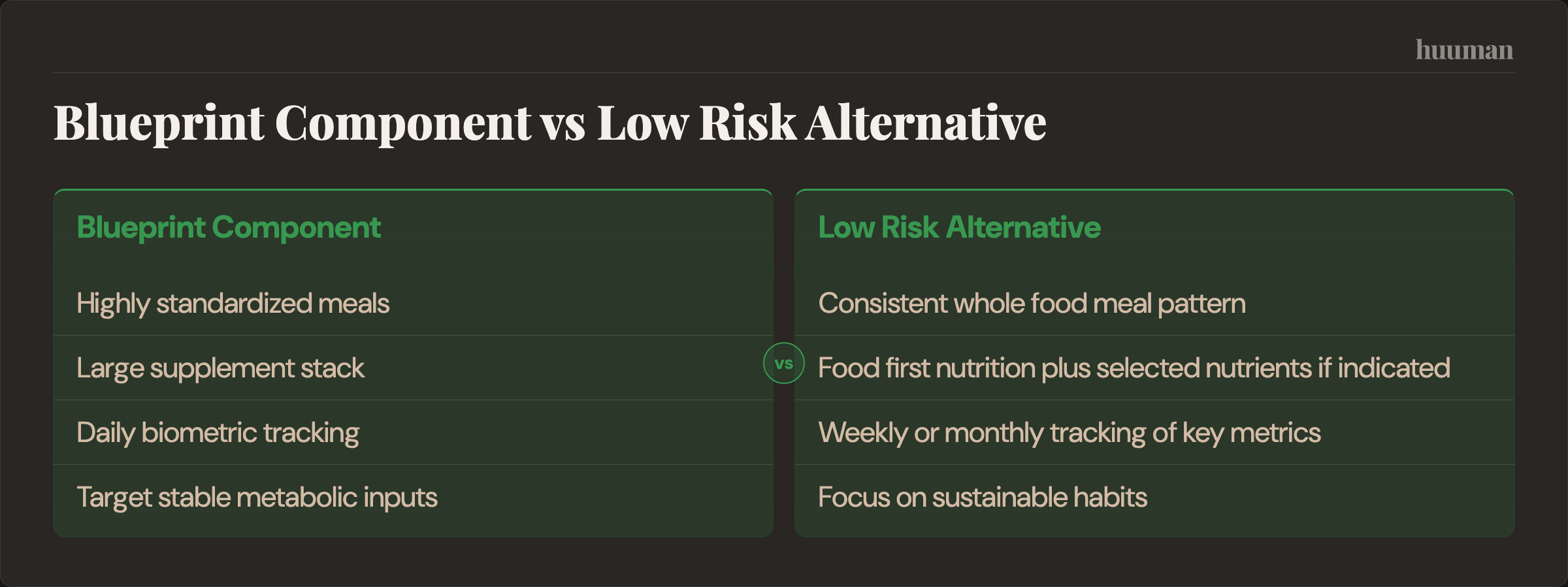
- Blueprint Component: Highly standardized meals — Goal: Stable metabolic inputs — Evidence Level: Moderate — Low Risk Alternative: Consistent whole food meal pattern
- Blueprint Component: Large supplement stack — Goal: Target micronutrients, longevity pathways — Evidence Level: Variable — Low Risk Alternative: Food first nutrition plus selected nutrients if indicated
- Blueprint Component: Daily biometric tracking — Goal: Feedback loops — Evidence Level: Moderate — Low Risk Alternative: Track a few key metrics consistently
- Blueprint Component: Comprehensive biomarker panels — Goal: Detailed physiological feedback — Evidence Level: Mixed — Low Risk Alternative: Focus on cardiometabolic foundations first
- Blueprint Component: Strict sleep routine — Goal: Optimize recovery and cognitive performance — Evidence Level: Strong — Low Risk Alternative: Regular bedtime and consistent sleep environment
- Blueprint Component: Structured training system — Goal: Maintain strength and aerobic fitness — Evidence Level: Strong — Low Risk Alternative: Balanced weekly program with cardio and resistance work
Non Prescriptive Strategies to Adapt the Protocol
The most practical approach is to adopt the system mindset without copying every component.
Start with a Baseline
Track two weeks of daily behavior before changing anything. Sleep patterns, physical activity, and meals provide a realistic starting point.
Improve the Biggest Bottleneck
For many adults the largest gains come from fixing obvious gaps such as sleep debt, low aerobic fitness, excessive alcohol intake, or low protein intake.
Add One Lever at a Time
Blueprint experiments are structured around controlled changes. Introduce only one new intervention at a time and observe changes across several weeks.
Food First, Supplements Later
Nutrition patterns drive most metabolic outcomes. Supplements may complement food intake but rarely replace dietary quality. A meta-analysis of 90 trials found that omega-3 supplementation reduced triglycerides in a dose-dependent manner.
A meta-analysis of 90 trials found that omega-3 supplementation reduced triglycerides in a dose-dependent manner, with EPA showing approximately 20% triglyceride reduction in clinical trials.
Understanding how nutrition influences energy and metabolic metrics can start with the larger framework covered in Metabolism, Nutrition & Energy – Overview. Some people also experiment with metabolic indicators such as tracking metabolic markers with the Dr. Boz ratio, though interpretation varies.
How to Track and Interpret Changes
- Metric: Sleep consistency — Tool: Wearable or sleep log — Frequency: Daily — What a Meaningful Change Could Suggest: Recovery habits improving — What Not to Overinterpret: One bad night
- Metric: Steps or movement — Tool: Phone or watch — Frequency: Daily — What a Meaningful Change Could Suggest: Higher baseline activity — What Not to Overinterpret: Single day spikes
- Metric: Strength progress — Tool: Training log — Frequency: Weekly — What a Meaningful Change Could Suggest: Muscle and neurological adaptation — What Not to Overinterpret: Short plateaus
- Metric: Waist or weight trend — Tool: Scale and tape — Frequency: Weekly — What a Meaningful Change Could Suggest: Long term body composition changes — What Not to Overinterpret: Daily fluctuations
- Metric: Basic labs — Tool: Healthcare provider — Frequency: Periodic — What a Meaningful Change Could Suggest: Metabolic and cardiovascular risk signals — What Not to Overinterpret: Minor isolated changes
Consistency matters more than precision. Tracking the same indicators over months reveals patterns that single snapshots cannot show.
Signal vs Noise in Longevity Tracking
- Sleep consistency improves recovery far more reliably than isolated sleep "hacks." Track bedtimes and wake times for two weeks before experimenting with gadgets.
- Strength and aerobic fitness compound slowly but reliably. Focus on progressive training rather than chasing exotic interventions.
- Copying a supplement stack without understanding nutrition or medications can introduce risks. Review supplements with a clinician first.
- Optimizing one biomarker while sleep or fitness are poor usually misleads decision making. Fix fundamentals before targeting specialty metrics.
- Adherence beats complexity. A simple plan followed for years outruns a perfect plan abandoned after months.
- HRV can fluctuate from stress, illness, or sleep changes. Evaluate multi week trends rather than reacting to daily scores.
- Biological age tests can provide interesting signals but should not become the sole measure of progress. Compare multiple health markers instead.
- Long term trends matter more than perfect daily curves in glucose or wearable graphs. Evaluate change over months, not hours.
Common Questions
What is Bryan Johnson's Blueprint Protocol in plain English?
It is a structured lifestyle system designed to optimize health metrics and track aging related biomarkers. It standardizes sleep, meals, exercise routines, testing, and supplementation to evaluate long term health changes.
Is the Blueprint Protocol evidence based or mostly biohacking?
The protocol mixes both. Many elements align with well established research such as sleep consistency, aerobic fitness, and strength training. Other elements such as large supplement stacks or biological age clocks remain more experimental.
Do I need the Blueprint supplement stack to benefit?
No. Many benefits associated with the protocol come from sleep quality, training consistency, and whole food nutrition. Supplements represent a smaller and often individualized layer.
What are the safest parts of Blueprint to copy first?
Most people start safely by focusing on sleep routines, balanced training that includes both cardio and resistance work, and consistent whole food meals. Tracking a small group of health metrics can then guide future adjustments.
How can someone track progress without expensive tests?
Simple markers already reveal a lot. Sleep consistency, aerobic fitness improvement, strength progress, waist measurements, and periodic routine lab work create meaningful feedback without requiring dozens of specialized tests.
Are biological age tests reliable?
Epigenetic clock research is evolving. Different clocks and testing methods often produce different results, and measurements can fluctuate over time. They may offer interesting research signals but should be interpreted cautiously.
Who should avoid highly structured or extreme health protocols?
People with histories of eating disorders, compulsive tracking behaviors, uncontrolled cardiovascular conditions, diabetes treated with medication, chronic kidney or liver disease, or those taking multiple interacting medications should discuss major lifestyle experiments with their healthcare providers first.
Used thoughtfully, the Blueprint Protocol is less about chasing extreme longevity claims and more about structured self observation. The most reliable lessons are surprisingly simple: sleep well, train consistently, eat mostly whole foods, and measure progress over time.
Rather than drowning in dozens of metrics, you can have your huuman Coach build weekly plans that respond to your key biomarker trends and focus training intensity around your recovery signals instead of chasing perfect numbers.
More health topics to explore
- Metabolism, Nutrition & Energy – Overview
- Aqua Running Calories Burned: Realistic Ranges + How to Estimate Yours
- 84-Hour Fasting: Timeline, Risks, Refeed, and a Safer Plan (3.5 Days)
- Longevity Protocol: How to Build a Personal, Evidence-Aware Plan
References
- Bryan Johnson — Blueprint Protocol (official site)
- Bryan Johnson — Blueprint Protocol summary page (official)
- Ramsey KA et al. — The association of objectively measured physical activity and sedentary behavior (2021)
- Bull FC et al. — World Health Organization 2020 guidelines on physical activity and sedentary ... (2020)
- Wang et al. — Association Between Omega-3 Fatty Acid Intake and Dyslipidemia: A Continuous Dos (2023)
- Liang et al. — Joint association of physical activity and sleep duration with risk of all-cause (2023)
- Bhatt et al. — Cardiovascular Risk Reduction with Icosapent Ethyl for Hypertriglyceridemia (2019)
- Kelsey et al. — Guidelines for Cardiovascular Risk Reduction in Patients With Type 2 Diabetes: JACC Guideline Comparison (2022)
- Kraus et al. — Daily Step Counts for Measuring Physical Activity Exposure and Its Relation to Health (2019)
- ACSM — Progression Models in Resistance Training (2009)
- Horvath S & Raj K — DNA methylation-based biomarkers and the epigenetic clock theory of ageing (2018)