A 45 minute treadmill workout is long enough to build aerobic capacity, improve threshold, or get a sharp interval stimulus without taking over your week. The result you get depends less on the machine and more on how you structure those 45 minutes. Most people don't need more workouts. They need clearer choices and better pacing.
This guide gives you three plug-and-play sessions you can follow immediately, plus a simple way to choose the right one today. You'll also see how to scale intensity using RPE and the talk test, how to progress without beating up your joints, and how to track what actually matters.
Key takeaways
1. 8–10 minutes warm-up: easy walk or jog, gradually increasing.
2. 25–30 minutes main set: choose one stimulus
• Intervals for speed and VO2-related fitness
• Tempo for threshold and durability
• Incline walking for joint-friendly aerobic volume
Think of this as a minimal effective dose approach. You can get fitter, support metabolism, and stay consistent with sessions that respect recovery and real life.
Where this fits in your training
Treadmill work sits at the intersection of Heart & Cardio fitness and day-to-day energy management. Done well, it supports cardiorespiratory fitness, durability, and the kind of steady energy throughput linked to better metabolic health signals. Done poorly, it becomes random intensity that competes with strength work and recovery.
Forty-five minutes is a useful middle ground. It can be enough stimulus on a "green" day, or too much if sleep, soreness, or stress are off. Paying attention to readiness keeps you consistent. That's how you stay in your prime across months, not just weeks.
Quick answer
A solid 45 minute treadmill workout follows a simple structure:
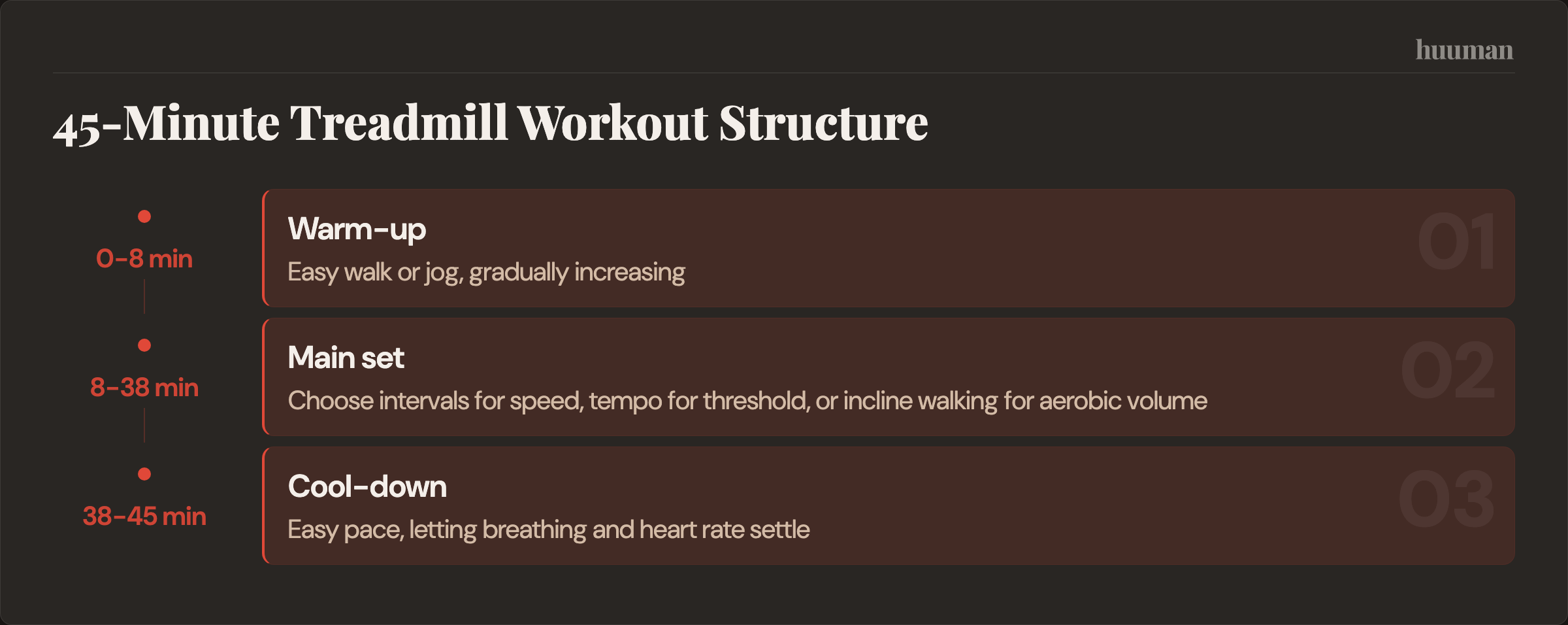
- 8–10 minutes warm-up: easy walk or jog, gradually increasing.
- 25–30 minutes main set: choose one stimulus
- Intervals for speed and VO2-related fitness
- Tempo for threshold and durability
- Incline walking for joint-friendly aerobic volume
- 5–10 minutes cool-down: easy, letting breathing and heart rate settle.
Scale intensity with RPE (1–10) and the talk test first. Heart rate can support decisions, but it may lag during short intervals and drift with heat and fatigue.
If you're starting to track training consistency, log your treadmill sessions with RPE and duration through the huuman app to see which intensities you recover from best.
Choose today's 45 minute treadmill workout
Pick the session based on three inputs: your goal, your readiness, and your joint tolerance.
- Goal
- Build aerobic base or support fat loss: incline Zone 2
- Improve durability and sustained pace: tempo
- Time-efficient performance boost: intervals (see also hiit for cardio and a full hiit workout plan)
- Readiness
- Green (slept well, low soreness, stable resting HR): any option
- Yellow (okay but a bit flat): tempo or incline
- Red (poor sleep, high soreness, rising resting HR): incline only
- Joint tolerance
- Sensitive or returning: incline walking or walk-jog tempo
- Robust: all options
This is the difference most pages miss. The "best" 45-minute treadmill workout is the one you can repeat next week without setbacks.
How hard is "hard" on a treadmill
Start with RPE and the talk test. They react instantly, which matters for intervals and changes in incline.

- RPE 3–4: easy, conversational (Zone 2 feel)
- RPE 6–7: comfortably hard, short phrases (tempo)
- RPE 8–9: hard, only a few words (intervals)
Heart rate is useful but secondary. It may lag on short reps and drift upward over time even at the same pace. Use it to confirm trends during steady work, not to chase a number during 1-minute intervals. If you're working on aerobic base, our zone 2 training plan explained goes deeper.
Evidence suggests a range of percentages of maximal heart rate corresponds to different training zones for developing cardiorespiratory fitness. Use these percentages as general guides, but remember heart rate may lag on short reps and drift upward over time even at the same pace.
If your treadmill shows power, treat it like pace: aim for repeatable outputs at a given RPE rather than a fixed target.
Treadmill setup and technique that change results
Small setup details meaningfully change the training effect.
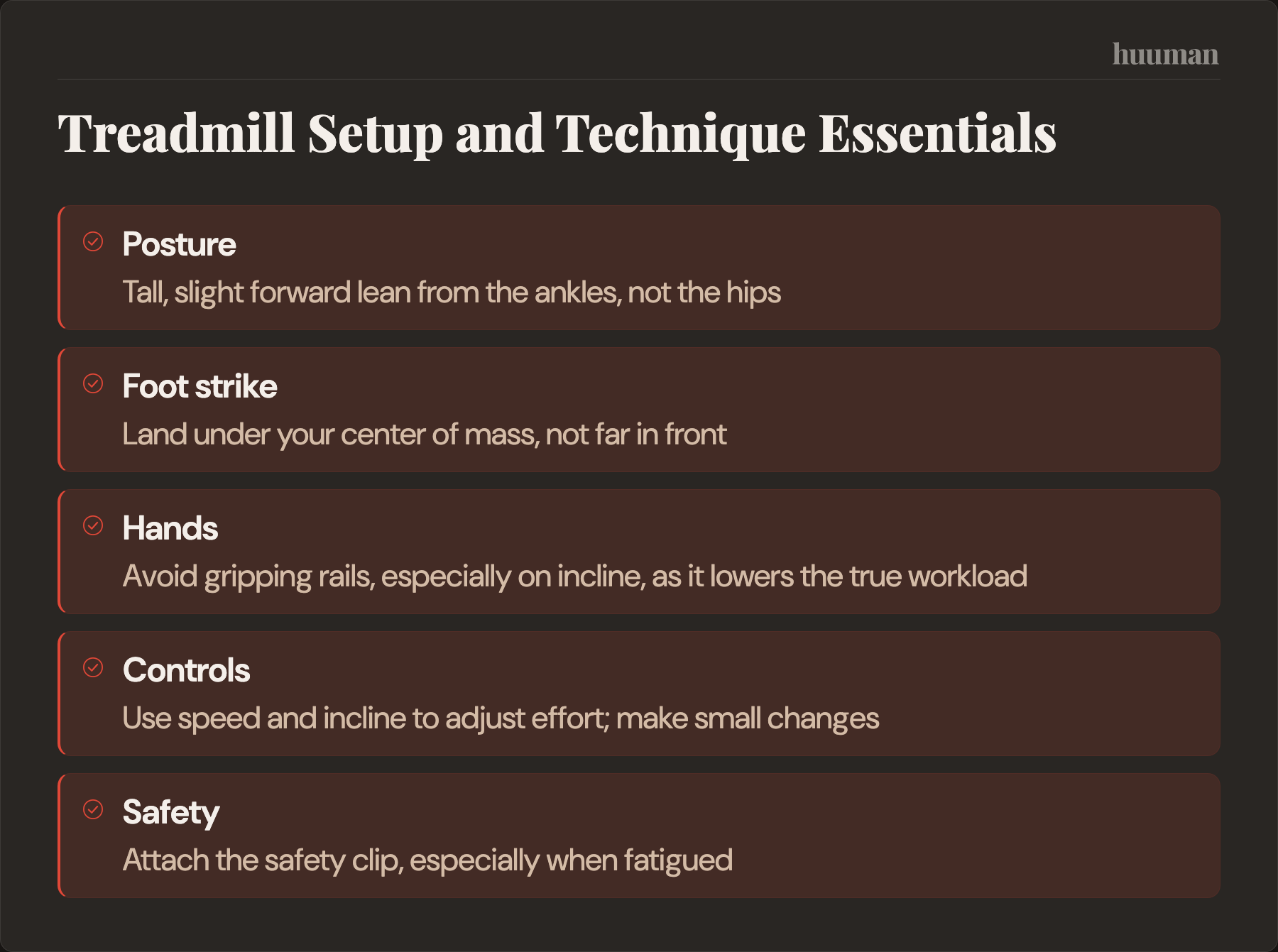
- Posture: tall, slight forward lean from the ankles, not the hips
- Foot strike: land under your center of mass, not far in front
- Hands: avoid gripping rails, especially on incline, as it lowers the true workload
- Cadence: find a comfortable rhythm rather than overstriding
- Controls: use speed and incline to adjust effort; make small changes
- Safety: attach the safety clip, especially when fatigued
Walking uphill is not a compromise. It can deliver a strong aerobic signal with lower joint stress. Running adds impact and elastic loading, which is useful but not mandatory every session.
Protocol cards: three 45-minute sessions you can follow
Protocol Card 1 – Aerobic Base Incline (Joint-Friendly)
Goal: steady aerobic volume
- 0:00–10:00 warm-up: easy walk to brisk walk (0–3% incline)
- 10:00–35:00 steady incline block: adjust grade to stay conversational
- 35:00–45:00 cool-down: easy flat walk
Intensity: RPE 3–4, talk in full sentences. If you use heart rate, mostly a Zone 2 feel.
Schedules: 2–4 times per week depending on recovery.
Readiness gates: stable sleep, no strong upward drift in resting HR, manageable soreness. HRV can inform trends but is not an oracle.
Protocol Card 2 – Tempo / "Comfortably Hard"
Goal: durability and threshold-adjacent work
- 0:00–10:00 warm-up: easy jog or brisk walk + optional short pickups
- 10:00–32:00 main: 2 x 8–10 minutes at comfortably hard, with easy recovery between
- 32:00–45:00 cool-down
Intensity: RPE 6–7, short phrases. Upper Zone 3 to Zone 4 feel if using HR.
Schedules: typically once per week, paired with easier sessions.
Protocol Card 3 – Intervals (Higher Stress, Time-Efficient)
Goal: VO2-related stimulus and speed economy (see understanding increase vo2 max)
- 0:00–12:00 warm-up: easy + short fast primers
- 12:00–32:00 main: 10 x (1:00 hard / 1:00 easy)
- 32:00–45:00 cool-down
Intensity: RPE 8–9 on hard minutes, 2–3 easy. Heart rate will lag, so use feel and repeatability.
Schedules: up to 1–2 times per week, supported by easier days. If recovery slides, swap to Protocol 1.
Decision table: Goal × Readiness × Impact
- Green + performance goal + robust joints: Intervals
- Green or Yellow + durability goal: Tempo
- Any readiness + joint sensitivity or high life stress: Incline
- Stacking with heavy lower-body strength: prefer incline or easy tempo on adjacent days; keep intervals away from heavy lifts (see strength training for weight loss for pairing concepts)
Is 45 minutes enough and where 12-3-30 fits
For general health, public guidelines commonly point to weekly totals of moderate or vigorous aerobic activity. A few well-structured 45-minute sessions can meaningfully contribute to that. Whether it's "enough" depends on consistency across the week, not a single workout.
ACSM guidelines recommend moderate-intensity cardio for ≥30 minutes on ≥5 days per week or vigorous-intensity for ≥20 minutes on ≥3 days weekly.
The viral 12-3-30 pattern (steep incline walking at a fixed speed for 30 minutes) is essentially an incline Zone 2 session with a fixed prescription. It can be effective and joint-friendly, but it assumes a one-size intensity. A 45-minute version simply wraps it with a proper warm-up and cool-down:
- 0–10 minutes easy build
- 30 minutes incline work adjusted to a conversational effort
- 5–10 minutes easy
Adjust incline and speed to your RPE.
For variety across the week, mix incline work with tempo or intervals. If you like short, intense formats, compare with a Tabata high-intensity workout, but keep total stress in mind.
Evidence and limits
Both steady aerobic training and interval training are associated with improvements in cardiorespiratory fitness. Intervals can produce strong gains in VO2-related metrics, while regular moderate work builds durability and is easier to sustain. In practice, the combination works well.
Evidence suggests HIIT produces greater VO2max improvements compared to continuous endurance training in healthy adults.
In clinical populations, HIIT is associated with superior improvements in cardiorespiratory fitness compared to moderate-intensity continuous training in individuals with chronic cardiometabolic conditions.
A systematic review found HIIT effectively modifies metabolic syndrome components and improves cardiometabolic health outcomes compared to moderate-intensity continuous training.
Individual response to training varies widely, partly due to differences in how athletes register physical and emotional stress. Device heart rate can be noisy. Sleep, stress, and recent strength training affect performance and perceived effort. Calorie burn is not a fixed number. It varies by body size, speed, grade, and efficiency, so any generic estimate is a rough guide at best.
The 2011 Compendium provides standardized MET values for 821 activities, enabling more accurate calorie estimates across different treadmill speeds and inclines.
For concise examples of structured treadmill sessions similar to what's used here, see Polar's treadmill workout examples. Use them as patterns, then scale with RPE and readiness.
Non-prescriptive strategies to discuss with a professional
- Progress one variable at a time: add a few minutes of hard work, slightly increase incline, or shorten recoveries. Avoid stacking all changes.
- Weekly structure: many people do well with 2–4 treadmill sessions, keeping harder days separated and supported by easier work.
- Pairing with other modalities: rotate with an air bike workout or workouts with rowing machine to manage joint load while keeping aerobic volume.
- Recovery awareness: if sleep drops, resting HR trends up, or soreness lingers, bias toward incline sessions or take an easy day. Guidance from a coach or clinician can help calibrate this.
- Long-term framing: think in months. Small, repeatable sessions build toward a broader longevity protocol rather than short bursts of extreme effort.
How to track and interpret changes
Keep tracking simple so you actually do it.
- Log (60 seconds): session type, total hard minutes, RPE, average HR (optional), speed or incline notes, post-session feel
- Next day check: soreness and energy
Signs it's working
- Same pace or incline feels easier (lower RPE)
- Intervals stay more even across reps
- You recover faster between efforts
- You're consistent week to week
Signal vs noise in a 45 minute treadmill workout
- Signal: consistent weekly minutes beat occasional maximal sessions. Next: schedule 2–3 repeatable sessions.
- Signal: warm-up and cool-down improve quality and recovery. Next: protect the first and last 10 minutes.
- Signal: interval quality matters more than a peak HR number. Next: aim for even reps.
- Signal: incline walking is real training. Next: use it on lower-readiness days.
- Noise: "burn X calories in 45 minutes" claims. Next: track consistency instead.
- Noise: copying influencer speeds or grades. Next: set effort by RPE and talk test.
- Noise: holding rails and counting it the same. Next: reduce speed or incline and walk hands-free.
- Noise: turning every day into HIIT. Next: cap interval sessions and support them with easy work.
Common questions
Is 45 minutes on a treadmill enough to see results?
It can be, if you repeat it consistently and match the session to your goal and readiness. Most benefits come from weekly patterns, not one workout.
Does the 12-3-30 treadmill workout actually burn fat?
Walking programmes can contribute to modest weight loss, with longer programmes showing greater effects. The 12-3-30 workout increases total activity, but fat loss depends on overall energy balance and consistency. As a workout, it's a fixed incline session that should be scaled to your own effort level.
Can I lose weight walking 45 minutes a day?
Walking helps increase energy expenditure and can support appetite regulation for some people. Outcomes vary. The practical target is consistency you can sustain alongside nutrition and sleep.
How many days a week should I do a 45-minute treadmill workout?
Many people land in the 2–4 sessions range, mixing easy incline with one harder day. Adjust based on recovery and how it fits with strength training or other sports.
What is the best 45-minute treadmill workout for beginners?
Start with the incline aerobic session. Keep it conversational, learn the controls, and build confidence before adding tempo or intervals.
Is incline walking as good as running for cardio fitness?
Both can improve cardiorespiratory fitness. Incline walking lowers impact and can be easier to recover from. Running adds different mechanical stress. Mixing them gives you options.
Should I use heart rate zones or RPE on a treadmill?
Use RPE and the talk test first. Add heart rate to confirm trends during steady work. On short intervals, rely on RPE and repeatable pace.
Rather than guessing which session fits your week, have your huuman Coach build personalized weekly plans that adapt treadmill work to your readiness and balance it with strength training.
More health topics to explore
- Heart & Cardio – Overview
- VO2max: what it means, what counts as a good value, and how to interpret it properly
- Zone 2 Heart Rate Calculator: How to Verify Your True Zone 2
- Zone 2 Training Plan: Weekly Templates, Intensity Cues, and Progression
References
- Polar — Three Treadmill Workouts Less 45 Minutes
- Piercy KL et al. — The Physical Activity Guidelines for Americans (2018)
- Wen et al. — HIIT Protocols for VO2max: Meta-Analysis (2019)
- Milanović et al. — HIT vs Continuous Training for VO2max (2015)
- Weston et al. — High-intensity interval training in patients with lifestyle-induced cardiometabo (2014)
- Swain DP et al. — Target heart rates for the development of cardiorespiratory fitness (1994)
- Poon ET et al. — High-intensity interval training for cardiometabolic health in adults with me... (2024)
- Ainsworth BE et al. — 2011 Compendium of Physical Activities: a second update of codes and MET values (2011)
- Garber CE et al. — American College of Sports Medicine position stand. Quantity and quality of e... (2011)
- Nature — Individual variability in the training response and stress perception in athletes (2025)
- NCBI — Pedometer-based walking programmes and weight loss: systematic review (2007)