4-7-8 breathing is a short breathing routine designed to help you downshift: inhale for 4 seconds, gently hold your breath for 7, and exhale slowly for 8. People often use it when stress feels high, their mind won't switch off at night, or they want to shift from activation into a calmer state.
It helps to put the technique in the right context. 4-7-8 breathing is not therapy, not a guaranteed sleep aid, and not a test of willpower. It's a form of ratio breathing, a paced breathing method with a deliberately slow rhythm. For many people, the longer exhale feels especially calming. For others, focusing on the breath feels uncomfortable. That distinction is what determines whether the technique is actually useful for you.
Key takeaways
1. Inhale: through the nose, calm and directed more into the belly than the shoulders
2. Hold: gently, without straining
3. Exhale: longer than the inhale, typically through the mouth
Below, you'll get a quick how-to, beginner-friendly variations, clear stop rules, common mistakes, and a simple framework for frequency and tracking. The practical goal is not to hit perfect numbers. The practical goal is to use the technique gently enough that it helps rather than creating more pressure.
Where 4-7-8 Breathing Fits In
In daily life, 4-7-8 breathing is most useful in three situations: as a short reset during an acute stress response, as a transition into a calmer evening, and as a downshift after mental or physical strain. That puts it more in the category of recovery and attention regulation than performance. If you're already working on sleep, recovery, and load management, think of it as a small tool rather than the main intervention. For the broader context, see Sleep & Recovery.
The mechanism is often oversimplified as "activating the parasympathetic nervous system" or "stimulating the vagus nerve." That's fine as a rough orientation, as long as it isn't overstated. Slow, rhythmic breathing can influence short-term autonomic markers such as heart rate and HRV, but that doesn't automatically mean everyone will feel noticeably calmer right away, or that a single reading tells you much. A more useful question is: after a few cycles, do you feel more settled, less rushed, and physically a little softer?
If your goal is concentration rather than falling asleep, other breathing patterns may fit better. For some people, box breathing feels more structured, while for bedtime it often makes more sense to use any technique with a longer exhale than a strongly activating pattern.
Quick Answer
4-7-8 breathing works best as a short, gentle routine. The typical format is: inhale through the nose for 4 seconds, hold for 7 seconds, and exhale slowly through the mouth for 8 seconds. Many people start with 3 to 4 cycles. What matters most is the ratio, not perfect timing. If you feel dizzy, short of breath, or the breath hold feels strained, stop and return to normal breathing. This standard sequence is also commonly described in patient education materials, including this typical 4-7-8 guide.
- Inhale: through the nose, calm and directed more into the belly than the shoulders
- Hold: gently, without straining
- Exhale: longer than the inhale, typically through the mouth
- Volume: usually 3 to 4 cycles to start; don't force it
- Stop rule: if you feel dizzy, tingly, or short of breath, return to normal breathing right away
If you want to test it in practice, you can log your stress before and after three breathing cycles in the huuman app and see whether the technique actually makes a difference for you.
How to Do 4-7-8 Breathing Correctly
The mobile-first card in 3 steps
- Inhale: Breathe in through your nose for 4 seconds. Easy and quiet, without lifting your shoulders.
- Hold: Hold your breath for 7 seconds. Gently. No straining, no bracing.
- Exhale: Breathe out slowly for 8 seconds, usually through your mouth. The exhale can be audible, but it doesn't have to be.
Timer tip: Count quietly in your head or use a gentle internal rhythm. If exact numbers stress you out, stick with the ratio. A longer exhale matters more than mathematical precision.
Setup and Cues
- Keep your jaw loose, tongue relaxed, and face soft
- Let your shoulders drop instead of pulling with your chest
- Keep the inhale more diaphragm-led, with movement in the belly area
- Exhale fully, but without forcing it
- Keep the pace calm; don't gasp for air after each cycle
Diaphragmatic or belly breathing is mainly a mechanical cue here. It helps many people avoid slipping into tense upper-chest breathing. The goal is not to breathe especially deeply. The goal is to breathe slowly, with control, and without excess effort.
What the Technique Probably Does – and What It Doesn't
4-7-8 breathing can feel calming because it combines several things at once: a slower breathing rate, a longer exhale, directed attention, and a clear rhythm. That combination can help interrupt an acute stress spiral. This is often loosely described in terms of the parasympathetic nervous system or the vagus nerve. A systematic review suggests that slow breathing techniques can influence autonomic markers such as HRV. That's plausible, but it's not a promise for every person or situation, and it isn't specific to 4-7-8 alone.
It's also important to distinguish this from hyperventilation. Controlled, slow breathing is not the same thing as breathing too deeply or too quickly. Dizziness and tingling often show up when someone moves too much air, pulls too hard on the inhale, or gasps after the breath hold. In that case, the exercise is too intense, not too weak.
The breath hold can also trigger air hunger. That feeling is not automatically dangerous, but it can be uncomfortable. Some people find this relates to how familiar their system is with a short rise in the urge to breathe. That's exactly why dialing the exercise down is often more useful than trying to push through it.
Who 4-7-8 Breathing May Suit – and When It May Not
It can be a good fit in clearly defined situations: before a demanding conversation, after a hectic workday, as part of the transition to bed, or as a brief downshift after training. If you deal with high cognitive stress during the day, even 1 to 3 cycles may be enough. If falling asleep is the issue, the technique can be part of a pre-sleep routine, for example alongside a short body scan, dimmer lighting, and less screen stimulation.
It may be less suitable if focusing on the breath itself makes you more uneasy. That can happen with panic-like symptoms, trauma triggers, or a strong need for control. In those cases, a lighter version without a long breath hold is often better. It's also not something to self-experiment with during acute shortness of breath, chest pain, unstable cardiac symptoms, fainting, or new palpitations with dizziness. Some clinical discussions suggest caution with breathing exercises during severe respiratory conditions.
The same applies in pregnancy: keep it gentle enough that it doesn't cause discomfort. Low-intensity breathing exercises can often be adapted, but they shouldn't be forced if they feel unpleasant. Breathing exercises during pregnancy generally benefit from a cautious, adapted approach.
Variations, Mistakes, and Practical Decision Rules

How-to table: standard, beginner, alternative
- Standard 4-7-8: The target feeling is a clear downshift and a steady rhythm. Common mistakes are inhaling too deeply, straining during the hold, and doing too many repetitions. Stop if you notice dizziness, marked air hunger, or a sense of tightness.
- Beginner 3-3-6: The target feeling is calm control without overload. Common mistakes are rushed counting and overdoing the exhale. Stop if you feel more agitated instead of less.
- Alternative 4-4-6: The target feeling is a bit more structure with a shorter hold. Common mistakes are clinging too rigidly to the numbers and tensing the shoulders. Stop if you find yourself gasping after the hold.
These are not competing methods. They're simply progressions and regressions. If 4-7-8 feels too intense for you, that doesn't mean you're doing it wrong or lacking discipline. It just means your starting point should be gentler.
The Most Common Mistakes
- You make the inhale too deep, which creates overbreathing rather than calm.
- You lift your shoulders and breathe mainly into the upper chest.
- You treat the breath hold like a stress test.
- You do too many repetitions even though the first cycles already felt unpleasant.
- You chase exact timing instead of staying gently within the ratio.
If you just need a subtle reset during the day, 1 to 2 cycles with a rough ratio are often enough. During concentration phases, it can also help to briefly alternate between breath focus and attention-focusing strategies, for example in the context of improving concentration or a more deliberate focus on yourself.
A Mini Decision Tree for Everyday Use

- Stressed during the day but otherwise stable: Start with 1 to 3 cycles. If it feels good, stay with 4-7-8 or 4-4-6.
- Before sleep: Breathe normally for 1 minute, then do 3 to 4 cycles. After that, return to normal breathing and notice how your body feels. If sleep is a recurring issue, it also helps to look at the bigger picture with what good sleep efficiency looks like or, if you wake up at night, this guide to the "wolf hour" of sleep.
- Panic-like symptoms or breath focus feels triggering: Skip the long hold. Use a gentler extended exhale pattern like 3-3-6, or simply make your exhale longer than your inhale.
- Dizziness, tingling, shortness of breath: Stop immediately, sit down, and breathe normally. Next time, start more gently or skip breath holds altogether.
- After training: Walk or cool down first. Then use only a mild version if at all. If you're still breathing hard, skip the hold. In training contexts, load management matters more than breathing hacks, for example in topics like how long to deload or whether to train with sore muscles.
Protocol Cards for Common Use Cases
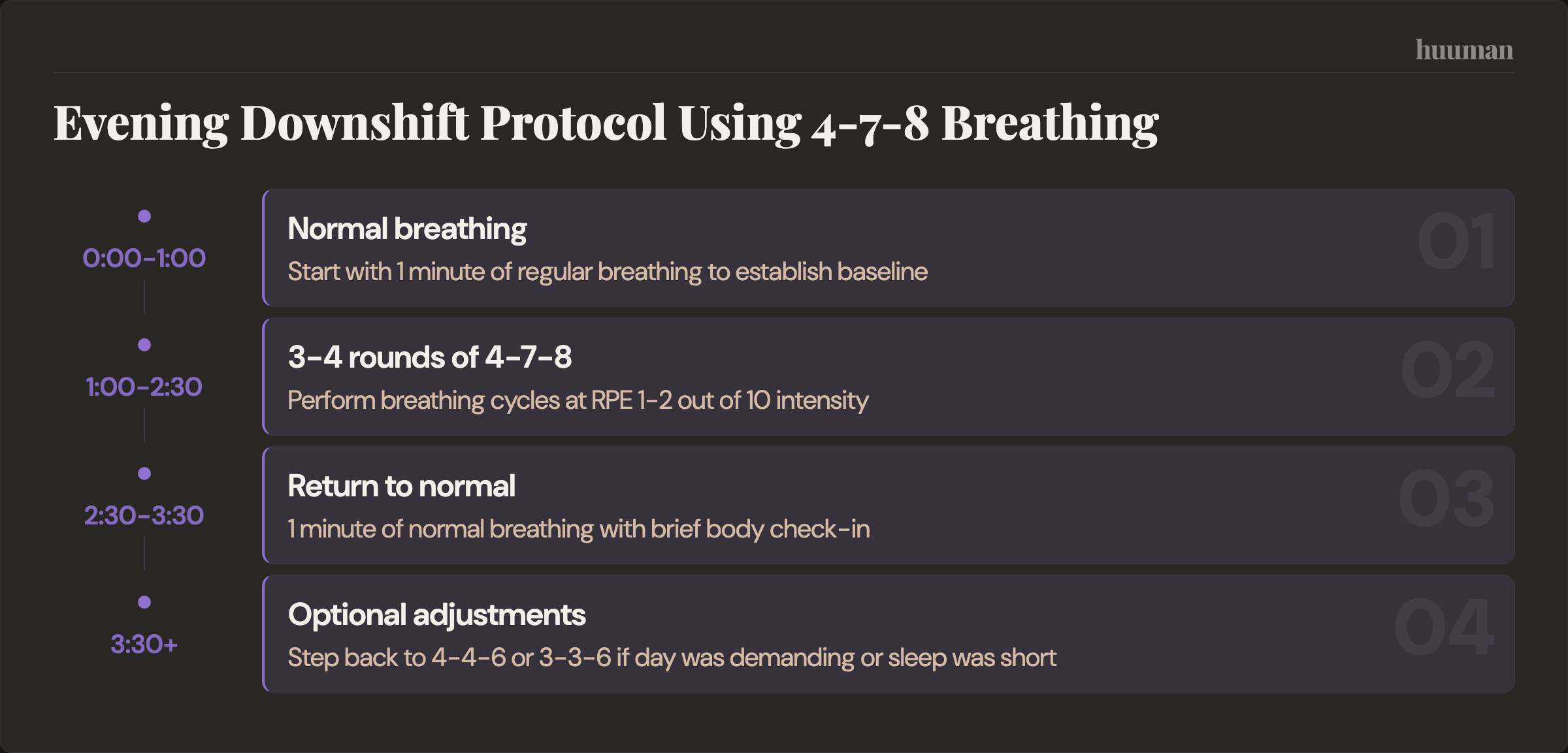
Evening Downshift
A common approach is: 1 minute of normal breathing, then 3 to 4 rounds of 4-7-8, then 1 minute of normal breathing and a brief body check-in. Keep the intensity very light, around RPE 1 to 2 out of 10. If the day was especially demanding or the previous night was short, it often makes more sense to step back to 4-4-6 or 3-3-6. For your sleep environment, simple supporting elements like caffeine-free herbal tea for sleep or pillow spray for deeper sleep may be relevant, but as background support rather than the main solution.
Acute Stress Reset
A common approach is: 30 seconds of normal breathing, then 2 to 3 cycles of 4-7-8 or a gentler variation, then 30 seconds of normal breathing again. Here, RPE is the most useful anchor. If the exercise feels harder than 3 out of 10, it's probably too intense for that moment. Heart rate often lags on very short time scales, so your subjective sense of calm is usually more informative than a single pulse reading.
Post-Workout Downshift
After training, start with basic physical calming: walk, cool down lightly, and relax your shoulders. Then 4-4-6 is usually a better fit than 4-7-8. If you still feel chest tightness, unusual shortness of breath, or high overall training stress, skip breath holds. If you're tracking both sleep and training, it's better to read the data as patterns, for example alongside sleep duration over 3 years, rather than treating one session as a verdict.
Evidence and Limitations
The stronger evidence base is not for 4-7-8 specifically, but for slow, controlled breathing in general. Reviews and smaller intervention studies suggest short-term changes in autonomic markers, anxiety, or perceived stress. One systematic review describes associations with parasympathetic activity and HRV.
The limitations matter. First, 4-7-8 as a precise pattern has been studied less directly than slow breathing overall. Second, people respond very differently to breath-focused techniques. Third, an acute change in heart rate or HRV does not automatically mean better sleep quality, less clinical anxiety, or long-term benefits. For sleep, stress, and recovery, this is better understood as one building block rather than a standalone solution.
The popular framing that the method was popularized by Dr. Andrew Weil is fair. That early description also includes the practical rule not to do more than four breaths at a time when starting out. That's not a medical dosage, but it is a sensible precaution for beginners.
The common idea that slow breathing acts like a brake should not be read as a hard guarantee either. It's better understood as a practical description of how rhythm, a longer exhale, and focused attention can help many people step out of acute mental overdrive. Clinically, that can be useful, but it isn't magic.
Strategies to Discuss with a Professional
If you notice that a longer exhale generally helps you but 4-7-8 itself feels too intense, it may be worth talking with a qualified professional to find the right regression. Milder paced-breathing patterns without a long breath hold are commonly used, especially if breath focus tends to increase your unease.
If sleep is your main goal, it helps not to focus only on the breathing pattern. Difficulty falling asleep may also be linked to light exposure, caffeine, mental activation, or fragmented sleep. In that case, a breathing routine is only truly helpful if it sits inside a broader evening structure. For many people, reducing stimulation before bed matters more than whether the exhale lasts exactly 8 seconds.
If physical symptoms are the main issue, such as chest pain, fainting, severe shortness of breath, new palpitations with dizziness, or neurological symptoms, this technique does not belong in the realm of self-optimization. That calls for medical evaluation, not fine-tuning.
How to Measure Progress and Interpret It
The most reliable way to track 4-7-8 breathing is across three channels. First, subjective: how high is your stress RPE from 0 to 10 before and after the exercise? Second, physical: did you notice dizziness, warmth, pounding, or more of a softening effect? Third, sleep-related: did falling asleep feel calmer, and did you wake up during the night?
Wearables can complement this, but they shouldn't lead it. Resting heart rate trends and HRV over 3 to 7 days can offer useful clues. A single HRV value right after a short breathing exercise is often more noise than signal. If you use data, use it to spot patterns, not to let each session judge you.
A simple 7-day note might look like this: Monday, 10:30 p.m., 3 cycles of 4-4-6, stress before 6 out of 10, after 3 out of 10, no dizziness, ease of falling asleep 4 out of 5. After a week, that tells you much more than one isolated experience.
If you want to collect that more systematically, you can use your huuman Coach to combine before-and-after check-ins, sleep, and short session notes and see over several days when the technique actually helps and when a gentler variation works better.
Signal vs. Noise in 4-7-8 Breathing
- Signal: You feel noticeably calmer after 2 to 4 cycles, without dizziness. If so, stay with that amount for now.
- Signal: Your exhale gets longer without pushing or straining. That usually suggests the dosage is right, so don't increase it unnecessarily.
- Signal: You use the technique earlier in the stress build-up rather than waiting until you're overwhelmed. Notice the timing, not just the outcome.
- Noise: One low HRV value after a session. Look at trends over several days instead.
- Noise: The idea that you need to clearly feel or measure your vagus nerve. Judge the exercise by your sense of calm, breath control, and how well you tolerate it.
- Noise: Treating perfect timing as the marker of success. Prioritize ratio and gentleness, not precision at any cost.
- Noise: Using the breath hold as a test of willpower. If it feels hard, shorten it next time.
- Signal: Better ease of falling asleep over 1 to 2 weeks. Give the technique a fair trial across several evenings.
- Noise: Forcing 4-7-8 immediately after exercise while you're still breathing hard. Bring your intensity down first, then try a milder version.
Frequently Asked Questions
What does 4-7-8 breathing actually do?
It may help reduce acute mental overdrive, focus attention, and make the transition into a calmer state easier. It shouldn't be promised as more than that. For some people it's very useful, for others just okay, and for others unpleasant. Its value lies in how quickly you can use it and how simple the structure is.
How do you do 4-7-8 breathing correctly, step by step?
Inhale through the nose, hold gently, then exhale slowly for longer than the inhale. The usual timing is 4, 7, and 8 seconds, but the ratio matters more than hitting exact numbers. Keep your shoulders loose, let the belly move, and relax your jaw. If you have to gasp for air in between, the round was too intense.
How often should you do 4-7-8 breathing?
For beginners, a few cycles per session is enough. Starting with only a handful of breath cycles is a sensible precaution, especially while you get used to the longer exhale and breath hold. In practice, what matters most is that it feels tolerable. More is not automatically better.
When is the best time: morning, daytime, or before sleep?
The best time is whenever you genuinely want to downregulate. During the day, it can work as a quick reset. In the evening, it fits well into a pre-sleep routine. Right before high physical performance, it's usually not the most obvious tool. For many people, the most useful moments are after mental stress or before sleep.
Why do I feel dizzy or tingly during 4-7-8 breathing?
Usually because the breathing is too deep, too fast, or too tense. At that point, the exercise shifts into overbreathing or unnecessary respiratory stress. Shorten the hold, reduce the depth, and switch to 3-3-6 or 4-4-6. If dizziness happens repeatedly, stop using the technique and get recurring symptoms medically evaluated.
Does 4-7-8 breathing help with panic attacks?
It can help some people, while others feel more unsettled when they focus on the breath. With panic or strong air hunger in particular, breath holding can be triggering. In that case, a gentler version without a hold is often a better choice. It should not be presented as a standalone solution for anxiety or panic.
Is holding your breath dangerous?
Usually not, if it is brief, gentle, and well tolerated. It becomes more concerning if you strain, feel severe shortness of breath, or have relevant heart or lung symptoms. If you have chest pain, fainting, severe shortness of breath, unstable cardiac symptoms, or known heart-lung disease, get medical guidance first.
More health topics to explore
- Sleep & Recovery – Overview
- Deload Week: How to Reduce Training Load Without Losing Progress
- Marathon Recovery: Your Plan from the First 48 Hours to Week 4
- How Long Should a Deload Last? Benchmarks, Decision Rules, and Example Weeks
References
- Cleveland Clinic — 4-7-8 Breathing Method For Sleep and Relaxation
- Rutgers University — Dr. Weil 4 7 8 Breathing Exercise
- Zaccaro A et al. — How Breath-Control Can Change Your Life: A Systematic Review on Psycho-Physio... (2018)
- Magnon V et al. — Benefits from one session of deep and slow breathing on vagal tone and anxiet... (2021)
- Gholamrezaei A et al. — Effect of slow, deep breathing on visceral pain perception and its underlying... (2022)
- Berkeley — Breathing Exercises
- Laborde S et al. — Effects of voluntary slow breathing on heart rate and heart rate variability:... (2022)