It sounds backward, but "why does caffeine make me sleepy" is a real troubleshooting question, not a contradiction. Caffeine can improve alertness for some people and in some situations, yet still leave you feeling tired, heavy, foggy, or even ready for a nap.
Key takeaways
1. Timing: sleepy within minutes, a couple of hours later, or mainly the next day?
2. Context: empty stomach, sugary drink, poor sleep, high stress, hard training, shift work?
3. Load: first caffeine of the day, later top-up, or hidden total from tea, soda, chocolate, meds, or pre-workouts?
The key is that caffeine changes signaling, not your actual sleep need. It can temporarily block adenosine, shift how alert you feel, and interact with sleep debt, meal timing, stress, training load, and your own metabolism. That is why the same coffee can feel helpful one day and awful the next.
This guide gives you a practical way to self-sort the most likely causes by time course, context, and symptoms. It also covers safe, non-prescriptive experiments, red flags, and how to track whether a change is actually helping.
In huuman terms, this sits at the intersection of metabolism, recovery, mind, and heart. Stimulants affect energy regulation and glucose stability, but they also shape sleep pressure, anxiety, attention, and sometimes palpitations.
Where caffeine sleepiness fits in the bigger picture
If caffeine makes you sleepy, the useful question is usually not "Is caffeine bad for me?" It is "What is caffeine revealing?" In many cases, it exposes one of four issues: you are carrying sleep debt, your timing is poor, your total caffeine load is higher than you think, or the drink is amplifying another stressor such as fasting, under-fueling, anxiety, or poor sleep quality.
That matters because alertness and energy are not the same thing. A stimulant can sharpen attention briefly while your body is still under-recovered. It can also make you feel more "on" without improving actual readiness. This is one reason people confuse a caffeine problem with a motivation problem, a blood sugar problem, or a training recovery problem.
For broader context on how stimulants fit into energy regulation, see the Metabolism & Nutrition overview. If your fatigue shows up mainly around training, training when your body feels off is often the better question than whether to add more caffeine.
Quick answer
The shortest answer to why does caffeine make me sleepy is this: caffeine may block adenosine for a while, but it does not erase sleep pressure or replace recovery. As it wears off, you may feel a rebound in tiredness, especially if you were already sleep-deprived, use caffeine daily, metabolize it slowly, or drank it at a time that disrupted later sleep.
Other common reasons are simpler than they sound. Coffee on an empty stomach, sweetened drinks, energy drinks, dehydration, anxiety, reflux, nausea, and hidden caffeine sources can all make "post-caffeine fatigue" more likely. Some people feel sleepy fast, others crash hours later, and that time pattern is one of the best clues.
Start with four checks:
- Timing: sleepy within minutes, a couple of hours later, or mainly the next day?
- Context: empty stomach, sugary drink, poor sleep, high stress, hard training, shift work?
- Load: first caffeine of the day, later top-up, or hidden total from tea, soda, chocolate, meds, or pre-workouts?
- Response style: calm and tired, or jittery and tired?
The huuman C.A.L.M. Loop for caffeine backfire
The C.A.L.M. Loop is a simple decision aid for this problem:
- C = Context: sleep debt, stress, training load, fasting, shift work, perimenopause or menopause sleep disruption.
- A = Adenosine & alertness: caffeine can change perceived alertness by blocking adenosine signaling, but sleep pressure still exists.
- L = Load: dose size, repeat dosing, tolerance, and hidden caffeine across the day.
- M = Metabolism: clearance speed varies, and food, sugar, hydration, and medication interactions can change how caffeine feels.
Use that loop before assuming a rare cause. Most caffeine sleepiness comes from context, load, or timing, not from exotic explanations.
What caffeine is supposed to do, and why it sometimes does the opposite
Caffeine does not create energy in the literal sense. It mainly changes signaling in the brain. Research shows that caffeine works by blocking adenosine receptors in the brain. Adenosine is part of the system that builds "sleep pressure" as wake time accumulates.
That explains why caffeine can make you feel more awake without solving the underlying reason you are tired. If you are under-slept, under-fueled, stressed, or recovering poorly, caffeine can briefly mask the message without fixing the condition that produced it.
It also helps explain the "wired but tired" feeling. Some people experience mental stimulation, faster thoughts, or shallow focus while the body still feels depleted. That mismatch is common when caffeine is layered on top of poor sleep, anxiety, or heavy training load.
The 8 most common reasons caffeine can make you sleepy

1. Sleep debt and sleep inertia are doing the real work
If you slept poorly, woke up repeatedly, are carrying a week of short nights, or wake unrefreshed, caffeine may not touch the main problem. It can reduce perceived sleepiness for a while, but not fully restore alertness, mood, reaction time, or judgment. If you are asking "why is caffeine making me sleepy" mainly on workdays, after travel, or after broken sleep, start here.
Morning sleepiness also has a timing component. If you drink coffee during heavy sleep inertia, it may feel underwhelming because your brain is still transitioning into full wakefulness. In some people, delaying that first caffeine until they are fully awake, moving around, and exposed to light leads to a better response.
2. A rebound effect as caffeine fades
The adenosine rebound idea is useful, but it should be treated as a concept, not a guaranteed script. Caffeine can blunt adenosine signaling for a period, and as the effect fades, your underlying sleep pressure may become more noticeable again. That is not proof that caffeine "caused" fatigue from nowhere. It often means fatigue was there and got temporarily masked.
This pattern usually feels like a later crash rather than instant sleepiness. If you feel okay after coffee and then distinctly worse one to three hours later, rebound plus sleep debt or under-fueling becomes more plausible.
3. Tolerance has shifted your baseline
Regular caffeine use can make the same amount feel weaker over time. Some studies indicate that habitual intake allows the brain to adapt, reducing the noticeable alerting effect and making "normal" feel dependent on having caffeine. Research suggests that regular caffeine use can lead to tolerance development over time.
A practical tell is needing coffee just to feel normal rather than more alert. Another is feeling flat or headachy if you delay it. In that situation, your first cup may simply relieve withdrawal enough to bring you back toward baseline, without providing much extra wakefulness.
4. You may metabolize caffeine more slowly
Clearance speed varies widely between individuals, and that variation changes how long caffeine stays active and how much overlap you get from repeated doses. For a deeper explanation, see how long caffeine stays in your system.
Some of that variability is genetic. A systematic review found that CYP1A2 variation affects caffeine metabolism, helping explain why some people are relatively fast and others relatively slow metabolizers. Research also indicates wide individual variation in caffeine metabolism more broadly.
If you clear caffeine slowly, a late coffee may not make you feel alert right then, but it may still disrupt later sleep and show up as next-day fatigue. This is one reason "I fall asleep fine" is not the whole story.
5. Your timing is mismatched to your physiology
There are several common timing mismatches:
- Too early: caffeine during heavy morning grogginess can feel ineffective.
- Too late: it may interfere with sleep quality even if total sleep time looks similar.
- Right before the afternoon dip: it may smooth the dip for some people, but worsen a later crash if sleep debt is high.
- Near bedtime: even if you fall asleep, you may still wake less restored.
Because source coverage is limited here, it is best to keep the guidance broad: many people do better when caffeine is concentrated earlier in the day, especially if sleep is fragile. Shift workers are a special case because their circadian timing is already disrupted, so the same clock time can mean different biology.
6. Blood sugar and under-fueling can create a crash
Many people blame caffeine when the bigger issue is what came with it, or what did not. Coffee as a meal replacement, coffee during fasting, sweetened coffee drinks, and training after minimal food can all set up a shaky energy curve. The result may feel like "coffee made me tired" when the actual problem was unstable fuel availability.
If your crash follows sweetened coffee, compare it with what happens after a more balanced breakfast. This is especially relevant if you already notice big swings with fruit-heavy snacks or sugary add-ins. The same logic behind how bananas affect your blood sugar and dates and blood sugar spikes applies here: pairing fast carbs differently can change how stable your energy feels.
7. Anxiety and the stress response can leave you "wired then tired"
Caffeine can increase tension, restlessness, or a sense of internal pressure, especially when stress is already high. That can feel stimulating at first, then draining later. People often describe this as "jittery but exhausted" or "my brain is buzzing but I want to lie down."
If this sounds familiar, caffeine may be amplifying arousal rather than improving useful alertness. This is more common when caffeine is stacked with deadlines, poor sleep, fasting, or intense training. If fatigue is blending into brain fog and overwhelm, it can help to read when fatigue becomes mental overload.
8. Hydration, GI effects, and the drink itself can muddy the picture
Caffeine has a mild diuretic effect, but alarmist claims are not helpful. At habitual intakes, coffee is not "basically dehydrating." Still, if you are already under-hydrated, sweating heavily, training hard, or replacing food and fluids with caffeine, fatigue can feel worse.
There is also a simpler explanation many people miss: reflux, nausea, diarrhea, or stomach discomfort after coffee can feel like tiredness. Energy drinks may add another layer because they include sugar, sweeteners, and other stimulants. Pre-workouts can do the same. If one specific drink reliably causes sleepiness while another does not, pay attention to the whole product, not caffeine alone.
When training load is high, eating enough matters too. If your appetite or hunger signals are off, why weight training makes you hungrier can help explain why stimulant-heavy, low-food days often backfire.
Caffeine backfire checklist
This one-screen checklist is designed to help you identify the highest-probability driver before you change anything.
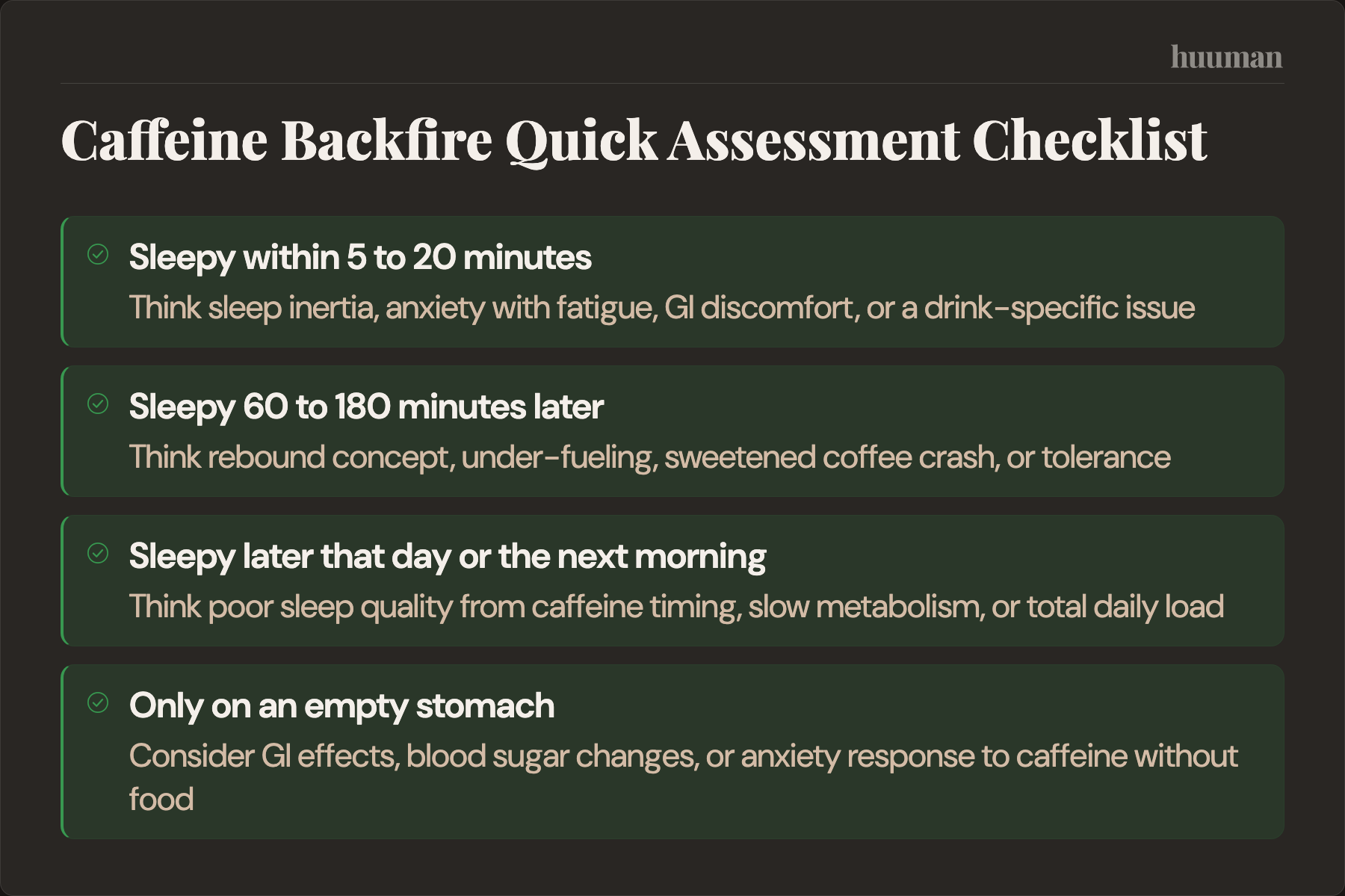
- Sleepy within 5 to 20 minutes: think sleep inertia, anxiety with fatigue, GI discomfort, or a drink-specific issue.
- Sleepy 60 to 180 minutes later: think rebound concept, under-fueling, sweetened coffee crash, or tolerance.
- Sleepy later that day or the next morning: think poor sleep quality from caffeine timing, slow metabolism, or total daily load.
- Only on an empty stomach: think under-fueling, reflux, nausea, or unstable energy availability.
- Only with sweetened coffee drinks: think sugar pattern more than caffeine itself.
- Only with energy drinks or pre-workouts: compare additives, total caffeine, and repeat dosing.
- Only during high stress: think "wired then tired" rather than poor stimulant effect.
- Only after short sleep: treat sleep debt as the lead explanation until proven otherwise.
- Need coffee to feel normal: consider tolerance and withdrawal dynamics.
- Palpitations, dizziness, chest discomfort, or fainting: pause self-experimentation and speak with a clinician.
Mini decision tree
Sleepy immediately? Start with sleep inertia, anxiety, GI effects, or a specific beverage formula.

Sleepy after a couple of hours? Start with rebound concept, tolerance, under-fueling, or sugar-heavy coffee.
Sleepy mainly the next day? Start with late caffeine, slow clearance, hidden total load, and sleep disruption.
Jittery and tired? Prioritize stress response and dose pattern.
Calm and tired? Prioritize sleep debt, timing, and under-fueling.
The mycotoxin or mold claim: signal vs speculation
People sometimes claim that coffee-related fatigue is mainly caused by mold or mycotoxins in coffee. What they usually mean is that contaminants or poor coffee quality are driving brain fog, tiredness, or inflammation.
The important point is probability. That explanation is not well established as a common reason people feel sleepy after caffeine. It may be discussed online because it is memorable and feels specific, but for most readers, sleep debt, dose, timing, under-fueling, anxiety, and metabolism are much more likely places to look first.
If you consistently react badly to one product and not another, changing brands may be reasonable as an observation. But do not anchor on mold claims before you have checked the basics.
Evidence and limits
What we can say with reasonable confidence is that caffeine acts primarily through adenosine receptor antagonism, that half-life varies substantially, and that genetic differences such as CYP1A2 contribute to different responses. Those are useful anchors because they explain why the same intake can feel completely different across people and across situations.
What is weaker in this article is the evidence for some practical sleep-timing rules and for exactly which mechanism explains a given individual's "crash." The source set here does not directly cover the strongest sleep architecture data or a specific universal cutoff for caffeine before bed, so it is better to be honest: many people are sensitive to later caffeine, but the exact timing is individualized.
Hydration is another area where people overstate the case. Mild diuretic effects do not mean routine coffee use severely dehydrates everyone. In practice, under-hydration becomes more relevant when it combines with hard training, heat, fasting, GI losses, or low overall fluid intake.
Self-experiments can improve decision quality, but they are not diagnoses. ADHD is a good example. Some people with ADHD report paradoxical responses to stimulants, including calmness or less obvious stimulation, but caffeine making you sleepy does not mean you have ADHD. The same caution applies to pregnancy, perimenopause or menopause, medication interactions, and medical conditions. Those contexts can change caffeine response, but they are not labels to assign to yourself from one symptom.
Non-prescriptive strategies to discuss with a professional
Fix the basics first
- Keep sleep and wake timing more consistent before trying to optimize caffeine.
- Use morning light and a few minutes of movement to reduce grogginess before your first coffee.
- Make sure caffeine is not replacing food and fluids.
Try one timing experiment at a time
- Delay your first caffeine until you feel fully awake.
- Keep caffeine earlier in the day if your sleep is fragile.
- Compare workdays with weekends to see whether stress and schedule are the main variable.
Shape the dose pattern
- A smaller first dose may feel cleaner than one large hit.
- Some people do better with smaller spaced doses than with a single larger dose.
- Lower-caffeine options such as tea or half-caf may reduce jittery fatigue.
Pair caffeine with steadier fuel
- Avoid using coffee as breakfast.
- Consider whether adding protein, fiber, and a real meal changes the crash pattern.
- If sweetened drinks are the problem, compare them with less sugary options.
Reduce tolerance carefully
- If you rely on caffeine to feel normal, tapering may be easier than stopping abruptly.
- Caffeine-light days can be useful if withdrawal is part of the cycle.
Respect context
- High stress, fasting, and intense training is a common backfire combination.
- If recovery is already poor, adding more stimulant is often the wrong lever.
- If body composition goals are pushing you toward under-fueling, look at caffeine and fat metabolism and triglycerides, energy, and weight gain in the broader metabolic context.
For readers interested in the bigger longevity and protocol conversation, caffeine's role in longevity protocols and stimulant use in the Blueprint protocol are useful context, but neither changes the basic troubleshooting order: sleep, timing, load, fuel, then edge cases.
How to track and interpret changes
Track one change for 7 days before changing something else. That is the easiest way to separate signal from noise.
Use the C.A.L.M. Loop again in tracking form:
- Context: bedtime, wake time, awakenings, stress, training, fasting.
- Adenosine & alertness: energy rating before caffeine, then at 30 minutes, 2 hours, and 6 hours.
- Load: what drink, roughly how much, what time, and whether there were hidden sources later.
- Metabolism: note if later caffeine seemed to affect sleep or next-day energy.
A simple copy-and-paste log can look like this:
- Day 1: 7:00 wake, broken sleep, coffee at 7:20 on empty stomach, energy 4 before, 5 at 30 min, 3 at 2 h, 2 at 6 h, jittery, mild nausea, hard workout at noon, poor sleep that night.
- Day 2: 7:00 wake, better sleep, light breakfast first, tea at 8:00, energy 5 before, 6 at 30 min, 6 at 2 h, 5 at 6 h, calm, no GI issues, better sleep that night.
Useful metrics include:
- Energy 1 to 10 at 30 minutes, 2 hours, and 6 hours after caffeine
- Bedtime, wake time, awakenings, and subjective sleep quality
- Morning resting heart rate as context
- HRV trend across several days as context, not as a verdict
- Anxiety, palpitations, GI symptoms, and whether you were fasted
HRV is a decision-support tool, not an oracle. A lower trend can support the interpretation that stress load or poor recovery is making caffeine feel worse, but it does not diagnose the cause.
If you want to make this easier to see over a week, use the 7-day caffeine and energy log in the huuman app so your sessions, meals, sleep, and check-ins are in one timeline.
Signal vs noise
- Signal: you are consistently short on sleep and caffeine barely helps. Next step: treat sleep debt as the main driver before changing brands or supplements.
- Signal: sleepiness appears as caffeine wears off later, not immediately. Next step: test whether smaller earlier doses change the later crash pattern.
- Signal: sweetened coffee precedes the crash. Next step: compare the same caffeine with a steadier meal and fewer fast carbs.
- Signal: later caffeine correlates with lighter sleep or worse next-day energy. Next step: move intake earlier for one week and watch sleep quality, not just sleep duration.
- Signal: you feel jittery and tired at the same time. Next step: look at stress, fasting, and large single doses before assuming low caffeine tolerance alone.
- Signal: symptoms are worse with repeated daily use and you need caffeine to feel normal. Next step: consider tolerance and withdrawal as part of the picture.
- Signal: one specific product causes problems. Next step: compare coffee, tea, energy drinks, and pre-workouts separately rather than blaming caffeine as one category.
- Noise: assuming mycotoxins or "mold coffee" is the main cause without checking sleep, timing, or meals. Next step: rule out the common explanations first.
- Noise: calling it "adrenal fatigue" because you crash after coffee. Next step: use the time-course and context checks instead of vague labels.
- Signal: palpitations, dizziness, chest discomfort, or new irregular heartbeat are part of the picture. Next step: stop self-testing and speak with a clinician promptly.
Common questions
Why does caffeine make me sleepy instead of awake?
Usually because caffeine is interacting with an existing problem rather than acting alone. The big ones are sleep debt, poor timing, tolerance, slow metabolism, under-fueling, and anxiety. Caffeine can change perceived alertness, but it cannot replace sleep or guarantee stable energy.
Why do I feel tired 10 minutes after coffee?
Immediate sleepiness points less toward a later rebound and more toward sleep inertia, anxiety with fatigue, GI discomfort, or the fact that you were already exhausted before the drink. It can also happen when coffee is taken on an empty stomach and makes you feel shaky, nauseated, or heavy.
Why does coffee make me sleepy in the morning?
Morning coffee can feel weak if you are still in a groggy transition from sleep, if you slept badly, or if you rely on coffee to offset chronic short sleep. For some people, waiting until they are fully awake works better than drinking it immediately after getting out of bed.
Can caffeine make you tired because of an adenosine rebound?
Yes, that concept is plausible and useful, but it is not the whole story. A rebound-like crash often reflects your underlying sleep pressure becoming more visible as caffeine fades. It is most convincing when the tiredness arrives later rather than immediately.
Why does caffeine suddenly stop working for me?
Tolerance, life context, and sleep quality are the usual reasons. If stress, training load, parenting demands, shift work, or poor sleep changed, the same caffeine may no longer feel effective. If your intake has gradually risen, you may mostly be preventing withdrawal rather than getting a true boost.
Does caffeine make people with ADHD sleepy?
Responses are mixed. Some people with ADHD describe caffeine as calming or less stimulating, but that does not mean caffeine-induced sleepiness confirms ADHD. It is one possible context, not a diagnosis. If attention issues are central, broader factors like sleep, stress, and total stimulant use still matter. For family context, see caffeine, focus, and children.
Why does sweetened coffee make me crash?
Often because the sugar pattern and the caffeine pattern overlap. A sweet drink may create a quick rise in perceived energy followed by a drop that feels like the caffeine "stopped working." If this is your pattern, compare it with coffee or tea paired with a more balanced meal.
Why does coffee ruin my sleep even if I fall asleep fine?
Falling asleep is not the same as sleeping well. Slow caffeine clearance, late intake, or hidden total load can leave enough caffeine active to affect sleep quality and how restored you feel the next day. That is one reason next-day fatigue can still be caffeine-related even without obvious insomnia.
If you want a more individualized approach, book a personalized caffeine strategy with your huuman Coach and use your sleep, meal, and training patterns to guide the plan.
Talk with a qualified clinician sooner if caffeine is tied to chest pain, fainting, severe palpitations, a new irregular heartbeat, severe anxiety after small amounts, persistent daytime sleepiness despite adequate sleep, loud snoring or witnessed breathing pauses, pregnancy, or complex medication or health-condition questions.
More health topics to explore
- Metabolism, Nutrition & Energy - Overview
- How to Measure Waist and Hip Circumference: WHR Calculator, Guide, and Interpretation
- Waist Circumference in Women: Normal Ranges, Risk Thresholds & How to Measure
- Triglyceride/HDL Ratio Calculator (TG:HDL) + Interpretation for Metabolic Health
References
- Nehlig A et al. — Caffeine and the central nervous system: mechanisms of action, biochemical, m... (1992)
- NIH StatPearls — Koffein (Pharmakologie, Stoffwechsel, Halbwertszeit)
- Kapellou A et al. — Genetics of caffeine and brain-related outcomes — a systematic review of obse... (2023)
- Grosso LM & Bracken MB — Caffeine metabolism, genetics, and perinatal outcomes: a review of exposure a... (2005)
- Carbone MG et al. — Caffeine in Aging Brains: Cognitive Enhancement, Neurodegeneration, and Emerg... (2025)