VO2max swimming matters if you want your hard pool work to build real aerobic power rather than just create fatigue. In water, that is harder than it sounds. Technique, breathing pattern, body position, and pacing all change whether a set actually reaches the oxygen demand you are aiming for.
Key takeaways
1. Use swimming-specific anchors. Running or cycling fitness does not transfer perfectly to the pool. Swim pace, stroke mechanics, and breathing constraints matter.
2. Build VO2 work around short, hard, repeatable intervals. Common structures are 25 to 50 m repeats, broken 100s, or efforts lasting roughly 30 to 90 seconds with controlled rest.
3. Let technique set the ceiling. If stroke quality collapses after a few reps, the pace, rest, or total volume is wrong for the day.
That is why VO2max in swimming is not just a copy of running or cycling physiology. Swimming fitness is highly sport-specific, and pool training needs swim-specific pace anchors, repeat structures, and recovery limits. Good sets are not simply "all-out." They are hard enough, repeatable enough, and technically clean enough to keep the right system under pressure.
This guide explains what VO2max means in swimming, why swimming often uses VO2peak language instead, how vVO2max and time-to-exhaustion shape interval design, how to test with a practical 400 m time trial, and how to build a conservative 6 to 8 week progression without overwhelming your shoulders, neck, low back, or recovery capacity.
Where VO2max swimming fits in the bigger picture
VO2max swimming sits at the intersection of performance and long-term capacity. On the performance side, it reflects how much oxygen your body can use during very hard effort, usually expressed in mL/kg/min, a standard exercise physiology unit supported by classic testing literature such as maximal oxygen uptake in mL/kg/min. On the practical side, it helps explain why some swimmers can sustain strong repeat efforts while others fade after a few hard 50s.
It also connects to broader cardiorespiratory fitness. If you want context beyond the pool, the Heart & Cardio overview explains why this category matters for health and performance together. Swimming adds a specific twist: central aerobic capacity matters, but so do mechanics. If your line is poor or your breathing falls apart, the engine cannot express itself well in the water.
For adults training around work, family, and imperfect sleep, swim VO2 work also has to fit real recovery constraints. It draws on heart and metabolism, but it is often limited by frame and recovery. Shoulder irritation, neck tension, low back extension, and poor spacing between hard sessions can cap progress faster than motivation does. That is one reason many swimmers do better with a conservative dose plus easy aerobic support, similar in principle to how Zone 2 base building for swimmers makes harder work more repeatable.
Quick answer
VO2max swimming is your highest oxygen-use rate while swimming, but in practice it is best treated as a swim-specific performance capacity rather than just a lab number. Most adult swimmers improve it with one hard VO2-focused pool session per week, sometimes two when technique, sleep, and recovery are stable, plus easy aerobic volume and repeatable pace testing.
- Use swimming-specific anchors. Running or cycling fitness does not transfer perfectly to the pool. Swim pace, stroke mechanics, and breathing constraints matter.
- Build VO2 work around short, hard, repeatable intervals. Common structures are 25 to 50 m repeats, broken 100s, or efforts lasting roughly 30 to 90 seconds with controlled rest.
- Let technique set the ceiling. If stroke quality collapses after a few reps, the pace, rest, or total volume is wrong for the day.
- Use pace and RPE more than heart rate for short intervals. Heart rate in water is harder to capture and tends to lag behind hard repeats.
- Test simply. A 400 m time trial is a practical field option for anchoring training paces, while lab flume or tethered testing is the only way to get closer to direct measurement.
- Do not confuse VO2 work with CSS or threshold work. They are related, but not the same training target.
If you want to track whether these sessions are working, log swim sessions with splits, rest, and RPE in the huuman app so you can compare repeatability, pace decay, and recovery from week to week instead of guessing from one hard day.
What VO2max is, and why swimming often reports VO2peak
VO2max is the highest rate at which your body can take in, transport, and use oxygen during exercise. In land sports, people often talk about it as if it were a single, universal trait. In reality, it depends on the mode of exercise and how it is tested. Swimming makes that especially clear.
In the pool or flume, direct testing is technically harder. Breathing apparatus, water conditions, pacing control, and stroke disruption can all make it difficult to document a true plateau in oxygen uptake. That is one reason swimming studies often report VO2peak rather than VO2max. Research on assessment methods in swimming shows that measurement strategy affects whether a plateau is identified, which helps explain the frequent use of VO2peak instead of VO2max in swimming tests.
For practical training, the distinction matters less than people think. If a swimmer reaches their highest observed oxygen uptake under a valid swim test, that number is still useful for understanding aerobic power. The bigger coaching question is whether you can translate that physiology into a pace you can repeat in the pool without losing form.
Why VO2max swimming is sport-specific
Swim fitness is not just "cardio with water around it." The body is horizontal, breathing is constrained by stroke timing, upper and lower body contributions differ from running and cycling, and technique strongly influences the energy cost of any given speed. That is why your run VO2max and your swim VO2max may not line up cleanly.
Evidence supports that sport specificity is real. In trained swimmers tested across multiple exercise modes, oxygen uptake differed by modality, with swimming VO2peak close to treadmill values but not identical, reinforcing that transfer between sports is limited rather than automatic according to mode-specific oxygen uptake comparisons. For triathletes and hybrid athletes, that means bike and run fitness help your overall engine, but they do not remove the need for pool-specific work.
This is also why some strong runners feel surprisingly ineffective during hard swim sets. Their central capacity may be decent, but drag, body position, timing, and breath control prevent them from expressing it. If you want alternatives or complementary aerobic work, pieces like treadmill workouts for VO2max, HIIT on the elliptical as a cross-training option, and proven strategies to increase VO2max can support the engine. They still do not replace swimming-specific skill under fatigue.
The pool translation: vVO2max, repeatability, and why rest matters
In swim training, coaches often work with vVO2max, sometimes written vVO2 or minimal velocity at VO2max. The idea is simple: what is the minimum speed that brings you to maximal oxygen uptake? That concept is more useful in the pool than chasing abstract laboratory percentages.

It also explains why good VO2 sets are rarely random. If you swim too slowly, you never get enough oxygen demand. If you sprint too hard, you spike effort but cannot accumulate enough quality work near the target. What you want is repeatable exposure near the speed that stresses aerobic power without turning every rep into a technique breakdown.
Time-to-exhaustion at vVO2max is part of this logic. A swimming review describes TLim-vVO2max as a key variable for understanding aerobic power and interval design, because it helps explain why hard repeats are usually short and broken up by controlled rest rather than done as one maximal swim to failure time-to-exhaustion at vVO2max. The practical takeaway is not to memorize a formula. It is to understand that interval structure exists for a reason: rest helps you hold enough pace and form to keep accumulating useful work.
That is why many swimmer-friendly VO2 sets use 25s, 50s, broken 75s, or broken 100s on fixed send-offs. The set should feel hard, usually around an RPE of 8 to 9 out of 10 by the working portion, with breathing clearly strained but pace still controlled. In water, breathing and rhythm cues often tell you more than the watch. If you cannot settle back into a repeatable stroke within the first part of each rep, the set is drifting away from aerobic power work and toward simple survival.
Technique is not separate from VO2 work
In swimming, technique is an intensity amplifier. Better mechanics do not just make you look smoother. They let the same oxygen demand produce more speed, and they let hard sets stay hard in the right way. That is why adults often improve swim performance faster by protecting form than by adding another brutal session.
The highest-leverage efficiency levers are usually these:
- Body line and head position. A small increase in drag can erase the value of a hard set because effort rises while useful speed does not.
- Breathing rhythm and relaxed exhale. Panic breathing shortens stroke length and raises tension. A calmer exhale helps preserve rhythm under stress.
- Catch basics and front-end timing. You do not need a perfect early vertical forearm to benefit, but you do need a stable front end that does not slip water every stroke.
- Kick timing. The kick should support line and timing, not create frantic noise that spikes fatigue.
- Turns and streamlines. In pool testing and short repeats, sloppy walls distort pace more than swimmers think.
A practical rule: if your form meaningfully collapses by rep two or three, scale before you push. That might mean more rest, fewer reps, shorter repeats, fins on one block, or changing the day to aerobic technique instead. For many busy adults, that judgment matters more than any theoretical target percentage.
Swim VO2 training menu
The goal is to match the set to the problem you are trying to solve. Not every swimmer needs the same interval shape.
- If you fade quickly: use shorter repeats with disciplined pace and enough rest to keep mechanics stable.
- If you are aerobically decent but technique falls apart: use mixed sets with easy skill swimming built around the hard work.
- If you train for open water or triathlon: use mostly freestyle and prioritize repeatability over pure sprint speed.
- If you are a sprinter: VO2 work still matters, but the balance with speed and power is different, and event-specific coaching matters more.
- Goal: Build repeatable hard speed
Set type: 25 to 50 m repeats
Interval length: short
Rest style: fixed rest or send-off that allows consistency
Cues: fast hands, long line, breathing stays organized - Goal: Spend longer near VO2 demand
Set type: broken 75s or broken 100s
Interval length: moderate
Rest style: short controlled breaks inside or between repeats
Cues: first half controlled, second half assertive, no pace cliff - Goal: Protect form while touching high intensity
Set type: VO2 plus skills sandwich
Interval length: short to moderate
Rest style: easy technical swimming between hard blocks
Cues: shoulders calm, turns clean, stroke count does not explode
Testing options and a simple 400 m time trial workflow
If you want true physiological measurement, lab testing in a flume or specialized tethered setup is the route closest to direct assessment. The limitation is access, cost, and the fact that many recreational swimmers do not need that level of precision.
For most people, a field test is enough. A widely used practical option is a 400 m freestyle time trial, which coaching literature uses to anchor training paces. It does not directly measure VO2max, and it should not be presented as a laboratory substitute. What it does provide is a repeatable pace anchor you can use to organize training.
A simple workflow:
- Warm up thoroughly with easy swimming and a few short builds.
- Swim 400 m freestyle as evenly and strongly as you can manage.
- Record total time, average pace per 100, how the last quarter felt, and whether form held.
- Use that average pace as an anchor, not a prophecy.
How to translate the result without fake precision:
- VO2 intervals: usually a little faster than 400 m average pace, but only if you can hold the stroke together.
- CSS or threshold work: usually near a sustainable pace that sits below true VO2 demand. This is a neighboring concept, not the same thing.
- Easy aerobic swimming: clearly slower than test pace, with enough control to keep technique clean.
If pacing a 400 is difficult, a 200 m trial can serve as a secondary check, but it tends to be more influenced by speed and pacing error. If you prefer broader aerobic structure, compare this with Zone 2 training on Zwift or Tabata intervals for cardio fitness to see how different interval formats stress different systems. The pool still requires its own translation.
Three protocol cards you can take to the pool
Protocol card 1: VO2 Builder 25/50s
Best for: swimmers who lose pace quickly or need cleaner first exposure to VO2 work.
Main set: alternate short hard repeats with controlled rest. Keep the pace fast enough to challenge you, but stop the block if stroke length collapses.
What to watch: stable splits across reps, breathing regains control within the rest, shoulders stay smooth rather than tense.
Good cue: "Fast but composed."
Protocol card 2: Broken 100s or 75s
Best for: swimmers who can hold form but need more time under hard aerobic stress.
Main set: use broken repeats that add up to moderate work duration with short planned rest. This creates more time near VO2-relevant demand than a pure sprint approach.
What to watch: the second half should be harder, not drastically slower. If every repeat turns into a survival effort, the send-off is too aggressive.
Good cue: "Build pressure, do not chase panic."
Protocol card 3: VO2 plus Skills Sandwich
Best for: Masters swimmers, triathletes, or anyone with recurring shoulder or neck irritation.
Main set: place hard repeats between easy technical swimming that reinforces line, breathing, and relaxed recovery.
What to watch: whether technique improves after the easy segment. If not, fatigue is probably too high for useful VO2 work that day.
Good cue: "Recover the craft, then hit the pace."
How to schedule VO2 work over 6 to 8 weeks
The key decision is not "what is the hardest set?" It is "how many hard swim exposures can I absorb while still improving?" For most adults, the conservative default is one VO2 session per week. Two can work when sleep is decent, technique is stable, and life stress is not already high.

- Minimal effective setup, 2 swims per week: one VO2 session, one aerobic and skills session.
- Standard setup, 3 swims per week: one VO2 session, one CSS or steady aerobic session, one easier technique-focused swim.
- Higher-frequency setup, 4 to 5 swims per week: usually no more than two intensity exposures, with the rest supporting recovery, skill, and aerobic base.
Separate major stressors when possible. Stacking a hard VO2 swim on top of heavy leg work and poor sleep is a common way to turn a useful session into a messy one. If you also lift, this article on combining swimming with strength work helps frame the overlap. If fatigue is already building, replacing the second hard session with minimal training on recovery days is often the smarter move.
A simple progression over 6 to 8 weeks usually looks like this: start with shorter repeats and modest total hard volume, then gradually improve either pace repeatability or total quality work. Do not increase all variables at once. If pace gets a little better at the same rest and RPE, that is progress. If you need more rest every week just to survive, that is not.
Evidence and limits
The evidence base supports the broad idea that structured swim training can improve VO2-related outcomes. In non-elite swimmers, a systematic review and meta-analysis found that structured swimming interventions were associated with improvements in aerobic and cardiovascular measures, including VO2max improvements after swim training. That supports the basic point that this quality is trainable.
What the evidence does not support is pseudo-precision from generic pool sets. A 400 m time trial is useful, but it does not directly tell you your exact vVO2max. Wearables are even more limited. Consumer devices may estimate aspects of fitness, but swimming VO2max data are rarely validated in a way that justifies treating them as ground truth.
There is also a difference between competitive physiology and useful training decisions. You may see arguments about very advanced intensity language or claims about exotic percentages in elite programs. Those discussions exist, but they are not necessary for most adults trying to improve swim aerobic power safely. What matters more is whether your chosen set lets you accumulate quality hard swimming without breaking mechanics or overwhelming recovery.
Some performance numbers get repeated online without context. There are studies showing high VO2 values in competitive swimmers, including documented high aerobic capacity in squad athletes high aerobic capacity in competitive swimmers. But comparing your worth to elite values is usually a distraction. Your useful benchmark is whether your own pace, repeatability, and recovery trend in the right direction.
Non-prescriptive strategies to discuss with a professional
A useful way to decide what to emphasize is to choose your main lever.
Lever 1: More time near VO2 demand
If you have decent technique but struggle to hold hard pace, use repeatable efforts lasting roughly 30 to 90 seconds. This is where broken 75s and broken 100s often fit. The goal is not all-out speed. It is enough controlled intensity to challenge aerobic power.
Lever 2: Faster speed at the same effort
If a pace that used to feel severe now feels manageable, your effective speed at high aerobic demand is improving. That can matter as much as any laboratory number.
Lever 3: Better efficiency
If drag, breathing, or timing are the bottleneck, technique work may improve VO2max swimming more than adding another hard set. This is especially relevant for adults with limited swim background.
Recovery and resilience considerations
Masters swimmers should watch shoulder soreness, neck tension, and low back extension fatigue. If those climb while pace stagnates, the issue may not be "fitness." It may be mechanics or load distribution. If fatigue is accumulating, compare your pattern with wider recovery principles such as recovery after high-volume swim training. If body composition is part of your goal portfolio, swimming for body composition adds context, but keep the primary goal of VO2 blocks focused on performance capacity, not calorie chasing.
How to track and interpret changes
Track trends, not single sessions. A useful session log includes the main set, actual splits, rest used, RPE, stroke count or strokes per 25, breathing pattern, and a brief note on how quickly you regained control after the set.
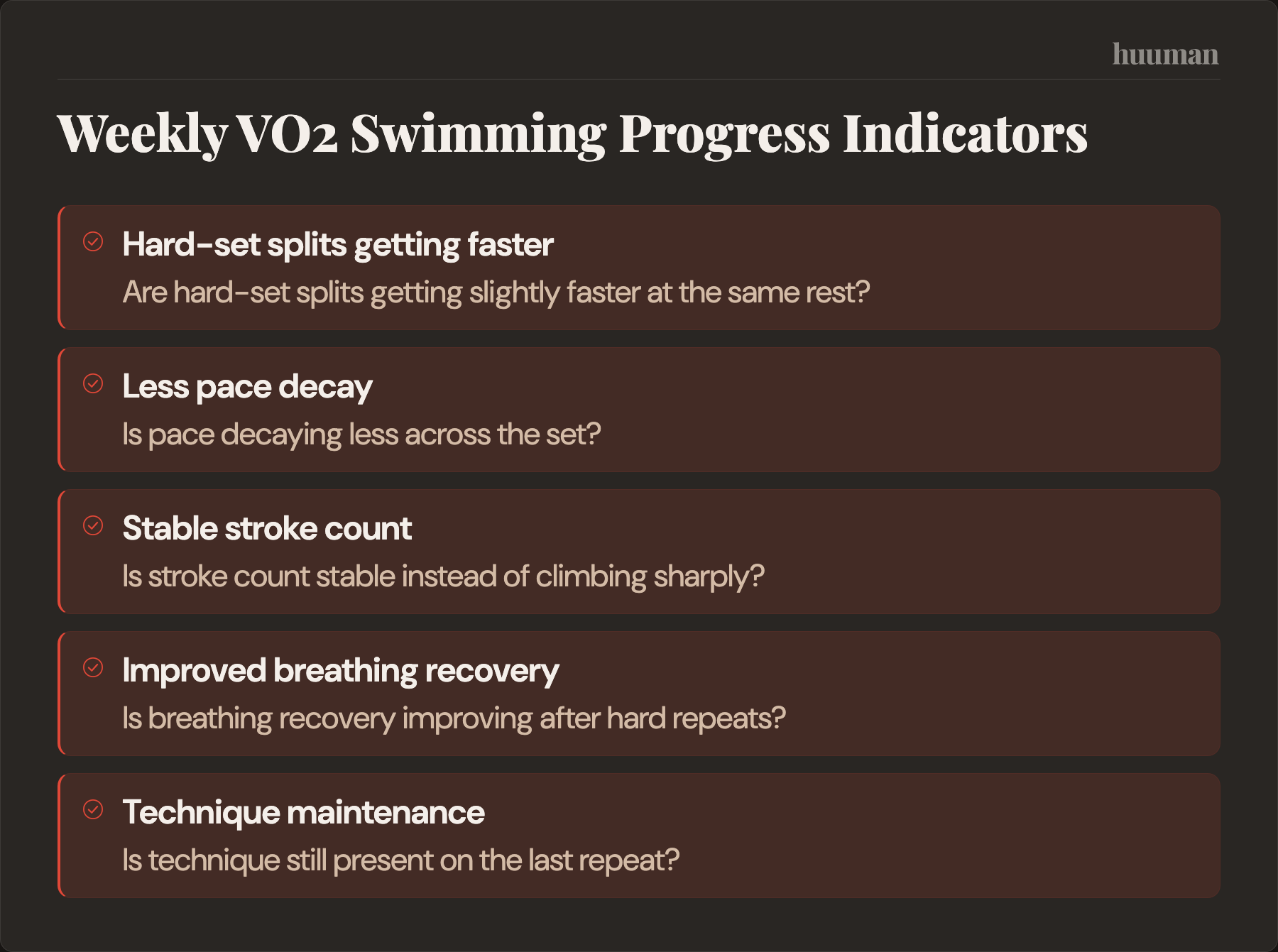
A simple weekly review checklist:
- Are hard-set splits getting slightly faster at the same rest?
- Is pace decaying less across the set?
- Is stroke count stable instead of climbing sharply?
- Is breathing recovery improving after hard repeats?
- Is technique still present on the back half of the session?
- Are sleep, resting heart rate, or general recovery trends compatible with another hard exposure?
Retest every 4 to 8 weeks, not every few days. The best anchor is usually one repeatable test plus one repeatable main set. That combination shows both capacity and execution. If you want a structured way to connect those logs to the rest of your training week, your huuman Coach can interpret swim trends alongside sleep, recovery, and weekly training load so you can decide whether to keep one VO2 session, add a second, or shift emphasis back to technique or CSS.
Signal vs noise in VO2max swimming
- Signal: faster average pace across the same set at similar RPE. Next step: keep the structure and reassess after another two weeks before adding volume.
- Noise: one random pool PR after extra rest or taper. Next step: wait for repeatability before changing training.
- Signal: less pace drop from early reps to late reps. Next step: note that your hard-speed endurance may be improving even if your watch says nothing.
- Noise: a wearable showing a dramatic jump in swimming VO2max. Next step: treat it as a loose estimate and compare it against pool performance instead.
- Signal: stroke count stays stable while pace improves. Next step: maintain technical cues and do not rush into harder send-offs.
- Noise: copying elite sprint sets from social media. Next step: choose a set that matches your event needs, skill level, and recovery capacity.
- Signal: breathing settles faster after hard blocks. Next step: log that recovery note because it often improves before dramatic time-trial changes appear.
- Noise: assuming hypoxic sets automatically build VO2. Next step: separate breath-control work from true aerobic power work unless you have a clear reason to combine them.
- Signal: you can complete one quality VO2 session each week without lingering shoulder or neck aggravation. Next step: consider a cautious second exposure only if sleep and life stress are also stable.
- Noise: forcing VO2 work when form is collapsing. Next step: convert the day to aerobic technique and protect the next week of training.
Common questions
What is VO2max in swimming, and how is it different from running VO2max?
It is the highest rate of oxygen use during swimming, but it is shaped by swim mechanics, breathing timing, and body position. Running fitness helps, but it does not fully transfer because the movement pattern and constraints are different.
How can I improve VO2max with swimming without overtraining?
For most adults, one high-quality VO2-focused swim each week is the safest default. Add easy aerobic volume, protect technique, and only consider a second hard session when recovery is clearly stable. If sleep is poor or your shoulders are irritated, shift emphasis to aerobic and technical work.
What is a good VO2max for swimmers?
There is no universally useful "good" number without context. Age, sex, event, training history, and test method all matter. Some competitive swimmer studies report high values, but those numbers are far less useful than whether your own pool pace, repeatability, and recovery are improving.
Do VO2max sets in the pool have to be all-out sprints?
No. True all-out swimming often becomes too anaerobic and too technically messy to provide repeatable aerobic power work. VO2 sets are usually hard but controlled, with enough rest to repeat quality.
How many times per week should I do VO2 intervals for swimming?
One session per week is the conservative default for most adults. Two can be workable when technique, recovery, and total training load are all stable. More is not automatically better.
Why does my Garmin or watch not show VO2max for swimming, or why is it inaccurate?
Because consumer devices are much better at estimating land-based metrics than capturing true swimming oxygen uptake. Pool environment, interval structure, and heart rate measurement challenges all reduce precision. Treat watch outputs as rough estimates, not validated swim physiology.
Is a 400 m time trial a good test for swim training zones?
It is a useful field anchor, especially for freestyle, but it is still an estimate. It helps you organize paces and compare progress. It does not replace direct metabolic testing, and it should not be confused with a precise measure of VO2max or CSS.
If you want broader intensity context outside the pool, articles on a structured HIIT plan for swimmers and Zone 2 base building for swimmers can help you place VO2 work inside a more complete week.
More health topics to explore
- Heart & Cardio – Overview
- Understanding HRV: Charts, Normal Ranges, and What "Good" Really Means
- HIIT for Cardio: How to Do It Safely, Effectively, and Without Burning Out
- HIIT on an Elliptical: 3 Repeatable Workouts + How to Progress
References
- Armstrong N & Davies B — An ergometric analysis of age group swimmers (1981)
- Fernandes RJ et al. — Different VO2max time-averaging intervals in swimming (2012)
- Rodríguez FA — Maximal oxygen uptake and cardiorespiratory response to maximal 400-m free sw... (2000)
- Fernandes RJ & Vilas-Boas JP — Time to Exhaustion at the VO2max Velocity in Swimming: A Review (2012)
- TrainingPeaks — A Beginners Guide to Swim Training
- Lahart IM & Metsios GS — Chronic Physiological Effects of Swim Training Interventions in Non-Elite Swi... (2018)
- McKay EE et al. — Physical work capacity and lung function in competitive swimmers (1983)
- Billat LV & Koralsztein JP — Significance of the velocity at VO2max and time to exhaustion at this velocity (1996)
- Research Article — Assessment of VO2 Max Reliability with Garmin Smart Watch Among Swimmers
- Tijani JM et al. — 400 meters freestyle pacing strategy and race pace training in age-group swim... (2021)