Strength training weight vests are simple hardware, but the buying decision is not simple if you care about pull-ups, dips, push-ups, split squats, step-ups, and carries. The wrong vest turns progressive overload into bouncing, neck pressure, restricted breathing, or awkward range of motion.
Key takeaways
1. Choose the type by use case: pocket-weight adjustable vests suit micro-loading and mixed exercises; plate carriers suit heavier calisthenics and stability; fixed-weight vests suit simplicity but limit progression.
2. Prioritize fit over maximum load: the vest should move with you on step-ups, push-ups, and pull-ups without shifting, choking, or compressing your ribcage.
3. Look for useful increments: smaller jumps make progression cleaner, especially for pull-ups, dips, and single-leg work.
The best vest for strength work is usually not the one with the highest listed load. It is the one that stays high and tight, lets you make small loading changes, clears your shoulders and hips, and remains comfortable enough that your technique does not change to avoid the vest.
This guide is fit-first and strength-first. It separates plate carriers, pocket-weight adjustable vests, and fixed-weight vests, then gives you a practical checklist, a decision tree, a comparison template, and safety cues you can use before buying or progressing.
Where weighted vests fit in a long-term training system
A weighted vest adds external load without occupying your hands. That makes it useful for bodyweight strength patterns, lower-body volume, and some conditioning work. It is not a replacement for thoughtful programming, and it is not automatically better than dumbbells, kettlebells, barbells, or machines.
For strength and movement capacity, the vest is most useful when it creates progressive overload while preserving the movement pattern you wanted in the first place. If you are building a broader base, place it within a structured strength and mobility training plan rather than treating.
Recovery matters because the vest increases loading through the spine, hips, knees, ankles, shoulders, and hands depending on the exercise. Poor sleep, elevated life stress, unusual soreness, or declining readiness signals can make a load that felt fine last week feel excessive today. Loaded walking and carries can also overlap with conditioning, but they should not quietly replace the strength work they were meant to support.
Quick answer
A strength-training weighted vest is a hands-free way to add load to squats, lunges, push-ups, dips, pull-ups, carries, and step-ups. The best choice for most strength-focused users is an adjustable vest that fits snugly, keeps the load high and close to your center of mass, and lets you progress in small increments without bounce.
- Choose the type by use case: pocket-weight adjustable vests suit micro-loading and mixed exercises; plate carriers suit heavier calisthenics and stability; fixed-weight vests suit simplicity but limit progression.
- Prioritize fit over maximum load: the vest should move with you on step-ups, push-ups, and pull-ups without shifting, choking, or compressing your ribcage.
- Look for useful increments: smaller jumps make progression cleaner, especially for pull-ups, dips, and single-leg work.
- Check range of motion: you need shoulder clearance for pull-ups, chest clearance for push-ups, hip clearance for squats, and enough room to breathe under effort.
- Start where form stays crisp: if pain, numbness, tingling, unusual shortness of breath, or sharp joint irritation appears, reduce load or stop and reassess.
If you want to see whether a vest is helping or just adding strain, log weight vest sessions with RPE in the huuman app so load, reps, effort, and next-day response are easier to compare over time.
What makes a weighted vest good for strength training
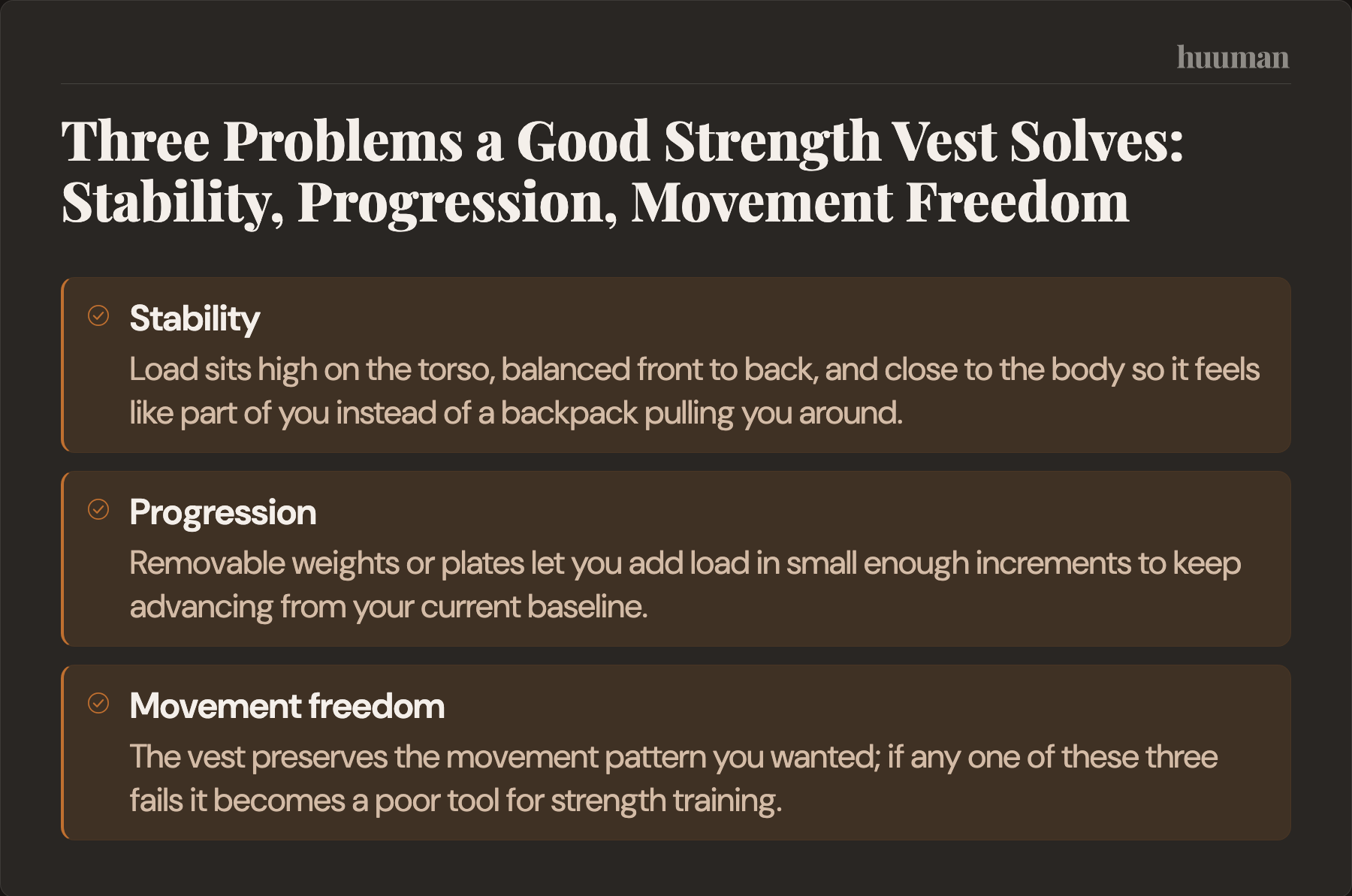
A good strength vest solves three problems at once: stability, progression, and movement freedom. If one of those fails, the vest may still be usable for casual walking, but it becomes a poor tool for strength training.
High-and-tight load placement
The load should sit high on the torso, balanced front to back, and close to the body. This position usually reduces swinging and makes the added weight feel more like part of you rather than a backpack pulling you around. A vest that hangs low can hit the hips during squats, interfere with bracing, or drag the shoulders forward.
“High and tight” does not mean constrictive. You still need ribcage expansion, normal breathing mechanics, and no choking sensation at the throat. If tightening the vest enough to stop bounce also restricts breathing, the geometry is wrong for you.
Useful increments beat impressive capacity
Micro-loading matters because bodyweight strength exercises are sensitive to small load changes. A big jump can turn technically clean pull-ups into swinging reps, or controlled split squats into knee-dominant survival reps. The smallest available increment is often more important than the largest possible load.
For advanced calisthenics, higher capacity can matter. For most mixed strength work, the more practical question is whether you can add or remove load quickly enough to use the vest in warm-ups, supersets, and back-off sets without derailing the session.
Range of motion and breathing clearance
The vest must respect the movement. Pull-ups need overhead shoulder position without the straps digging into the neck or pinning the shoulder blades. Push-ups need enough chest clearance to reach normal depth. Squats and lunges need a torso length that does not collide with the hips or thighs. This is where mobility and hardware interact, which is why checking your own movement standards matters as much as reading product specs. For a broader lens, see expert standards for mobility.
The H.U.U.M.A.N Fit-Load Framework
Use this one-screen checklist before buying, fitting, or progressing a vest. It is not a brand ranking. It is a way to compare hardware against the movements you actually train.
- H, High-and-tight load placement: the vest sits high on the torso, close to the body, and balanced front to back.
- U, Useful increments: removable weights or plates allow progress in small enough jumps for your current baseline.
- U, Unrestricted breathing and ROM: the ribcage expands, the shoulders reach overhead, the hips clear the vest, and push-up depth is not blocked.
- M, Material and sweat management: mesh, padding, and fabric reduce heat buildup, chafing, and soaked friction during longer sets or circuits.
- A, Application match: the vest matches your main job, such as calisthenics strength, lower-body accessories, carries, loaded walking, or conditioning finishers.
- N, No-bounce, no-hotspots: step-ups, burpees, and pull-up transitions feel stable without collarbone, trap, rib, or lower-back pressure points.
Vest type decision tree
Start with the movement you care about most, not the vest category that looks most serious.
- If your main goal is weighted pull-ups and dips: choose a stable plate carrier or a secure pocket-weight adjustable vest. Prioritize minimal swing, shoulder comfort, and front-back balance.
- If your main goal is push-ups, split squats, step-ups, and mixed accessories: choose a pocket-weight adjustable vest with small increments, low-profile pockets, and good torso clearance.
- If your main goal is loaded walking crossover: choose comfort over time, breathable materials, wide load distribution, and straps that do not rub the neck or compress the ribs.
- If your main goal is budget simplicity: a fixed-weight vest can work, but only if the load is appropriate now and you accept limited progression later.
- If you plan fast circuits: favor quick loading changes, minimal rattle, heat management, and a fit system that stays secure when fatigue rises.
Product types: what to choose and why
Pocket-weight adjustable vests
Pocket-weight vests use small removable weights, often sand, iron, or similar inserts distributed across the torso. Their main advantage is progression granularity. If the pockets are secure and evenly distributed, they are often the most flexible choice for mixed strength work.
The trade-off is management. More pockets can mean more time loading and unloading, and poorly secured weights may rattle or shift. Check whether the pockets close tightly, whether the inserts are quiet under movement, and whether the weight distribution remains symmetrical as you change load.
Plate carrier style vests
Plate carrier vests use front and back plates. They tend to feel stable, compact, and better suited to higher-load calisthenics when they fit well. They can also create pressure points because the load is concentrated through harder surfaces.
The risk is that “secure” can become “restrictive.” Hard plate edges may interfere with push-ups, ribs, collarbones, or chest position. A cummerbund or side strap system can improve stability, but if it compresses breathing or places straps poorly across the chest, especially for women, the vest may be a poor match even if the specs look strong. For broader considerations around training context, see strength training for women.
Fixed-weight vests
Fixed-weight vests are simple and often cheaper. They can be fine for walking, warm-ups, or a narrow exercise menu if the load happens to be right for you. Their limitation is that you cannot easily match the load to different movements or progress gradually.
A fixed vest that feels appropriate for step-ups may be too heavy for pull-ups or too light for squats. That mismatch matters because strength training is exercise-specific. Simplicity is useful only when it does not remove the ability to scale.
Comparison template: score the vest before you buy
Use this mobile-first comparison structure for any product you are considering. Because manufacturers list different capacities, sizes, and materials, treat their specs as the starting point, then score the fit using your own movements.
Pocket-weight adjustable vest
- Product type: pocket weight, modular loading with removable inserts.
- Max load: use the manufacturer-listed maximum, then ask whether you will realistically need it for your training.
- Smallest increment: usually the key spec for strength progression; smaller is generally easier to scale.
- Empty weight: check whether the vest itself adds meaningful load before inserts are added.
- Front/back balance: strong if pockets are evenly distributed and can be loaded symmetrically.
- Adjustability points: look for shoulder straps, sternum strap, side straps, or a stable wrap system.
- Sizing range: confirm torso length, chest circumference, and whether the vest can sit high without riding into the neck.
- Breathability score: often moderate to good if mesh and thinner padding are used.
- Bounce score: good when pockets are tight and side straps control movement; poor when inserts swing.
- ROM limitations: watch deep push-up depth, overhead arm position, and lower-pocket contact during squats.
- Noise/rattle risk: low to moderate depending on pocket security and insert material.
- Loading time: slower than a fixed vest, faster if pockets are easy to access.
- Best for: mixed strength work, micro-loading, push-ups, split squats, step-ups, and progressive calisthenics.
- Fit notes: check collarbone clearance, ribcage expansion, strap placement across the chest, women’s fit considerations, and torso length when seated or squatting.
- Red flags: loose pockets, uneven loading, scratchy seams, poor strap geometry, and a return policy that does not allow realistic fit testing.
Plate carrier vest
- Product type: plate carrier using front and back plates.
- Max load: use the plate and carrier specifications listed by the manufacturer, not assumptions from other plate systems.
- Smallest increment: determined by available plate options, often less granular than pocket weights.
- Empty weight: usually less relevant than plate comfort, but still worth checking.
- Front/back balance: strong when matched plates sit flat and close to the torso.
- Adjustability points: shoulder straps, side straps, sternum strap, and cummerbund design matter.
- Sizing range: plate size and torso length must match your body, not just your chest measurement.
- Breathability score: often moderate to low during longer circuits because plates and padding trap heat.
- Bounce score: often excellent when properly fitted.
- ROM limitations: hard edges can limit push-ups, overhead comfort, or ribcage expansion.
- Noise/rattle risk: low if plates lock in securely, higher if plate pockets are loose.
- Loading time: fast if plates are easy to swap, slow if access is tight.
- Best for: pull-ups, dips, carries, and higher-load users who tolerate the geometry.
- Fit notes: test collarbone pressure, trap pressure, chest strap placement, ribcage expansion, and whether the lower plate edge hits the abdomen or hips.
- Red flags: exposed plate edges, numbness or tingling in the arms, choking sensation, hard pressure on ribs, poor return policy, and plates that can shift or drop.
Fixed-weight vest
- Product type: one-piece vest with non-adjustable or minimally adjustable load.
- Max load: the listed weight is the working load, so it must fit your current exercises now.
- Smallest increment: none or very limited, which restricts progression.
- Empty weight: not separate from the working load.
- Front/back balance: depends entirely on the built-in distribution.
- Adjustability points: often basic, so strap quality is more important.
- Sizing range: confirm that the fixed shape works for your torso length and chest size.
- Breathability score: varies widely; cheaper models can run hot.
- Bounce score: acceptable for walking, often less predictable during dynamic strength work.
- ROM limitations: depends on bulk and torso length; test push-ups, squats, and overhead reach.
- Noise/rattle risk: usually low if construction is solid.
- Loading time: fastest because there is nothing to change.
- Best for: simple loaded walking, basic circuits, or a narrow exercise menu where the load is known to fit.
- Fit notes: check ribcage expansion, neck rubbing, women’s fit considerations, and whether the lower edge interferes with hip flexion.
- Red flags: load that is too aggressive for your weakest movement, no return flexibility, rough fabric, poor stitching, and no way to adapt as strength changes.
Exercise match: choose based on how you train
For pull-ups and dips, stability matters more than breathability. You want minimal swing, secure front-back balance, and shoulder straps that do not dig into the neck at the bottom of the rep. If the vest changes your scapular position or makes you cut depth, it is not helping the movement.
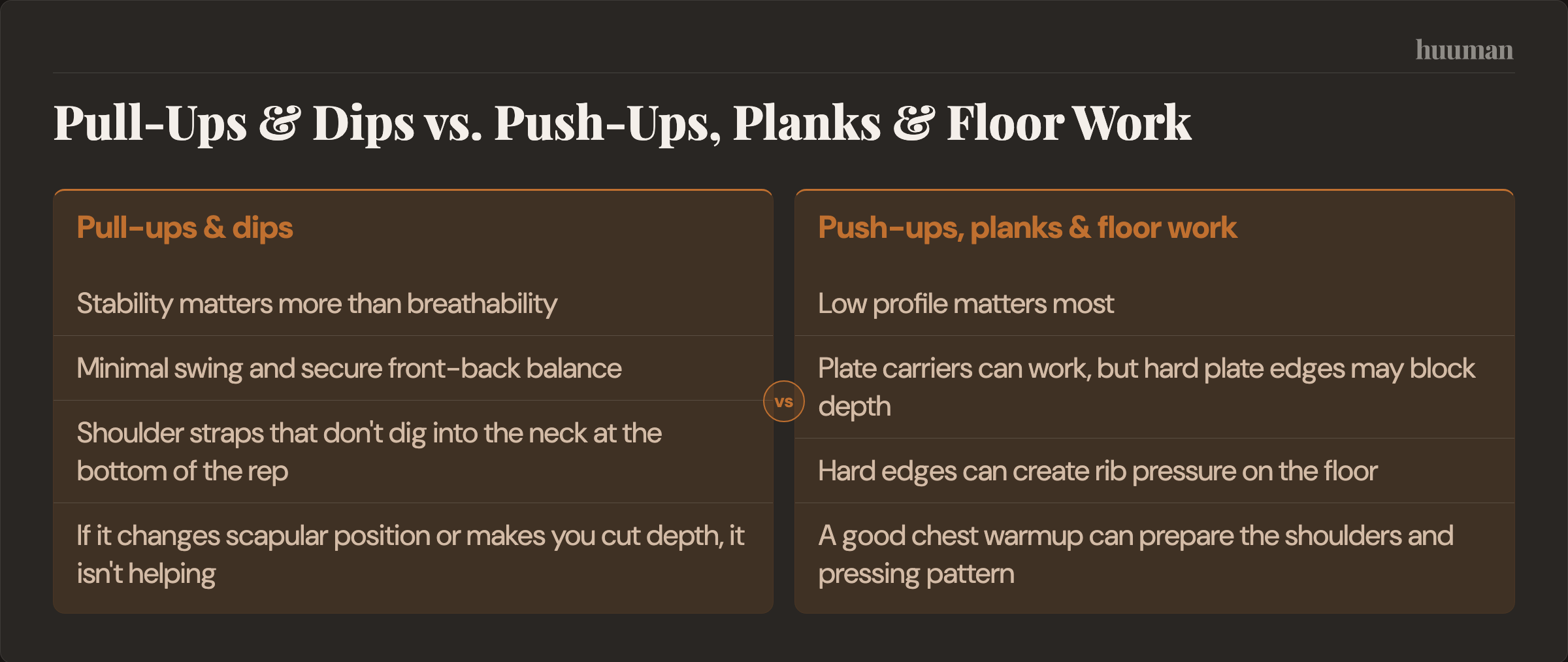
For push-ups, planks, and floor work, low profile matters. Plate carriers can work, but hard plate edges may block depth or create rib pressure. A good chest warmup can prepare the shoulders and pressing pattern, but it will not fix a vest that is physically in the way.
For squats, lunges, split squats, and step-ups, balance and hip clearance matter. The vest should not swing forward, hit the thighs, or force a shortened range. If your lower-body work is the priority, compare the vest against your existing lower body training patterns rather than judging it only with a walking test.
For carries and conditioning finishers, long-wear comfort and heat management matter. Mesh, padding geometry, strap width, and sweat behavior become more important as duration increases. Loaded steady work can be useful conditioning, but it should not be confused with a comprehensive strength training plan.
Compared with a barbell workout, the vest offers less precise external loading but more freedom for bodyweight patterns. That trade-off is the point: use the vest when hands-free load improves the exercise, not when it merely makes training feel harder.
Safety and progression principles
The safest starting load is not a universal percentage of body weight. It is the lowest vest load that preserves joint comfort, breathing, balance, range of motion, and technique in the exact exercise you are training. Baseline strength, body size, injury history, exercise selection, and fatigue all change the answer.

Progress by changing one meaningful variable at a time: load, reps, sets, density, range, or exercise difficulty. If you add load and also add fatigue, speed, impact, and volume, you will not know which variable caused the response. Many programs introduce vest work conservatively and keep it separate from the highest-impact or highest-fatigue training until the joints and tendons tolerate it well.
Use the vest first where form is easiest to control: pull-ups, dips, push-ups, split squats, step-ups, carries, or sled-like marching variations. Be more cautious with running, aggressive HIIT, maximal-impact plyometrics, and technical lifts where the vest changes balance or landing mechanics.
Specific areas to respect include the Achilles and calves during jumping or stairs, the front of the knee during step-heavy work, the low back during long loaded sessions, and the neck, traps, ribs, or collarbones under compression. Practical hazards also matter: donning and doffing a heavy vest, tripping while fatigued, and poorly secured plates or weights shifting unexpectedly.
Consult a qualified professional before using a weighted vest if you have persistent joint pain, neurological symptoms such as numbness or tingling, recent surgery, pregnancy or postpartum considerations, diagnosed osteoporosis, unstable cardiovascular disease, chest pain, fainting, sudden severe back pain, persistent joint swelling, or shortness of breath beyond expected exertion.
Evidence and limits
The strongest responsible claim is mechanical: adding external load increases the demand of a movement if the movement pattern remains intact. That can support strength or hypertrophy goals when the exercise, total volume, effort, progression, nutrition, and recovery are appropriate. The vest is a loading tool, not a guaranteed adaptation.
Claims about bone density, metabolic rate, VO2max, posture, fat loss, or muscle gain need more caution than marketing pages usually provide. Outcomes depend on who is training, what they were doing before, how much load they can tolerate, whether the stimulus progresses, and whether they recover. Without specific cited studies in this article, any precise improvement claim would be stronger than the evidence presented here.
The practical takeaway is not skepticism for its own sake. It is better decision quality. If your goal is strength, judge the vest by progressive overload and exercise quality. If your goal is conditioning, judge it by sustainable work, breathing, heart-rate response, and recovery. If your goal is bone or medical risk management, discuss the plan with a clinician rather than assuming a consumer product creates a clinical outcome.
Non-prescriptive strategies to discuss with a professional
A common starting approach is to place the vest into accessory work rather than making every main lift heavier immediately. Pull-ups and dips can use it for strength skill; push-ups, split squats, and step-ups can use it for hypertrophy accessories; carries and loaded walking can use it for conditioning. The right role depends on your baseline and your program.
If shoulders or neck get irritated, the issue may be vest geometry rather than toughness. Try reassessing strap placement, load distribution, collarbone clearance, and total load. If breathing feels restricted, loosening the system may solve it, but if looseness creates bounce, a different vest profile may be the better answer.
If knee or Achilles irritation appears after step-ups, stairs, jumping, or loaded walking, reduce the stressor and look at volume, footwear, surface, fatigue, and exercise choice. If low-back fatigue shows up during long loaded sessions, shorten the exposure, check bracing, and consider whether the load sits too low or too far from the body.
A vest can support body composition training, but it does not bypass nutrition, total training quality, or recovery. If your interest is aesthetic outcome, pair the hardware decision with realistic expectations about strength, muscle, and energy balance. For related context, see ab training for women, which separates training and body composition from shortcuts.
How to track and interpret changes
Track the signals that tell you whether the vest is productive: exercise, vest load, sets and reps, RPE, range of motion quality, technique notes, next-day soreness, and joint irritation. A useful log entry might read: “Push-ups, pocket vest, smallest added load, controlled depth, three hard sets, RPE high but stable, no shoulder pain, mild chest soreness next day.”
Also watch recovery context. Sleep duration, resting heart rate trend, HRV trend, motivation, and unusual soreness can help explain why the same vest load feels smooth on one day and clumsy on another. These signals do not diagnose anything, but they can prevent you from confusing fatigue with loss of fitness.
Compare like with like. Reps at the same load, total clean reps in a session, and RPE at a familiar movement are more useful than chasing a heavier vest every time. Good progression feels repeatable, not heroic. If technique degrades, range shortens, or joints complain, the log is telling you the load is no longer clean overload.
Rather than forcing the same vest session when readiness is low, your huuman Coach can adapt weekly strength and cardio plans to recovery signals, recent load, preferences, and available time while keeping the goal of staying fit, confident, and capable in view.
Signal vs noise
- “More weight is always better.” More load is useful only if the rep quality stays intact; compare technique at the same movement before increasing again.
- “Wear it all day.” Constant loading can create fatigue and irritation without a clear training stimulus; use defined sessions and monitor the next-day response.
- “It fixes posture.” A vest can change loading, but it does not automatically correct movement habits; assess mobility, strength balance, and desk or daily positions separately.
- “It replaces leg training.” Loaded step-ups and split squats can help, but they do not cover every lower-body strength need; keep the full program in view.
- “It is required for bone density.” Bone-related claims are context-dependent and not guaranteed; discuss medical goals with a clinician.
- “Any bounce is fine.” Bounce changes force timing and comfort; tighten the fit, reduce load, or choose a different shape if the vest shifts during step-ups or burpees.
- “One progression rule applies to everyone.” Baseline strength, tendon tolerance, sleep, and exercise choice differ; progress when your log shows stable effort and joint comfort.
- “HIIT with a vest is automatically superior.” Added load can degrade landing mechanics and breathing; earn intensity with clean movement before adding speed or impact.
- “A plate carrier is always more serious.” Plates can be stable, but pocket weights may fit better for push-ups, split squats, and micro-loading; let the exercise decide.
- “If it hurts, push through.” Sharp pain, numbness, tingling, skin breakdown, or unusual shortness of breath are not normal training signals; stop and reassess with professional input if needed.
A broader hardware mindset
Good health hardware should reduce friction, not create new problems. The same evaluation logic applies beyond weighted vests: use-case fit, comfort, evidence, and behavior change matter more than buying the most aggressive product. That lens is useful whether you are comparing training tools, a longevity book, anti-aging pillow, reading focus cards, or recovery slides.
Common questions
Are weighted vests good for strength training, or mainly for cardio?
They can be good for strength training when they add load to movements that already look clean. Pull-ups, dips, push-ups, split squats, step-ups, and carries are common fits. They become more cardio-focused when used for longer continuous walking, circuits, or loaded conditioning.
How heavy should a weighted vest be for strength training?
There is no single correct starting weight. The right load is the lightest load that makes the exercise meaningfully harder while preserving technique, breathing, range of motion, and joint comfort. The smaller the increment, the easier it is to find that point.
What is the downside of training with a weighted vest?
The main downsides are bounce, heat, pressure points, restricted breathing, reduced range of motion, and extra joint or tendon load. These are hardware and programming issues, not signs that vests are inherently bad. A poor fit or rushed progression is usually the bigger problem.
Plate carrier vs adjustable pocket-weight vest: which is better for pull-ups and dips?
A well-fitted plate carrier can be excellent for pull-ups and dips because it stays compact and stable. A secure pocket-weight vest can also work well and usually offers finer loading jumps. Choose based on swing control, shoulder comfort, and whether the smallest load change fits your current strength.
Can you do push-ups with a plate carrier vest comfortably?
Sometimes. The deciding factors are plate thickness, edge shape, torso length, and whether the front plate blocks depth or presses into the ribs. Test push-up depth and breathing before assuming a plate carrier is suitable for floor work.
How do I stop a weighted vest from bouncing or rubbing my neck?
First, make the load high, balanced, and close to the torso. Then adjust shoulder, sternum, side strap, or cummerbund tension so the vest moves with you without choking or compressing breathing. If neck rubbing persists, the cut or strap geometry may not suit your body.
Is it safe to use a weighted vest for running or HIIT?
It can increase impact, balance demands, heat, and fatigue, so it deserves caution. If you are not prepared for the movement without load, adding a vest is usually premature. Persistent pain, unusual breathlessness, or altered mechanics are reasons to stop and reassess.
If you want a clearer next step after choosing the vest type, your huuman Coach can explain each week’s training rationale and help connect strength work, conditioning, and recovery signals without turning every session into a harder session.
This article is educational only and is not medical advice. Personal decisions about training, symptoms, chronic conditions, pregnancy or postpartum exercise, recent surgery, or persistent pain should be discussed with a qualified clinician or health professional.
About this article · Written by the huuman Team. Our content is based on peer-reviewed research and clinical guidelines. We follow editorial standards grounded in scientific evidence.
This article is for educational purposes only and does not constitute medical advice. Health and training decisions should be discussed with qualified professionals.