Strength training is one of the most reliable ways to make your body more resilient, improve posture, and build usable capacity for everyday life. As a beginner, the key isn't finding the "perfect" plan, it's learning movements well and repeating them consistently.
This guide gets you there: a clear starting point with 2–3 sessions per week, a simple structure built around six fundamental movement patterns, and a progression model that builds strength without overwhelming you.
Key takeaways
1. Start with 2 full-body sessions per week, optionally 3 if recovery is good.
2. Each session includes 5–6 movement patterns: squat, hinge, push, pull, carry, core.
3. Prioritize clean technique: stable spine, controlled lowering phase, full foot contact, shoulder blade control.
You'll get a ready-to-follow 8-week plan for both home and gym training, plus the logic behind it so you can make informed decisions on your own.
Why strength training is your foundation
Strength training goes beyond building muscle. It increases the load tolerance of tendons and bones, stabilizes joints, and improves the movement patterns you use every day. It also supports body composition and glucose management, without requiring extreme dieting.
If you want to see how strength fits into the bigger picture, check out Strength & movement overview. For most beginners, the most important decision isn't exercise selection, but choosing a structure you can stick to.
Quick answer
If you're starting beginner strength training, this approach works best in practice:
- Start with 2 full-body sessions per week, optionally 3 if recovery is good.
- Each session includes 5–6 movement patterns: squat, hinge, push, pull, carry, core.
- Prioritize clean technique: stable spine, controlled lowering phase, full foot contact, shoulder blade control.
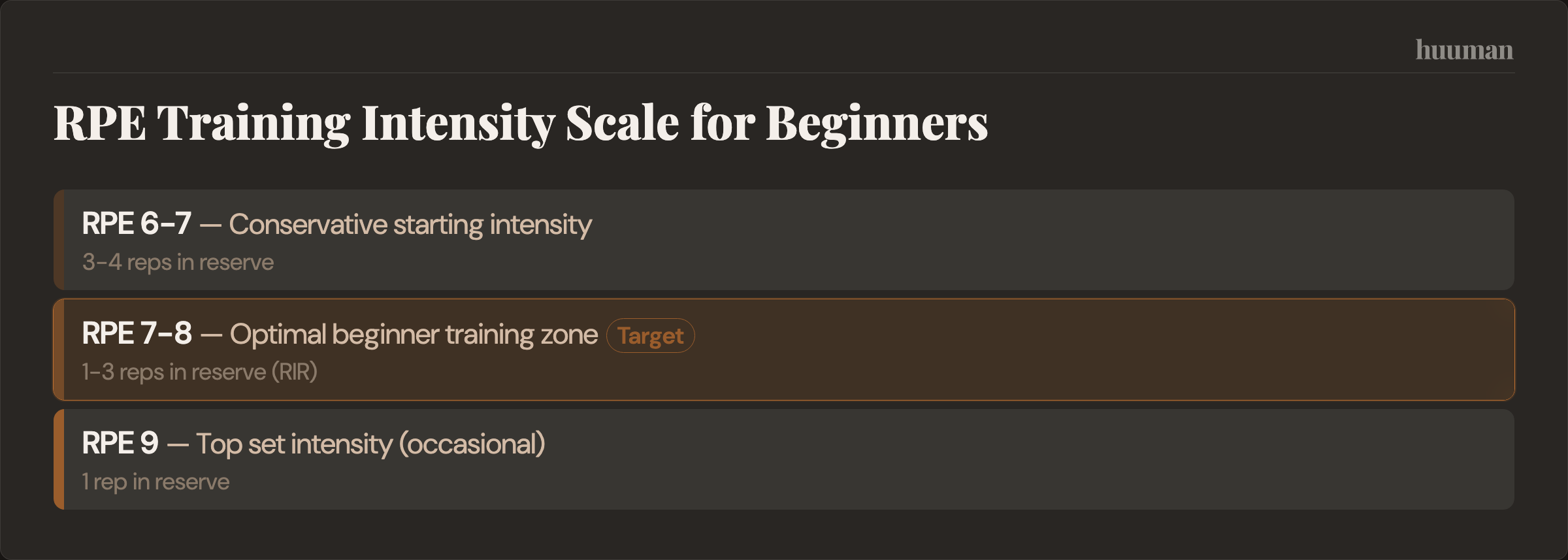
- Intensity: mostly RPE 7–8, meaning 1–3 reps left in reserve (RIR).
- Progression: increase reps first, then add small weight increments.
- Allow about 48 hours between training the same muscle groups.
Your goal in the first 8 weeks is to become "movement-strong": consistent technique plus consistency, not maximum exhaustion.
Instead of guessing whether you're progressing, track your strength sessions and RPE patterns with the huuman app to see clear trends in your lifting capacity and recovery readiness.
What "beginner" really means
Being a beginner doesn't mean being unfit. It means you haven't yet developed strength-specific skills, your body isn't coordinating load efficiently. Early on, you respond to almost any structured training. The limiting factor is technique and repeatability, not intensity.
If you're returning after a break, you may progress faster but should still build tendons and passive structures conservatively. Cardio-trained beginners often feel exhausted quickly without properly loading target muscles, longer rest periods and clearer technique help here.
The FRAME-6: your planning shortcut
Six patterns cover nearly everything: squat, hinge, push, pull, carry, core. Three rules keep you on track: repeatable (technique), progressive (logbook), and recoverable (readiness).

Movement patterns → exercises, mistakes, cues
- Pattern: Squat - Home: Goblet squat, box squat - Gym: Leg press, hack squat - Common mistakes: Heels lift, rounded back - Coaching cue: "Push through the whole foot, chest proud"
- Pattern: Hinge - Home: Dumbbell RDL, band hinge - Gym: RDL, hip thrust - Common mistakes: Moving from the back instead of hips - Coaching cue: "Push your hips back"
- Pattern: Push - Home: Incline push-ups - Gym: Chest press, incline bench - Common mistakes: Shrugging shoulders, flared elbows - Coaching cue: "Shoulders down, control the descent"
- Pattern: Pull - Home: Band rows, dumbbell rows - Gym: Seated cable row, lat pulldown - Common mistakes: Using momentum, no scapular control - Coaching cue: "Pull your shoulder blades first"
- Pattern: Carry - Home: Suitcase hold/march - Gym: Farmer carry - Common mistakes: Leaning sideways - Coaching cue: "Stay tall and upright"
- Pattern: Core - Home: Dead bug, plank - Gym: Cable anti-rotation - Common mistakes: Overarching, losing tempo - Coaching cue: "Ribs down, breathe steadily"
Intensity without 1RM: RPE and RIR
You don't need a one-rep max test. Use RPE (effort from 1–10) or RIR (reps in reserve). For beginners, RPE 7–8 works well: you finish a set knowing you could do 1–3 more clean reps. This helps maintain technique and repeatable sessions.
Muscle growth can happen across different rep ranges, as long as you train close enough to fatigue. 8–12 reps are common, but lower or higher ranges work too if the final reps are challenging.
Sets, reps, rest: the minimum that works
Beginner strength training doesn't require many sets. Most programs use 2–3 working sets per exercise. What matters is that every rep is controlled.
- Tempo: controlled lowering phase, no "dropping" the weight.
- Rest: long enough to keep technique clean – often 60–180 seconds.
- Warm-up: brief general warm-up, then 1–2 specific warm-up sets before your first main lift.
Progression that doesn't burn you out
Progress builds over weeks through progressive overload. In practice, double progression works well:
- Pick a rep range, e.g., 6–10.
- Keep the same weight until you reach the top of the range in all sets.
- Then increase the weight slightly and start again at the lower end.
When not to increase? If technique breaks down, RPE stays unexpectedly high, or recovery is clearly poor. Every 4–8 weeks, a lighter week can help. If you're unsure, see when a deload makes sense and what a deload week looks like.
Full-body vs. split: why full-body usually wins
For beginners, full-body training is easier to manage: you repeat movements more often, learn faster, and distribute volume across the week. Splits like upper/lower can make sense later once you can handle more volume, but early on, frequency is the advantage.
Gym or home: same principles, different tools
Both machines and free weights work well for beginners. Machines provide stability and repeatable setups; free weights improve coordination. At home, you can do a lot with bodyweight, bands, and dumbbells. Also see building muscle at home and effective dumbbell training.
8-week starter plan (2× and 3×/week)
Structure beats perfection. Repeat the same exercises over weeks and track your performance.

Option A: 2×/week (minimal)
- Week: 1–2 - Sessions: Mon/Thu - Focus: Technique, conservative RPE 6–7 - Progression: Build reps at the low end
- Week: 3–6 - Sessions: Mon/Thu - Focus: RPE 7–8 - Progression: Double progression per exercise
- Week: 7 - Sessions: Mon/Thu - Focus: Light week - Progression: Halve volume, maintain technique
- Week: 8 - Sessions: Mon/Thu - Focus: RPE 7–8 - Progression: Slightly increase starting weights
Option B: 3×/week (standard, A/B)
- Week: 1–2 - Split: A/B/A - Focus: Technique, RPE 6–7 - Progression: Increase reps
- Week: 3–6 - Split: B/A/B - Focus: RPE 7–9 (top set) - Progression: Double progression
- Week: 7 - Split: A/B - Focus: Light week - Progression: Reduce volume
- Week: 8 - Split: A/B/A - Focus: Stable output - Progression: Small load increases
Protocol cards
huuman 6×2 (minimal effective dose)
- Goal: start without overwhelm, build technique
- Week: 2 sessions + 2–4 walks
- Session (35–45 min): 5–7 min warm-up, then squat, hinge, push, pull, carry/core, short cool-down
- Intensity: RPE 7–8, RIR 1–3
- Progression: increase weight slightly once top reps are reached at ≤RPE 8
- Readiness: check sleep, soreness, resting heart rate, HRV trend
huuman full-body 3×/week (standard)
- Goal: faster skill and strength development
- A day: squat, horizontal push, horizontal pull, core
- B day: hinge, vertical/incline push, vertical pull, carry
- Intensity: top set RPE 7–9, back-off sets 7–8
- Progression: 4–8 weeks of double progression, then a lighter week
huuman home gym starter (bands + dumbbells)
- Goal: same patterns without a gym
- Split: lower body + upper body + core/carry substitute
- Intensity: RPE 7–9
- Note: short circuits stress the heart more – manage effort via RPE and tempo rather than heart rate
Warm-up, technique, safety
A brief general warm-up plus specific warm-up sets is enough. Only add mobility work if it directly improves your movement. "Technique over weight" isn't just a slogan, it reduces injury risk and makes progress more reliable.
Learn to distinguish sensations: muscle burn is expected, but sharp or radiating pain, numbness, or joint pain are warning signs. If you experience dizziness under load, chest pain, noticeable swelling, or loss of function, get it checked.
Nutrition and recovery
Training is only as effective as your recovery. Sleep and stress determine how quickly you can progress. Soreness (DOMS) is normal, but not the goal, your performance in the next session matters more.
Adequate energy intake, sufficient protein, and hydration support adaptation. Exact amounts depend on your body, lifestyle, and goals.
Evidence and limitations
In untrained individuals, strength and muscle increase with almost any structured program. Around two sessions per week is often described as an effective starting point. Different rep ranges can work if sets are taken close to fatigue. RPE and RIR are practical tools to regulate intensity without 1RM testing. Progressive overload over time is a core principle in training literature.
Limitations: anatomy, training history, sleep, stress, injury history, and coaching quality all influence outcomes. Both machines and free weights are suitable for beginners; differences matter more as you advance.
For an overview of training without equipment, see strength training at home – building muscle without equipment.
Strategies to discuss with a professional
- Limited time: 2 sessions of 35–45 minutes, 4 main exercises + core/carry.
- Quick fatigue: fewer sets, longer rest, prioritize technical reps.
- Home setup: bands and dumbbells as a base, optional pull-up bar.
- Hesitation with weights: progress reps and tempo before adding load.
Tracking and interpreting progress
Record three essential metrics for each exercise: weight used, sets and reps completed, and perceived effort (RPE 1-10). Note weekly trends in sleep hours, muscle soreness, and energy levels to spot recovery patterns.
Progress shows in subtle ways: lifting the same weight with better form, completing extra reps at the same RPE, or needing less rest between sets. Watch for consistent improvements over 2-3 weeks rather than session to session.
Instead of generic templates, have your huuman Coach build personalized weekly strength plans that adapt to your technique progress and recovery signals for sustainable long-term development.
Signal vs. noise in beginner strength training
- Signal: Cover all six movement patterns and progress patiently. Next step: stick with the same exercises for 4–8 weeks.
- Signal: Stop sets before technique breaks down. Check: review video of your final rep.
- Signal: Repeatable sessions. Action: schedule fixed training days.
- Signal: Adequate rest. Test: extend rest periods and compare set quality.
- Noise: Training to failure every day. Fix: use RIR 1–3.
- Noise: Constant exercise changes. Adjust: change only after a full cycle.
- Noise: "Only free weights work." Use: machines for stable learning phases too.
- Noise: "No soreness, no progress." Watch: next session performance.
- Noise: Obsessing over the perfect warm-up. Focus: 1–2 specific warm-up sets.
Frequently asked questions
What's the best way to start strength training as a beginner?
Start with 2 full-body sessions per week, 5–6 core movement patterns per session, and moderate intensity (RPE 7–8). Keep exercises consistent and focus on clean technique. A structured training plan makes this easier to follow.
2 or 3 times per week?
Two sessions are a solid starting point. Three can speed up learning if your sleep and schedule allow it. If performance stays stable and recovery is good, you can add a third. If not, stay with two.
What are "compound exercises"?
Anything that covers the six patterns: squat, hinge, push, pull, carry, and core. The exact exercise depends on your equipment and comfort. For fundamentals, see muscle-building basics.
Should I train to failure?
Not necessary. Beginners usually benefit from leaving 1–3 reps in the tank. This keeps technique solid and sessions repeatable.
What if I'm very sore?
Mild soreness is normal. If it's severe, reduce volume or intensity and keep movements clean. If movement is restricted, prioritize recovery and ease back in gradually.
Can I build strength at home without equipment?
Yes. Bodyweight, bands, and dumbbells can cover all movement patterns. For many, this is the easiest starting point. For more, see strength training for women and building muscle as you age.
How fast should I increase weight?
As slowly as needed, as consistently as possible. Stay within your rep range, increase reps first, then add small amounts of weight. If RPE jumps or technique suffers, hold the weight steady.
More health topics to explore
- Strength, Muscle & Mobility – Overview
- Chest Day: A Shoulder
- Building Muscle While Sick: When to Train, When to Pause, and How to Come Back Safely
- Body Fat Percentage: Normal Ranges, Charts & How to Interpret (Women/Men)
References
- AOK — Krafttraining Zu Hause Starke Muskeln Ohne Geraete
- ACSM — Progression Models in Resistance Training (2009)
- Grgic J et al. — Effects of resistance training performed to repetition failure or non-failure... (2022)
- Lea JWD et al. — Convergent Validity of Ratings of Perceived Exertion During Resistance Exerci... (2022)
- NSCA — Ptq 10.2.1 Progressive Strategies for Teaching Fundamental Resistance Trainin...
- NSCA — Foundationsoffitnessprogramming
- ETSU — Exercise is Medicine
- NSCA — Basics of Strength and Conditioning Manual
- Miranda H et al. — Repetition Performance and Blood Lactate Responses Adopting Different Recover... (2018)
- ACE Fitness — How to Squat Properly: Body Type Breakdown & Anatomy Considerations
- NSCA — Exercise Technique: The Dead Bug (2019)
- BarBend — How to Use the RPE Scale for Strength Training
- NASM — Rate of Perceived Exertion
- PT Pioneer — NSCA CPT Chapter 15: Resistance Training Program Design