Strength, muscle, and mobility form the physical foundation that lets you move well, resist injury, and stay capable as you age. Done consistently, strength training supports metabolic health, joint resilience, bone density, and everyday performance. Population guidelines such as the Physical Activity Guidelines for Americans include regular muscle strengthening for exactly this reason.
This page is the starting point for understanding strength training and muscle development without getting lost in unnecessary complexity. The goal is simple: give you the smallest set of ideas that reliably produce results.
Key takeaways
1. Train 2 to 3 sessions per week using a small set of full body movements.
2. Use the six fundamental movement patterns: squat, hinge, push, pull, carry, and core stability.
3. Progress gradually by increasing load, reps, or difficulty when the current workload feels manageable.
You will find three things here: the essential movement patterns your body needs, the core principles that make training effective, and a minimal plan you can actually sustain. From there you can explore deeper guides on hypertrophy, recovery, and sport-specific strength.
Where strength, muscle, and mobility fit in the bigger health picture
Many people treat strength training as an optional add-on to health. Research and public health guidelines increasingly treat it as a core pillar.
Evidence from over 2 million participants suggests that muscular strength is inversely associated with all-cause mortality, supporting its role in long-term health outcomes.
Handgrip strength measurements specifically show strong associations with mortality outcomes across diverse populations, providing a simple clinical marker of overall strength.
Additionally, regular resistance training is associated with lower all-cause, cardiovascular disease, and cancer mortality risk.
Resistance training also supports bone density, metabolic health, and functional independence across the lifespan. For example, For example, organizations like the National Institute of Arthritis and Musculoskeletal and Skin Diseases overview of bone health highlight mechanical loading as an important factor for bone maintenance. At the same time, better mobility helps joints tolerate everyday forces and sport-specific movement.
The most useful way to think about training is that strength, mobility, cardiovascular fitness, and recovery reinforce each other. Lifters often benefit from maintaining an aerobic base. If that topic interests you, see why cardio matters for lifters and how aerobic fitness supports your lifting.
This hub focuses on the mechanical side of health: how to maintain strong muscles, stable joints, and movement capacity that still serves you decades from now.
Quick answer
If you want the highest return from strength training, focus on a few fundamentals:
- Train 2 to 3 sessions per week using a small set of full body movements.
- Use the six fundamental movement patterns: squat, hinge, push, pull, carry, and core stability.
- Progress gradually by increasing load, reps, or difficulty when the current workload feels manageable.
- Prioritize technique and full but controlled range of motion.
- Recover well through sleep, rest days, and nutritional support.
This structure appears across most evidence-informed training systems. Progressive overload, sufficient training stimulus, and adequate recovery cycles form the foundation of effective strength development.
If you want a deeper breakdown of programming, see a proven muscle building protocol or a structured training plan for hypertrophy.
If you want to see how your actual training sessions connect to strength gains over time, log your squat and deadlift sessions with the huuman app using RPE and weight to build a clear picture of your progression across these fundamental patterns.
The six movement patterns every program should cover
Effective strength programs rarely revolve around individual muscles. They are built around movement patterns that train coordinated muscle groups and joint mechanics.
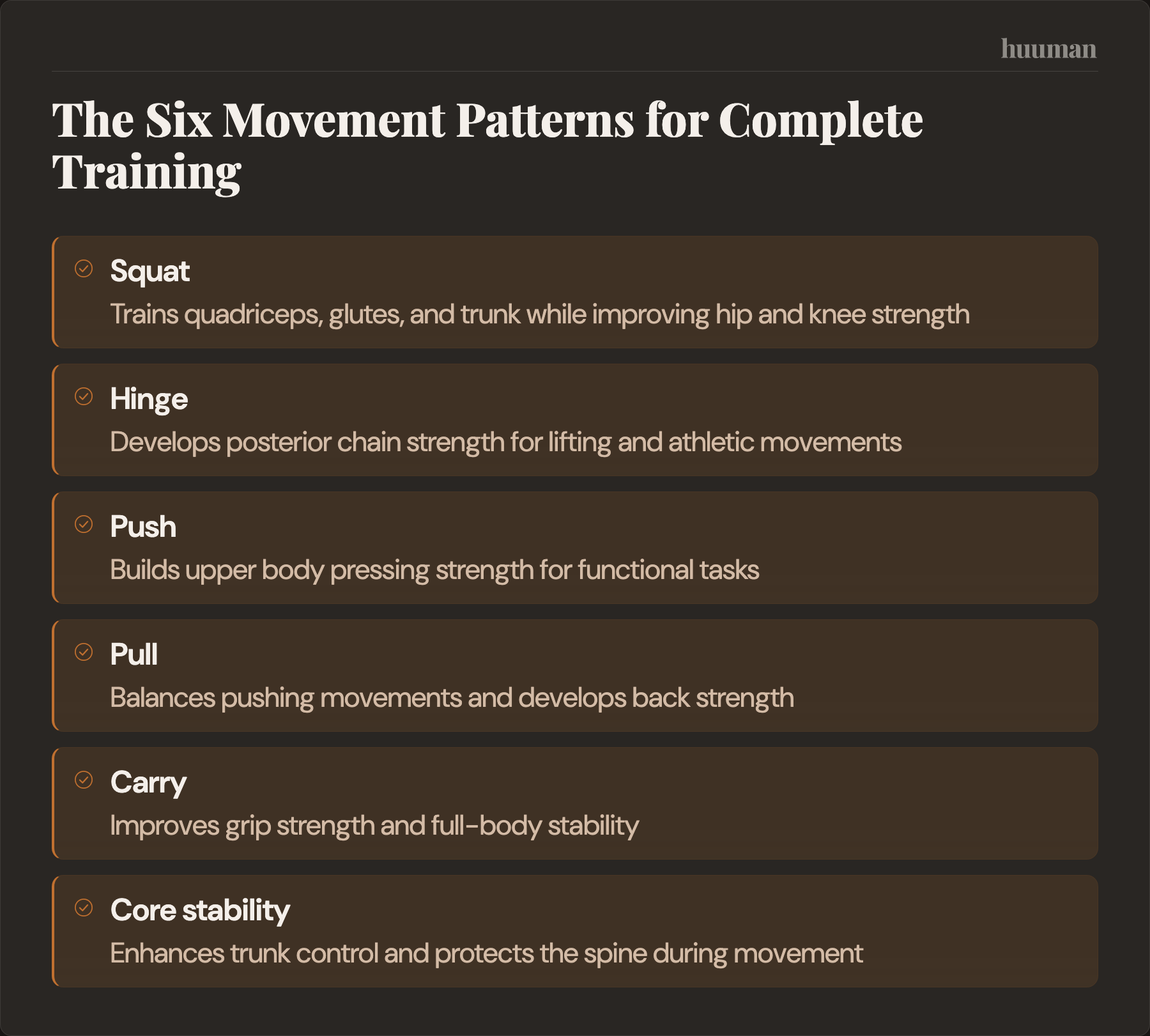
Covering these patterns tends to provide balanced muscular development and better durability.
Squat
The squat pattern trains the quadriceps, glutes, and trunk while improving hip and knee strength. Variations include bodyweight squats, goblet squats, and barbell squats.
This pattern supports everyday tasks such as standing up, lifting objects, and climbing stairs.
Hinge
The hinge trains the posterior chain, particularly the glutes and hamstrings. Deadlifts, Romanian deadlifts, and hip hinges are common examples.
Many programs consider this pattern essential for protecting the lower back and maintaining posterior chain strength.
Push
Push patterns train the chest, shoulders, and triceps. They include presses such as push-ups, dumbbell presses, and overhead presses.
Programs often include both horizontal and vertical pushing movements for balance.
Pull
Pulling movements build the upper back and arm flexors. Examples include rows, pull-ups, and pulldowns.
For many people who sit for much of the day, pulling strength helps maintain shoulder balance and posture.
Carry
Loaded carries challenge grip, trunk stability, and full body coordination. Farmer carries and suitcase carries are frequently used in training and rehabilitation settings.
Carrying movements are closely related to real-world strength demands.
Core stability
In most training literature the core is trained through anti-movement, meaning exercises that resist bending or twisting rather than repeatedly flexing the spine.
Planks, dead bugs, and anti-rotation drills fall into this category. Their role is to allow efficient force transfer through the body.
Principles that make training work
Many programs look different on the surface. The underlying principles tend to be the same.
Progressive overload
Your body adapts when training stress gradually increases. This can mean slightly heavier weights, more repetitions, more sets, or more challenging variations.
Progression models in resistance training highlight this gradual increase in training demand as a central driver of strength development.
Technique and range of motion
Good technique controls joint position and distributes forces across the muscles designed to handle them. Many programs emphasize a controlled and comfortable range of motion rather than partial movements performed with excessive load.
Mobility work often serves this goal: enabling joints to move through usable ranges while maintaining stability.
Recovery
Muscle adaptation occurs after training, not during it. Recovery allows tissues to repair and adapt to the stimulus.
Sleep quality, rest days, and energy intake can all influence how well your training translates into actual progress. If you want to dive deeper, see recovery is where the gains happen and guides on programming deload weeks.
A minimal weekly plan that works for many people
The simplest structure that covers most needs is a full body routine two times per week.

Many training programs described in the literature use some variation of this format.
- A squat movement
- A hinge movement
- A push exercise
- A pull exercise
- A short core stability exercise
Sessions typically prioritize controlled technique, moderate effort, and gradual progression over time.
As consistency improves, some people expand to three sessions per week or explore more specialized programming. If hypertrophy becomes the priority, structured approaches like structured training plans for hypertrophy can organize training volume and progression more deliberately.
Strength training also looks different depending on age and lifestyle. Discussions around building muscle after 50 highlight how gradual progression and recovery become increasingly important.
Troubleshooting common problems
Progress in strength training rarely follows a straight line. Plateaus, discomfort, or time constraints are common.
Some issues simply indicate normal adaptation cycles, while others deserve attention.
Plateaus
If weights stop increasing, programs often reduce fatigue temporarily through lighter training periods before gradually rebuilding workload.
Minor back, knee, or shoulder discomfort
Mild symptoms frequently relate to technique, range of motion limitations, or excessive workload increases.
Many training environments respond by temporarily reducing load, emphasizing controlled technique, and exploring alternative movement variations.
Safety red flags
Seek medical or professional evaluation if you experience:
- Sharp or worsening pain during movement
- Loss of strength or sensation
- Pain that persists or escalates despite reducing training
- Symptoms following a clear injury event
Strength training should challenge tissues but not produce acute injury symptoms.
Mini glossary of common strength training terms

- Volume: total work performed, usually calculated as sets multiplied by repetitions.
- Intensity: the relative difficulty of a set, often related to load or proximity to fatigue.
- RIR (reps in reserve): estimate of how many repetitions could still be performed before failure.
- ROM (range of motion): the movement distance a joint travels during an exercise.
- Compound movement: exercise using multiple joints and muscle groups.
- Isolation exercise: exercise targeting a specific muscle with minimal joint movement.
- Progression: gradual increase in training stress over time.
- Deload: temporary reduction in training stress to manage fatigue.
- Hypertrophy: muscle size increase associated with resistance training.
- Mechanical tension: force placed on muscle fibers during contraction.
How to track progress and interpret changes
Tracking helps separate real progress from random fluctuations.
Simple systems tend to work best. Three signals are usually enough:
- Load or repetition progress: are key exercises gradually improving?
- Training consistency: are you actually completing weekly sessions?
- Movement quality: does technique feel more stable and controlled?
Over time these trends reveal more than a single workout ever could. Consistency across months matters more than short-term fluctuations.
Rather than guessing which movement patterns to prioritize each week, your huuman Coach can build personalized weekly strength plans that balance squat, hinge, push, and pull patterns based on your recovery signals and training readiness.
Signal vs noise in strength training
- New soreness after a workout: soreness alone does not measure training quality. Track performance improvements instead.
- One poor session: fatigue, sleep, or stress often explain short dips. Look at trends across several weeks.
- Small weight changes: gyms use different plates or dumbbells. Evaluate overall progression rather than single increments.
- Exercise variation changes: switching movements resets learning curves. Compare progress within the same variation.
- Daily energy swings: hydration, work stress, and sleep vary. Record sessions and look for longer-term patterns.
- Short plateaus: adaptation cycles naturally flatten before progressing again. Maintain consistency and reassess workload after several weeks.
Where to go next
This overview introduces the structure of effective strength training. From here, deeper guides explore specific training goals.
- A proven muscle building protocol
- A structured training plan for hypertrophy
- Building muscle after 50
- Strength training for endurance athletes
Common questions
What are the essential movement patterns?
Most strength training systems rely on the same six patterns: squat, hinge, push, pull, carry, and core stability. Covering these movements usually provides balanced muscular development and joint loading across the body.
What is the simplest two-day strength plan?
A common structure includes two weekly sessions with a squat or hinge, a push exercise, a pull exercise, and a short core movement. Each session trains most major muscle groups while allowing recovery between sessions.
How should progression happen?
Many programs use gradual increases in load or repetitions when exercises feel manageable. The ACSM position stand on resistance training progression describes this gradual overload as a primary driver of strength gains.
What if I have occasional back, knee, or shoulder discomfort?
Minor discomfort sometimes appears with new training stress. Programs often adjust load, technique, or exercise selection temporarily. Persistent or worsening symptoms should be evaluated by a qualified clinician.
When should someone seek professional help?
Seek guidance if pain is sharp, progressive, associated with weakness or neurological symptoms, or follows a specific injury event.
References
- Zhang et al. — Handgrip strength and all-cause mortality in patients with chronic kidney disease (2023)
- ACSM — Progression Models in Resistance Training (2009)
- Straight et al. — Improvements in skeletal muscle fiber size with resistance training are age-depe (2020)
- Long et al. — Exercise-based cardiac rehabilitation for adults with heart failure (2019)
- Kell RT et al. — Musculoskeletal fitness, health outcomes and quality of life (2001)
- García-Hermoso A et al. — Muscular Strength as a Predictor of All-Cause Mortality in an Apparently Heal... (2018)
- Piercy KL et al. — The Physical Activity Guidelines for Americans (2018)
- Shailendra et al. — Resistance Training and Mortality Risk: A Systematic Review and Meta-Analysis. (2022)
- Chaves TS et al. — Effects of Resistance Training Overload Progression Protocols on Strength and... (2024)