Old people strength training is best understood as independence training. The goal is not to lift maximally or chase soreness. It is to keep enough strength, coordination, and confidence for real life tasks like standing up from a chair, climbing stairs, carrying groceries, and getting up from the floor.
That matters because aging changes muscle, tendon, and bone. Sarcopenia refers to the age-related loss of muscle mass. Dynapenia is the loss of strength and power that can happen even faster than muscle loss. Frailty is a broader pattern of reduced reserve and resilience. None of these terms mean decline is inevitable. They are a reminder that strength training gives you something valuable to protect.
Key takeaways
1. Use 2 full-body sessions each week. Public health guidelines recommend that adults do muscle-strengthening activities on at least 2 days per week.
2. Center each session on squat-to-chair, hinge, push, pull, carry, calf raise, and brief balance or trunk stability work.
3. Start with bodyweight, bands, light dumbbells, or machines. They all count as progressive resistance training.
This guide shows how to start old people strength training in a conservative, joint-friendly way. You will see which movement patterns matter most, how hard sets should feel, how to progress week to week, what to do if knees, back, shoulders, or balance are limiting factors, and what to track so you can tell the difference between progress and noise.
If you want a wider view of how strength fits with mobility, recovery, and long-term capacity, the Strength, Muscle & Mobility – Overview overview is a useful next read.
Why strength training matters more with age
As people get older, the main value of strength training is not cosmetic. It is functional reserve. Stronger muscles and connective tissue can make daily movement less taxing. Strength also supports bone loading, balance practice, walking confidence, and the ability to tolerate life's small physical stressors without feeling fragile.
There is also a metabolism angle. Muscle is active tissue. More muscle and better muscle function are associated with better glucose handling and greater capacity to stay active. In practical terms, that means strength work often supports the same outcomes people want from walking programs: energy, resilience, and better day-to-day function.
It also changes psychology. Many older adults avoid training because they worry about injury. The better frame is stress dosing. The right amount of load, done with controlled technique and enough recovery, can build confidence rather than erode it. Week-to-week consistency beats single hard sessions.
Quick answer
For most beginners, the simplest effective old people strength training plan is two full-body sessions per week on separate days, built around a few basic patterns and performed at a controlled effort. The key is not complexity. The key is choosing variations you can do well and progressing gradually.
- Use 2 full-body sessions each week. The Physical Activity Guidelines for Americans recommend muscle-strengthening activities on 2 or more days per week for adults.
- Center each session on squat-to-chair, hinge, push, pull, carry, calf raise, and brief balance or trunk stability work.
- Start with bodyweight, bands, light dumbbells, or machines. They all count as progressive resistance training.
- Move at a controlled speed you can own.
- Stop the set with 2 to 4 reps in reserve.
- Use pain and recovery as guardrails. Pain that is sharp, radiating, or changes your gait is a stop-signal.
- If you are busy, two 25 to 35 minute sessions are enough to start, and a short brisk walk after meals on a few days can complement the program.
If you want to make this consistent instead of guessing each week, track your strength sessions, recovery notes, and chair-supported exercises with the huuman app so you can see whether effort, soreness, and progress are actually lining up.
What strength training means for older adults
Strength training for older adults is not a bodybuilding phase, and it is not just cardio with light weights. It is progressive resistance training, often shortened to PRT. That means you ask your muscles to produce force against some form of resistance, and over time you increase the challenge enough to keep adapting. That increase might come from more reps, an extra set, a slightly heavier dumbbell, a stronger band, a deeper range of motion, or less use of hand support.
Progressive overload is the engine behind results. Without it, the body has little reason to maintain or improve strength. But for beginners, overload should be subtle. You do not need mandatory failure training, maximal testing, or aggressive loading jumps. Many people do better with a quiet progression they can recover from.
This is also why machines are not cheating, bands are not too easy, and bodyweight is not automatically safe. The right question is whether a variation lets you challenge the target pattern with control. A leg press may be more joint-friendly than a free squat for one person. A sit-to-stand from a high chair may be the right first step for another. A band row may be safer and more productive than trying to copy a gym program built around a classic chest day.
Balance training and cardio still matter, but they do different jobs. Strength work improves force production and tissue capacity. Walking and other aerobic work support cardiovascular health and recovery. Balance practice helps reduce the gap between strength you have and strength you can use when your base of support changes.
The movement patterns that matter most
You do not need dozens of exercises. Most useful programs for older adults revolve around a small set of movement patterns that transfer well to daily life.
- Squat-to-chair: helps with sit-to-stand, toilet transfers, and stairs.
- Hip hinge: helps with bending, picking things up, and building posterior chain strength without turning everything into a squat.
- Push: supports tasks like pushing doors, getting up from the floor, and upper-body force production.
- Pull: supports posture, carrying, and shoulder function.
- Carry: directly trains real life tasks like groceries, luggage, and trunk control while walking.
- Calf raise: supports ankle strength and push-off when walking or climbing stairs.
- Trunk stability and single-leg balance: help transfer force and improve control when the body is less stable.
A Cochrane review of progressive resistance training in older adults found improvements in physical function, including chair rise time and gait speed, which is one reason these patterns matter more than isolated gym movements for many people starting out. See physical function improvements with progressive resistance training.
How hard should it feel
The biggest beginner mistake is often not doing too much. It is doing workouts that are too easy to create change, then deciding strength training does not work. The solution is simple effort language.
RPE means rate of perceived exertion. RIR means reps in reserve, or how many more good reps you likely had before form would break down. For older adults, a practical starting target is a set that feels clearly challenging by the last few reps but still controlled. Stop the set with 2 to 4 reps in reserve.
If the weight moves fast, breathing stays calm, and you could have kept going for a long time, it may be more warm-up than working set. If technique unravels, you hold your breath uncontrollably, or you need to grind, it is probably too hard for where you are right now.
The American College of Sports Medicine describes resistance training for older adults in the range of 2 to 3 days per week, often using 8 to 12 repetitions for novice to intermediate participants, with effort guided by training status and tolerance. See the ACSM position stand on resistance training. In practice, many beginners do well starting below their ceiling and building trust in the pattern first.
The talk test is less useful for lifting than for walking or cycling, but it still helps. During strength work, breathing should be controlled enough that you can speak a short sentence between reps or immediately after the set. Lifting is not the place to chase heart rate zones. If you want conditioning, add walking or use ideas from workouts with rowing machine in depth on separate days or after your strength work at an easy pace.
Progress without getting hurt
The progression rule that works best for most older beginners is simple: add reps, then add a set, then add load. This avoids dramatic jumps and makes it easier to separate productive challenge from risky enthusiasm.
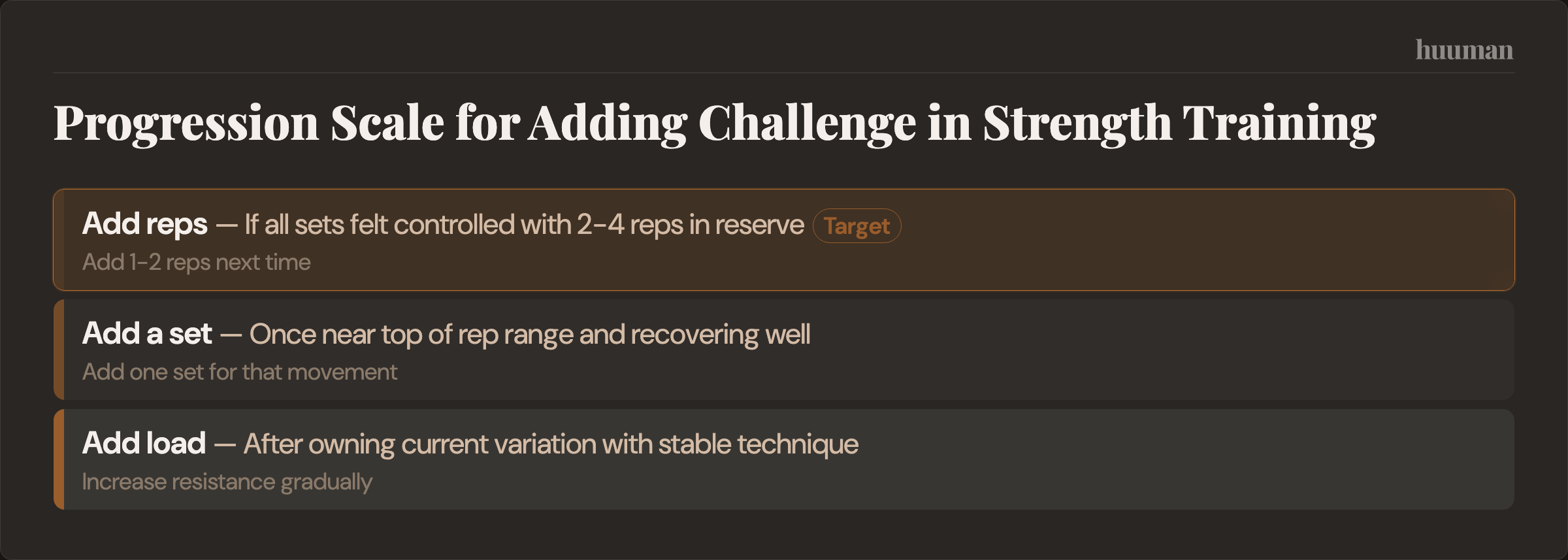
- Add reps: if all sets felt controlled and you still had 2 to 4 reps in reserve, add a rep or two next time.
- Add a set: once you are near the top of the rep range and recovering well, add one set for that movement.
- Add load: only after you can own the current variation with stable technique and acceptable soreness should you increase band tension, dumbbell load, machine pin, or range of motion.
This is especially important for the returning lifter. If you trained hard years ago, your memory of what you used to lift is not a useful starting point now. Tendons and joints usually need a slower ramp than motivation does. Think ego reset. Your first three weeks should feel almost too easy. If fatigue accumulates or a session leaves you unusually sore, repeating the same week can be smarter than forcing progress. If you want more context on intentionally backing off, both bodybuilding deload explained and deload weightlifting cover the idea from a broader training perspective.
Slow, controlled repeatability matters more than novelty. High-frequency tricks like greasing the groove can help some advanced lifters with skill practice, but most older beginners need recoverable full-body work first.
Who should check with a clinician first
Strength training can be highly worthwhile, but not every starting point is the same. It is sensible to check with a clinician or qualified health professional before beginning if you have recent surgery, unexplained chest pain, dizziness, a recent fall with injury, severe untreated high blood pressure, a major change in exercise tolerance, significant balance impairment, or conditions where exertion guidance needs supervision.
The reason is not that resistance training is inherently dangerous. It is that symptoms, medications, and medical history can change exercise tolerance and exercise selection. A check-in can help clarify restrictions, precautions, and what signs should trigger reassessment.
Safety checklist before you train
Technique is not about looking perfect. It is about creating a stable enough setup that the target tissues do the work.

- Green flags: you slept reasonably well, soreness is mild, no new pain, and your normal warm-up movements feel smoother as you go.
- Yellow flags: poor sleep, elevated stress, lingering soreness, or feeling unusually stiff. Keep the session, but reduce range, load, or total sets.
- Red flags: sharp pain, radiating symptoms, dizziness, chest symptoms, unusual shortness of breath, or pain that changes your gait. Do not push through. Pain that is sharp, radiating, or changes your gait is a stop-signal.
Use a stable setup. Wear shoes that feel secure. Clear floor clutter. Keep a wall, rail, or sturdy chair nearby for balance-based drills. Warm up before loading and cool down by returning breathing and pace toward baseline rather than treating cooldown as a second workout.
Exercise options and modifications
The best beginner exercise is the one you can perform with confidence, enough challenge, and a range of motion your joints tolerate. This table gives a practical starting menu.
Movement pattern guide
- Squat-to-chair: best beginner exercise: sit-to-stand from a chair. Regression: higher chair or use hands lightly on armrests. Progression: lower box, goblet squat, or machine leg press. Common mistakes: dropping too fast, knees collapsing inward, sitting back onto a chair that is too low.
- Hip hinge: best beginner exercise: hip hinge to a wall. Regression: shorter hinge with hands on thighs. Progression: dumbbell deadlift from blocks, then Romanian deadlift to comfortable depth. Common mistakes: rounding under load, letting the weight drift far from the body, turning it into a squat.
- Push: best beginner exercise: wall push-up. Regression: taller wall angle or countertop. Progression: incline push-up on a bench, then dumbbell or machine chest press. Common mistakes: shrugging shoulders, flaring elbows excessively, losing trunk tension.
- Pull: best beginner exercise: band row. Regression: lighter band or seated cable row with chest support. Progression: machine row or one-arm dumbbell row with support. Common mistakes: yanking with momentum, jutting the chin forward, arching the low back.
- Carry: best beginner exercise: suitcase carry with a light dumbbell. Regression: lighter load, shorter distance, or standing hold. Progression: farmer carry or carries with brief pauses. Common mistakes: leaning sideways, rushing, gripping so hard that breathing becomes strained.
- Calf raise: best beginner exercise: supported calf raise holding a rail or chair. Regression: smaller range of motion. Progression: slower tempo, pauses at the top, then single-leg assisted work. Common mistakes: bouncing, rolling ankles out, cutting reps short.
- Balance and trunk: best beginner exercise: tandem stance with hand support. Regression: wider stance. Progression: single-leg stance with fingertip support or step-ups with rails. Common mistakes: trying unsupported balance too early, holding breath, using unstable surfaces too soon.
If you train at home, a chair and a resistance band can cover most needs. If you prefer dumbbells, a light pair can open up carries, hinges, and presses. If joints are sensitive, machines often make it easier to load the target area without fighting balance and setup. Home-focused readers may also find ideas in strength training at home for women or the broader strength training plan guide, even though your exercise choices should stay age- and tolerance-appropriate.
Weekly plans you can actually follow

2-day full-body starter: home, chair, band, or light dumbbells
This minimal effective dose suits deconditioned beginners, busy professionals, and people returning after a long break. Keep each session around 25 to 35 minutes.
- Warm-up: 5 minutes of easy marching, sit-to-stands, wall push-up practice, hip hinge practice, and light band rows.
- Squat-to-chair: 1 to 2 sets of 6 to 10 reps at a controlled effort.
- Band or supported row: 1 to 2 sets of 8 to 12 reps.
- Wall or incline push-up: 1 to 2 sets of 6 to 10 reps.
- Supported hinge: 1 to 2 sets of 6 to 10 reps.
- Suitcase carry or standing hold: 2 to 3 rounds of a short distance or time per side.
- Supported calf raise: 1 to 2 sets of 10 to 15 reps.
- Balance finisher: 2 to 5 minutes of tandem stance, supported single-leg stance, or heel-to-toe walking.
Keep rest long enough that your breathing settles and the next set looks as good as the last. Separate the two sessions across the week rather than stacking them back to back.
2-day machine-based plan: joint-friendly gym option
This works well for active older adults, those with balance concerns, and people with knee or back sensitivity who benefit from guided movement.
- Warm-up: 5 to 7 minutes of easy cardio plus one lighter practice set for each first exercise.
- Leg press or sit-to-stand pattern: 2 to 3 sets.
- Seated row: 2 to 3 sets.
- Chest press: 2 to 3 sets.
- Cable pull-through or short-range back extension: 1 to 2 sets.
- Lat pulldown or assisted pull variation: 1 to 2 sets.
- Carry or standing hold: 2 to 4 rounds.
- Calf raise and balance work: brief finisher.
Optional third day: light technique and balance
If recovery is good, a third day can be a light session rather than another hard workout. Think of it as practice: one set of the main patterns, easy carries, and a few minutes of balance work. This is a better use of extra motivation than jumping straight into a hard three-day split like a modified muscle building training plan for women or chasing aggressive mass-focused ideas such as 20 pound muscle gain.
Joint-friendly substitutions
If a pattern makes sense but the classic exercise does not, change the variation before abandoning the pattern.
- Knee-sensitive: use a higher chair for sit-to-stands, shorten depth, try leg press, or reduce step-up height. Let pain-free range guide you.
- Back-sensitive: use chest-supported rows, elevated deadlift patterns, or shorter hinges. Keep the load close to the body and reduce depth before assuming you cannot hinge.
- Shoulder-sensitive: use neutral-grip pressing, incline or wall push-ups, and range-limited pressing if needed. Many people find pulling patterns more comfortable than pressing early on.
- Balance-limited: use machines, chairs, rails, or countertops. Building strength with support is usually better than avoiding strength because unsupported drills feel risky.
Form policing is less useful than choosing the right variation and range for your body. If a movement is mechanically sound but clearly does not match your current tolerance, the fix is usually regression, not grit.
Evidence and limits
The evidence for progressive resistance training in older adults is strong enough to justify making it a core part of healthy aging. Guidelines from major health organizations support muscle-strengthening work at least two days per week, and the NHS guidance for older adults specifically pairs strength with balance and flexibility.
On function, the evidence is especially practical. Progressive resistance training improves abilities that map to independence, such as chair rise and gait-related tasks. The strongest support here comes from randomized trials and meta-analyses rather than anecdote alone, including the Cochrane review on strength and physical function.
On bone, the picture is positive but more nuanced. A meta-analysis found that progressive resistance training was associated with improvements in muscle strength and small but meaningful gains in bone mineral density at the hip in older adults. That does not mean every program changes bone in every person, but it supports the idea that loading matters. See resistance training and bone density findings.
On falls and balance, the research suggests resistance training can help, especially in frailer populations, but it should not be presented as a guarantee. A systematic review reported reduced falls and fewer fallers among physically frail older adults, but outcomes depend on baseline status, program design, and whether balance is trained directly. See fall-related outcomes in frail older adults.
On sarcopenia, resistance training is one of the most consistently supported tools. A recent meta-analysis in older adults with sarcopenia found improvements in muscle mass, strength, and physical performance, though many studies combined training with protein support and used supervised interventions. See sarcopenia outcomes with resistance training.
There are still limits. Research protocols are often supervised and more structured than real life. People vary widely in medication use, osteoarthritis symptoms, prior training history, sleep, nutrition, and confidence. That is why a safe beginner program should be judged less by what is theoretically optimal and more by whether it is repeatable.
Non-prescriptive strategies to discuss with a professional
If you want to make the plan more individualized, several topics are worth discussing with a qualified coach, clinician, or physical therapist.
- Which movement patterns need support first: squat, hinge, or balance.
- Whether machines or free weights are the best entry point for your joints and balance.
- How much soreness is acceptable given your daily activity demands.
- Whether sleep disruption, medication side effects, or pain flare patterns should change your progression speed.
- How to pair strength with walking so total stress stays manageable.
A common approach is to keep walking as the cardiovascular base and use strength sessions to build force and tissue capacity. If you are already doing longer endurance work, your recovery planning may resemble the logic used in articles like recovery after marathon, even though the sport demands are different.
How to track and interpret changes
Tracking matters because motivation is unreliable, and soreness is a poor scoreboard. The best dashboard combines function, recovery, and performance.
Three functional checks
- Sit-to-stand ability: note how many controlled chair rises you can do in a fixed time or how the same number feels over time.
- Stair or step-up tolerance: use a fixed step height or one flight of stairs and note confidence, control, and breathlessness.
- Carry capacity: track distance or time with the same weight while posture and breathing stay controlled.
Three recovery signals
- Soreness duration: mild soreness that resolves within a couple of days is different from soreness that lasts and changes how you move.
- Sleep quality: poorer sleep often predicts a session that should stay lighter.
- Resting heart rate or HRV trend: a few days of a higher resting heart rate or a downward HRV trend can be a reason to repeat the week rather than progress. HRV is a decision-support tool, not an oracle.
Two performance markers
- More reps at the same load: if the same dumbbell or band tension now allows more controlled reps, that is progress.
- The same reps at lower effort: if a set that felt hard now feels manageable, that also counts.
Two good sessions every week beats occasional perfect workouts. You do not need to feel destroyed for the program to be working.
If you want a clearer picture of trend lines instead of relying on memory, your huuman Coach can interpret sleep, session effort, and recovery patterns to build weekly plans that adapt to your actual readiness rather than forcing progress when your body is asking for a steadier week.
Signal vs noise
- "I missed one week, so I lost everything." Detraining is not that immediate. Restart with the same or a slightly easier week and rebuild rhythm.
- "I am not sore, so it did not work." Soreness is not required for progress. Look at reps, control, and confidence before changing the plan.
- "Machines do not count." Machines are often ideal for joint-friendly loading and balance-limited beginners. Use the tool that lets you train the pattern well.
- "If the set feels easy early, the program is pointless." The first weeks often build skill and tolerance. Stay patient, then progress by reps or load once movement quality is stable.
- "I need perfect form before I can add resistance." Perfection is not the goal. Owned, repeatable technique is. Adjust range or support and then keep training.
- "I should train to failure for best results." Many older adults build strength without failure training. Leave 2 to 4 reps in reserve and focus on repeatability.
- "Balance problems mean I should avoid strength training." Balance concerns usually argue for more supported strength work, not less. Set up a stable environment first, then train.
- "Pain during training is always fine if it goes away." Discomfort and effort are normal, but sharp, radiating, or gait-changing pain is not. Stop, regress the variation, and reassess before the next session.
Common questions
Should a 70 year old do strength training?
Many 70 year olds can benefit from strength training if it is matched to their starting point. The relevant question is not age by itself, but current function, symptoms, balance, and recovery capacity. A supervised start may be useful if confidence is low or medical complexity is high.
What is the best strength training for older adults at home?
Usually the best home plan uses a chair, a resistance band, and enough floor space to move safely. Sit-to-stands, band rows, wall push-ups, supported hinges, carries or standing holds, calf raises, and brief balance drills cover most needs. That is often more effective than trying to copy advanced home circuits built for younger lifters.
How many days per week should older adults lift weights?
For most beginners, two days per week is the best starting point because it is frequent enough to improve but conservative enough to recover from. The guideline for muscle-strengthening activity supports two days per week as a baseline. A third light day can help with practice if the first two sessions no longer create excessive soreness.
Can you regain muscle later in life?
Evidence suggests older adults can improve strength and function even when they start later. The pace and visible changes vary, but later-life adaptation is real. The most important condition is that training is progressive enough to matter and conservative enough to repeat.
What if I have arthritis or joint pain?
Joint pain does not automatically rule out strength training. It usually means exercise selection, setup, and range of motion matter more. Higher chairs, shorter ranges, supported rows, neutral-grip pressing, and machine options often make training more tolerable. Persistent or worsening symptoms deserve professional input. input.
Are resistance bands enough for older adults?
Yes, for many beginners bands are enough to begin building strength, especially for rows, presses, hinges, and assistance around difficult ranges. The limitation appears later when the band no longer provides enough challenge or the setup becomes awkward. At that point, dumbbells or machines may make progression easier.
Is slow strength training effective for seniors?
Controlled tempo can be very effective because it improves position, reduces momentum, and makes lighter loads feel more challenging. What matters is not moving slowly for its own sake, but moving at a controlled speed you can own. Very slow lifting is not mandatory, and explosive intent should only be added when control is already solid.
If you want to move from reading to a plan you can actually follow, the huuman app can turn your health data into a clear picture and help you log progress over the first month so you can see whether your routine is building capacity instead of just taking up time.
More health topics to explore
- Strength, Muscle & Mobility – Overview
- 20 Pound Muscle Gain: How Long It Takes and a Realistic Plan
- One and Done Workout: The Evidence-Aware 7-Minute Protocol (Without the Hype)
- Strength Training for Women: A Practical Plan for Strength, Muscle, and Longevity
References
- CDC — Physical Activity Basics
- Liu CJ & Latham NK — Progressive resistance strength training for improving physical function in o... (2009)
- Garber CE et al. — American College of Sports Medicine position stand. Quantity and quality of e... (2011)
- NHS — Empfehlungen zur körperlichen Aktivität für ältere Erwachsene
- O'Bryan SJ et al. — Progressive Resistance Training for Concomitant Increases in Muscle Strength ... (2022)
- Cadore EL et al. — Effects of different exercise interventions on risk of falls, gait ability, a... (2013)
- Li ML et al. — Improving sarcopenia in older adults: a systematic review and meta-analysis o... (2024)
- Keysor et al. — Have we oversold the benefit of late-life exercise? (2001)
- Dela et al. — Resistance training, insulin sensitivity and muscle function in the elderly. (2006)
- Kalyani et al. — Age-related and disease-related muscle loss: the effect of diabetes, obesity, and other diseases. (2014)
- Piercy KL et al. — The Physical Activity Guidelines for Americans (2018)