Music can make focused work easier, or unnecessarily harder. The difference usually isn't just the genre. What matters more is how much information the sound carries, how loud it is, how predictable it is, and whether your task depends on language or can tolerate more rhythm.
That's why the same playlist can work perfectly while you sort emails, then throw you off when you sit down to write. If you want to use music for concentration well, you don't need an endless library of "focus tracks." You need a few clear rules for choosing the right sound.
Key takeaways
1. For reading, writing, analysis, and many coding tasks: instrumental, steady, moderately quiet. Lo-fi, ambient, calm nature sounds, or consistent noise often work better here than music with lyrics.
2. For routine work like inbox clearing, filing, housework, or simple admin: something a little more rhythmic is often fine, as long as you avoid lyrics, big drops, and emotionally loaded favorite songs.
3. If you work in a noisy environment or get distracted easily: white, pink, or brown noise, as well as rain, waves, or forest sounds, can help as acoustic wallpaper because they mask interruptions.
This guide explains which sounds tend to fit which kinds of tasks, why lyrics and strong shifts often interfere, how to think about nature sounds and noise, and how to run a clean two-week test to find what actually works for you. If you want to place this in the broader context of Mindset & Stress, it's really a question of attentional control, not lifestyle.
Where Focus Music Fits Into the Bigger Picture
Focus isn't a fixed trait, and it isn't just a mood. It emerges from the interaction between the task, your environment, your level of arousal, and your current stress load. Music is one tool within that system, and it can have two opposite effects: it can mask distractions and make it easier to get started, or it can become the distraction itself.
This matters even more if your day is made up of fragmented work blocks. In that case, it's not enough for a sound to be good in theory, it also has to reduce decision-making. Every playlist search, every skip, every switch costs attention. That's exactly why music for concentration is most useful when it works as a stable backdrop, not as another layer of input you actively process.
A second point is often overlooked: poor sleep, high stress, or too much caffeine will often shift your distractibility more than any playlist will. If you've been feeling unsettled lately, it may also help to look at topics like sleep music in more detail, this guide to waking in the early hours, or 4-7-8 breathing, because recovery and activation shape how background sound affects you.
Quick Answer
If you want a fast decision rule, don't look for the "best" genre. Choose the sound with the lowest distraction potential for the task in front of you.
- For reading, writing, analysis, and many coding tasks: instrumental, steady, moderately quiet. Lo-fi, ambient, calm nature sounds, or consistent noise often work better here than music with lyrics.
- For routine work like inbox clearing, filing, housework, or simple admin: something a little more rhythmic is often fine, as long as you avoid lyrics, big drops, and emotionally loaded favorite songs.
- If you work in a noisy environment or get distracted easily: white, pink, or brown noise, as well as rain, waves, or forest sounds, can help as acoustic wallpaper because they mask interruptions.
The most practical rule is this: if you start humming along, waiting for lyrics, or reacting to breakdowns, the sound is too dominant for that task. Test two or three setups, not ten genres.
If you want to try this today, you can track your focus sessions with short notes in the huuman app and compare two 25-minute setups side by side.
Concentration Is About Attentional Control, Not Just Mood
Part of your attention gets captured from the outside. That's called exogenous attention. Sudden sounds, fragments of speech, loud transitions, or unexpected musical events can trigger an orienting response, a brief shift of attention toward the stimulus. That's exactly why many focus playlists don't hold up in practice even when they sound pleasant: they may be enjoyable, but they contain too many small surprises.
That doesn't mean silence is automatically best. In a busy office, on a train, or in a café, a steady background sound can work better than leaving yourself open to every external noise. In those settings, music or noise is less a performance booster than a filter against interruption.
At the same time, working memory has limits. In language-heavy tasks like reading, writing, or forming arguments, music with lyrics often competes directly with the same processing channels your task needs. Research supports the idea that lyrical music can interfere with cognitive tasks, including work on music with lyrics and cognitive performance. For language-based deep work, that's one of the most reliable reasons to avoid vocals.
Your arousal level matters too. The relationship between activation and performance is often described through the Yerkes-Dodson principle: too little activation can leave you sluggish, too much can impair performance. But the performance literature also describes this relationship as more complex than a simple U-curve, with both cognitive and physiological components, as noted in this review on arousal regulation and performance. In practical terms: a mildly activating sound may help with routine work, while that same activation may already be too much for demanding reading.
The Three Main Dials That Matter Most
Genre debates usually miss the point. When it comes to music for concentration, three factors matter more.

Information load
The more lyrics, voices, strong melodic turns, harmonic shifts, or attention-grabbing details a track contains, the more likely it is to pull focus. For deep work, lower information load is usually better. That's why instrumental, repetitive, and predictable sounds tend to work more reliably than favorite songs or densely arranged music.
Activation
Some tasks benefit from a bit of drive; others benefit from calm. Routine work can often handle more rhythm. Language-heavy or error-prone tasks tend to fall apart faster when the sound becomes too stimulating. Caffeine can amplify this effect. If you're already highly activated, adding more stimulation doesn't automatically improve performance.
Control
Even the best sound won't help much if you're tweaking the playlist every three minutes. Loss of control often shows up behaviorally rather than acoustically: skipping, searching, reordering, sampling favorites. A good focus playlist reduces decisions. That fits with the idea behind focusing on what you can control: good environments remove micro-decisions.
How to Choose the Right Sound for the Task
The most important distinction isn't your taste in music. It's the type of task you're doing.
Deep work: reading, writing, analysis, complex coding
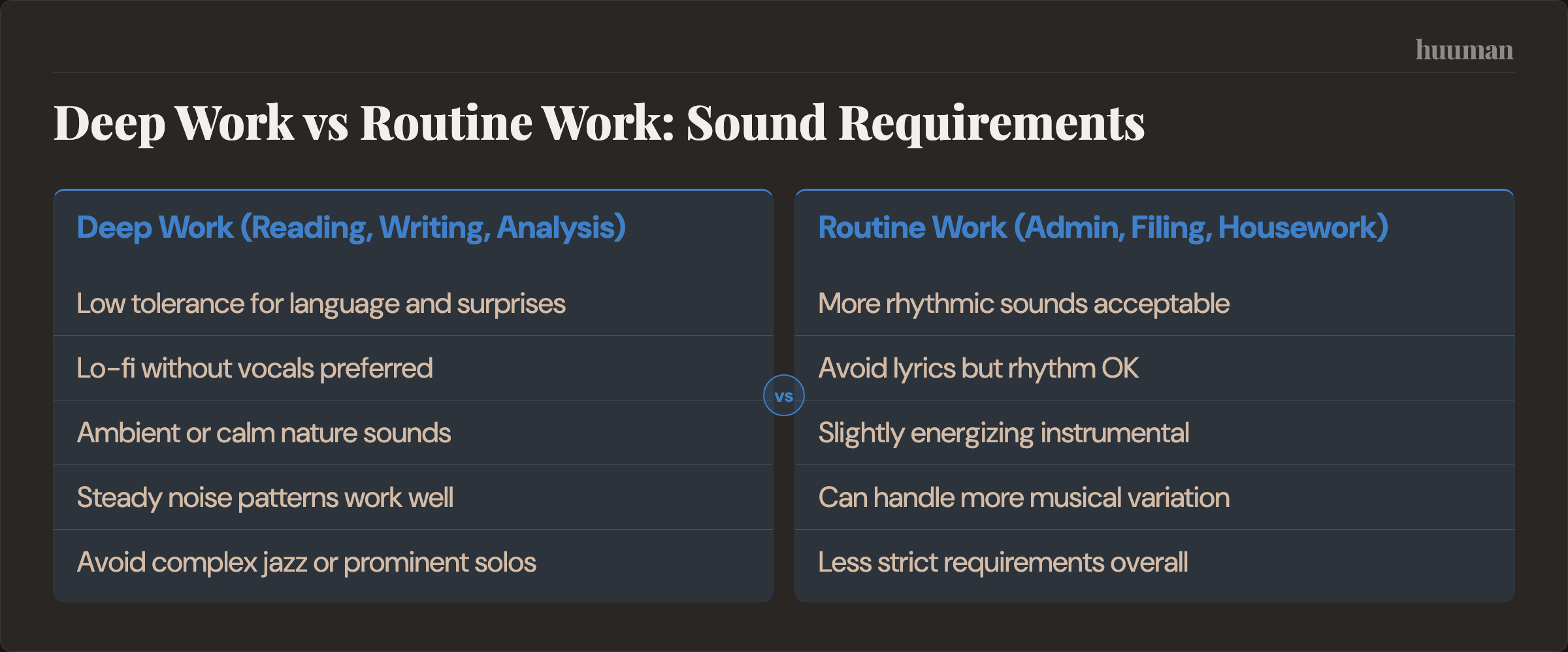
For these tasks, tolerance for language and surprises is low. Lo-fi without vocals, ambient, calm nature sounds, or steady noise are often good options. Calm classical music can work too, as long as the piece doesn't become overly dramatic. Complex jazz or music with prominent solos usually becomes distracting in this category faster than people expect.
Routine and admin
For inbox clearing, filing, setup work, cleaning, or other repetitive tasks, more rhythmic music can help because it raises activation without heavily loading working memory. Even here, instrumental is often more stable. As soon as you start singing along or waiting for the next hook, you're more likely to lose focus than gain it.
Creative work
Creative tasks vary. Brainstorming, sketching, and visual work may tolerate more musical color for some people than precise wording does. The right sound is more individual here. Introverted or noise-sensitive people often respond more strongly to extra stimulation, while others find a bit more activation helpful. Studies suggest this area is highly context-dependent, which makes testing more useful than broad rules.
Types of Sound at a Glance: What Usually Works and What Often Distracts
These categories aren't guarantees. They're sensible starting points.
- Lo-fi and ambient: usually steady, low in dynamics, and often without language. These often work well for deep work. The catch is hidden vocals, heavy beat changes, or too much nostalgia factor that pulls attention.
- Calm classical music: can work well if it stays structurally quiet. Highly dramatic pieces with sudden volume shifts are riskier.
- Gentle jazz: works better when it's repetitive and understated. Complex jazz with lots of harmonic surprises or virtuosic solos is usually better suited to active listening.
- Nature sounds: rain, waves, or forest soundscapes often work well as acoustic wallpaper. Not because they have a magical effect, but because they can stay constant and make environmental noise less salient.
- White, pink, and brown noise: these sounds carry very little information and can be helpful mainly as masking tools. They're especially relevant in open offices, while traveling, or when distractibility is high.
- Binaural beats and isochronic tones: at most, worth trying as a cautious experiment. Many of the claims around them are marketed more strongly than they are supported.
A meta-analysis on binaural beats found some evidence of possible effects, including on attention, but the evidence remains mixed, protocol-dependent, and not nearly robust enough to make this a standard focus solution. This area is often loaded with strong frequency-based promises. If you're interested in it, it's better to read those claims critically, especially alongside articles like Alpha Waves Meditation, without assuming automatic performance effects.
Table: Sound Type, Task Fit, Distraction Potential, and Setup Tips
- Lo-fi / ambient: good for reading, writing, analysis. Distraction potential: low to moderate. Look for no vocals, low dynamics, and a long playlist.
- Calm classical music: good for focused solo work. Distraction potential: moderate. Avoid dramatic shifts and overly familiar favorite pieces.
- Gentle instrumental jazz: better for routine tasks and light creative work. Distraction potential: moderate to high. Use only calm, repetitive tracks.
- Nature sounds: good for deep work in noisy environments. Distraction potential: low. Rain and steady waves are often more reliable than birdsong with lots of individual events.
- White / pink / brown noise: good for masking, open offices, and travel. Distraction potential: low. Especially useful if nearby speech distracts you strongly.
- Rhythmic instrumental music: good for routine and organizational tasks. Distraction potential: moderate. Usually not ideal for text-heavy work.
- Binaural beats / isochronic tones: only as a case-by-case experiment. Distraction potential: unclear. Keep expectations modest and don't change too many variables at once.
Special Cases: ADHD, Noise Sensitivity, and Open Offices
If you're more distractible, a bit of additional but controlled background sound can sometimes help. One plausible mechanism is that steady acoustic input masks environmental distractions and makes the sensory landscape more predictable. But this is not a universal pattern in ADHD. There is some evidence that white or pink noise may be associated with better task performance in a subset of people.
A meta-analysis on white and pink noise in ADHD examined these effects in young people with ADHD or elevated attention problems. In addition, a study on white noise in preschool children with ADHD suggested attention and task-related behavior may improve. That does not mean noise helps all adults or works in every setting. If the sound makes you feel more tense, irritated, or agitated, that's a clear sign to stop.
For open offices and travel, noise and nature sounds are often the most practical solution because they make surrounding speech less prominent. If you're very noise-sensitive, though, even pleasant music may be too much. In that case, a more acoustically neutral backdrop is often better than musical stimulation.
Evidence and Limits
The research on music for concentration is heterogeneous. That isn't a side note, it's the core of the issue. Effects depend heavily on the person, the task, the volume, the environment, and how familiar the material is. That's why blanket claims like "this genre makes you more productive" so often fail in real life.
What is relatively well supported is that lyrics are more likely to interfere during language-heavy tasks. In those situations, music and the task compete for similar processing resources, which is consistent with research on lyrics and cognitive interference.
It's also plausible, and practically relevant, that constant background sound can reduce distraction, especially when it masks environmental noise. There are positive signals for noise in people with higher distractibility or ADHD, but not in a form that justifies recommending it across the board. The most conservative reading is: it may help, especially in the right context.
For binaural beats, the evidence is much less certain than the marketing often suggests. A meta-analysis of 22 studies described possible effects in several domains, including attention. At the same time, protocols, quality, and real-world transfer remain inconsistent. If you experiment with them, treat them as an optional add-on, not a reliable mechanism.
One thing people often forget: expectancy effects are real. If a certain sound reliably helps you enter a focused work mode, that isn't meaningless just because part of the effect may be ritualized or subjective. It only becomes a problem when that turns into absolute claims or rigid frequency myths.
Strategies to Discuss with a Professional
Strategy A: Deep work without lyrics
A common approach is a long, instrumental, steady playlist for reading, writing, and analysis. The goal isn't motivation. It's reducing friction. If you actively notice the music, it's probably too information-rich or too loud.
Strategy B: Routine work with rhythm
For admin or repetitive tasks, a slightly more energizing instrumental sound can make sense. The limit is where the sound starts pulling you in emotionally instead of simply supporting the task. This is especially true for favorite songs and tracks with obvious build-ups.
Strategy C: Masking instead of music
In noisy environments, the most practical option is often noise or natural sound instead of music. This is especially helpful when surrounding speech is the main distraction. In that setting, acoustic wallpaper often beats the more carefully curated playlist.
Strategy D: Playlist hygiene
- Use only long playlists or continuous sound loops.
- Avoid vocals for language-heavy work.
- Prefer low dynamics and few surprises.
- Don't put emotionally important favorite songs into focus sets.
- Don't curate during the session.
- Use music as a start ritual, then keep it stable.
If you want to improve focus more broadly, the fundamentals often matter more than the next playlist. Related reads include how to improve concentration, focusing on yourself, and goals and ambition.
How to Measure Progress and Make Sense of It
The most useful test is a short two-week A/B self-experiment. Same task, roughly the same time of day, similar work duration, two clearly different sound setups. That way you're not testing what sounds nice, you're testing what actually supports your work.

A simple two-week setup you can copy
- Week 1: Setup A for three comparable sessions, for example instrumental and steady.
- Week 2: Setup B for three comparable sessions, for example nature sounds or noise.
- Start each session the same way: same task, same duration, no multitasking.
Three fields per session are often enough
- Starting friction: How hard was it to begin?
- Focus block: How long could you work without interruption?
- Quality: How many errors, revisions, or restarts came up?
Optionally, you can note subjective fatigue. Data like resting heart rate or HRV are, at most, context markers for sleep and stress, not proof that the music caused an effect. If you slept badly or were already mentally drained that day, that often explains more than the playlist does. Topics like the best time of day to meditate and motivational routines like motivation for runners reflect the same principle: results often come from fit and repeatability, not from the perfect standalone technique.
If you want to approach this more systematically, your huuman Coach can help you spot weekly patterns across focus, sleep, and stress load and turn a handful of sessions into something more reliable.
Signal vs. Noise
- Signal: Instrumental, steady sounds often work better for language-heavy tasks than music with lyrics. Next step: build your own deep-work set without vocals.
- Signal: Constant background sound can mask interruptions, especially in open or unpredictable environments. Try this: on a noisy workday, test noise or rain instead of music.
- Signal: Personal preference matters – as long as you're not actively listening. Watch for this: does the sound stay in the background, or does it start demanding attention?
- Noise: Alpha-wave tracks or frequency claims marketed as guaranteed focus boosters. Treat these conservatively and rely more on observable work quality.
- Noise: Obsessing over BPM or Hz without considering the task and your distractibility. Start instead with lyrics, dynamics, and volume.
- Noise: Constantly switching playlists. Limit yourself to two saved presets.
- Signal: Lower volume often beats more intensity. Simple test: if you start humming along, the sound is too dominant.
- Noise: Thinking something is wrong with you if music doesn't help. Consider this: silence or neutral masking may simply be the better fit for your task.
Frequently Asked Questions
What kind of music is best for concentration?
The most reliable options are usually sounds with low information load: instrumental, steady, moderately quiet, and without strong shifts. For many people, lo-fi, ambient, calm classical music, nature sounds, or noise are good starting points. But the best setup depends on both the task and your level of distractibility.
Is music with lyrics really worse for studying?
For reading, writing, and other language-heavy tasks, often yes. Research suggests lyrics can interfere with performance because they compete with language processing. For simple routine tasks, this may be less of an issue, but it still varies from person to person.
Does lo-fi actually help, or is it just a trend?
Lo-fi helps not because of the label, but because its typical features can fit the task: low dynamics, few surprises, no vocals, and stable repetition. Many lo-fi playlists do this well. Others include samples, voices, or shifting beats that create the opposite effect.
Are binaural beats useful for focus?
They can be interesting to test, but they should be viewed soberly. There is some evidence of possible effects, but the research is mixed and not strong enough to support big claims. If you experiment, don't also change the volume, task, and time of day all at once.
What's better: music, nature sounds, or white noise?
For deep work in a noisy environment, nature sounds or noise are often more stable than music. For routine work, music can fit well. If nearby speech is the main issue, neutral masking sounds are often the simpler option.
Can background audio improve concentration in ADHD?
For some people, additional but controlled background sound may help, whether through masking or through a level of stimulation that fits the task. But it isn't universal. If restlessness, overstimulation, or worse performance increase, a different sound, or complete quiet, is the better option. Music is not a substitute for diagnosis or treatment.
How loud should music be for concentration without stressing your ears?
Quiet enough to stay in the background. The WHO describes safe listening as listening behavior in which the volume, duration, and frequency of exposure do not put hearing at risk; see the WHO guide to safe listening. A German-language overview also points to the risks of long exposure at higher volume levels, for example in this summary on headphone use and tinnitus risk. In practice: don't turn the volume up just to make the sound "work better," and build in listening breaks regularly.
If you develop new tinnitus, ear pressure, hearing loss, dizziness, one-sided ear symptoms, increased anxiety triggered by audio, persistent sleep problems, or a clear drop in performance, get it checked by a qualified professional.
More health topics to explore
- Mindset, Stress & Mental Health – Overview
- How to Improve Concentration: What Helps Right Away
- How to Focus on Yourself: Without Feeling Selfish
- Sunday Night Blues: Causes, Quick Relief, and a 10-Minute Sunday Reset Plan
References
- Souza AS & Leal Barbosa LC — Should We Turn off the Music? Music with Lyrics Interferes with Cognitive Tasks (2023)
- Gould D & Udry E — Psychological skills for enhancing performance: arousal regulation strategies (1994)
- Garcia-Argibay M et al. — Efficacy of binaural auditory beats in cognition, anxiety, and pain perceptio... (2019)
- Nigg JT et al. — Systematic Review and Meta-Analysis: Do White Noise or Pink Noise Help With T... (2024)
- WHO: Safe listening / Hearing loss prevention guidance
- Lin HY — The Effects of White Noise on Attentional Performance and On-Task Behaviors i... (2022)
- Quarks — So Schaedlich Sind Kopfhoerer fuer Deine Ohren