Mental overload describes a state in which your brain has to process more information, open tasks, and decisions at the same time than it can handle comfortably. Many people know the feeling: you jump between emails, chats, to‑dos, and personal obligations, yet by the end of the day it still feels like nothing is truly finished.
Key takeaways
1. Mental overload is not burnout, it is a reversible state where the brain processes more tasks, decisions, and inputs than it can handle, leading to concentration loss, irritability, and the feeling of never being done.
2. The most common amplifiers are open task loops (things started but not finished), constant notifications, and the absence of genuine recovery time between cognitively demanding blocks.
3. Recovery from mental overload typically takes days, not weeks. The most effective first step is reducing input: fewer open tabs, fewer decisions, and at least one 20-minute block of genuine cognitive rest per day.
Common signs include a mix of concentration problems, irritability, racing thoughts, and sleep issues. Your mind feels "full," and even small decisions can suddenly seem overwhelming. Many people respond by multitasking, spending more time on screens, or procrastinating.
This guide helps you understand mental overload more clearly. You'll learn how it differs from similar concepts, which symptoms are most typical, and which everyday triggers show up most often. Most importantly, you'll get a practical troubleshooting model: start with quick relief, then move toward structural changes.
You'll also learn simple tracking methods to recognize mental overload instead of only feeling its effects. This approach connects focus, sleep, stress regulation, and daily structure to give you a clearer picture of your mental workload.
Where Mental Overload Fits in Health and Performance
Mental overload is not a medical diagnosis. It describes a functional problem: the mental load temporarily exceeds the processing capacity of your attention and working memory.
In everyday life, this overlaps with several areas of health:
- Mind: focus, priorities, emotional regulation, and decision‑making. Too many open loops increase cognitive load.
- Recovery: sleep, break structure, and recovery time. Sleep deprivation can intensify typical overload symptoms like irritability or memory problems.
- Metabolism: energy availability and blood‑sugar dynamics can influence how stable your attention and mood remain. Learn more in the overview of nutrition for a resilient brain.
- Heart and Frame: movement, breathing rhythm, and muscle tension indirectly affect stress regulation. Light activity can help release mental tension. See also movement as an outlet during overload.
Once you understand mental overload, it becomes clear that the issue is rarely just "time management." It's usually a mix of too much input, too many open responsibilities, and insufficient recovery. For a broader introduction, see the hub mindset and mental health overview.
Quick Answer
Mental overload means: your brain has to process more information, tasks, and decisions at the same time than it can handle reliably in the moment. Common effects include:
- constant mental loops and the feeling of never being "done"
- difficulty concentrating or frequent task switching
- irritability or inner restlessness
- poor sleep or persistent fatigue
- increased multitasking, procrastination, or doom‑scrolling
Quick relief within the next few minutes may look like this:
- stop incoming input (pause notifications or news)
- write down all open tasks to get them out of your head
- choose a single priority for today
- define the smallest possible next step
After that, system changes often help: fewer parallel projects, clearer responsibilities, defined communication windows, and more time for recovery. If strong anxiety, depressive symptoms, or prolonged exhaustion appear alongside overload, professional support may be helpful.
If you're experiencing these symptoms, track your daily energy and mental clarity patterns with the huuman app to identify which factors correlate with your overload episodes.
What Mental Overload Is – and What It Isn't
Several terms are often used interchangeably, but they describe different aspects of mental strain.

- Mental overload: a temporary state of overload caused by too many demands or parallel tasks.
- Information overload: excessive input such as messages, emails, social media, or meetings.
- Cognitive load: the strain placed on working memory during complex thinking tasks.
- Mental load: the often invisible planning and coordination work in daily life, such as organizing a household or family responsibilities.
Mental load and information overload can eventually lead to a moment of mental overload. Research in cognitive psychology consistently shows that working memory has limited capacity. When too many tasks or pieces of information need to be held at the same time, mental strain rises sharply.
Multitasking also comes with costs. Attention constantly shifts, which can increase error rates and decision time. Many people misinterpret these effects as "lack of discipline" or "laziness." In many cases, it's simply a capacity issue.
Common Symptoms of Mental Overload
Mental overload rarely appears only on a cognitive level. Several layers often occur together.
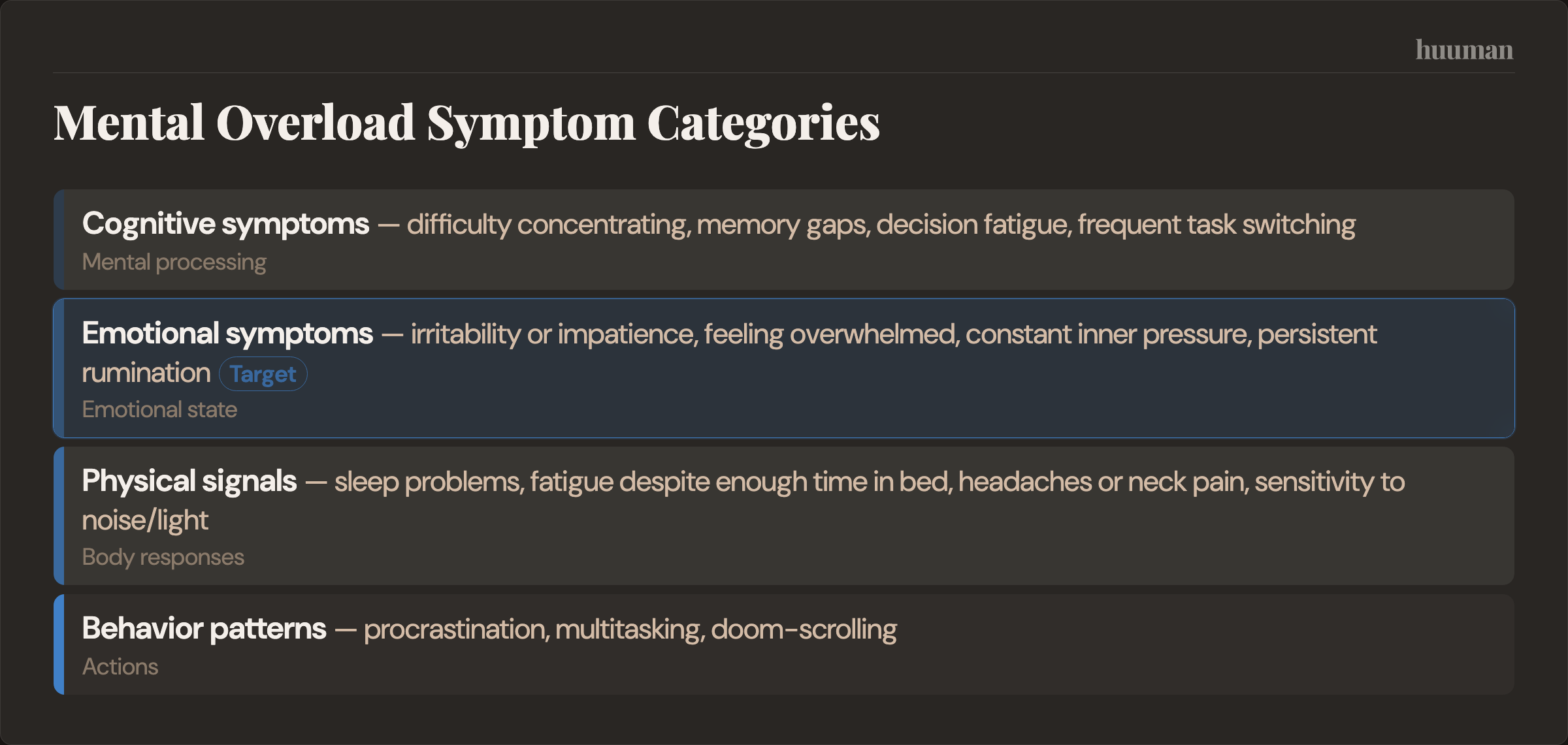
Cognitive symptoms
- difficulty concentrating
- memory gaps or forgetting details
- decision fatigue
- frequent task switching
Emotional symptoms
- irritability or impatience
- feeling overwhelmed
- constant inner pressure
- persistent rumination
Physical signals
- sleep problems or restless sleep
- fatigue despite enough time in bed
- headaches or neck pain
- increased sensitivity to noise or light
Behavior patterns
- procrastination
- constant multitasking
- too many open tabs, documents, or to‑do lists
- doom‑scrolling or social withdrawal
Health resources describe similar clusters of symptoms and emphasize that mental overload often affects multiple areas of life.BKK Pfalz: Mental Overload
Common Causes and Reinforcing Factors
Mental overload rarely comes from a single issue. Usually several factors combine.
At work
- constant context switching between meetings, emails, and projects
- unclear priorities or conflicting expectations
- permanent digital availability
- too many simultaneous projects
At home
Mental load in household or family organization often means planning and coordinating many tasks simultaneously. This invisible organizational work can create significant stress.
Personal patterns
- perfectionism
- people‑pleasing
- difficulty setting boundaries
Lifestyle amplifiers
- sleep deprivation
- lack of breaks
- very high training load with insufficient recovery
- high caffeine or energy‑drink consumption
If you often rely on stimulants to push through mental fatigue, it can be helpful to look at their effects and limitations. Examples include energy drinks for concentration or the question of whether concentration pills actually help.
Understanding the Overload Spiral
Mental overload often develops as a self‑reinforcing loop.
- more incoming input
- more unfinished tasks
- more decisions
- later sleep or poorer recovery
- less focus the next day
The system keeps generating new mental loops while your ability to close them drops. The way out is usually to relieve pressure first instead of trying to become even more efficient at doing everything.
Symptoms → Possible Drivers → First Step
- Symptom: Thoughts constantly jump — Possible driver: too many open tasks — First step: 1‑minute brain dump on paper
- Symptom: Concentration breaks quickly — Possible driver: frequent context switching — First step: a single focused work block without notifications
- Symptom: constant irritability — Possible driver: sleep deficit or chronic stress — First step: observe and shift your sleep routine earlier
- Symptom: procrastinating important work — Possible driver: projects feel too large — First step: break the next step into a two‑minute action
- Symptom: doom‑scrolling — Possible driver: mental exhaustion — First step: take a short walk instead of another screen session
Evidence and Limitations
Research in cognitive psychology consistently shows that working memory and attention are limited resources. When too many pieces of information must be processed at once, mental strain increases and performance may decline.
Frequent task switching may be associated with reduced productivity and more errors. Part of the problem is not the individual task itself but the constant switching between them.
Long‑term stress may be associated with sleep disturbances, reduced concentration, and increased emotional reactivity. Many practical recommendations around mental overload are based on these underlying mechanisms.
Research on the HPA axis shows that stress regulation involves dynamic cortisol responses, providing a biological basis for how chronic stress impacts cognitive function.
Sleep deprivation studies show that sleep deficit amplifies cognitive strain through increased microsleeps and lapses in attention, which can worsen mental overload symptoms.
At the same time, there are limits: there is no objective test that can definitively measure mental overload. Tools like wearables can provide hints about stress patterns, but they are not diagnostic tools.
Strategies That Often Help

Acute: RESET (5–20 minutes)
- Reduce input: pause notifications or news
- Externalize: briefly write down all thoughts or tasks
- Sort: today / this week / later
- Execute one step: define the smallest next action
- Tone shift: short walk, water, daylight
Short term: Protect focus
- reduce the number of parallel projects
- handle emails and chats in time blocks
- create if‑then rules for meetings and interruptions
System level: Structure instead of heroics
- make recurring tasks visible
- clarify responsibilities at home or in teams
- define standard blocks for focus, admin, and recovery
Physical influences can also support stress regulation: movement, breathing rhythm, and regular sleep affect the nervous system. Learn more in the overview why sleep matters for mental overload.
When Training Becomes an Amplifier
Very intense training phases can increase mental stress, especially when combined with little sleep or heavy workloads. During these periods, it may help to temporarily reduce training intensity and add more easy sessions.
When Professional Support Makes Sense
Sometimes persistent overload is more than an organizational challenge. Professional support may be helpful if the following warning signs appear:
- persistent low mood or loss of interest
- panic attacks or strong anxiety
- long‑lasting insomnia
- increasing substance use to cope with stress
- thoughts of self‑harm or not wanting to exist
- sudden neurological symptoms or extremely severe headaches
Tracking Progress and Understanding Change
7‑Day Overload Dashboard
- Signal: Overload scale — Daily observation: 0–10 in the morning and evening
- Signal: Sleep — Daily observation: duration and perceived quality
- Signal: Context switching — Daily observation: count meetings or task changes
- Signal: Focus block — Daily observation: at least one clearly defined work block
- Signal: Recovery — Daily observation: one intentional break or short walk
Wearables can offer additional context, for example through resting heart rate or heart‑rate variability trends. These metrics are best interpreted as general stress trends rather than a day‑to‑day verdict on your performance. Learn more here: how mental overload may affect HRV.
Signal vs. Noise in Mental Overload
- Several weeks of increasing irritability may signal chronic overload. Observe patterns over multiple days.
- A single stressful day is usually just noise. Recurring patterns matter more.
- Dozens of open tabs or to‑dos can be a signal of overload. Reduce the number of active projects.
- Isolated wearable fluctuations are often noise. Look at long‑term trends instead of individual values.
- Doom‑scrolling as your main stress‑coping strategy can be a warning sign. Occasionally replace it with movement.
- If small decisions suddenly feel overwhelming, a simple priority list may help.
- Frequent conflicts or impatience may signal stress spillover. Check whether sleep or recovery is missing.
- If activities consistently stop feeling enjoyable, professional evaluation should be considered.
Frequently Asked Questions
What does "mental overload" mean?
The term describes a situation in which your brain has to process more tasks, information, and decisions at the same time than it can handle reliably.
What is the difference between mental load and mental overload?
Mental load refers to the planning and coordination work in everyday life, such as organizing appointments or managing household tasks. Mental overload occurs when that load, combined with other demands, exceeds your attentional capacity.
How do you recognize the tipping point?
Many people describe a moment when even small decisions feel overwhelming. Focus declines, irritability increases, and sleep quality worsens.
Can mental overload be a sign of burnout or depression?
Mental overload is not a diagnostic term. However, it can appear alongside stress, burnout, or depressive symptoms. If low mood, anxiety, or extreme exhaustion worsen over time, professional help should be considered.
What helps immediately with mental overwhelm?
Many people experience quick relief from three steps: reduce incoming input, write down all open tasks externally, and define one small next action.
Can heavy phone or news consumption increase mental overload?
Very high information input can increase the likelihood of information overload. Studies and reviews often discuss this effect in connection with frequent interruptions and constant context switching.
Does meditation actually help?
Meditation and mindfulness practices can support attention and stress regulation, but they don't work the same way for everyone. Some people initially experience impatience or boredom, which can be completely normal. Learn more here: boredom in meditation.
Rather than trying to power through overload alone, have your huuman Coach build personalized weekly plans that balance cognitive load with genuine recovery blocks based on your current capacity and stress patterns.
More health topics to explore
- Mindset, Stress & Mental Health – Overview
- Electrodermal Activity (EDA) Score: Meaning, “Good” Ranges, and How to Interpret Your Trend
- Box Breathing (Square Breathing): How It Works—and When to Use It
- Concentration in Children: Causes, Quick Fixes, and Warning Signs
References
- ARD alpha — Was Tun Mental Load Muetter Frauen Symptome Definition Test Tipps Aufgaben Be...
- BKK Pfalz — Mental Overload: Überblick, Symptome und Tipps
- Cleveland Clinic — What Is Mental Load and How to Manage It
- Barrouillet P et al. — Time and cognitive load in working memory (2007)
- Lightman et al. — Dynamics of ACTH and Cortisol Secretion and Implications for Disease (2020)
- Killgore et al. — Effects of sleep deprivation on cognition (2010)
- Choshen-Hillel et al. — Acute and chronic sleep deprivation in residents: Cognition and stress biomarkers (2021)