
A "longevity protocol" sounds like a stack of hacks, tests, and expensive add-ons. The challenge is separating what reliably moves healthspan from what mostly adds noise.
This guide gives you a simple way to build a longevity protocol that fits real life: start with foundations, add a small set of measurements, then layer targeted changes only when they solve a defined problem. You'll get a one-page checklist, three weekly protocol cards, and a quarterly review so you can adjust without guessing.
Key takeaways
1. Level 1, foundations: consistent sleep, strength training and aerobic work, a minimally processed, plant-rich diet with adequate protein and fiber, stress downshifting, and regular social connection. WHO guidance supports at least 150 minutes per week of moderate aerobic activity and strength training on 2 or more days.
2. Level 2, feedback: track a few outcomes so you know if it's working. Think energy, training consistency, waist circumference, resting heart rate, and a small set of labs like lipids including ApoB and HbA1c.
3. Level 3, add-ons: only add tests, supplements, or clinic-based options when they address a measured bottleneck. Avoid large stacks by default.
You don't need a perfect routine. You need a repeatable system that survives busy weeks and still nudges your metrics in the right direction.
Where a longevity protocol fits
Heart. Cardio-respiratory fitness, blood pressure, and lipids shape long-term risk. A durable protocol builds an aerobic base and keeps pressure and lipids in check over time.
A meta-analysis of over 20.9 million observations found that cardiorespiratory fitness strongly predicts mortality, reinforcing its importance in longevity protocols.
Frame. Muscle and bone support strength, stability, and independence. Strength training and loading are the levers that keep you resilient with age. See building muscle in old age in depth for context.
Metabolism. Glucose control, body composition, and diet pattern influence energy and downstream risk. A practical overview sits under Metabolism & Nutrition.
Recovery. Sleep and stress determine whether training adaptations stick. If recovery slips, performance and adherence follow. For runners, all about running recovery covers common pitfalls.
Mind. Adherence, stress tools, and social connection keep the plan alive. The best protocol is the one you can execute for years.
Quick answer
A longevity protocol is a personalized, repeatable set of habits and check-ins designed to improve healthspan, how well you function as you age. The safest structure is three layers:
- Level 1, foundations: consistent sleep (around 7 to 9 hours for most adults), strength training and aerobic work, a minimally processed, plant-rich diet with adequate protein and fiber, stress downshifting, and regular social connection. WHO guidance supports at least 150 minutes per week of moderate aerobic activity and strength training on 2 or more days.
- Level 2, feedback: track a few outcomes so you know if it's working. Think energy, training consistency, waist circumference, resting heart rate, and a small set of labs like lipids including ApoB and HbA1c.
- Level 3, add-ons: only add tests, supplements, or clinic-based options when they address a measured bottleneck. Avoid large stacks by default.
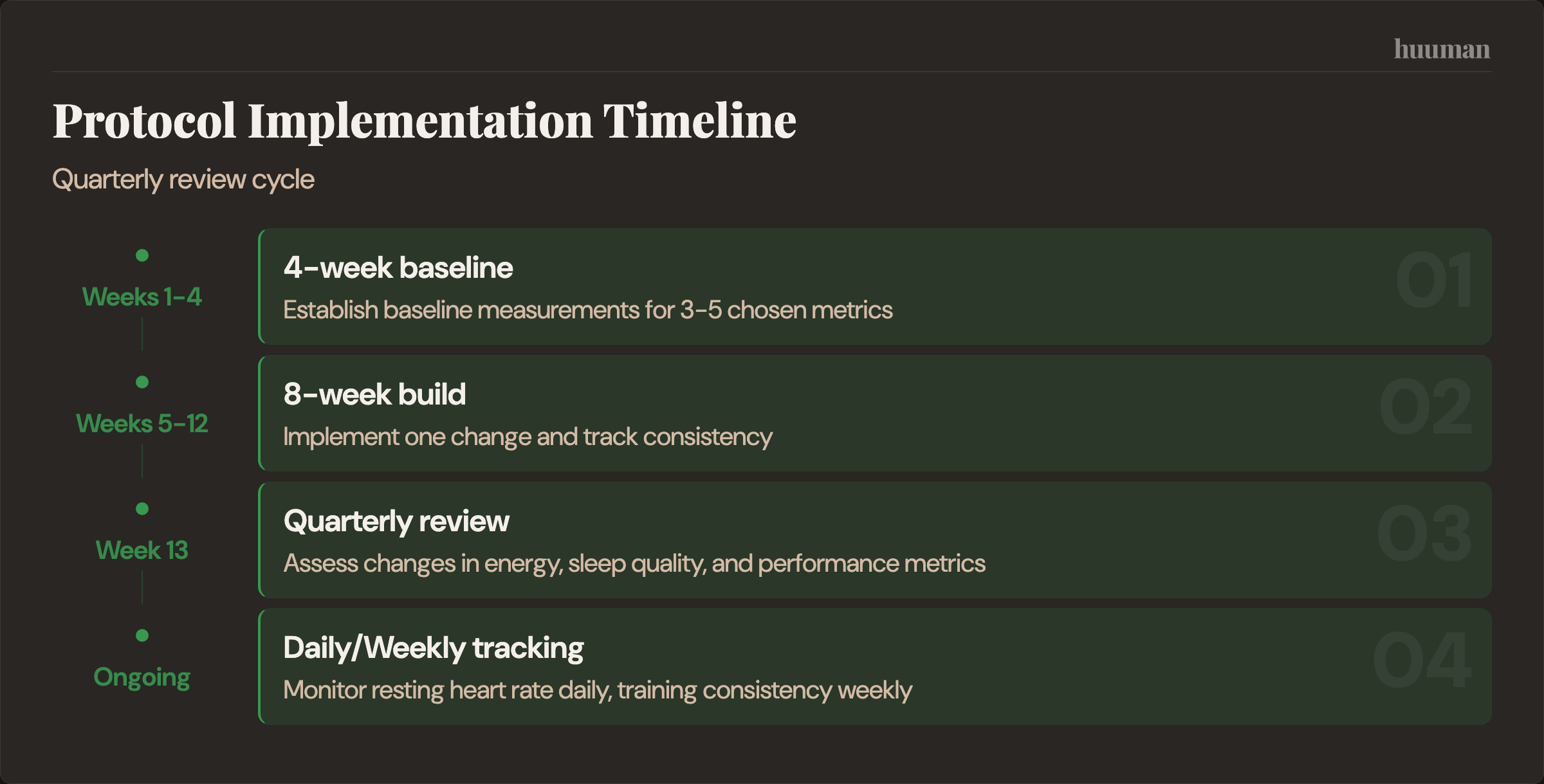
Run a 4-week baseline, build for 8 weeks, then review quarterly. Change one variable at a time.
The simplest way to build momentum is to track your foundational habits and daily energy patterns with the huuman app for two weeks, then identify which Level 1 elements actually stick in your routine.
What a "longevity protocol" means, and what it does not
It's a system, not a lifestyle aspiration. A protocol defines what you do on a typical week, what you measure, and how you decide to change. It trades novelty for repeatability.
It targets healthspan more than lifespan. You're improving function, capacity, and risk factors that are associated with longer life at a population level. No protocol can guarantee outcomes for an individual.
It's personal. Your baseline, schedule, preferences, and medical context determine what is realistic. Copying a celebrity routine like the blueprint protocol can be instructive, but without matching resources and monitoring, it often fails or backfires.
The huuman F3 method: FOUNDATION → FEEDBACK → FOCUS
Foundation: Exercise, diet patterns, sleep, and not smoking dominate the evidence. They influence multiple systems at once with relatively low downside.

Feedback: Without a few metrics, you're guessing. A short list keeps you honest without turning your week into a lab.
Focus: Change one layer at a time for 4 to 8 weeks. Keep what works, drop what doesn't. This avoids the common trap of adding five variables and learning nothing.
Level 1 foundations: the high-impact core

Training
Most sustainable protocols combine:
- Strength to maintain muscle and bone.
- Aerobic base (Zone 2) to improve cardio-respiratory fitness at manageable fatigue.
- Short intervals sparingly, when recovery allows.
- Daily movement through steps and short walks.
- Mobility as brief, regular work.
WHO guidance supports regular aerobic activity and at least two days of strength work per week. Practical details for lifting are in muscle building protocol in depth, and energy cost context in calories burned strength training.
Nutrition
A Mediterranean-style, plant-rich pattern with adequate protein and fiber is consistently associated with better cardiometabolic markers. Limit ultra-processed foods and treat alcohol as a tradeoff. Rather than chasing a single "best" diet, set defaults you can repeat on busy days.
Sleep
Most adults need about 7 to 9 hours, with regular timing doing as much work as duration for many people. Morning light, a consistent wind-down, and a stable wake time are simple levers that amplify everything else. If snoring, witnessed apneas, or excessive daytime sleepiness are present, screening for sleep apnea can be relevant.
Stress and recovery
Downshifting tools like slow breathing, brief mindfulness, time outdoors, and boundaries around work help you actually absorb training. Plan lower-load weeks or rest days before fatigue accumulates.
Connection
Social ties support adherence and mental health. For many, this is the difference between a plan that lasts and one that doesn't.
Level 2 personalization: measurement-guided adjustments
Choose 3 to 5 metrics that matter to your context, establish a baseline, and identify one bottleneck. Examples:
- Symptoms: energy, sleep quality, mood.
- Performance: easy-pace speed at a fixed heart rate, a repeatable strength set.
- Anthropometrics: waist circumference trends.
- At-home vitals: resting heart rate and, where available, blood pressure.
- Labs (via a clinician): lipids including ApoB, HbA1c or fasting glucose.
Then add one change for 4 to 8 weeks. If glucose markers are a concern, tools like an hba1c to blood sugar calculator can help you understand trends. For lipids, the triglyceride/hdl ratio can add context.
Level 3 add-ons: optional and higher uncertainty
Testing: Reasonable first-line checks include blood pressure, lipids (with ApoB), and glucose control. Fitness testing can include a VO2max estimate and simple strength benchmarks. Optional tools like DEXA add detail but not always better decisions.
Supplements: They can make sense for a clear need or deficiency, but large stacks without a target often add cost and complexity without improving outcomes.
Clinics and advanced therapies: Peptides, NAD+ therapies, IV drips, and aggressive hormone manipulation are often marketed as longevity solutions. Evidence is limited or mixed, and risks, costs, and monitoring requirements are higher. If you consider them, it requires medical supervision and a clear reason tied to measured data.
Popular programs like Blueprint or tiered systems can be useful for structure. Use them as references, not templates to copy wholesale.
Evidence and limits
There is strong, consistent evidence that exercise, sleep, diet patterns, and not smoking are associated with better cardiometabolic markers and lower risk at the population level. Guidance on aerobic activity and strength training comes from international recommendations, and sleep duration from consensus statements.
A systematic review and meta-analysis examining evidence-based pathways found that combined lifestyle interventions significantly improve healthy aging markers.
At the same time, longevity is multi-factorial. A protocol improves probabilities, not guarantees. Many add-ons lack high-quality randomized evidence or show variable effects across individuals. Self-experimentation is prone to placebo effects and confounding. A change that coincides with better sleep or lower stress can be misattributed to a new supplement.
A practical stance is to bias toward foundations, keep add-ons small and testable, and partner with a clinician for interpretation of labs, especially if you have chronic conditions or take medications. Blood pressure categories and thresholds, lipid management, and glucose screening are best understood in clinical context rather than isolated numbers.
Non-prescriptive strategies you can use
Layering: Level 1 → Level 2 → Level 3
Start with low downside habits, add measurement, then consider higher-uncertainty options only when they solve a defined problem.
Pick a segment path
Busy professionals: use a minimal effective dose. Endurance or hybrid athletes: protect recovery. Strength-first trainees: add a consistent aerobic base. Data-curious readers: limit testing to decisions you will act on.
Design your week
Anchor two to three sessions that always happen. Define a "minimum on bad weeks" version so you don't quit when work spikes.
Environment design
Default meals, calendar blocks, and a fixed bedtime anchor remove daily decision cost.
Protocol cards
Protocol Card 1: Minimal Effective Dose (MED) Longevity Week
- Goal: cover the largest levers with the least time.
- Weekly schedule: Strength 2× (30–45 min); Aerobic base 2× (25–40 min); Daily movement 7/7; Mobility 5–10 min after sessions.
- Session structure: Strength: warm-up 5–8 min; 4–6 compound moves; 2–4 sets; brief cooldown. Aerobic: 5–10 min easy; 20–30 min steady; 5 min easy.
- Intensity: Aerobic Zone 2, RPE 3–4, conversational pace. Strength RPE 7–8, leave 1–3 reps in reserve.
- Readiness gates: If resting HR is above your baseline for several days or sleep is poor, reduce volume. Use HRV trends as context, not a command.
Protocol Card 2: Standard Longevity Week (Balanced)
- Goal: build durable fitness with manageable fatigue.
- Weekly schedule: Strength 2–3×; Aerobic base 2–4×; optional HIIT 1×; Mobility 2–4 short sessions.
- HIIT structure: Warm-up 10–15 min; 4–8 short intervals; long easy recoveries; cooldown 10 min.
- HIIT intensity: Intervals reach Zone 4–5 by the end, RPE 8–9. Heart rate lags on short intervals, so use pace or power.
- Readiness gates: If soreness is high or performance dips for a week, swap HIIT for easy aerobic. If HRV trends down and resting HR trends up, prioritize sleep and low intensity.
Protocol Card 3: Advanced Longevity Week
- Goal: maintain high fitness while protecting recovery and injury risk.
- Weekly schedule: Strength 3× (include unilateral and posterior chain work); Aerobic base 3–5×; HIIT 1–2× only if recovery is excellent; planned deload every 4–8 weeks.
- Monitoring: Sleep regularity, appetite, mood, libido, niggles, and performance trends guide adjustments.
Tiered longevity protocol checklist (one page)
- Level 1 foundations
- Sleep: consistent timing; target 7–9 hours most nights.
- Training: strength ≥2 days; aerobic ≥150 min/week; daily steps.
- Nutrition: plant-rich pattern; protein at each meal; high fiber; limit ultra-processed foods; alcohol as a tradeoff.
- Recovery: 1–2 low-load days; brief downshift practice.
- Connection: at least one social touchpoint weekly.
- Level 2 feedback
- Pick 3–5 metrics (energy, sleep quality, RHR, waist, performance).
- Baseline 4 weeks; set one bottleneck.
- Plan one change for 4–8 weeks.
- Level 3 add-ons
- Labs with a clinician: lipids including ApoB, HbA1c or fasting glucose.
- Optional tests: VO2max estimate, sleep screening, DEXA.
- Supplements or therapies only if tied to a clear need and monitored.
How to track and interpret changes
Use a simple cadence: 4-week baseline, 8-week build, then a quarterly review. Keep the number of metrics small so you actually look at them.
Quarterly longevity review tracker
- Metric: Energy & sleep quality - How to measure: Weekly 1–5 rating - Cadence: Weekly, review quarterly - What a change may mean: Improvement often precedes performance gains; declines suggest recovery issues
- Metric: Training consistency - How to measure: Sessions completed vs planned - Cadence: Weekly - What a change may mean: Consistency predicts outcomes better than intensity spikes
- Metric: Resting heart rate - How to measure: Morning average - Cadence: Daily, trend weekly - What a change may mean: Lower with improved fitness; sustained rises can signal fatigue or illness
- Metric: Waist circumference - How to measure: At navel, same conditions - Cadence: Monthly - What a change may mean: Tracks central adiposity more directly than scale weight
- Metric: Submax aerobic test - How to measure: Pace at a fixed HR - Cadence: Monthly - What a change may mean: Faster pace at same HR suggests improved aerobic efficiency
- Metric: Strength benchmark - How to measure: Reps at a fixed load - Cadence: Monthly - What a change may mean: Progress at the same load indicates adaptation
- Metric: Lipids (incl. ApoB) - How to measure: Blood test via clinician - Cadence: Every 3–12 months - What a change may mean: Improving profile indicates lower atherogenic burden at population level
- Metric: Glycemia (HbA1c or fasting) - How to measure: Blood test via clinician - Cadence: Every 3–12 months - What a change may mean: Better control is associated with improved metabolic health
Add a short safety check before each change: "What would make me stop or adjust this?" If sleep, mood, or performance worsen, reduce load or revert.
Rather than chase every fluctuation, have your huuman Coach build personalized weekly plans that respond to your actual trends in sleep, training consistency, and recovery—keeping changes grounded in patterns, not single data points.
Signal vs noise in a longevity protocol
- Signal: consistency beats novelty. Next step: track sessions completed for 4 weeks before adding anything new.
- Signal: strength plus an aerobic base is a durable combination. Next step: ensure both appear every week.
- Signal: regular sleep timing unlocks other habits. Next step: fix a wake time for 14 days.
- Signal: smoking avoidance and prudent alcohol use matter. Next step: set a weekly alcohol guardrail you can keep.
- Noise: large supplement stacks without a target. Next step: define the outcome you want or remove the stack.
- Noise: "biological age" numbers treated as precise outcomes. Next step: use them, if at all, as a rough trend alongside real metrics.
- Noise: extreme restriction that harms training or sleep. Next step: monitor energy and performance and adjust intake.
- Noise: copying a celebrity protocol wholesale. Next step: match only elements that fit your time and context.
- Noise: overusing HIIT. Next step: replace one interval session with easy aerobic for a week and reassess.
- Noise: chasing edge-case tests early. Next step: cover blood pressure, lipids, and glucose control first.
Common questions
What is a longevity protocol, in plain English?
A short, repeatable plan for your week plus a small set of metrics you review regularly. It focuses on habits that improve how you function as you age, then uses data to decide what to change.
How do I start if I only have 3–5 hours per week?
Use the MED card: two short strength sessions, two aerobic sessions, daily steps, and a fixed sleep schedule. That covers the largest levers with minimal time.
Is Bryan Johnson's Blueprint a good protocol to copy?
It's a structured example with extensive tracking, but it assumes significant time, resources, and medical oversight. Borrow ideas, but build your own protocol around your constraints.
What tests are worth doing and how often?
Start with blood pressure, lipids including ApoB, and glucose control (HbA1c or fasting), guided by a clinician. Add fitness tests like a VO2max estimate or simple strength benchmarks. Recheck intervals depend on your clinical context, often several months apart.
The American Diabetes Association's 2024 Standards of Care provides HbA1c screening thresholds to help identify prediabetes and diabetes risk ranges.
Do I need supplements?
Not by default. They can help when there is a clear need or deficiency, but general stacks without targets often add cost without improving outcomes.
How do I know if it's working?
Look for trends: better energy and sleep, consistent training, improved pace at the same heart rate, gradual waist changes, and favorable lab trends over time. Avoid judging by single data points.
What are the biggest mistakes?
Starting with add-ons instead of foundations, changing too many variables at once, under-recovering, and choosing a plan that doesn't survive a busy week.
A practical protocol is boring in the right ways. It frees attention for the few decisions that actually change your trajectory.
More health topics to explore
- Metabolism, Nutrition & Energy – Overview
- How Long Does It Take to Notice Weight Loss? A Realistic Timeline: Scale, Mirror, and Photos
- Convert HbA1c to Blood Glucose: Calculator, Table, and Formula (eAG/MBG)
- Dr. Boz Ratio Calculator: Glucose-to-Ketone Ratio
References
- Watson NF et al. — Recommended Amount of Sleep for a Healthy Adult: A Joint Consensus Statement ... (2015)
- Arnett DK et al. — 2019 ACC/AHA Guideline on the Primary Prevention of Cardiovascular Disease: A... (2019)
- Joshi S et al. — Evidence-Based Pathways to Healthy Aging: A Systematic Review and Meta-analys... (2025)
- Bull FC et al. — World Health Organization 2020 guidelines on physical activity and sedentary ... (2020)
- American Diabetes Association Professional Practice Committee — 2. Diagnosis and Classification of Diabetes: Standards of Care in Diabetes-2024 (2024)
- Lang JJ et al. — Cardiorespiratory fitness is a strong and consistent predictor of morbidity a... (2024)
- Mandsager K et al. — Association of Cardiorespiratory Fitness With Long-term Mortality Among Adult... (2018)
- Rinott E et al. — The effects of the Green-Mediterranean diet on cardiometabolic health are lin... (2022)
- NCBI — Minimum Retesting Intervals in Clinical Laboratory Testing