

A good HIIT workout plan doesn't work because it's maximally brutal – it works because it's well dosed. Too much intensity kills recovery, too little doesn't create enough stimulus. The effective range often requires less volume than people think, but consistent control.
Key takeaways
1. HIIT improves cardiovascular fitness and metabolism when properly dosed with controlled intensity and adequate recovery.
2. Effective HIIT uses 6-12 intervals of 20-40 seconds hard effort at RPE 8-9, done 1-2 times weekly.
3. Progress by increasing interval count first, then density, and intensity last to avoid overtraining.
HIIT can improve your cardiorespiratory fitness, work capacity, and metabolic markers – if you manage intensity, frequency, and progression. This is where most plans fall apart: too frequent, too chaotic, and with too little feedback.
This guide gives you a practical 4‑week plan for home or the gym, shows you how to hit the right intensity, and helps you know when to push – and when to hold back.
Where HIIT Fits into the Big Picture
HIIT is a tool for improving cardiovascular fitness and metabolism. It doesn't stand alone. Many programs pair it with low-intensity training, like Zone 2 training as a complement to HIIT, to build volume without overwhelming recovery.
Recovery is almost always the limiting factor. Sleep, stress, and total workload determine whether HIIT drives progress or just fatigue. The training mode also matters: running and jumping stress your joints differently than cycling or rowing intervals as a HIIT alternative. For many people between 30 and 50, "low-impact but intense" is the more sustainable option.
If you want the bigger picture, this overview helps: cardio and endurance explained.
Quick Start
Here's how to start a working HIIT workout plan today:
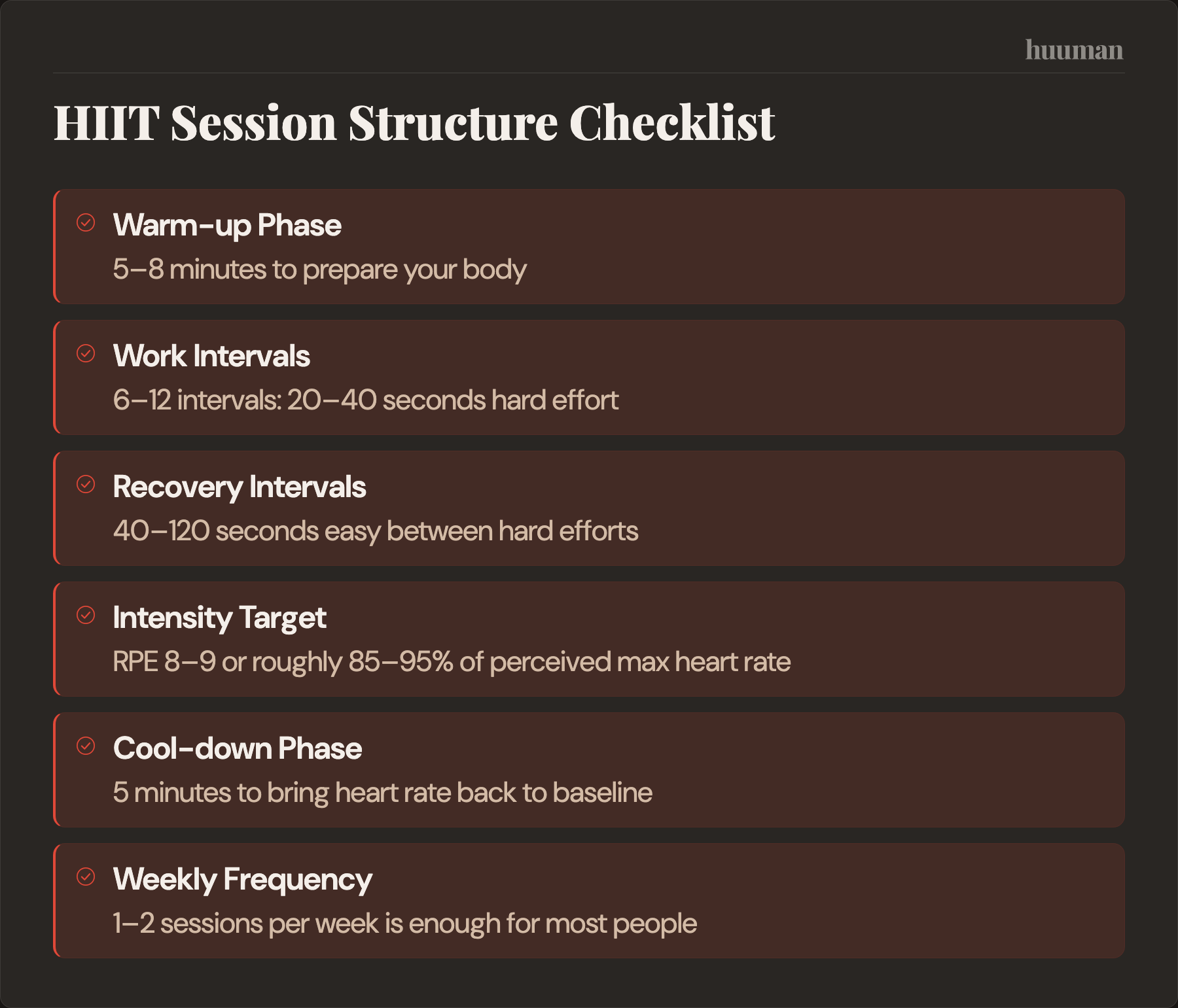
- 5–8 minutes warm-up
- 6–12 intervals: 20–40 seconds hard, 40–120 seconds easy
- "Hard" = about RPE 8–9 or roughly 85–95% of your perceived max heart rate
- 5 minutes cool-down
- 1–2 sessions per week is enough for most people
Progress by increasing intervals first, then density, and only later intensity. If sleep quality drops, resting heart rate rises, or soreness lingers – scale back.
If you want to track your HIIT sessions with consistent RPE and interval counts, log your training sessions and recovery signals with the huuman app to see patterns in your readiness and performance over time.
What HIIT Is – and What It Isn't
HIIT (High-Intensity Interval Training) means repeated bouts of hard effort with active recovery. It's not the same as going all-out. That's closer to Sprint Interval Training (SIT), which should be used sparingly.
The difference matters in practice:
- HIIT: hard but controlled, repeatable
- SIT: maximal, highly fatiguing, longer recovery needed
- Intervals in general: any structured work/rest pattern, including moderate efforts
Many programs confuse intensity with chaos. A solid HIIT workout plan keeps technique stable, limits all-out efforts, and uses clear rest periods.
How to Hit the Right Intensity (Without Overdoing It)
There are four practical ways to control intensity:
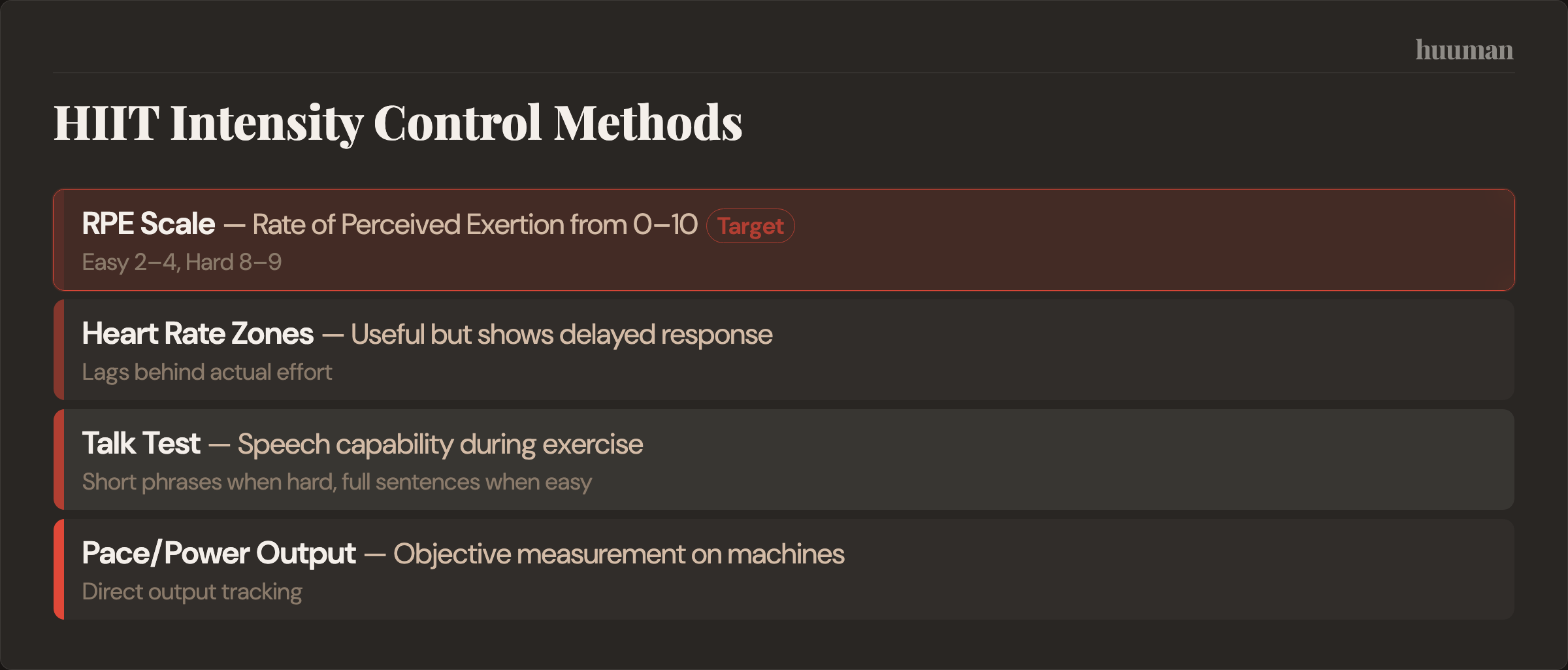
- RPE (0–10): easy 2–4, hard 8–9
- Heart rate zones: useful but delayed
- Talk test: short phrases when hard, full sentences when easy
- Pace or power: objective output on machines or while running
Important: heart rate lags behind effort. In short intervals, it doesn't reflect intensity in real time. For 20–40 second efforts, rely more on RPE and pace than on heart rate.
Max heart rate is individual, not a fixed number. Formulas are rough estimates. Some use heart rate reserve (HRR), which factors in resting heart rate. In practice, "hard" should feel demanding but still controlled.
The 5 Variables of Your HIIT Plan
An effective HIIT workout plan isn't about new exercises – it's about adjusting these variables:
- Interval duration: short (20–30 s) vs. longer (2–4 min)
- Rest duration: determines recovery between efforts
- Number of intervals: total volume
- Mode: bike, treadmill, bodyweight
- Frequency: 1–2 sessions per week for most people
Typical progression:
- more repetitions
- shorter rest
- only then higher intensity
Interval Formats at a Glance
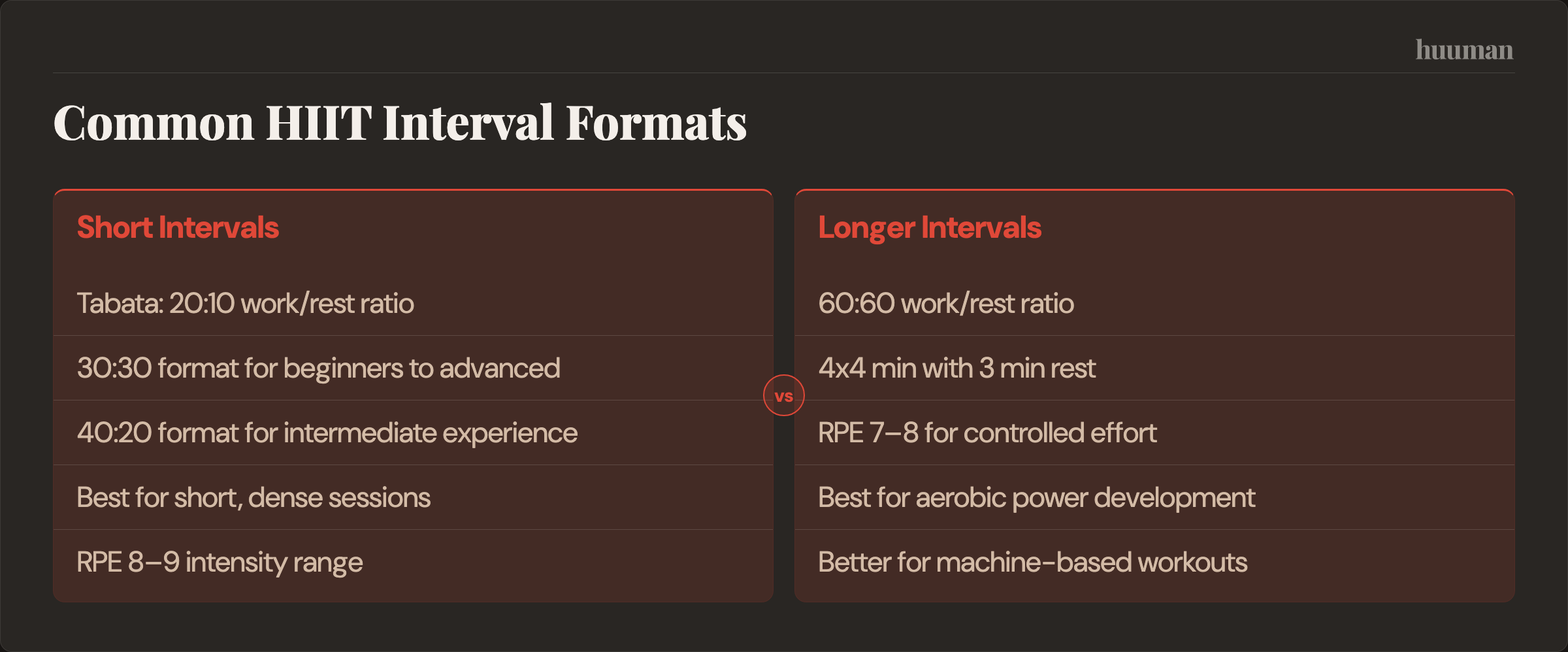
- Format: Tabata - Work/Rest: 20:10 - Intensity: RPE 8–9 - Best for: short, dense sessions
- Format: 30:30 - Work/Rest: 30:30 - Intensity: RPE 8 - Best for: beginner to advanced
- Format: 40:20 - Work/Rest: 40:20 - Intensity: RPE 8–9 - Best for: intermediate experience
- Format: 60:60 - Work/Rest: 60:60 - Intensity: RPE 7–8 - Best for: controlled effort
- Format: 4x4 min - Work/Rest: 4 min / 3 min - Intensity: RPE 8 - Best for: aerobic power, machines
Want to explore formats like Tabata in more detail? Learn more about Tabata as a HIIT method.
Ready-to-Use Protocols
Minimal HIIT (20–25 minutes)
- Warm-up: 6 minutes
- 8x (30 s hard / 90 s easy)
- Cool-down: 5 minutes
- Frequency: 1–2x/week
Tabata Light
- 2 blocks of 8x (20 s hard / 10 s easy)
- 3 minutes rest between blocks
- Focus: consistent output, not all-out burnout
4x4 Minutes
- 4x 4 minutes hard, 3 minutes easy
- Heart rate reaches target after ~2 minutes
- Pairs well with a 45-minute treadmill workout with HIIT intervals
4‑Week Plan (Copy-Paste Calendar)
- Week: Week 1 - Home (Bodyweight): 6x 30:90, focus on technique - Gym (Bike/Rower): 6x 30:90 moderate
- Week: Week 2 - Home (Bodyweight): 8x 30:90 - Gym (Bike/Rower): 8x 30:90
- Week: Week 3 - Home (Bodyweight): 8x 30:60 - Gym (Bike/Rower): 10x 30:60
- Week: Week 4 - Home (Bodyweight): 6x 30:90 (deload) - Gym (Bike/Rower): 6x 30:90 easy
Minimum: 1 session/week. Standard: 2 sessions with at least 48 hours between them. Advanced: add one easy endurance session.
Readiness Check Before Each Session
- Resting heart rate: elevated for several days → reduce volume
- HRV: downward trend → adjust intensity
- Sleep: poor or short → keep it lighter
- Soreness: strong localized pain → reduce impact
HRV is a useful signal, but not a crystal ball. Look at trends, not single values.
Evidence and Limitations
Research reviews suggest HIIT is associated with improvements in cardiorespiratory fitness and metabolic markers. Compared to moderate endurance training, it can be similarly effective with less time investment. At the same time, protocols vary widely.
A meta-analysis of older adults found HIIT reduces blood pressure with effects emerging after at least 4 weeks of training.
A meta-analysis found HIIT improved insulin resistance markers compared to control conditions.
Guidelines emphasize that intensity and frequency should be individualized. For many people, 1–2 sessions per week within a broader program is sufficient.
The main limitation is overload. Too much frequency, too much impact, or lack of base training increases injury risk. Warning signs like chest pain, unexplained shortness of breath, dizziness, or persistent heart rhythm issues should be checked by a professional.
Strategies to Discuss with a Professional
Common decision points in practice:
- Machine vs. home: joint-friendly vs. functional
- Low-impact options: bike, rower, airbike, or airbike workouts for maximum intensity
- Bodyweight: squat, hinge, push, core in circuits
A typical warm-up includes mobility work and a couple of short build-ups. The cool-down helps bring heart rate and breathing back to baseline. Many programs use this structure in short, high-impact workouts.
For long-term goals, it helps to understand high-intensity training and longevity and how to recover after hard sessions, such as recovery after intense training.
Tracking and Interpreting Progress
- Marker: Performance - What to Watch: more consistent pace/power - Meaning: better work capacity
- Marker: Load - What to Watch: session RPE × minutes - Meaning: internal training load
- Marker: Recovery - What to Watch: resting heart rate, sleep - Meaning: system recovery
Focus on trends, not single data points. If the same workout feels easier or your output is more consistent, that's a strong signal of progress.
Signal vs. Noise in HIIT
- Faster recovery between intervals → slightly reduce rest
- Stable output → increase repetitions
- Less soreness at the same workload → progress, not overload
- Machine "calories" → ignore, focus on performance
- Single HRV outliers → watch multi-day trends
- More sweat → not a quality marker
- Every session max effort → deliberately include moderate sessions
- Form breaks down → reduce intensity instead of pushing through
FAQs
How often should I do HIIT if I also lift weights?
For most people, 1–2 sessions per week works well alongside strength training and possibly low-intensity cardio. The key is whether you recover between sessions.
What does a good beginner HIIT plan without equipment look like?
A simple start is 6x 30:90 seconds using exercises like squats, lunges, push-ups, and planks. Focus on technique, not speed.
Which interval length is best: 20:10, 30:30, or 4x4 minutes?
None is universally better. Short intervals are more intense and technically demanding. Longer ones are more controlled. The best choice depends on your goal and experience.
Do I need to hit a specific heart rate zone during HIIT?
Heart rate can guide you, but it's unreliable in short intervals. RPE and output are often better indicators.
Why does HIIT sometimes feel "too hard" even though it's short?
High intensity creates rapid fatigue. If it consistently feels too hard, the dose is likely too high or your recovery is insufficient.
What are signs I'm overdoing it?
Elevated resting heart rate, poor sleep, declining performance, or persistent soreness are common signs. Scale back if you notice them.
Is HIIT good for fat loss or endurance?
It can support both, but works best within a broader training program. For many people, combining it with low-intensity cardio is more effective.
Rather than guessing when to push harder or scale back, have your huuman Coach build personalized weekly plans that adjust HIIT frequency based on your sleep and readiness trends for more consistent progress without overtraining.
More health topics to explore
- Heart & Cardio – Overview
- Sleeping Heart Rate: What’s Normal, What Patterns Matter, and When to Check It
- HIIT for Cardio: How to Do It Safely, Effectively, and Without Burning Out
- Heart Rate Variability Chart by Age (HRV): Ranges, Sex Differences, and How to Use Them
References
- Weston KS et al. — High-intensity interval training in patients with lifestyle-induced cardiometabo (2014)
- Batacan RB Jr et al. — Effects of high-intensity interval training on cardiometabolic health: a systema (2017)
- MacInnis MJ et al. — Physiological adaptations to interval training and the role of exercise intensit (2017)
- Gibala MJ et al. — Physiological adaptations to low-volume, high-intensity interval training in hea (2012)
- Buchheit M et al. — High-intensity interval training, solutions to the programming puzzle: Part I: c (2013)
- Jelleyman et al. 2015 — The effects of high-intensity interval training on glucose regulation and insulin resistance: a meta-analysis.
- Carpes et al. 2022 — High-intensity interval training reduces blood pressure in older adults: A systematic review and meta-analysis.
About this article · Written by the huuman Team. Our content is based on peer-reviewed research and clinical guidelines. We follow editorial standards grounded in scientific evidence.
This article is for educational purposes only and does not constitute medical advice. Health and training decisions should be discussed with qualified professionals.

