HIIT elliptical sessions can be one of the cleanest ways to get hard conditioning work without the impact cost of running. The machine gives you three useful control knobs at once, resistance, incline or ramp, and cadence, which makes it easier to create repeatable hard efforts and easier recoveries while you keep moving.
That matters if you are returning to training, managing irritated knees or feet, trying to fit conditioning around a busy week, or adding cardio without wrecking leg recovery from strength work. A randomized trial in experienced runners found that elliptical training can produce similar physiological benefits with lower impact forces than running, which helps explain why the modality works well for cross-training.
Key takeaways
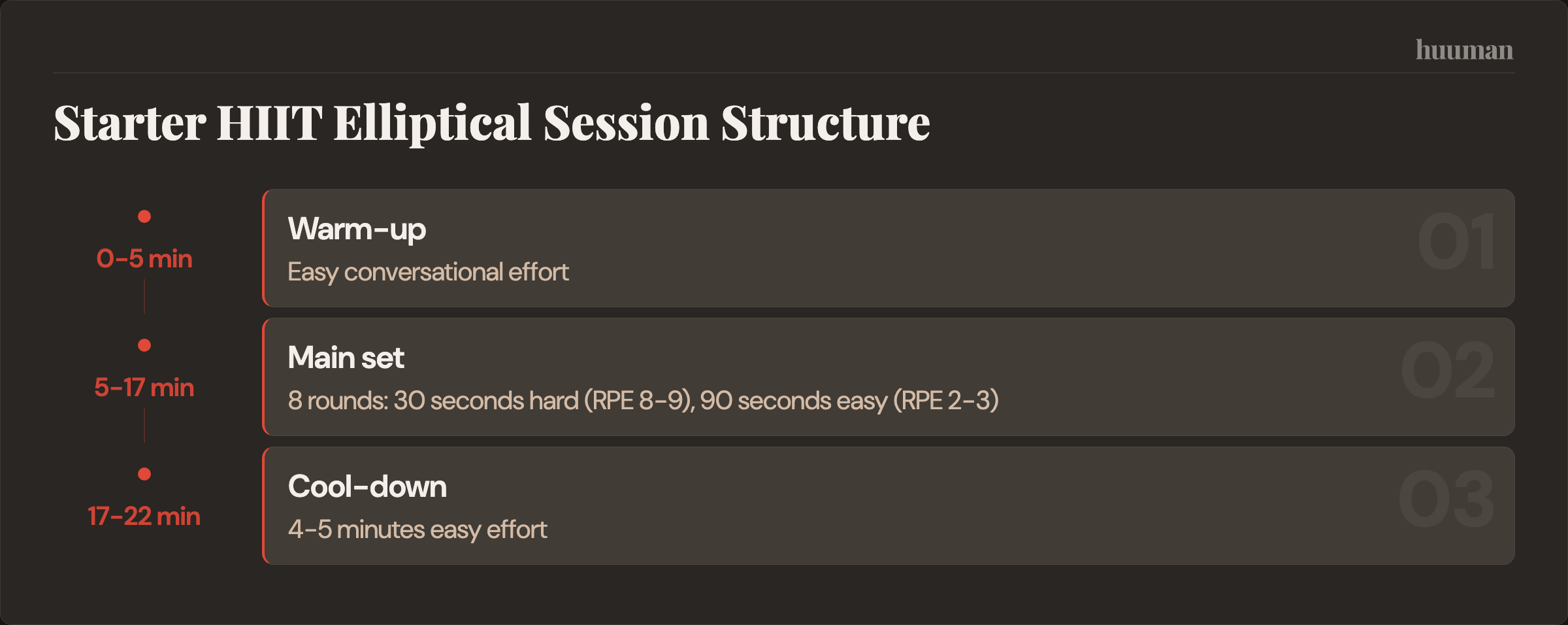
1. Warm-up: 5 minutes easy, conversational effort.
2. Main set: 8 rounds of 30 seconds hard, then 90 seconds easy.
3. Cool-down: 4 to 5 minutes easy.
This guide gives you a safe default hiit elliptical workout, shows you how to judge intensity without getting fooled by heart rate lag, and gives you three protocol cards you can actually repeat. It also covers when to hold back, what to track, and how to progress one variable at a time instead of turning every session into a test.
Where hiit elliptical sessions fit in a bigger training picture
Elliptical HIIT is best understood as a targeted high-stress input. It can help improve high-end aerobic capacity and your ability to produce hard repeatable efforts. Research on interval training indicates that HIIT can drive classic endurance adaptations including improved VO2max and cardiac output signaling, as described in a review of physiological adaptations to interval training.
It is not a complete cardio plan by itself. If you are an endurance athlete, it does not fully replace lower-intensity volume for aerobic base development. If you are strength-first, it can add useful conditioning, but only if it does not spill over into constant leg heaviness and weaker lifts. If you are joint-sensitive, the elliptical can be a practical way to keep conditioning in the week when running is not tolerated.
That balance matters inside a broader Heart & Cardio plan. Hard intervals can move fitness forward, but only when sleep, soreness, life stress, and fueling allow you to absorb them.
Quick answer
If you want one default hiit elliptical session that works for most people, start here:
- Warm-up: 5 minutes easy, conversational effort.
- Main set: 8 rounds of 30 seconds hard, then 90 seconds easy.
- Cool-down: 4 to 5 minutes easy.
- Hard effort: RPE 8 to 9, fast but controlled cadence you can repeat.
- Easy effort: RPE 2 to 3, breathing settles but you keep moving.
- How to make it hard: use resistance and cadence first. Add incline only if you can keep mechanics smooth.
- Frequency: start with one session per week. A second session may fit if recovery is consistently good. ACE guidance recommends 2 to 3 HIIT sessions per week as commonly employed in research.
- Stop rule: if cadence falls apart, symptoms feel abnormal, or round 1 already feels much harder than usual, modify or stop.
If you want to make this repeatable instead of guessing each time, log your sessions with RPE and interval details in the huuman app so you can compare the same workout across weeks.
What counts as real HIIT on an elliptical
Not every hard elliptical session is HIIT. For practical purposes, hiit training on elliptical means short or moderate hard intervals alternated with lower-effort recovery while you continue moving. The hard bouts should feel clearly uncomfortable but still repeatable. If you blast the first interval so hard that every later round collapses, that is not productive interval training. It is just poor pacing.
The best sessions have quality repeats. You should be able to hit a similar cadence and machine setting across rounds with only modest drift. That is also why elliptical HIIT works well for time-crunched readers. You can accumulate meaningful time at high effort in a short session without impact and without the setup complexity of outdoor pacing.
Work to rest ratios of 1:2 and 1:1 are commonly used in interval training, and research in trained runners suggests those structures can help sustain high work quality across repeats, as shown in work to rest ratio research. On an elliptical, that usually translates well because resistance is easy to standardize and recovery can stay active.
The three intensity knobs: cadence, resistance, and incline
The elliptical gives you more than one way to make an interval hard. That is useful, but it also creates confusion. Most programming problems come from changing all the knobs at once.

- Cadence: raises cardiovascular demand quickly and is often the cleanest way to create a harder effort. The trade-off is that excessive cadence can make mechanics sloppy.
- Resistance: increases muscular demand, especially through the hips and quads. Too much resistance can stall the stride and turn the interval into grinding rather than smooth power.
- Incline or ramp: changes muscle emphasis and often raises local leg fatigue faster than pure cadence changes. It can be useful, but it is usually the third lever, not the first.
A simple rule works well: set one primary knob for the day. If you are newer, use cadence plus a moderate resistance. If it feels too easy, increase resistance slightly before trying extreme cadence. If cadence cannot stay smooth, lower resistance. Change one variable at a time so the session is comparable from week to week.
How hard should the hard intervals feel
Use RPE first. On short intervals, heart rate lags behind the actual effort, so it is a poor primary guide for the first few rounds. RPE 8 to 9 is hard but controlled. You should not want to hold a conversation, and the talk test should fail quickly, but the interval should still look mechanically clean.
Heart rate is still useful, just in a different role. It can confirm that recovery is happening during the easy portions and show whether your response is drifting upward across rounds. If you use HR, a chest strap is usually more reliable than grip sensors on the handles. Handle sensors are often too noisy to judge short intervals well.
If you like HR zones, use them as guardrails rather than mandatory targets. Research on target heart rates shows that work near 80 to 85 percent of VO2max often corresponds to about 89 to 92 percent of maximum heart rate, but individual response varies and machine intervals are often too short for HR to stabilize. Maximum heart rate estimates are rough, and medications, stress, heat, and fatigue all change HR behavior.
Practical summary:
- Use RPE and repeatable cadence to dose the hard intervals.
- Use HR to see whether recovery is occurring and whether fatigue is accumulating faster than expected.
- Use the talk test as a simple backup. Hard intervals should make talking impractical. Recovery portions should make breathing more manageable again.
Technique that protects joints and preserves power
Good form on an elliptical is less about looking polished and more about keeping force smooth. That matters for both power output and joint comfort.

- Posture: keep a tall spine with ribs stacked over pelvis. Do not lean heavily onto the console.
- Shoulders: stay relaxed and down. A death grip wastes tension.
- Feet: think whole-foot pressure and smooth circles. Avoid bouncing through the forefoot.
- Knees: track over the mid-foot. Do not let them cave inward as effort rises.
- Handles: moving handles can increase perceived effort and whole-body involvement. Fixed handles may feel more stable. Pick one approach and stay consistent if you want valid comparisons across sessions.
- Stride mechanics: smooth and connected beats frantic. If the machine starts feeling jerky, the setting is probably too aggressive for a repeatable interval.
This is one reason elliptical HIIT can be a useful substitute when a 45 minute treadmill workout is not tolerated well. You can still train hard, but the low-impact pattern gives you a wider safety margin for irritated joints.
Three repeatable protocol cards
Protocol card 1: Starter HIIT
- Best for: returning to training, joint-sensitive athletes, busy professionals, and anyone who wants the minimal effective dose.
- Session: 5 minutes easy warm-up, 8 rounds of 30 seconds hard and 90 seconds easy, then 4 to 5 minutes easy cool-down.
- Hard intervals: RPE 8 to 9, fast but controlled cadence you can repeat without bouncing or twisting.
- Easy intervals: RPE 2 to 3, keep moving until breathing settles.
- Weekly use: minimal 1 time per week, standard 1 to 2 times per week with at least 48 to 72 hours between sessions, advanced only if other high-intensity work is limited and recovery is strong.
- Readiness gates: last two nights of sleep are adequate for you, soreness is low, resting HR is not elevated versus baseline, and HRV trend is stable or improving if you track it.
Protocol card 2: Classic 1:1 intervals
- Best for: general fitness building when the starter protocol feels too easy but you still want a compact session.
- Session: 6 minutes progressive warm-up including 2 short fast spins, 10 rounds of 45 seconds hard and 45 seconds easy, then 4 to 6 minutes easy cool-down.
- Hard intervals: around RPE 8, choose a cadence and resistance combination you can hold across all rounds.
- Easy intervals: around RPE 3, keep moving rather than stopping.
- Weekly use: minimal 1 time per week, standard 2 times per week only if no other HIIT is in the plan.
- Readiness gates: same as above, plus a performance check. If round 1 feels unusually hard, reduce resistance or cut rounds.
Protocol card 3: Long intervals
- Best for: conditioned athletes using elliptical HIIT for cross-training, winter training, or VO2-oriented work without sprinting.
- Session: 8 to 10 minutes progressive warm-up, 4 to 6 rounds of 2 minutes hard and 2 to 3 minutes easy, then 5 minutes cool-down.
- Hard intervals: RPE 7 to 8, strong and sustainable, not all-out.
- Easy intervals: RPE 2 to 3.
- Weekly use: usually replaces other HIIT and fits best once per week plus easier aerobic work.
- Readiness gates: if HRV has trended down for several days, resting HR is elevated, sleep debt is present, or legs are heavy from lifting, swap to easy aerobic work instead.
If you want more structures to compare, a broader hiit workout plan, a tabata high intensity workout, an airbike workout explained, and all about workouts with rowing machine can help you decide whether elliptical intervals are the best fit for your week.
How to place hiit elliptical sessions in your week
Start conservatively. One session per week is enough to learn the machine, judge recovery, and establish a repeatable benchmark. A second session can make sense if sleep is stable, soreness is low, and performance is not declining.
- If you run: use the elliptical when impact tolerance is low or as winter cross-training. It will not fully replace all easy volume, so preserve some lower-intensity work if endurance is the goal. Related reading on zwift zone 2 training shows why easier aerobic work still matters.
- If you lift: do not place hard elliptical intervals right before heavy lower-body work. The session is low-impact, not low-fatigue. If muscle gain is your priority, conditioning should support rather than sabotage a plan like 20 pound muscle gain.
- If you are time-crunched: the starter protocol or even a single one and done workout style session can be enough to maintain conditioning momentum.
- If you are recovering from a race block: be cautious adding HIIT too quickly. Context from all about recovery after marathon applies to any period of accumulated fatigue.
Progression without burnout
The safest way to progress hiit training elliptical sessions is to advance one variable at a time every week or two, not every session. That keeps the stimulus clear and recovery readable.
- Add 1 to 2 rounds while keeping the same settings.
- Or add a small amount of resistance while keeping cadence and rounds stable.
- Or shorten recovery slightly while keeping the work interval and machine settings unchanged.
Do not raise cadence, resistance, incline, and round count in the same progression step. If you want a simple benchmark, repeat the same starter session every 2 to 4 weeks and compare cadence, resistance, perceived difficulty, and next-day recovery.
A practical minimal-dose path for busy readers is four weeks of one weekly session using the starter 30/90 format. If the fourth week feels smoother, not just harder, you can either repeat the same plan and raise one setting slightly or add a second weekly session only if sleep, soreness, and performance all support it.
Evidence and limits
The evidence for HIIT improving cardiorespiratory fitness is good, but the magnitude of benefit varies with baseline fitness, interval design, adherence, and recovery. A meta-analysis of randomized trials in older adults found that HIIT improved VO2max compared with controls, which supports the idea that interval training can raise aerobic capacity even outside young athletic populations. Research comparing elliptical and running training shows that elliptical can be effective for improving cardiorespiratory fitness and maintaining aerobic work with less impact.
Clinical assessment of cardiorespiratory fitness is associated with improved risk stratification and health outcomes, making it a valuable metric to track alongside interval training adaptations.
That does not mean every hiit on elliptical program works equally well, and it does not mean more HIIT is automatically better. Reviews of interval training support its usefulness for fitness adaptation, but they also make clear that intensity is only one part of the picture. Lower-intensity aerobic training still has a role, especially for endurance athletes and for people who need recoverable volume.
There are also measurement limits. Grip-based HR sensors on ellipticals are a weak tool for short intervals, because signal quality is inconsistent and heart rate itself responds slowly. Chest straps are better if you want cleaner data. HRV and resting HR can be useful as trend signals, but neither should be treated as an oracle. A poor night of sleep, travel, alcohol, illness, work stress, and hard lifting can all distort the picture.
Safety also depends on context. Preparticipation screening principles from ACSM are there for a reason, especially if you have symptoms, known cardiovascular disease, or a long gap from exercise. ACSM guidance on preparticipation screening recommendations is useful background for deciding when more caution is warranted.
Non-prescriptive strategies to discuss with a professional
If you want to use high intensity interval training elliptical sessions more systematically, a few common approaches are described in the training literature:
- Joint-friendly conditioning: use the starter protocol when running volume must be reduced but you still want hard aerobic work.
- Fitness builder: use the 45/45 structure when you want a stronger rhythm and can tolerate less recovery.
- VO2-oriented work: use longer intervals only after shorter formats feel repeatable and your week already includes enough easier cardio.
- Deload logic: keep the session structure but cut rounds during stressful weeks rather than forcing progression.
- Cross-training: if your sport is swimming or cycling, compare the strain from elliptical intervals with plans like vo2max swimming to avoid stacking too much high intensity across modalities.
People focused on body composition sometimes overuse HIIT because it feels efficient. It can help maintain activity density, but it is not a shortcut that replaces nutrition consistency or total training quality. If that is your main goal, context from reduce body fat for women can help frame expectations more realistically.
How to track and interpret changes
You do not need a complex dashboard. The minimum useful tracking takes less than a minute:
- Session RPE from 0 to 10
- Total intervals completed
- Best repeatable interval, noted as cadence plus resistance, and incline if used
- Next-morning recovery rating, such as fresh, normal, heavy, or unusually flat
Optional data can sharpen decisions:
- Chest-strap HR
- One-minute HR recovery after the final hard interval
- HRV trend over 3 to 7 days
- Resting HR
- Sleep duration
A simple notes format works well: "Starter 30/90. Resistance 10, incline 4, hard cadence 83 to 86. Completed 8 rounds. Session RPE 8.5. Next morning normal, slight quad fatigue."
Use if-then adjustments rather than emotions. If performance drops sharply by round 3, cut rounds or reduce resistance next time. If cadence is smoother at the same settings and next-day recovery is good, keep the program the same once more before progressing. If round 1 feels wrong and sleep has been poor, swap to easy cardio instead.
Rather than manually piecing together readiness and training load, your huuman Coach can build weekly plans that adapt strength, cardio, and recovery to your actual readiness signals so your hard sessions sit in a recoverable week.
Signal vs noise in hiit elliptical training
- Signal: you hold smoother cadence at the same resistance and RPE. Next step: repeat that benchmark session once more before progressing.
- Noise: the machine says you burned more calories. Next step: ignore the calorie display and compare repeatable performance instead.
- Signal: your breathing settles faster during easy intervals. What to do: note it with session RPE and see if the pattern holds for two sessions.
- Noise: grip heart-rate readings jump around. Better move: use a chest strap or rely on RPE for the interval itself.
- Signal: you complete the same rounds with less leg burn and better next-day freshness. Then: consider a small progression in one variable only.
- Noise: comparing settings across different brands of elliptical. Use this instead: benchmark against your own machine and your own notes.
- Signal: one-minute HR recovery improves while session quality stays high. Action: keep the same protocol and confirm the trend rather than rushing to harder settings.
- Noise: chasing a "fat burn zone" label on the console. Do next: judge the session by its actual goal, quality HIIT repeats, not by a generic machine graphic.
Common questions
Is HIIT on an elliptical actually effective compared with running or cycling?
Research shows elliptical training can be effective for improving cardiorespiratory fitness and maintaining hard aerobic work with less impact. It is especially useful when running volume is limited by joint irritation or when you want controlled indoor intervals.
How long should an elliptical HIIT workout be for beginners?
For most beginners, 15 to 25 minutes total is enough, including warm-up and cool-down. The starter 30/90 session sits in that range and is easier to repeat well than more aggressive formats.
What resistance and incline should I use for HIIT on an elliptical?
There is no universal setting because machines differ and fitness levels differ. Start with a resistance that lets you raise cadence smoothly during the hard intervals without bouncing or grinding. Use incline only if mechanics stay controlled. If cadence falls apart, lower resistance before doing anything else.
Should I use heart rate zones or RPE for elliptical intervals?
Use RPE first for short intervals because HR lags. HR is better for confirming that recovery is occurring and for spotting excessive drift across rounds. If you use zones, treat them as rough context rather than strict targets.
How many HIIT sessions per week on an elliptical is too much?
For general readers, more is not better. One weekly session is a sensible starting point, and a second may fit if recovery is strong and you are not already doing other intense work. If sleep worsens, legs stay heavy, motivation drops, or performance declines, the current dose is probably too high.
Can I do elliptical HIIT if I have knee pain or plantar fasciitis?
Sometimes the lower-impact pattern is better tolerated than running, but pain still matters. If symptoms worsen during the session or linger afterward, that is a sign to modify or stop and discuss options with a qualified professional. The elliptical is joint-friendlier, not risk-free.
What is a good warm-up and cool-down for elliptical HIIT?
A good warm-up gradually raises cadence and breathing over 5 to 10 minutes and may include one or two short fast spins before the main set. A good cool-down is 4 to 6 minutes of easy movement until breathing and leg tension settle.
Stop the session and seek prompt medical care if you get chest pressure or pain, fainting or near-fainting, unusual shortness of breath, palpitations with dizziness, new neurologic symptoms, calf swelling or pain, or any symptom that feels distinctly abnormal for you.
More health topics to explore
- Heart & Cardio – Overview
- VO2max Swimming: What It Means, How to Train It, and How to Track Progress
- Calculate VO2max: Calculators, Formulas, and Tests for Running & Cycling
- Workouts With a Rowing Machine: 9 Sessions + 3 Weekly Routines
References
- Klein IE et al. — Comparison of Physiological Variables Between the Elliptical Bicycle and Run ... (2016)
- MacInnis MJ & Gibala MJ — Physiological adaptations to interval training and the role of exercise inten... (2017)
- ACE Fitness — High Intensity Interval Training for Clinical Populations
- Seiler S & Hetlelid KJ — The impact of rest duration on work intensity and RPE during interval training (2005)
- Swain DP et al. — Target heart rates for the development of cardiorespiratory fitness (1994)
- Wu ZJ et al. — Impact of high-intensity interval training on cardiorespiratory fitness, body... (2021)
- Thompson PD et al. — ACSM's new preparticipation health screening recommendations from ACSM's guid... (2013)
- Ross et al. — Cardiorespiratory Fitness as Clinical Vital Sign (2016)