The phrase "focus in you" shows up a lot online, but it is usually a mis-phrasing of "focus on you" or "focus in on yourself." The idea is simple: direct your limited attention and effort toward what you can control, what matters to you, and the next useful action, instead of reacting to noise, comparison, or constant input.
This matters most when life gets loud: heavy workloads, caregiving, training cycles, or big transitions. In those periods, better focus is often a recovery problem before it is a motivation problem. When sleep and stress load are off, attention, patience, and decision quality follow.
Key takeaways
1. Today's 3-step start: pick one meaningful task, set one boundary (response window or "not now"), and do one recovery action (sleep window, short walk, or break).
2. Keep it small: a 5-minute daily check-in and a 20 to 30 minute weekly reset are often enough to reduce reactivity.
3. Track simply: score focus, reactivity, and energy; look for trends, not perfection.
Below is a clear, non-therapy plan you can use this week. It focuses on boundaries, attention control, and small daily behaviors you can actually sustain.
Where this fits: attention, control, and recovery
"Focus on you" is less about mindset slogans and more about allocation. You have finite attention and recovery resources. Selective attention determines what you notice, which drives what you do, and ultimately what compounds over time. Switching between messages, tabs, and conversations can fragment attention and reduce performance.
At the same time, your locus of control matters. Effort directed at controllable inputs tends to move outcomes; effort spent on uncontrollable variables increases rumination and stress. A simple mental shift toward focusing on what you can actually control reduces decision noise.
Recovery underpins both. Sleep loss is associated with worse attention and emotion regulation, making boundaries harder to hold and distractions more tempting. Movement, regular meals, light exposure, and breaks may help maintain cognitive bandwidth. You can explore related fundamentals in the Mindset & Mental Health overview and how mindfulness fits into a mindfulness in a longevity protocol.
Evidence suggests that even time-efficient exercise formats support this - as little as 3 HIIT sessions per week improves aerobic capacity and muscle adaptations.
Quick answer
"Focus in you" usually means focus on yourself or focus in on yourself: prioritize your values, choose 1 to 3 weekly priorities, and protect them with a few clear boundaries. Practically, it looks like fewer priorities, better attention hygiene, and small daily actions that protect sleep, energy, and relationships.
- Today's 3-step start: pick one meaningful task, set one boundary (response window or "not now"), and do one recovery action (sleep window, short walk, or break).
- Keep it small: a 5-minute daily check-in and a 20 to 30 minute weekly reset are often enough to reduce reactivity.
- Track simply: score focus, reactivity, and energy; look for trends, not perfection.
If you want to build this habit consistently, you can track your daily focus scores and energy patterns with the huuman app to see which boundaries and recovery actions actually move your attention quality.
What people mean by "focus on you" (and what they do not)
When used well, it means three things at once: attention, agency, and values. Attention points to what you notice and work on. Agency clarifies what you can influence. Values define what matters enough to earn your limited time.
It does not mean ignoring responsibilities, cutting people off impulsively, or drifting into "I will only do what feels good." It also does not mean passive "manifesting." Real focus shows up as small, chosen actions repeated under normal, messy conditions.
"Focus on" vs "focus in on" (and the "focus in you" mix-up)
Both are correct, with slightly different emphasis:
- Focus on you: a broad orientation to your priorities and boundaries. Example: "This week, I will focus on my sleep and one key project."
- Focus in on yourself: a narrower, more deliberate zoom into thoughts, feelings, and current behavior. Example: "Before the meeting, I will focus in on my breathing and name what I am feeling."
"Focus in you" is a common mistaken version that likely intends one of the two above.
The huuman F.O.C.U.S. Loop
A simple weekly loop that connects attention, values, and behavior without overcomplicating things:
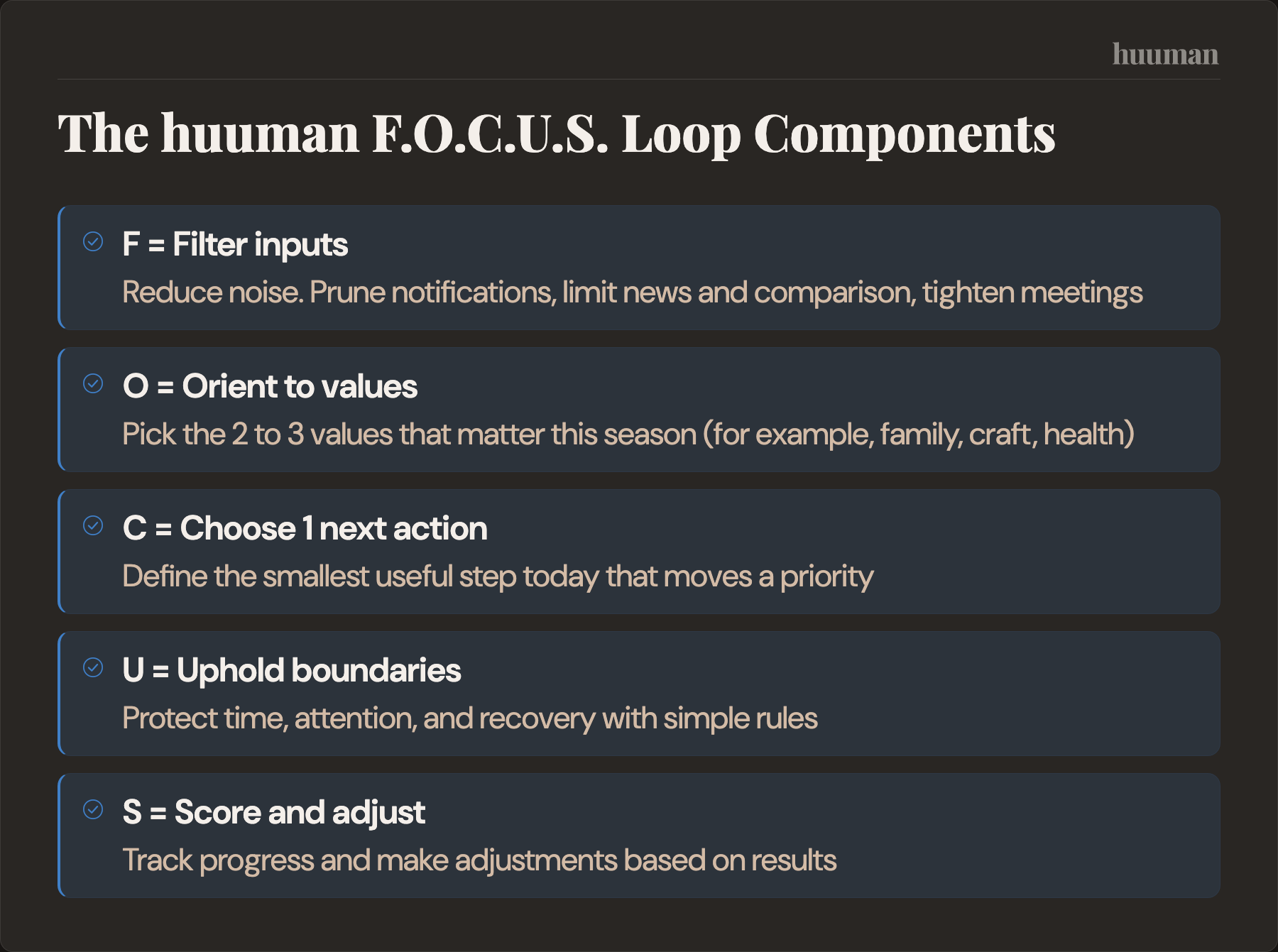
- F = Filter inputs: reduce noise. Prune notifications, limit news and comparison, tighten meetings.
- O = Orient to values: pick the 2 to 3 values that matter this season (for example, family, craft, health).
- C = Choose 1 next action: define the smallest useful step today that moves a priority.
- U = Uphold boundaries: protect time, attention, and recovery with simple rules.
- S = Score and adjust: track a few signals, review weekly, and iterate.
Self-care vs self-indulgence vs avoidance
Not all "focusing on me" is helpful. This table clarifies the difference:
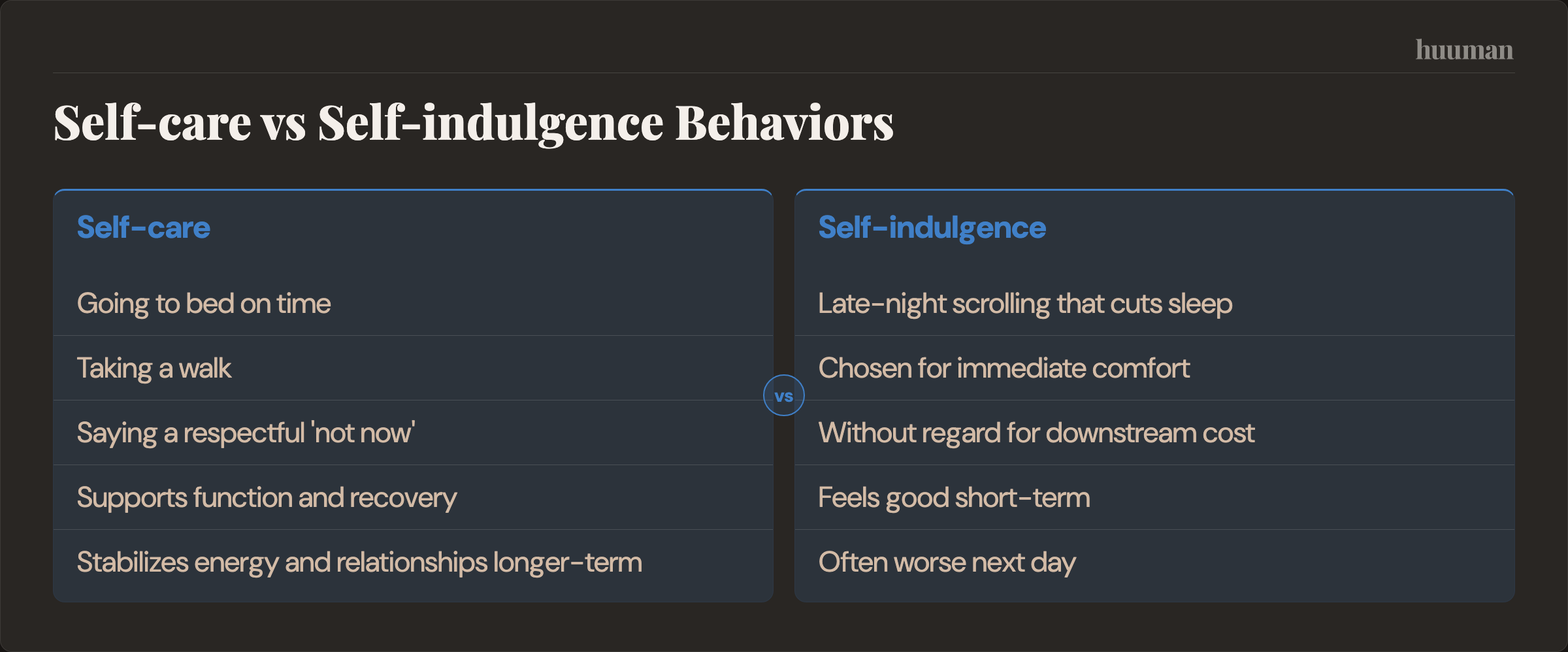
- Self-care: behavior that supports function and recovery. Example: going to bed on time, taking a walk, saying a respectful "not now." Short-term it can feel neutral or slightly uncomfortable; longer-term it stabilizes energy and relationships.
- Self-indulgence: behavior chosen for immediate comfort without regard for downstream cost. Example: late-night scrolling that cuts sleep. Feels good short-term; often worse next day.
- Avoidance: staying busy or distracted to not face a necessary conversation or task. Example: "researching" instead of sending the hard email. Relieves tension briefly; prolongs the problem.
Why it is hard: attention limits, stress, and social pull
Three frictions show up repeatedly. First, selective attention is limited, so constant switching between messages and tasks lowers quality and increases time-on-task. Second, stress reactivity narrows focus toward perceived threats and fuels rumination, especially during transitions. Third, social reinforcement keeps you checking: messages, feeds, and other people's urgency.
If any of this sounds familiar, it is often a sign of load, not a lack of willpower. Practices like box breathing for instant calm or a body scan meditation to build inner focus may help reduce reactivity. It also helps to recognize signs of overload early using cues from recognizing signs of mental overload.
Evidence and limits
Several elements in this approach are supported at a broad level. Research shows that switching between tasks can reduce performance. Sleep loss is associated with poorer attention and emotion regulation; consensus guidance on adult sleep needs often describes the 7 to 9 hour range as a heuristic. Implementation intentions, or "if-then" plans, have a strong base of behavioral research showing improved follow-through.
What is less solid are one-size-fits-all routines and absolutist trends such as strict "dopamine detox." Effects vary widely with context. Use these tools as flexible structures, not rules.
Strategies to discuss with a professional
Strategy set A: boundary moves (pick one)
- Response windows: check messages at defined times to reduce constant switching.
- Meeting hygiene: decline agendas without a clear decision, shorten default durations.
- "No" scripts: "I cannot take that on this week. I can revisit next Monday."
- Renegotiate: "What would success look like if we narrowed scope to the top two items?"
Strategy set B: attention hygiene (pick one)
- Single-task ritual: close extra tabs, set a 20 to 30 minute timer, define one output.
- Notification pruning: keep only mission-critical alerts.
- Environment shaping: phone out of reach, blockers for high-friction sites.
Strategy set C: recovery anchors (pick one)
- Sleep window: protect a consistent bed and wake range (heuristic often cited as 7 to 9 hours).
- Morning light + walk: brief outdoor exposure to support alertness.
- Breaks: short decompression between work blocks.
Strategy set D: mind skills (pick one)
- Label and choose: name the feeling, identify the trigger, pick the next behavior.
- If-then plan: "If I open social media during work, then I close it and return to the single task."
- For targeted regulation, see using meditation to process anger.
Boundary scripts box (copy/paste)
- "I do not have capacity for that this week. I can look at it next week."
- "I can join for the first 20 minutes, then I have to drop."
- "Can we clarify the one decision needed so I can prepare?"
- "I will reply to messages at 11 and 4 today."
- "That timeline is tight. What should we deprioritize?"
- "I cannot commit to this without pushing something else. Which is more important?"
5-minute daily check-in (copy/paste)
- Top value today (pick one): __________
- One meaningful task: __________
- One boundary (time or communication): __________
- One recovery action (sleep, walk, break): __________
- If-then plan: If ______, then I will ______.
20 to 30 minute weekly reset (copy/paste)
- Values this week (2 to 3): __________
- Outcomes (1 to 3): __________
- Calendar check: what supports or conflicts with these?
- Leaks (time or attention drains): __________
- Boundary to strengthen: __________
- Environment tweak: __________
- Recovery anchors to protect: __________
How to track and interpret changes
Keep measurement light and consistent. Trends matter more than any single day.

- Daily focus score (1–10): did you complete your one meaningful task?
- Reactivity score (1–10): how often did you get pulled into other people's urgency?
- Energy: subjective rating.
- Sleep consistency: how stable were bed and wake times?
Review weekly: note wins, identify leaks, and pick one boundary to strengthen. If sleep is erratic or you often wake with racing thoughts, explore factors like why racing thoughts wake you at 3am and simple wind-down cues such as calming music to quiet the mind or creating a calming bedtime routine.
Rather than managing all these signals manually, your huuman Coach can build personalized weekly plans that adapt to your focus trends and automatically adjust training intensity when your attention and recovery data suggest you need lighter weeks.
Signal vs noise: focus on you
- Signal: fewer priorities and clearer calendars. Next step: cut one non-essential commitment this week.
- Signal: steadier sleep and breaks. Next step: protect a simple sleep window for five nights.
- Signal: clearer requests and fewer resentments. Next step: use one boundary script in a real interaction.
- Signal: consistent small actions. Next step: keep the daily check-in under five minutes.
- Noise: adding routines without removing commitments. Next step: subtract before you add.
- Noise: chasing novelty hacks. Next step: run the same loop for one week before changing tools.
- Noise: using "focus on me" to avoid a hard conversation. Next step: schedule the conversation with a simple agenda.
- Noise: measuring worth by reactions of others. Next step: define one internal success metric for the week.
- Noise: treating burnout as discipline-only. Next step: audit sleep, load, and recovery first.
Common questions
What does "focus in you" mean, and is it the same as "focus on you"?
It is usually a mistaken version of "focus on you" or "focus in on yourself." The meaning is to direct attention and effort toward your values and next actions rather than external noise.
Is focusing on yourself selfish?
It depends on behavior. Value-based priorities plus clear boundaries tend to support relationships by reducing reactivity and resentment. Isolation, impulsive cutoffs, or ignoring shared responsibilities move toward selfishness or avoidance.
How do I focus on myself when other people need me?
Use micro-boundaries and defined response windows. Choose one meaningful task per day and protect a small block for it. Communicate availability clearly. Caregivers and high-responsibility roles often benefit from smaller, repeatable actions rather than big routine overhauls.
What should I focus on first: goals, habits, or boundaries?
Start with values, translate them into 1 to 3 weekly outcomes, then pick one daily action. Add one boundary to protect that action. Habits grow from repeated actions under stable conditions.
How can I stop getting distracted by my phone and other people's urgency?
Reduce inputs and increase friction: disable non-essential notifications, move the phone out of reach, and use short single-task blocks. Pair this with an if-then plan for predictable triggers.
How long does it take to feel a difference?
Some people notice reduced reactivity within days when they simplify priorities and protect sleep; others need longer. Look for trends in your scores rather than a specific timeline.
When does "focus on me" become a red flag?
If it leads to isolation, avoidance of necessary conversations, or worsening mood and functioning, it is time to reassess. Persistent distress, sleep disruption, or inability to carry out daily roles are reasonable prompts to seek professional support.
"Focus on you" works when it is boringly consistent: fewer inputs, clearer values, one next action, and boundaries that protect your time and recovery. Done this way, it tends to improve both performance and relationships because you are less reactive and more deliberate.
More health topics to explore
- Mindset, Stress & Mental Health – Overview
- Music for Focus: Which Sounds Actually Help—and When They Get in the Way
- How to Improve Concentration: What Helps Right Away
- How to Focus on Yourself: Without Feeling Selfish
References
- Schumann F et al. — Restoration of Attention by Rest in a Multitasking World: Theory, Methodology, a (2022)
- Koch et al. — Cognitive structure, flexibility, and plasticity in human multitasking-An integr (2018)
- Ottaviani et al. — Physiological concomitants of perseverative cognition: A systematic review and m (2016)
- Killgore et al. — Effects of sleep deprivation on cognition (2010)
- Oliva et al. — The efficacy of mindfulness-based interventions in attention-deficit/hyperactivi
- Gillen JB & Gibala MJ — Is high-intensity interval training a time-efficient exercise strategy to imp... (2014)
- Watson et al. — Recommended Amount of Sleep for a Healthy Adult: A Joint Consensus Statement of the American Academy of Sleep Medicine and Sleep Research Society. (2015)
- Schumacher et al. — Changing Physician Behavior With Implementation Intentions: Closing the Gap Between Intentions and Actions. (2016)
- Hirshkowitz M et al. — National Sleep Foundation's updated sleep duration recommendations: final report (2015)