You check your wearable or smart scale and see an electrodermal activity score. The instinct is to ask: is this good or bad? That question pushes you toward a single number. EDA does not work that way. It is a signal about moment-to-moment arousal, shaped heavily by context and by how your device chooses to score it.
This guide translates the electrodermal activity score into something you can actually use. You will learn what EDA measures in plain physiology, why device scores differ, what "good" means for you, and how to track changes without overreacting.
Key takeaways
1. Use EDA primarily as a trend, not a single reading.
2. Prioritize within-device changes over comparisons to others or other brands.
3. Interpret shifts alongside sleep, resting heart rate, HRV, and context like caffeine, heat, or training.
If you treat EDA as a trend tied to sleep, workload, and daily context, it becomes a useful pacing tool. If you treat it as a verdict, it quickly turns confusing.
Where EDA fits in your health picture
Electrodermal activity, also called skin conductance, reflects how active your sweat glands are. Those glands are driven largely by the sympathetic branch of your autonomic nervous system, the same system that ramps you up under stress, excitement, pain, or heat. In other words, EDA sits in the "arousal" layer of your physiology.
That makes it a complement to metrics like HRV as a stress biomarker, resting heart rate, and sleep duration. Together, they give a clearer picture of how loaded or recovered you are. EDA adds a fast, sensitive readout of sympathetic activation that can change within seconds.
It also connects to everyday levers. Stimulants, hydration, temperature, and training all shift EDA. That is why it belongs in the same conversation as recovery and lifestyle, not just "stress." For a broader view of how mental state and physiology interact, see the Mindset & Mental Health overview.
Quick answer
An electrodermal activity (EDA) score is a device-specific estimate of how strongly your sweat glands are responding, which tracks sympathetic nervous system arousal. Higher scores usually mean more arousal at that moment. A "good" EDA score is not a universal number. It is the stable baseline you generate under consistent conditions on your device.
- Use EDA primarily as a trend, not a single reading.
- Prioritize within-device changes over comparisons to others or other brands.
- Interpret shifts alongside sleep, resting heart rate, HRV, and context like caffeine, heat, or training.
- A spike can be normal. A sustained, unexplained change deserves context first, then attention.
Instead of guessing whether your daily EDA reading is meaningful, track your electrodermal activity patterns alongside sleep and weight data in the huuman app to establish what baseline arousal looks like for your physiology.
What EDA actually measures
EDA is measured as changes in skin conductance. A very small electrical current is applied across the skin, and the device detects how easily it passes. When sweat gland activity increases, conductance rises. This exosomatic direct-current measurement approach is standard in psychophysiology.
Because sweat glands are controlled by sympathetic nerve fibers, EDA is closely tied to sympathetic nervous system activity. Research often uses EDA to track arousal dynamics in humans PMC: Electrodermal Activity Responses, Scientific Reports on EDA and autonomic function.
Two components matter:
- Tonic (skin conductance level): your baseline level over minutes. Think of it as your background arousal.
- Phasic (skin conductance responses): rapid spikes tied to events, thoughts, or stimuli.
This distinction is standard in EDA analysis and helps explain why a calm baseline can still show brief peaks during a busy day University of Birmingham EDA guide.
EDA "score" vs EDA signal: why your number is not universal
In research, EDA is expressed in microsiemens (µS). Consumer devices translate that raw signal into a simplified score. That translation is where most confusion comes from.
- Units vs scores: µS reflects the physical signal. Consumer scores compress, smooth, and rescale it, often into a 0–100 style range. The mapping is proprietary and device-specific Withings Support.
- Body location: lab measurements often use fingers or palms where sweat glands are dense. Wearables use the wrist. Smart scales measure through the feet. Signals differ by site, so numbers are not directly comparable.
- Algorithms: devices filter movement, reject artifacts, and weight tonic vs phasic changes differently. Two brands can see the same physiology and output different scores.
Examples you may see:
- Withings EDA Score: measured via the feet during a scale session and presented as a wellness-oriented score. It is currently offered as a non-medical metric and noted as US-only in support materials Withings Support.
- Fitbit / Pixel Watch EDA: short "EDA scans" or background features that estimate sympathetic arousal during rest periods and tie into stress-oriented insights Google Research Blog.
Takeaway: compare your EDA score to your own past readings on the same device, not to someone else or another brand.
What a "good" EDA score means
A good electrodermal activity score is a stable personal baseline with appropriate flexibility.
Stable means that under similar conditions, your readings cluster in a narrow range. Flexible means your EDA can rise when life demands it and settle when the demand is gone. A flat, unresponsive signal is not the goal, and neither is chronically elevated arousal.
How to think about deviations:
- Acute spike: often normal. Check immediate context like caffeine, a stressful meeting, or heat.
- Sustained elevation across days: look for stacked stressors such as poor sleep, high training load, illness, or travel.
- Unusually low readings: can reflect a calm state, but also measurement issues like dry skin or poor contact.
Research vs consumer EDA, side by side
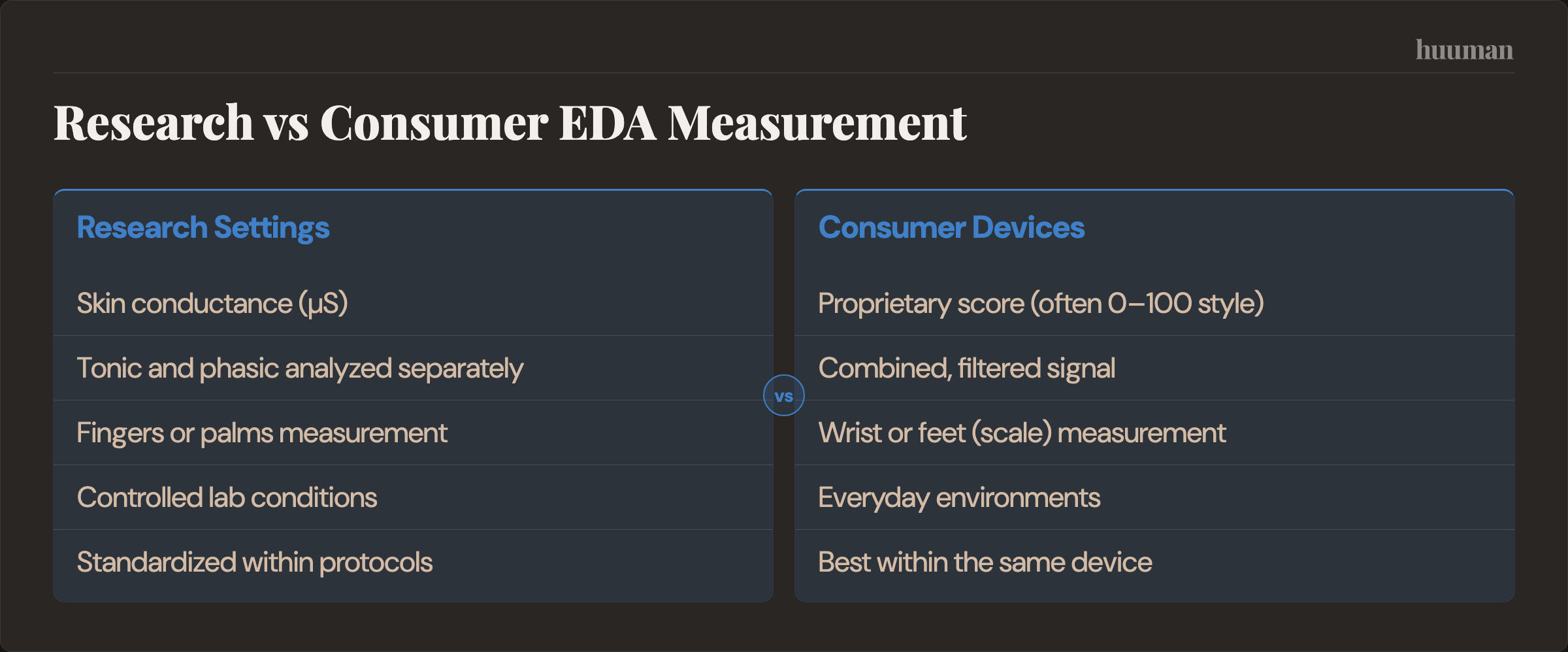
- Aspect: Signal - Research settings: Skin conductance (µS) - Consumer devices: Proprietary score (often 0–100 style)
- Aspect: Components - Research settings: Tonic and phasic analyzed separately - Consumer devices: Combined, filtered signal
- Aspect: Measurement sites - Research settings: Fingers or palms - Consumer devices: Wrist or feet (scale)
- Aspect: Protocol - Research settings: Controlled lab conditions - Consumer devices: Everyday environments
- Aspect: Comparability - Research settings: Standardized within protocols - Consumer devices: Best within the same device
Common drivers and confounders
EDA is sensitive. That is part of its value and its limitation. Many factors can move the signal:

- Increase arousal: acute stress, excitement, pain, heat, illness or fever, caffeine or nicotine, poor sleep, high-intensity training.
- Decrease arousal: cooler environments, calm breathing, restful sleep, low-stimulation periods.
- Measurement confounders: skin temperature, hydration, humidity, lotions, calluses, electrode pressure, movement artifacts, and device fit.
EDA signals also vary across body locations and conditions, which is one reason cross-device comparisons are weak PMC: Electrodermal Activity Responses.
Evidence and limits
There is solid physiological grounding for EDA as a marker of sympathetic activation. Measurement via skin conductance using a small applied current is well established, and the tonic versus phasic framework is standard in the literature.
In applied and experimental studies, EDA often tracks arousal responses to stimuli and may correlate with aspects of autonomic function Scientific Reports. Consumer implementations extend this into daily life, but accuracy depends heavily on context, body location, and signal processing. Even device makers frame EDA features as wellness metrics rather than diagnostic tools Withings Support, Google Research Blog.
The main limitations are practical: motion artifacts, environmental effects, and proprietary scoring reduce comparability and can blur interpretation. EDA is best viewed as a sensitive, context-dependent proxy for arousal, not a direct measure of "stress," and not a mental health diagnosis.
Non-prescriptive strategies to get useful data
Measurement hygiene (highest return)
- Use a consistent time window and similar posture.
- Keep ambient temperature stable when possible.
- Avoid measuring immediately after a hot shower or intense exercise.
- Take a minute to settle your breathing before a reading.
- Ensure good skin contact. For scales, stand still with even pressure; for wearables, check fit.
Reduce false positives
- Tag caffeine timing, alcohol, recent workouts, travel, and poor sleep.
- Note environmental heat and humidity, which may influence EDA readings.
- Be cautious with readings during movement or fidgeting.
Use EDA to pace your week
If your EDA trend is elevated while sleep is down and resting heart rate is up, many programs shift toward lower-arousal work and more recovery until signals stabilize. The inverse pattern supports resuming higher intensity. This is a common approach described in training and recovery literature, not a rule.
Simple practices that downshift arousal can help you test how responsive your system is. Short breathing sessions, a walk outside, or mindful cooldowns often reduce acute spikes. If you explore mental routines, pieces like how meditation helps manage anger or overcoming boredom in meditation add practical options. Be cautious about quick fixes such as supplements that claim to boost focus or relying on stimulants like those discussed in do energy drinks really improve focus?, since they can push EDA up without improving recovery.
How to track and interpret changes
Start with a short baseline and then look at trends.

- Baseline: 14 days, consistent conditions.
- View: 7-day rolling average rather than single readings.
- Pairings: sleep duration or quality, resting heart rate, HRV trend, subjective stress, and training load.
- Thresholds: define "meaningful change" as a deviation from your baseline, not a public cutoff.
EDA Context Stack decision tree
- Device layer: same device, same mode, good contact?
- Signal layer: single spike or part of a multi-day rise?
- Context layer: check sleep, caffeine, heat, recent training, emotions, illness signs.
- Action layer: downshift today, recover, re-measure under clean conditions, or monitor for persistence.
When your EDA trends shift consistently over several days, context becomes everything—sleep quality, training load, and daily stressors all matter. Let your huuman Coach build weekly training plans that respond to your arousal patterns rather than pushing through when your nervous system is already elevated.
Signal vs noise: electrodermal activity score
- Single readings are noisy; trends matter. Look at a 7-day average before reacting.
- Different devices score differently. Avoid cross-brand comparisons and stick to your device.
- Heat and humidity may influence EDA readings. Check the environment before drawing conclusions.
- Movement and poor contact create false spikes. Repeat the reading under stable conditions.
- Caffeine, nicotine, and acute emotions elevate skin conductance responses. Tag timing to explain sudden changes.
- Poor sleep may affect next-day arousal patterns. Compare with your sleep and resting HR trend.
- EDA is an arousal signal, not a stress verdict. Pair it with context and subjective notes.
- Without context tags, EDA becomes random. Add a one-word note to each entry.
- If you experience sudden unexplained sweating with other concerning symptoms, consider seeking clinical evaluation.
Common questions
What does an electrodermal activity (EDA) score actually measure?
It estimates changes in skin conductance driven by sweat gland activity, which reflects sympathetic nervous system arousal. Consumer devices convert that signal into a proprietary score.
What is EDA on a Withings scale, and why is it measured on the feet?
Withings uses metal electrodes on the scale to measure conductance through the feet during a session and presents a wellness-oriented EDA score. Feet provide a stable contact surface for a brief measurement, though signals differ from hand-based lab setups Withings Support.
What is a "good" EDA score, and can I compare it to other people?
"Good" means stable for you under consistent conditions. Scores are device-specific, so comparing numbers across people or brands is generally not meaningful.
Why is my EDA score high even when I feel calm?
Common reasons include caffeine, heat, recent exercise, minor illness, or measurement factors like skin temperature and contact. Phasic spikes can also occur without a strong conscious feeling.
What causes day-to-day swings in EDA readings?
Changes in sleep, workload, stimulants, environment, and measurement conditions. EDA is sensitive, so small shifts can show up as noticeable differences.
How should I track EDA alongside HRV, resting heart rate, and sleep?
Use a 14-day baseline, then a 7-day rolling average. Interpret EDA with sleep and HRV together. Consistent moves in the same direction carry more weight than a single metric alone.
When should an unusual pattern be checked by a clinician?
If you notice persistent, unexplained sweating or EDA changes along with symptoms such as fever, chest discomfort, shortness of breath, fainting, unintentional weight loss, or new neurological issues, seek medical evaluation.
More health topics to explore
- Mindset, Stress & Mental Health – Overview
- Box Breathing (Square Breathing): How It Works—and When to Use It
- Concentration in Children: Causes, Quick Fixes, and Warning Signs
- Concentration Pills: What the Evidence Actually Shows
References
- University of Birmingham — Guide Electrodermal Activity
- Nature Scientific Reports: Assessing Autonomic Function from EDA and Heart
- Google Research — What Does Electrodermal Sensing Reveal Insights from the Pixel Watch Fitbit S...
- De Benedittis G — Hypnotic Modulation of Autonomic Nervous System (ANS) Activity. (2024)
- Silveira RJ et al. — Continuous evaluation of exosomatic electrodermal activity in patients with p... (2024)
- Qasim MS et al. — Influence of ambient temperature on tonic and phasic electrodermal activity c... (2022)
- Parent M et al. — PASS: A Multimodal Database of Physical Activity and Stress for Mobile Passiv... (2020)
- Boucsein W et al. — Continuous recordings of impedance and phase angle during electrodermal react... (1989)
- Posada-Quintero HF & Chon KH — Innovations in Electrodermal Activity Data Collection and Signal Processing: ... (2020)
- Sánchez-Reolid R et al. — Machine Learning Techniques for Arousal Classification from Electrodermal Act... (2022)
- Nagai Y et al. — Galvanic Skin Response (GSR)/Electrodermal/Skin Conductance Biofeedback on Ep... (2019)
- Gordon E et al. — Integrative neuroscience: the role of a standardized database (2005)
- Zahn TP & Rapoport JL — Acute autonomic nervous system effects of caffeine in prepubertal boys (1987)
- Source
- Withings — Body Comp — Learn more about Electrodermal Activity Score (EDA) – Withings