Dumbbell strength training gives you a complete, repeatable way to build strength and muscle without a complex setup. One pair of dumbbells, a small space, and a clear plan are enough to train your whole body effectively.
This guide focuses on what actually drives progress: the right movement patterns, clear set and rep targets, and progression rules you can follow week after week. You will get ready-to-use protocol cards, a simple way to choose weights, and a system to progress without guessing.
Key takeaways
1. Train 2–3 full-body sessions per week.
2. Build each session around 5 patterns: squat or lunge, hinge, push, pull, and carry or core.
3. Do 2–4 sets per exercise, mostly in the 6–12 rep range.
Whether you train at home, travel often, or want a reliable gym alternative, this structure is designed to keep you consistent and moving forward.
Where dumbbell training fits (and why it works)
Dumbbell strength training sits at the center of what matters for a durable, capable body. It loads muscle, tendons, and bone through controlled ranges of motion, which supports long-term strength and joint resilience. That is your physical "frame."
It also carries over into other systems. More muscle and training volume are associated with better energy handling. Circuit-style sessions can raise heart rate modestly, though they do not replace dedicated aerobic work like workouts with rowing machine. And on the mindset side, a simple plan with clear progression reduces decision fatigue and improves adherence.
If you want a broader view of how strength and mobility fit together, see Strength & Mobility.
Quick answer
Dumbbell strength training works best when you keep it simple and repeatable:
- Train 2–3 full-body sessions per week.
- Build each session around 5 patterns: squat or lunge, hinge, push, pull, and carry or core.
- Do 2–4 sets per exercise, mostly in the 6–12 rep range.
- Stop sets with about 1–3 reps in reserve (RIR), so you are working hard without losing form.
- Progress by adding reps first, then increasing weight once you hit the top of the range.
If you want to track your progress without guessing, log your dumbbell sessions with sets and RPE through the huuman app to build a clear record of what weights and rep ranges are working for your body.
Core concepts that make the plan work

What dumbbell strength training actually means
Dumbbells are free weights. Each arm works independently, which increases stability demands and helps address side-to-side differences. They are also flexible: you can train at home, in small spaces, or in a busy gym.
Your goal determines how you use them:
- Strength: lower reps, heavier weights, longer rest.
- Hypertrophy (muscle): moderate reps and volume, controlled effort.
- Endurance: higher reps, lighter loads.
- General fitness: a mix, often anchored around moderate reps.
Most people benefit from staying in the middle, building strength and muscle together with controlled sets.
The movement-pattern checklist
Instead of chasing dozens of exercises, filter everything through five patterns. If you cover these each week, you are covering your body.
- Squat or lunge: goblet squat, split squat, Bulgarian split squat.
- Hinge: Romanian deadlift, single-leg RDL.
- Push: dumbbell floor press or bench press, overhead press.
- Pull: one-arm row, chest-supported row, rear delt fly.
- Carry or trunk: suitcase carry, farmer carry, dead bug, side plank.
This is your one-screen checklist. If a session includes all five, it is complete.
The huuman Dumbbell 5-2-1 Framework
- 5 patterns: cover squat or lunge, hinge, push, pull, and carry or core each week.
- 2 progression levers: add reps first, then increase load.
- 1 recovery gate: do not progress when sleep, soreness, and performance are trending worse.
This keeps your plan stable while still moving forward.
How hard should sets feel
For strength work, effort matters more than heart rate. Use RPE or RIR:
- RIR 3: you could do about three more reps.
- RIR 2: two more reps left, solid work.
- RIR 1: one more rep left, near your limit with good form.
Most productive sets land between RIR 1 and 3. Stop when technique starts to break down.
How to choose dumbbell weight
Use a simple rule: pick a rep range, then choose a weight that lets you finish the set with the target RIR.
- If you cannot reach the minimum reps, the weight is too heavy.
- If you exceed the top of the range with more than 3 reps in reserve, it is too light.
Adjustable dumbbells help because small jumps make progression smoother. If your weights are limited, you can use unilateral work, slower tempo, or pauses to increase difficulty without chasing exhaustion.
Progression that actually works
The most reliable method is double progression:
- Pick a range, for example 3 sets of 8–12 reps.
- Keep the same weight and add reps over sessions.
- Once you hit 12 reps on all sets, increase weight and repeat.
You can add a set later, but only after performance is stable and recovery is good. If progress stalls and recovery markers worsen, use a short reduction in volume or load. See deload weightlifting explained and a deload week example explained for context.
Choose your plan
This table helps you match your schedule and goals to a structure you can sustain.
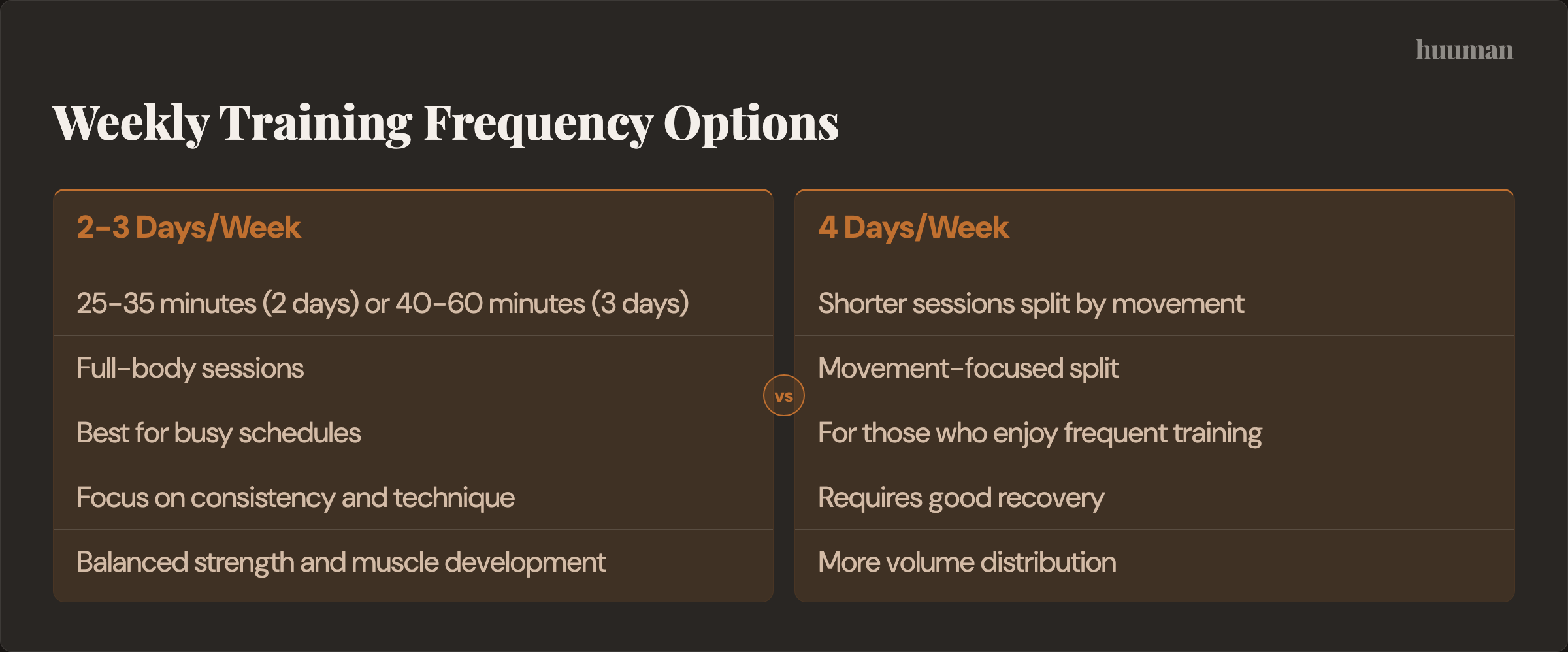
- 2 days/week: 25–35 minutes per session. Best for busy professionals or when restarting. Focus on consistency and clean technique.
- 3 days/week: 40–60 minutes per session. Balanced strength and muscle with steady progression.
- 4 days/week: shorter sessions split by movement focus. Useful if you enjoy training more often and recover well.
Protocol Cards (choose one)

Protocol Card A – MED Full-Body (2 days/week)
Structure
- Warm-up: hinge drill, squat prying, scapular retraction, 1–2 lighter sets.
- Block 1: goblet squat + one-arm row.
- Block 2: dumbbell floor press + Romanian deadlift.
- Block 3: suitcase carry + dead bug.
Sets, reps, rest
- Main lifts: 2–3 sets of 6–12 reps, rest 60–120 seconds.
- Carries: 3–5 rounds of 20–40 meters per side.
Intensity
- RPE 7–9 (about 1–3 reps in reserve).
- Heart rate is not a target. Keep breathing controlled.
Readiness gates
- If sleep drops, resting heart rate trends up, or soreness lasts beyond 48–72 hours, hold load and reduce one set.
- HRV can be useful, but it is a decision-support tool, not an oracle.
Protocol Card B – Standard Full-Body (3 days/week)
Workout structure
- Day A: goblet squat, floor press, one-arm row, carry.
- Day B: Romanian deadlift, overhead press, split squat, rear delt fly or core.
- Day C: Bulgarian split squat, press variation, row variation, carry.
Target intensity
- Main lift: around RIR 2.
- Accessories: RIR 2–3.
Scheduling
- Minimal: 3 sessions.
- Standard: add 1 easy aerobic day.
- Advanced: add 2 aerobic days if recovery is strong.
Protocol Card C – Limited Load / Home Minimalist
Structure
- Bulgarian split squat (slow eccentric).
- Single-leg Romanian deadlift.
- One-arm row.
- Overhead press.
- Suitcase carry and side plank.
Approach
- Use tempo, pauses, and unilateral work to increase difficulty.
- Higher reps can work if effort stays high and form stays clean.
Evidence and limits
General guidelines recommend including muscle-strengthening activities multiple times per week for health. Research also suggests that a wide range of rep ranges can support muscle growth and strength when sets are taken close to fatigue, and that total training volume is an important driver of hypertrophy.
Dumbbells can support these outcomes well, especially for beginners and intermediates, and even advanced lifters when loading is sufficient and exercises are chosen carefully.
The main limitations are practical:
- Load ceiling: legs and hip hinges may outgrow available weight.
- Grip fatigue: can limit posterior chain work before the target muscles are fully challenged.
- Stability demand: unilateral work raises coordination requirements.
Workarounds include unilateral exercises, tempo control, and optional use of straps for hinges. If you consistently hit very high reps just to reach effort, it may be time to expand your setup.
Strategies to adjust without overcomplicating
- No bench: use floor press.
- Tight hips: temporarily elevate heels for goblet squats.
- Grip limits: straps can help for RDLs, but reduce grip training stimulus.
- Rest intervals: longer rest supports strength, shorter rest increases density.
- Finishers: optional and low frequency. If used, remember heart rate lags on short intervals, so use perceived effort or pace rather than HR.
If you want complementary plans, see build muscle at home, strength training for beginners, strength training for women, muscle building training plan explained, strength training for runners explained, and building muscle in old age.
How to track and interpret changes
Track trends, not single workouts.
- Performance: log the first working set of each main lift.
- Recovery: sleep quality, resting heart rate trends, soreness duration.
- Function: movement quality, balance, control.
When performance improves and recovery is stable, continue progressing. When both drift in the wrong direction, hold or reduce load briefly.
Rather than cycling through random workouts, have your huuman Coach build personalized weekly strength plans that adjust based on your recovery signals so you can focus on consistent progression instead of program hopping.
Signal vs noise in dumbbell strength training
- Signal: progressive overload with stable exercises. Next step: keep the same lifts for at least 4 weeks.
- Signal: stopping sets with 1–3 reps in reserve. Next step: adjust load if you miss the target effort.
- Signal: full-body 2–3 times per week works well for busy schedules. Next step: commit to consistency first.
- Signal: unilateral leg work offsets limited weight. Next step: add split squats or single-leg hinges.
- Noise: chasing soreness. Shift focus to performance trends instead.
- Noise: copying no-rest circuits when strength is the goal. Add proper rest intervals.
- Noise: using heart rate as the main target. Base intensity on load and RIR.
- Noise: constant exercise variety. Keep a core set of movements stable.
- Noise: searching for one perfect rep range. Use a range and focus on effort.
Common questions
Can you build strength with just dumbbells?
Yes. With the right exercises and sufficient effort, dumbbells can build strength and muscle effectively. Limitations tend to appear when loads are no longer challenging for lower-body lifts.
How heavy should dumbbells be?
Heavy enough that you reach your target rep range with about 1–3 reps left in reserve. The "right" weight depends on the exercise and your current capacity.
Is a 2-day plan enough?
For many people, yes. Two focused full-body sessions can drive steady progress, especially when consistency is high and progression is clear. This aligns with physical activity guidelines recommending muscle-strengthening activities at least twice weekly.
What is the best full-body dumbbell workout?
One built around the five movement patterns with repeatable progression. The exact exercises matter less than covering those patterns and progressing them over time.
How many sets and reps should I do?
Common structures use 2–4 sets of 6–12 reps for most lifts, with effort near but not at failure. Adjust based on recovery and schedule.
What if my dumbbells are too light?
Use unilateral work, slower tempo, and pauses. Increase reps within reason while maintaining technique.
Does the "3-3-3 rule" matter?
It is one of many simple heuristics. What matters more is consistent progression, appropriate effort, and recovery you can sustain.
Dumbbell strength training works when it is simple enough to repeat and structured enough to progress. Cover the five patterns, train close to fatigue with good form, and advance reps before weight. Keep an eye on recovery signals so the plan fits your actual week, not an ideal one.
More health topics to explore
- Strength, Muscle & Mobility – Overview
- Strength Training Plan: Templates for 2–4 Days per Week (with Progression)
- Muscle-Building Workout Plan for Women: 2–4 Days, Progression, Examples
- Beginner Strength Training: A Clear 8-Week Starter Plan (Home & Gym)
References
- ACSM — Progression Models in Resistance Training (2009)
- Schoenfeld BJ et al. — Dose-response relationship between weekly resistance training volume and incr... (2017)
- Piercy KL et al. — The Physical Activity Guidelines for Americans (2018)
- Watson SL et al. — High-Intensity Resistance and Impact Training Improves Bone Mineral Density a... (2018)
- Robinson ZP et al. — Exploring the Dose-Response Relationship Between Estimated Resistance Trainin... (2024)
- Grandou C et al. — Overtraining in Resistance Exercise: An Exploratory Systematic Review and Met... (2020)
- Schoenfeld BJ et al. — Strength and Hypertrophy Adaptations Between Low- vs. High-Load Resistance Tr... (2017)
- Refalo MC et al. — Influence of Resistance Training Proximity-to-Failure on Skeletal Muscle Hype... (2023)
- Schoenfeld BJ et al. — Effects of Resistance Training Frequency on Measures of Muscle Hypertrophy: A... (2016)
- Refalo MC et al. — Similar muscle hypertrophy following eight weeks of resistance training to mo... (2024)