
A deload weightlifting phase is not falling behind. It is how you keep progress going when fatigue starts to mask your fitness. If you train hard for weeks at a time, stress accumulates across muscles, joints, and your nervous system. At some point, pushing harder stops working.
This guide gives you a clear definition of deloading, a simple checklist to decide if you need one now, and three practical ways to run a deload next week without losing momentum.
Key takeaways
1. Cut volume, load, or both
2. Keep movements familiar
3. Avoid training to failure
You will also see how to adjust volume, load, and effort instead of just "lifting lighter," and how to track whether it actually worked.
Where deloading fits in a long-term training plan
Deloads sit inside the broader goal of staying fit, capable, and consistent over years. They manage fatigue so you can keep building rather than cycling between overreaching and burnout.
From a big-picture perspective:
- Recovery: you are reducing accumulated fatigue so adaptations can show up.
- Frame: joints, tendons, and movement quality get a break from high stress patterns.
- Metabolism: sleep, energy availability, and life stress influence how much fatigue you carry.
- Mind: perceived effort and motivation often rebound after a well-timed deload.
Deloading connects directly to topics like Sleep & Recovery – Overview and longer-term planning such as a longevity protocol.
Quick answer
A deload in weightlifting is a planned 5 to 10 day period where you reduce training stress to let fatigue drop while keeping your technique and rhythm. Most lifters do this by lowering total sets, reducing load, or both, while continuing a few familiar lifts. The goal is to feel fresher, not detrained, and to return ready to train hard again.
- Cut volume, load, or both
- Keep movements familiar
- Avoid training to failure
- Leave the week feeling better than you started
If you want to see whether fatigue is actually dropping during your deload week, track your sleep stages and efficiency with the huuman app for seven nights and watch how your deep sleep and wake times respond to reduced training stress.
What deloading means and what it is not
Deloading is a temporary reduction in training stress to dissipate fatigue while maintaining skill. Stress comes from several levers: volume, load, proximity to failure, frequency, and exercise selection.
It is not the same as a full rest week. A complete break can be useful after illness or travel, but in most training blocks, keeping some exposure to lifts helps maintain coordination and confidence.
It is also different from a taper. A taper is designed to peak performance for a competition. A deload is designed to extend productive training over months.
Terms like "active recovery" overlap but are broader. A deload is structured and tied to your lifting program.
The 5 stress dials you can turn
Think of your training week as five adjustable dials. You do not need to turn all of them down at once.
- Sets (volume): total work done across the week
- Load (intensity): how heavy the weight is relative to your capacity
- Reps in reserve (RIR): how close you train to failure
- Frequency: how many sessions per week
- Exercise selection: joint stress and technical demand
Rule of thumb: reduce two or three dials, not all five, unless you are clearly run down. Keeping exercises familiar usually limits soreness and preserves movement quality.
When to deload: planned vs reactive
There are two valid entry points into a deload.
Planned deloads often follow a hard training block. Periodization texts and coaching practice commonly place them every several weeks, especially as intensity and volume climb. More experienced lifters tend to need them more often than beginners because they can generate more stress per session.
Reactive deloads are driven by signals that you are no longer adapting.
- If performance is drifting down at the same effort
- If soreness and joint irritation linger
- If sleep and motivation are dropping together
A simple rule: when multiple signals point in the same direction, act sooner rather than forcing another hard week.
Checklist: do you need a deload now?
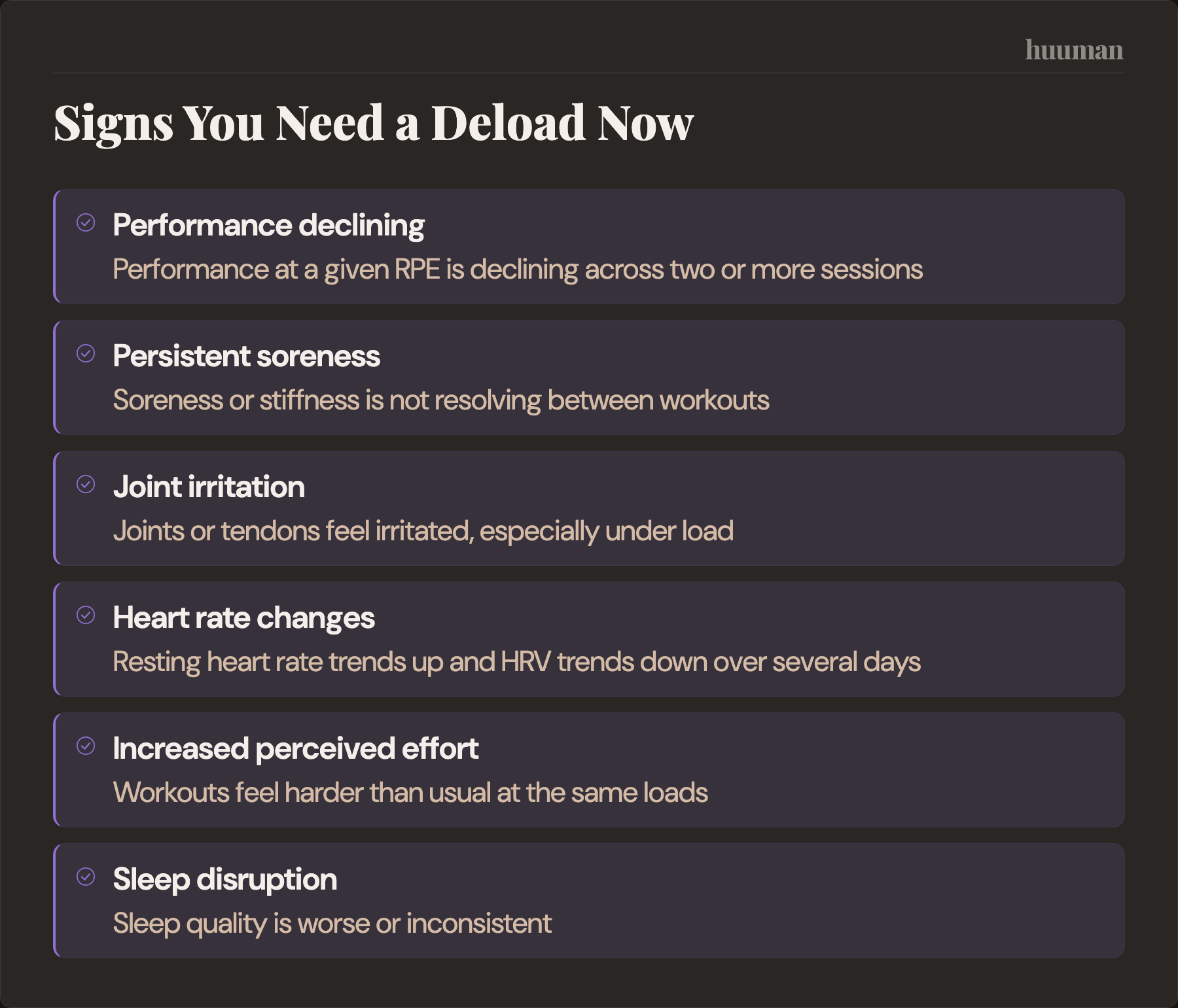
- Performance at a given RPE is declining across two or more sessions
- Soreness or stiffness is not resolving between workouts
- Joints or tendons feel irritated, especially under load
- Resting heart rate trends up and HRV trends down over several days
- Workouts feel harder than usual at the same loads
- Sleep quality is worse or inconsistent
- Life stress or travel has reduced recovery capacity
If you check several boxes, a deload is usually the cleaner move than pushing through.
Deload styles and when to use them
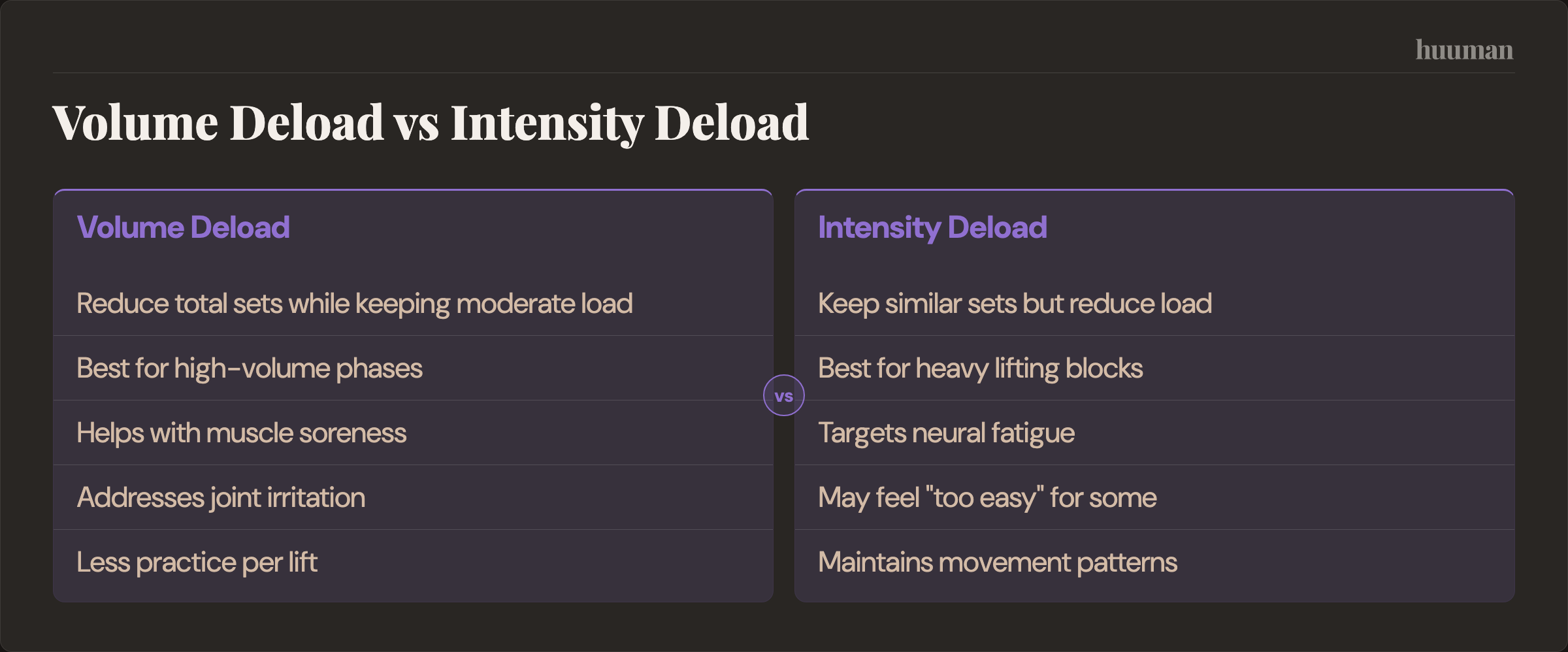
- Deload style: Volume deload - What you change: Reduce total sets while keeping moderate load - Best use case: High-volume phases, muscle soreness, joint irritation - Trade-off: Less practice per lift
- Deload style: Intensity deload - What you change: Keep similar sets but reduce load - Best use case: Heavy lifting blocks, neural fatigue - Trade-off: May feel "too easy" for some
- Deload style: Combined deload - What you change: Reduce both sets and load - Best use case: Significant fatigue, poor sleep, multiple warning signs - Trade-off: Largest drop in stimulus
- Deload style: Variation deload - What you change: Swap high-stress lifts for lower-stress versions - Best use case: Joint or tendon irritation, technical reset - Trade-off: Less specificity
- Deload style: Frequency deload - What you change: Train fewer days - Best use case: Busy weeks, life stress, travel - Trade-off: Lower weekly exposure
Coaching surveys of deload practices commonly describe modest reductions in total sets and load, often in the range of up to a quarter, while staying well shy of failure. The exact choice depends on which dial has been driving most of the fatigue.
Protocol cards you can use next week
Volume-First Deload
- Best for: soreness, joint irritation, high-volume phases
- Dials: reduce sets, keep moderate load, increase RIR
- Structure (3–4 days):
- Main lifts: 1–2 working sets instead of your usual volume
- Load: similar or slightly reduced
- Effort: stop at RPE 6–7
- Conditioning: easy aerobic work (comfortable pace, talk test passes), avoid hard intervals
- Readiness gates: look for improving sleep, dropping soreness, stable or improving performance at given RPE
- Notes: keep exercises familiar; avoid novelty
Intensity-First Deload
- Best for: heavy singles or doubles have been the focus
- Dials: reduce load, keep some volume, increase RIR
- Structure (3–5 days):
- Main lifts: same sets, lighter loads
- Effort: RPE 5–6
- Conditioning: if you include intervals, use RPE or pace rather than heart rate because HR lags on short efforts
- Readiness gates: sessions feel easier, bar speed snappier, motivation returns
- Notes: keep technique crisp; zero grinders
Technique or Variation Deload
- Best for: technical lifts, movement cleanup, cautious return after irritation
- Dials: change exercise selection, moderate reductions in load and volume
- Structure (3–4 days):
- Swap barbell lifts for variants with lower joint stress
- Pause or tempo work at lower loads, RPE 6–7
- Conditioning: mostly easy aerobic work; keep intensity low
- Readiness gates: improved movement quality, fewer symptoms, stable energy
- Notes: prioritize positions and control
HRV can be useful as part of the picture, especially as a 3 to 7 day trend alongside resting heart rate and sleep. HRV is a decision-support tool, not an oracle.
Minimal effective deload for busy weeks
If time is tight, you can run a two-session week:
- Keep 2–3 main movement patterns
- 2–3 sets per lift at RPE 6–7
- Skip accessories that add fatigue but little value
This approach often preserves rhythm without adding stress when work or travel is high.
What to do during a deload that actually helps
- Sleep: prioritize consistency in bedtime and duration
- Nutrition: maintain adequate intake rather than pushing aggressive deficits
- Low-intensity cardio: easy aerobic work can support recovery if it feels restorative
- Mobility: use it to address symptoms, not as punishment
- Footwear and comfort: small changes like cushioned options outside the gym can reduce cumulative load, similar to guidance in best recovery slides
Post-deload ramp: a simple one-week template
The week after a deload is where many people overshoot. The goal is to reintroduce stress, not spike it.
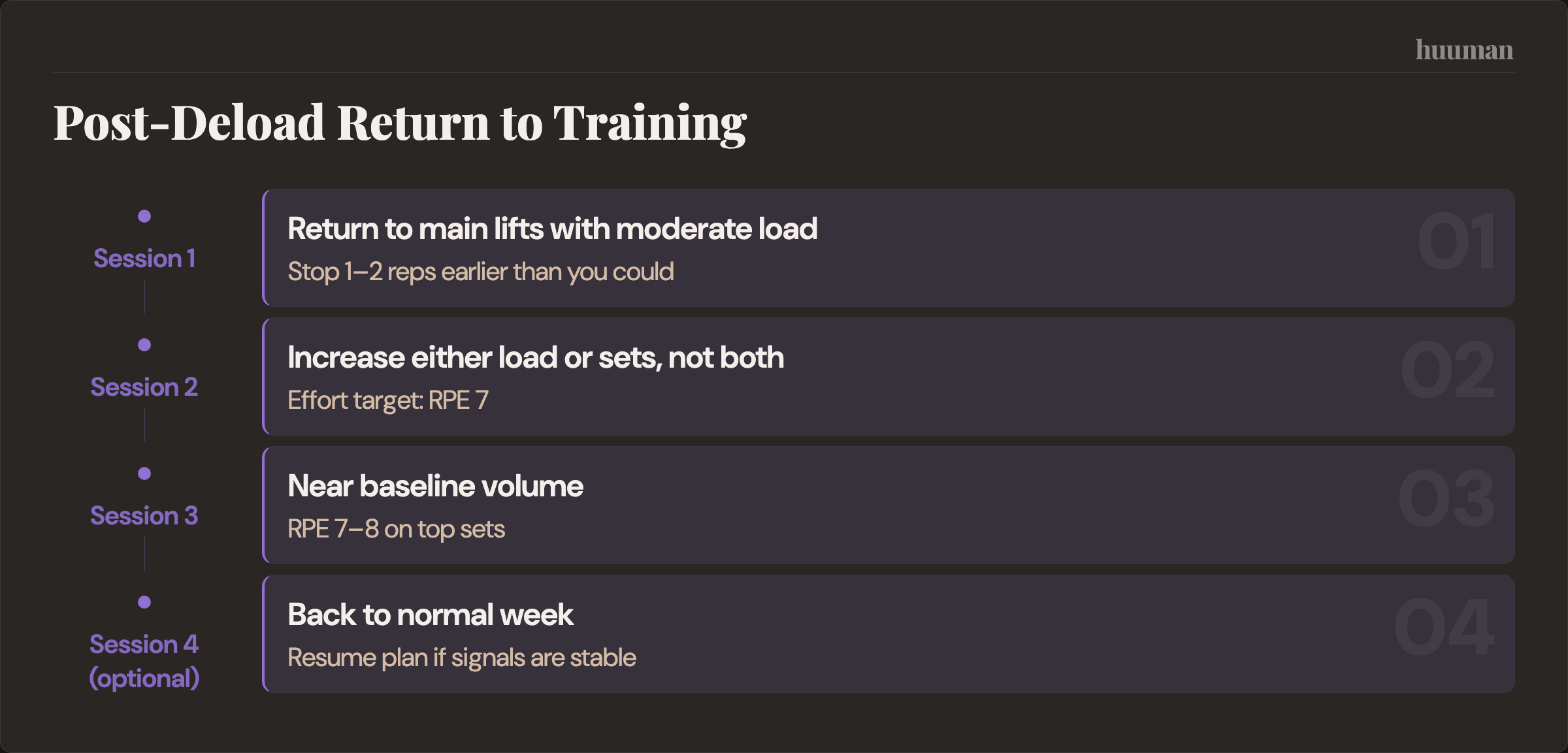
- Day: Session 1 - Plan: Return to main lifts with moderate load - Effort target: Stop 1–2 reps earlier than you could
- Day: Session 2 - Plan: Increase either load or sets, not both - Effort target: RPE 7
- Day: Session 3 - Plan: Near baseline volume - Effort target: RPE 7–8 on top sets
- Day: Session 4 (optional) - Plan: Back to normal week - Effort target: Resume plan if signals are stable
If performance and recovery markers are trending well, resume your normal program such as a muscle building protocol. If not, extend the ramp by a few sessions.
Evidence and limits
Research directly comparing specific deload formats is limited. Much of the guidance comes from coaching literature and periodization frameworks that manage fatigue across blocks. These consistently emphasize that performance depends on the balance between stress and recovery, not constant escalation.
General guidance aligns on several points. Deloads are typically short, around a week, and involve reducing volume, load, or both while maintaining movement patterns. A clinical explainer from Cleveland Clinic describes the same concept of a deliberate, temporary reduction in training load to allow recovery and maintain consistency Cleveland Clinic: The Benefits of Adding a 'Deload Week'.
Signals such as HRV and resting heart rate can support decisions, but interpretation is context dependent. Reviews on HRV in athletes emphasize trend-based interpretation rather than single-day changes, and caution against treating any one metric as definitive.
Overtraining syndrome is a separate medical condition with systemic symptoms and requires clinical evaluation. A standard deload is not a treatment for that, and most lifters are dealing instead with manageable, training-related fatigue.
How to track and interpret changes
Keep tracking simple. You want signals that move within a week.
- Top set at fixed RPE: same lift, same effort, note load and reps
- Session RPE: how hard the workout felt overall
- Soreness or joint pain: 0 to 10, look for trends
- Sleep: duration and subjective quality
- Resting HR and HRV: follow a 3 to 7 day trend
Success looks like easier sessions at the same loads, reduced soreness, and more stable sleep. If you want a structured way to combine these, use a simple sheet that maps your dials and signals.
Signal vs noise in deload weightlifting
- One bad workout does not equal accumulated fatigue. Check the trend over several sessions before changing the plan.
- "Heavy feels heavy" after a poor night of sleep can be transient. Repeat the session at the same RPE before deciding.
- HRV dips for a day are common. Look at a multi-day trend alongside resting HR.
- DOMS from new exercises is not the same as under-recovery. Reduce novelty during deloads.
- Life stress counts as training stress. Adjust volume or frequency during busy weeks.
- Pain that changes your technique is a stronger signal than general soreness. Switch to a variation deload.
- Feeling good on day three of a deload does not mean you should ramp early. Finish the planned week.
- Cutting calories while fatigued can amplify stress. Keep nutrition steady during the deload.
Common questions
What is deloading in weightlifting, in plain English?
A short, planned easy period where you reduce training stress so fatigue drops while keeping your lifting rhythm.
What is a deload workout supposed to feel like?
Comfortably challenging but clearly easier than your normal sessions. You should finish with energy left and no grinding reps.
How often should you deload if you train heavy?
There is no single schedule. Many programs include deloads after several hard weeks, while others trigger them based on performance and recovery signals. More advanced lifters often need them more frequently because they generate more stress per session.
How long should a deload phase last?
About a week is typical, often five to ten days in practice. Shorter if fatigue is mild, slightly longer if multiple signals are off.
Should I reduce weight or reduce sets during a deload?
Either can work. Choose based on what drove your fatigue. If volume has been high, cut sets. If loads have been very heavy, reduce intensity. Combined reductions are useful when you feel broadly run down.
Can I still train to failure during a deload?
Generally no. Keep a buffer of reps in reserve. The goal is to drop fatigue, not pile it on.
Will I lose strength or muscle during a deload week?
Short deloads are designed to preserve performance. Many lifters return feeling stronger because fatigue no longer masks their capacity.
Rather than guessing when to deload or which approach to take, let your huuman Coach build personalized weekly plans that automatically adjust training volume and intensity based on your sleep patterns, session feedback, and recovery signals.
More health topics to explore
- Sleep & Recovery – Overview
- Caffeine-Free Herbal Tea for Sleep: Ingredients, Safety, and What to Buy
- Sleep Duration at Age 3: Guidelines, Naps & a Practical Reality Check
- 4-7-8 Breathing: How to Do It, What It Does, How Often to Use It, and Safer Variations
References
- Cleveland Clinic — What Is a Deload Week and Do You Need One
- Aubert AE et al. — Heart rate variability in athletes (2003)
- Carrard J et al. — Diagnosing Overtraining Syndrome: A Scoping Review (2022)
- De Marco K et al. — Resistance Training Prescription During Planned Deloading Periods: A Survey o... (2024)
- Rogerson D et al. — Deloading Practices in Strength and Physique Sports: A Cross-sectional Survey (2024)
- Pritchard et al. — Higher- Versus Lower-Intensity Strength-Training Taper: Effects on Neuromuscular Performance (2019)