Deep sleep duration is one of the most watched metrics in sleep apps. No surprise: this phase is associated with physical recovery, memory processing, and a well-functioning immune system. Deeper context on how sleep shapes longevity sits in our sleep-and-longevity overview. At the same time, it varies a lot from night to night, changes with age, and is only indirectly estimated by most trackers.
If you want to know what's "normal" and how to interpret your numbers, you need more than a single percentage. This article gives you clear benchmarks in hours and percentages, explains sleep architecture, and shows you how to focus on trends instead of single-night values.
Key takeaways
1. Deep sleep share: typically 15–25% of total sleep time
2. Deep sleep duration: usually around 1–2 hours per night, depending on how long you sleep overall
You'll also learn which levers realistically influence deep sleep, and when a low value is more likely measurement noise than a real issue.
Putting Deep Sleep in Context
Deep sleep is one part of your overall sleep architecture, not the sole goal. Sleep consists of N1, N2, N3, and REM stages. N3 is deep sleep, often called slow-wave sleep. It occurs mostly in the first half of the night, while REM sleep becomes more dominant later.
From a recovery perspective, what matters is the combination of sufficient sleep duration, stable sleep cycles, and your overall load. More deep sleep alone doesn't automatically make you feel more rested. What counts is how you feel the next day and how consistent your sleep is over time. For a broader overview, see Sleep & Recovery Explained.
Quick Answer
For adults, roughly:
- Deep sleep share: about 15–25% of total sleep time
- Deep sleep duration: usually around 1–2 hours per night, depending on how long you sleep overall
Deep sleep isn't evenly distributed, it's concentrated in the first half of the night. It also declines on average with age. Important: trackers only estimate sleep stages indirectly. Trends over several weeks and how rested you feel matter more than a single night's data.
To see how your own deep sleep patterns evolve, sync your Apple Health sleep data with the huuman app for 14 nights and track the percentage trends alongside how rested you feel each morning.
What Is Deep Sleep, Exactly?
Deep sleep corresponds to the N3 stage of non-REM sleep. In this phase, brain activity slows significantly, muscles relax, and the body shifts into a state linked to tissue repair and memory consolidation.
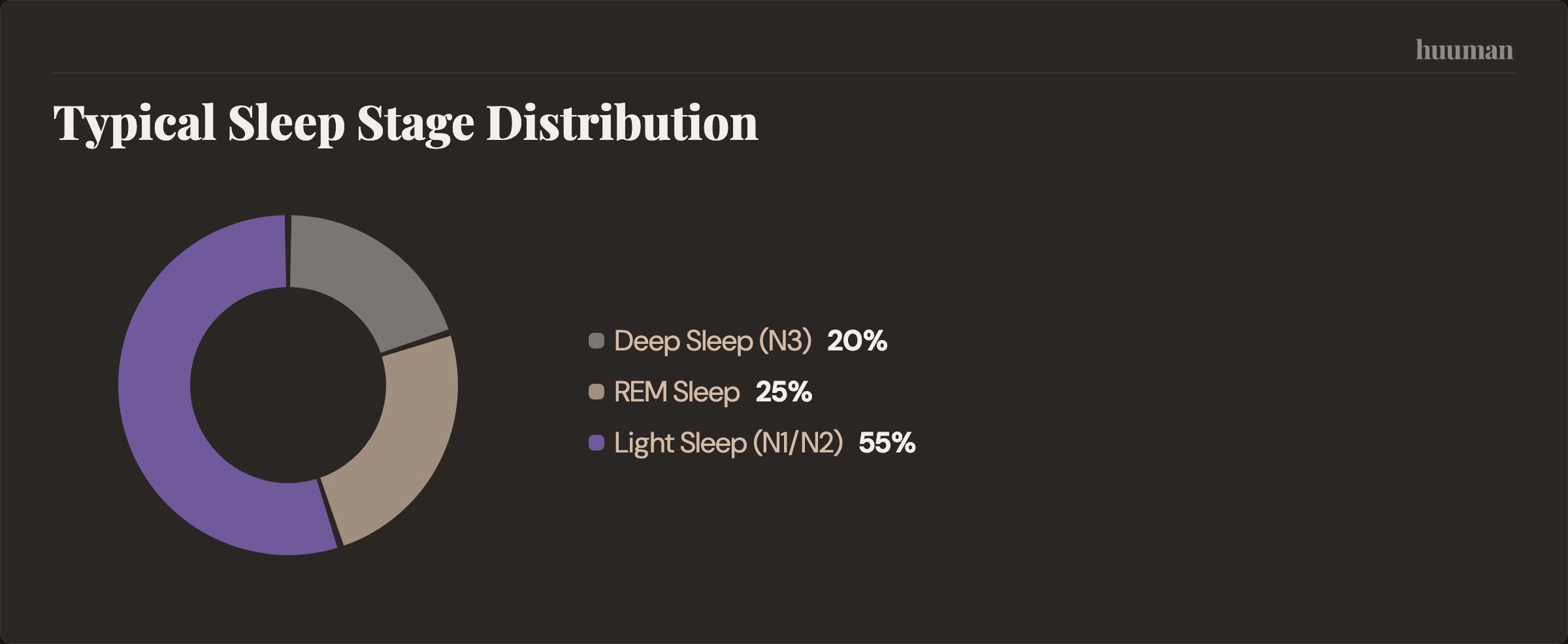
Unlike N1 and N2 (lighter sleep), deep sleep is harder to disrupt. REM sleep, on the other hand, is characterized by vivid dreaming and serves a different role in recovery.
You cycle through these stages multiple times per night, typically in cycles of 90 to 120 minutes.
Benchmarks: Deep Sleep Duration and Percentage
The most useful way to evaluate deep sleep is relative to your total sleep time. The table below shows typical ranges derived from the common 15–25% guideline.
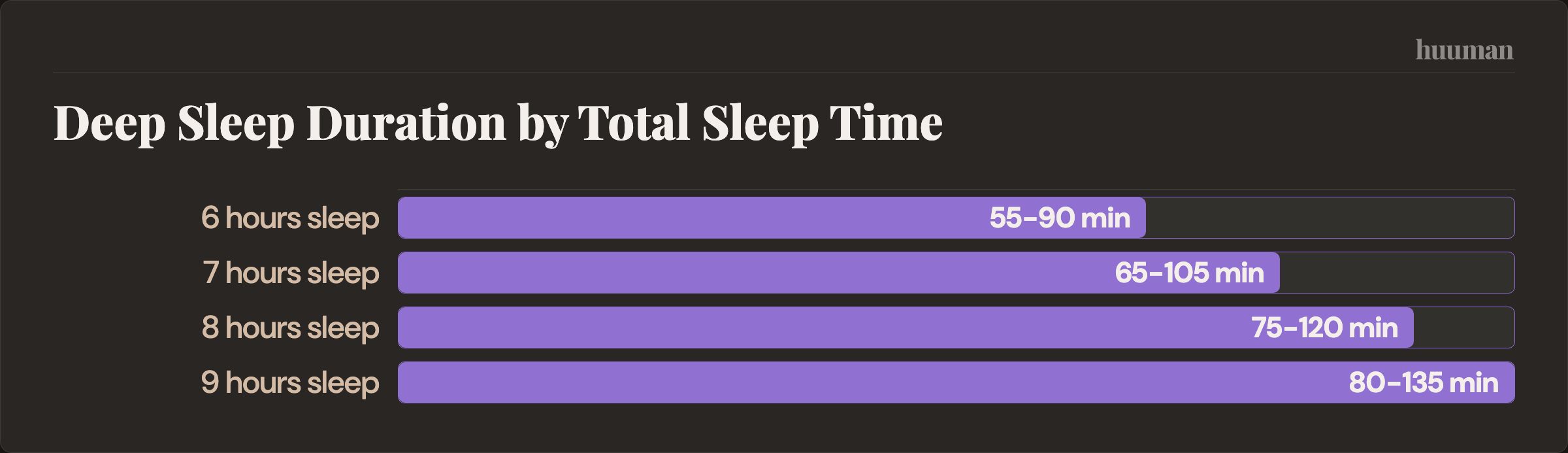
- Total Sleep Time: 6 hours - Deep Sleep (Minutes): typically 55–90 minutes - Deep Sleep (%): 15–25%
- Total Sleep Time: 7 hours - Deep Sleep (Minutes): typically 65–105 minutes - Deep Sleep (%): 15–25%
- Total Sleep Time: 8 hours - Deep Sleep (Minutes): typically 75–120 minutes - Deep Sleep (%): 15–25%
- Total Sleep Time: 9 hours - Deep Sleep (Minutes): typically 80–135 minutes - Deep Sleep (%): 15–25%
How to interpret this:
- These are population-based ranges, not target values.
- Individual variation is normal.
- One bad night means little – look at trends.
Deep Sleep and Age
As you get older, the proportion of deep sleep tends to decrease on average. This doesn't mean your sleep is "broken", your sleep architecture is simply changing.
- More light sleep (N2)
- More brief awakenings
- Sleep often feels lighter subjectively
What matters most is how you feel during the day. Lower deep sleep with age is rarely a problem on its own.
Why Deep Sleep Happens Mostly Early in the Night
The main driver of deep sleep is sleep pressure, the need for sleep that builds throughout the day. It's highest at the beginning of the night. That's why deep sleep is concentrated early, while REM sleep periods get longer later on.
Practical takeaway: if you go to bed late and wake up early, you may cut short the very part of the night richest in deep sleep.
Wearables & Apps: How Accurate Are Deep Sleep Metrics?
The clinical gold standard for measuring sleep is polysomnography. Wearables rely on movement and optical heart rate data, so they provide estimates, not precise measurements.
What to expect: useful trends over weeks, but not exact stage-by-stage accuracy.
Common misinterpretations:
- Overvaluing a single night
- Ignoring firmware updates or switching devices
- Mistaking alcohol, stress, or unusual activity for real physiological change
Treat your data like a dashboard: compare within the same device and over 2–4 weeks.
Evidence and Limits
The basics of sleep architecture, its stages and cycles, are well established. Deep sleep tends to be concentrated in the first half of the night and often declines with age.
What's less clear are hard cutoffs for when "too little deep sleep" is inherently a problem. Without symptoms like persistent fatigue or reduced performance, isolated deviations are often not meaningful.
The same applies to wearables: useful for trends, limited in precision when it comes to sleep stages.
Strategies That Often Help
If you want to improve deep sleep, it's usually not about hacks, it's about fundamentals:
- Sleep duration: More total sleep often naturally increases deep sleep.
- Consistency: A stable wake-up time supports sleep architecture.
- Alcohol: Can disrupt and fragment sleep.
- Caffeine timing: Late intake may reduce deep sleep.
- Environment: Cool, dark, and quiet supports stable cycles.
- Training: Very intense late workouts can disrupt sleep. An occasional deload phase can help if your load is high.
- Stress: A simple wind-down routine can ease the transition. Content like music for deeper sleep can also be supportive.
If you're in a high training phase, it may also help to review recovery after intense exertion or plan a structured deload week for better recovery.
How to Measure and Interpret Progress
A simple 14-day approach:
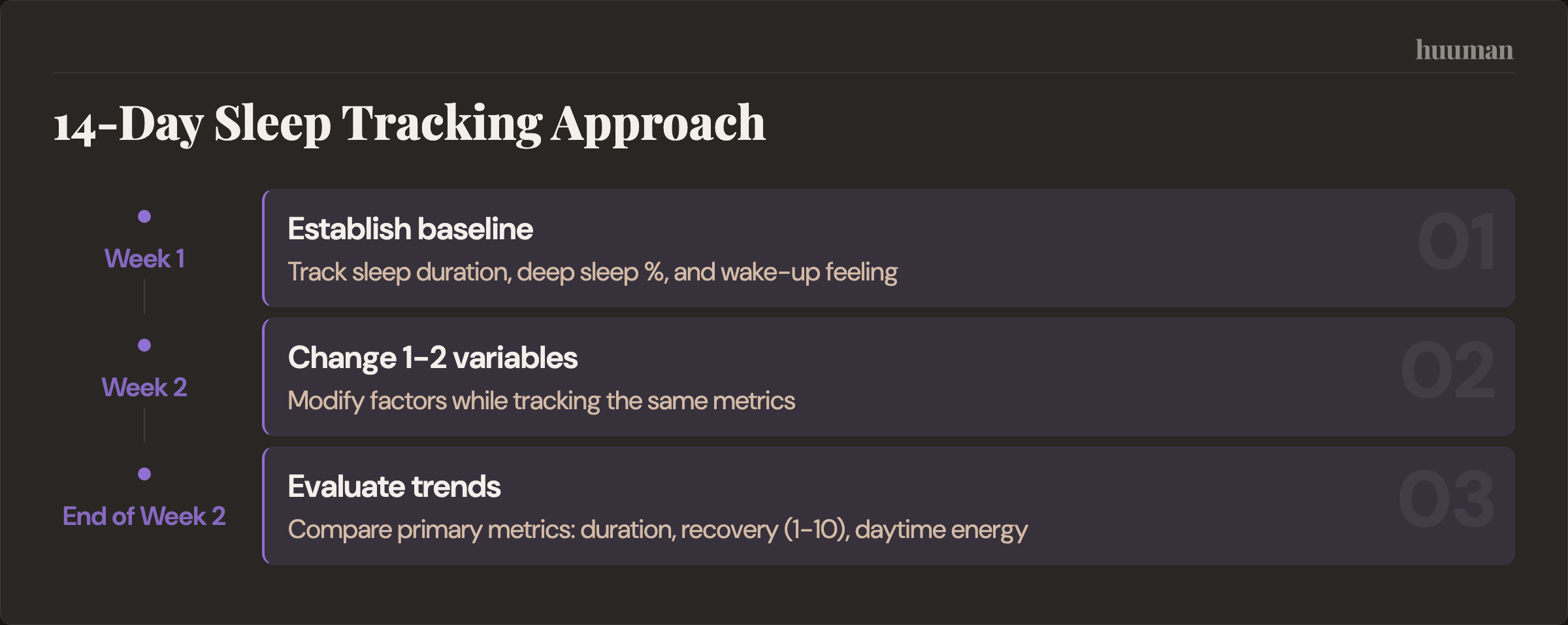
- Phase: Week 1 - Approach: Establish baseline: sleep duration, deep sleep, wake-up feeling
- Phase: Week 2 - Approach: Change 1–2 variables, track the same metrics
Key metrics:
- Primary: sleep duration, recovery (1–10), daytime energy
- Secondary: deep sleep % as a trend, wake time, sleep heart rate as a deep sleep indicator
- Optional: what good HRV values say about your sleep or HRV as a measure of sleep quality
Once you identify what influences your deep sleep trends, your huuman Coach can build personalized weekly plans that optimize sleep timing with training load to support both recovery and consistent sleep architecture.
Signal vs. Noise in Deep Sleep Data
- One night is noise; two weeks show a pattern – focus on trends, not outliers.
- More deep sleep can happen when catching up on sleep – check if you were previously sleep-deprived.
- Very high deep sleep isn't automatically better – pay attention to how you feel during the day.
- Alcohol can separate metrics from actual recovery – compare nights with and without.
- Late intense workouts can fragment sleep – test different timing.
- Sleep duration is often the biggest lever – try extending it slightly.
- Tracker updates change algorithms – compare data within the same system.
- Snoring plus fatigue matters more than any percentage – consider getting evaluated.
FAQ
How much deep sleep should you get?
On average, about 1–2 hours per night or 15–25% of total sleep. Context matters more than a fixed target.
How much deep sleep is normal with 7 or 8 hours of sleep?
Typically around 65–105 minutes for 7 hours, and 75–120 minutes for 8 hours. These are typical ranges, but individual variation is normal.
Is 30 minutes of deep sleep enough?
One night with low deep sleep can happen. If it's consistent and you don't feel rested, it's worth looking at sleep duration, stress, and habits.
Why do I get so little deep sleep according to my tracker?
Common reasons include measurement limitations, short sleep duration, stress, alcohol, or irregular schedules. Look at multi-week trends instead of single nights.
Can you have too much deep sleep?
A very high share may reflect recovery from sleep debt or measurement artifacts. More isn't automatically better.
More health topics to explore
- Sleep & Recovery – Overview
- Caffeine-Free Herbal Tea for Sleep: Ingredients, Safety, and What to Buy
- Sleep Duration at Age 3: Guidelines, Naps & a Practical Reality Check
- 4-7-8 Breathing: How to Do It, What It Does, How Often to Use It, and Safer Variations
References
- IQWiG — Was Ist Normaler Schlaf
- AOK — Was Sie ueber die Verschiedenen Schlafphasen Wissen Sollten
- Schyvens AM et al. — A performance validation of six commercial wrist-worn wearable sleep-tracking... (2025)
- Li J et al. — Sleep in Normal Aging (2018)
- Li J et al. — Sleep in Normal Aging (2022)
- Bes F et al. — The distribution of slow-wave sleep across the night: a comparison for infant... (1991)
- Danker-Hopfe H et al. — Referenzwerte zur Schlafarchitektur für Erwachsene (2020)
- de Gans CJ et al. — Sleep assessment using EEG-based wearables — A systematic review (2024)
- Chinoy ED et al. — Performance of seven consumer sleep-tracking devices compared with polysomnog... (2021)
- Lee T et al. — Accuracy of 11 Wearable, Nearable, and Airable Consumer Sleep Trackers: Prosp... (2023)
- Voss U — Functions of sleep architecture and the concept of protective fields (2004)
- Born J & Wagner U — Sleep, hormones, and memory (2009)
- Feriante J & Singh S — REM Rebound Effect (2026)
- Gardiner C et al. — The effect of alcohol on subsequent sleep in healthy adults: A systematic rev... (2025)
- Pauchon B et al. — Caffeine Intake Alters Recovery Sleep after Sleep Deprivation (2024)