Children's concentration naturally fluctuates. Some days homework takes 20 minutes; on others, every line feels like a struggle. This is rarely a "character issue." It's usually a mix of sleep, energy, environment, task load, and time of day.
Once you understand the main levers, you can quickly tell: is this a setup and timing issue, or a signal that needs closer attention? This guide turns the confusion into clear next steps.
Key takeaways
1. Sleep: enough and restful?
2. Food/hydration: has your child eaten and is water nearby?
3. Distractions: is it quiet, tidy, with no phone/TV in view?
You'll get a simple quick fix, a practical system, everyday adjustments you can use right away, and clear warning signs for when professional support makes sense.
How to frame the problem
Concentration isn't a single "muscle." It's built from several abilities: attention (staying with one thing), concentration (sustaining that attention over time), and executive functions like working memory, inhibition, and cognitive flexibility. Foundational factors also matter: sleep, regular food and hydration, stress level, and the environment.
Think in systems: child + task + environment + time of day. If one piece is off, concentration drops quickly. A calm setup and clear structure often work better than "more pressure." Research shows that parenting and family environment significantly impact children's development of executive function, attention, and self-regulation.
If you want to explore the mental side further, see this overview of mindset & stress and common patterns in mental overload.
Quick answer
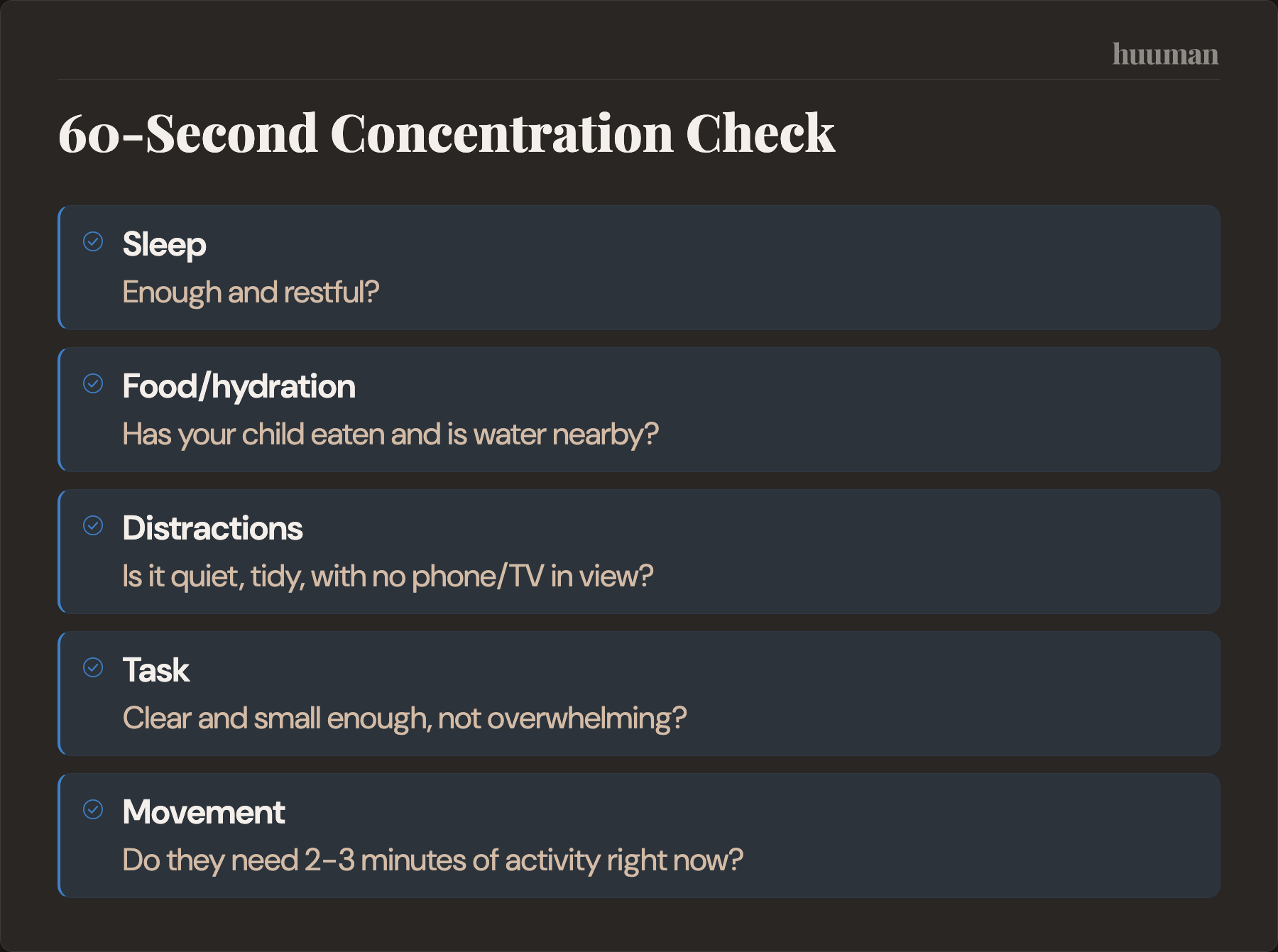
60‑second check:
- Sleep: enough and restful?
- Food/hydration: has your child eaten and is water nearby?
- Distractions: is it quiet, tidy, with no phone/TV in view?
- Task: clear and small enough, not overwhelming?
- Movement: do they need 2–3 minutes of activity right now?
3 fast levers:
- Reduce distractions: clear the desk, remove the phone, keep noise neutral or quiet.
- Break it down: start with a 5‑minute micro‑task and a visible checkmark.
- Move first: 2–3 minutes of stairs, jumping, or throwing a ball.
Start building better focus patterns by tracking sleep stages and bedtime consistency with the huuman app for the next week. You'll see how sleep quality directly impacts your child's concentration window.
What "concentration" really means in kids
Attention, concentration, and self-regulation work together. A child may be attentive but follow every distraction if inhibition is weaker. Or they understand the task but lose track because working memory is overloaded.
That's why performance varies with context. The same math task is much easier in the morning after good sleep and with clear structure than late in the day after school. That's normal, not contradictory.
A helpful distinction is "won't do" vs. "can't do." "Won't do" often shows up as avoidance of doable tasks. "Can't do" looks like getting genuinely stuck, many careless mistakes, or quick fatigue despite effort. The response differs: motivation and incentives vs. less complexity, more structure, and support.
Common everyday causes
Most triggers are changeable and often occur together:
- Lack of sleep: lower attention, more irritability.
- Irregular meals and low hydration: energy swings, more mistakes.
- Too much stimulation: noise, clutter, parallel media reduce focus.
- Lack of structure: unclear start/end, tasks too big.
- Too hard or too easy: frustration vs. boredom and restlessness.
- Not enough movement: strong urge to move during work.
- Stress, anxiety, conflict: attention turns inward.
Medical or developmental factors can also play a role, but they're not the only explanation. Differentials include ADHD, learning disorders, sleep issues, or vision/hearing problems. See this overview at overview of concentration problem causes.
Age matters: what's "normal"?
Concentration depends on development and context. Younger children sustain attention for shorter periods; it increases with age. It doesn't replace real-life observation.
As a broad range, elementary school children often manage a few minutes up to around 15 minutes at a time, with longer spans toward the end of primary school. These are estimates, not targets. Breaks are part of the plan, not a failure.
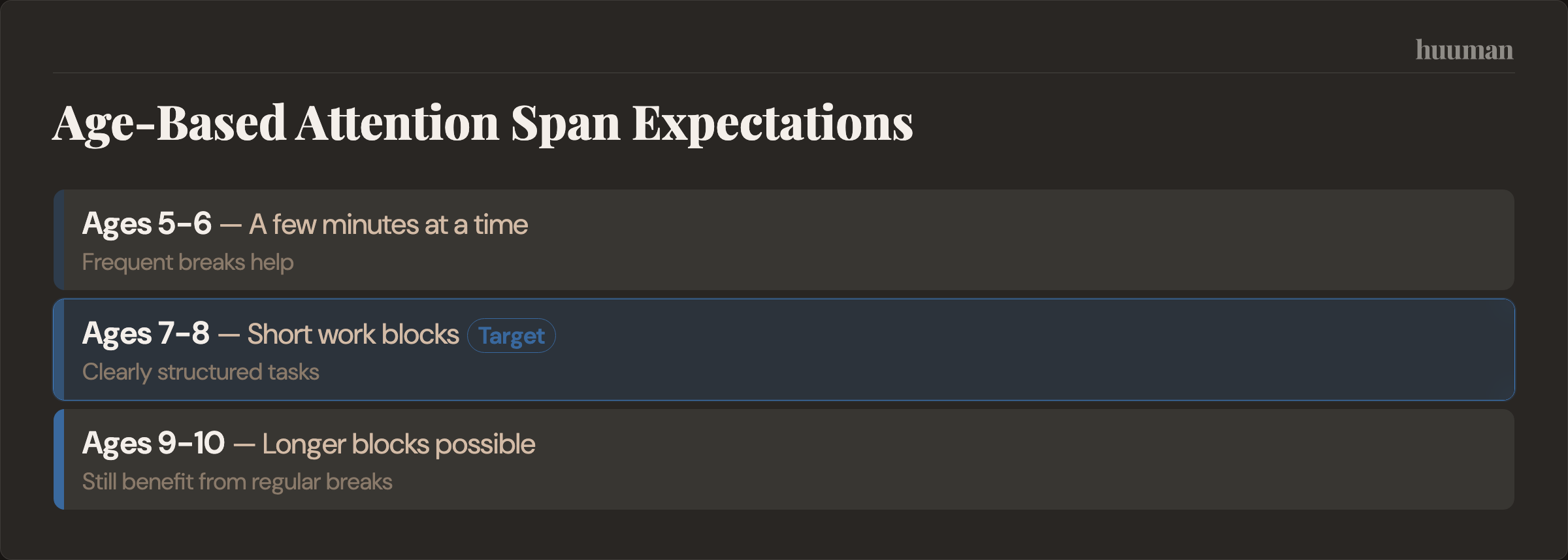
Quick reference (approximate, not normative)
- Ages 5–6: a few minutes at a time, frequent breaks help
- Ages 7–8: short work blocks, clearly structured tasks
- Ages 9–10: longer blocks possible, still benefit from regular breaks
Concentration as a system: finding the "window"
Between overload and underload lies the "working window." Go above it and you see frustration, tears, anger, or shutdown. Go below it and you get boredom, fidgeting, and drifting.
In practice: don't just adjust the child, adjust the task dose and the setup. Shorter blocks, a clear start, and a visible end often bring kids back into the window.
What the evidence says (and its limits)
Strong evidence links sleep, structure, movement, and fewer distractions with better attention and more on-task time. Guidelines generally recommend about 9–11 hours of sleep for school-aged children; irregular routines are often associated with concentration issues. Evening screen use can delay sleep onset and reduce sleep quality.
Physical exercise interventions can improve executive function in children. That's why a 2–3 minute activity reset often works better than a scrolling break.
Evidence is mixed, and often marketing-driven, for "brain training" apps and individual supplements. Some programs train specific skills, but gains don't automatically transfer to everyday functioning. Broad claims about sugar as the main cause are oversimplified.
Limitations: development, personality, and comorbidities all matter. If adjustments don't help after several weeks, or impairment is significant, seek professional guidance. Helpful school psychology resources include Düsseldorf School Psychology Center, concentration in children (PDF).
What you can do (not a magic fix, but often effective)
1) Improve the study setup in 5 minutes
- Study zone: only materials for the next task. Everything else away.
- Phone/TV: out of sight and reach.
- Visible timer: makes start and end clear.
- Sound: quiet or consistent. Optional ear protection or neutral noise.
- Light/seating: bright enough, stable posture, feet supported.
2) Task dose: make "too big" doable
- Micro-goals: 5‑minute steps, one clear first action.
- Checklist: make progress visible.
- Easy entry: start with a simpler subtask.
- Blocks: short work blocks with breaks (e.g., ~10–15 minutes work, then a short break as a practical baseline).
3) Breaks that actually help
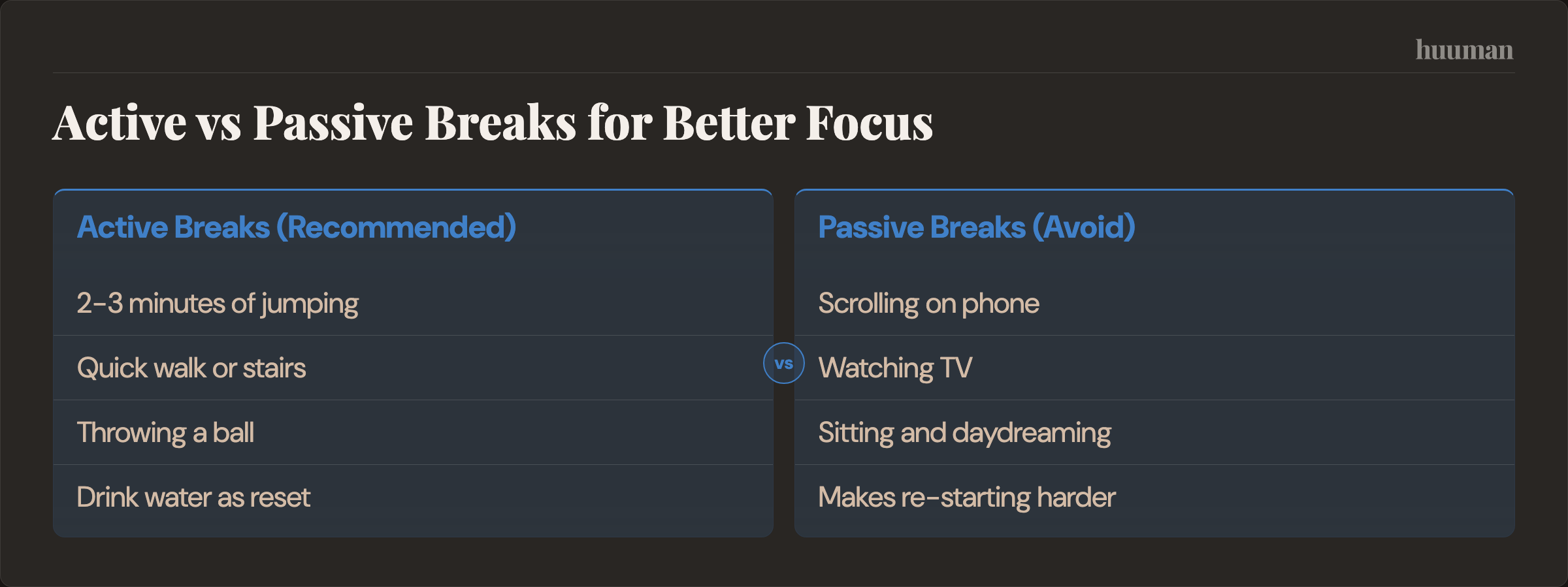
- Active, not passive: 2–3 minutes of jumping, stairs, ball, or a quick walk.
- Drink water as a reset.
- No scrolling during short breaks – it makes re-starting harder.
4) Communication and your role as a parent
- Co-regulation: name it, normalize it, and set the next small step ("This is a lot right now. Let's start the first task together.").
- Praise the process, not just results ("You stuck with it," not just "correct").
- Realistic expectations: plan based on age and the day; reduce pressure rather than increasing it.
5) Basics: sleep, food, hydration
- Sleep routine: consistent times, simple wind-down, less screen use before bed.
- Regular meals: predictable routines before study time.
- Water within reach.
- Caffeine/energy drinks: avoid for children. See also energy drinks and concentration.
6) 5-step reset (mini flow)
- Stop: briefly pause the task
- Check: sleep/food/hydration/environment
- Reset: 2–3 minutes of movement + water
- Split: define the next 5‑minute subtask
- Start: set the timer, mark it done visibly
One-page focus checklist (compact)
- Before starting: slept? eaten/drunk? materials ready?
- Setup: clear desk, phone away, timer visible
- Plan: 1 micro-goal (5–10 minutes)
- Breaks: schedule a short active break
- Review: what helped? set the next micro-goal
Measuring progress
A 14-day view tells you more than single days. Track a few clear markers and compare week 1 vs. week 2.
- Inputs: sleep (duration/quality), breakfast/hydration, screen use before homework, start time.
- Outputs: on-task minutes, start resistance (0–10), interruptions, total duration.
- Context: subject/difficulty, mood, notable events.
14-day focus tracker (template)
- Day | Sleep (h/quality) | Breakfast (yes/no) | Water (glasses) | Screen before (yes/no)
- Start resistance (0–10) | On-task minutes | Interruptions (#) | Duration (min)
- What helped today? | What will I change tomorrow?
If you're noticing patterns but want structured support beyond environmental changes, your huuman Coach can develop personalized weekly plans that balance activity and recovery to support your child's developing attention system.
Signal vs. noise in children's concentration
- Signal: Consistent routines beat one-off fixes. Next step: test the same start time and checklist on 4 days.
- Signal: Fewer pre-task distractions work better than more pressure. Next step: stick to a strict 5‑minute setup.
- Signal: Short movement breaks improve restarts. Next step: make every break active.
- Signal: Small, clear tasks reduce overload. Next step: split every task into 5‑minute steps.
- Noise: "Sugar is always the problem." Next step: optimize sleep, structure, and environment first.
- Noise: "One supplement will fix it." Next step: prioritize basics; discuss decisions with professionals. See also concentration pills explained.
- Noise: "More hours sitting = better performance." Next step: test shorter blocks plus breaks.
- Noise: "Apps replace fundamentals." Next step: stabilize setup, sleep, and task dose first.
When to seek help (warning signs)
Seek medical or school psychological support if any of the following persist for weeks or worsen noticeably:
- Sudden, sustained drop in performance
- Marked fatigue or exhaustion
- Significant mood dips, anxiety, withdrawal
- Signs of bullying or major social conflict
- Ongoing sleep problems
- Recurring headaches, vision or hearing issues
- Pronounced hyperactivity/impulsivity with clear impairment
Depending on the situation, your pediatrician, child and adolescent psychiatry, or school psychology services are good starting points. A thorough assessment can distinguish between ADHD, learning disorders, stress-related issues, and physical causes.
Frequently asked questions
How long can children concentrate at different ages?
It varies widely with age and context. Elementary school children often manage a few minutes up to around 15 minutes at a time, with longer spans toward the end of primary school. These are rough estimates, not targets. Context matters: time of day, difficulty, and environment.
What if my child can't focus on homework at all?
Start with the 60‑second check, reduce distractions, split the task into a 5‑minute micro-goal, and add 2–3 minutes of movement before starting. A clear start (timer) often works better than long discussions. If the pattern persists, track for 14 days and review together with the school.
Which games or exercises help concentration?
Games that train inhibition and working memory can help, but transfer to everyday life is limited. Bigger levers are stable routines, clear task structure, and breaks. For short calm periods, a simple body scan can help if your child responds to it.
Do sleep and hydration affect concentration?
Yes. Both are commonly associated with distractibility and errors. Guidelines generally suggest around 9–11 hours of sleep for school-aged children, along with adequate fluid intake throughout the day.
Is screen time a cause?
It can be a factor, especially right before study time or in the evening. Screens can increase arousal and delay sleep onset. Timing and overall routine matter more than total duration alone.
What about ADHD?
ADHD can be one cause, but it doesn't explain every concentration difficulty. An evaluation makes sense if impairment is strong, persistent, and present across multiple settings. First check modifiable factors like sleep, structure, and environment. Recent meta-analyses show significant variability in ADHD prevalence estimates, emphasizing the importance of thorough evaluation before assuming ADHD as the cause.
What if my child is either fidgety or easily frustrated?
Fidgeting often points to underload or a need to move; frustration points to overload. Adjust the dose: shorter blocks, clearer steps, appropriate difficulty, and regular active breaks.
More health topics to explore
- Mindset, Stress & Mental Health – Overview
- Sunday Night Blues: Causes, Quick Relief, and a 10-Minute Sunday Reset Plan
- Reading Focus Cards: What They Are, Who They Help, and How to Choose
- How to Improve Concentration: What Helps Right Away
References
- Apotheken Umschau — Konzentration: Wie lange sollten Kinder still sitzen können?
- Stadt Düsseldorf — 40 Konzentration von Kindern ZFS Web Bf
- Kinderärzte im Netz — Ursachen » Konzentrationsstörungen » Kinderkrankheiten, Kinder- und Jugendgesundheit » Startseite » Kinderaerzte-im-Netz
- Zhu F et al. — Comparative effectiveness of various physical exercise interventions on execu... (2023)
- Frey et al. — Blue blocker glasses as a countermeasure for alerting effects of evening light-emitting diode screen exposure in male teenagers. (2015)
- Hirshkowitz M et al. — National Sleep Foundation's updated sleep duration recommendations: final report (2015)
- Daly-Smith AJ et al. — Systematic review of acute physically active learning and classroom movement ... (2018)
- Masini A et al. — Evaluation of school-based interventions of active breaks in primary schools:... (2020)
- Hjetland GJ et al. — The Association Between Self-Reported Screen Time, Social Media Addiction, an... (2021)
- Ruhland S & Lange KW — Effect of classroom-based physical activity interventions on attention and on... (2021)
- Bourke M et al. — Within-Person Association Between Daily Screen Use and Sleep in Youth: A Syst... (2026)