Cellulite strength training can improve the appearance of cellulite for many people, especially around the thighs, glutes, and hips. The key idea is simple: cellulite is structural, not a character flaw or a sign that you are doing something wrong. Training changes the tissue underneath the skin and may improve how that area looks, but it does not erase cellulite for everyone.
Key takeaways
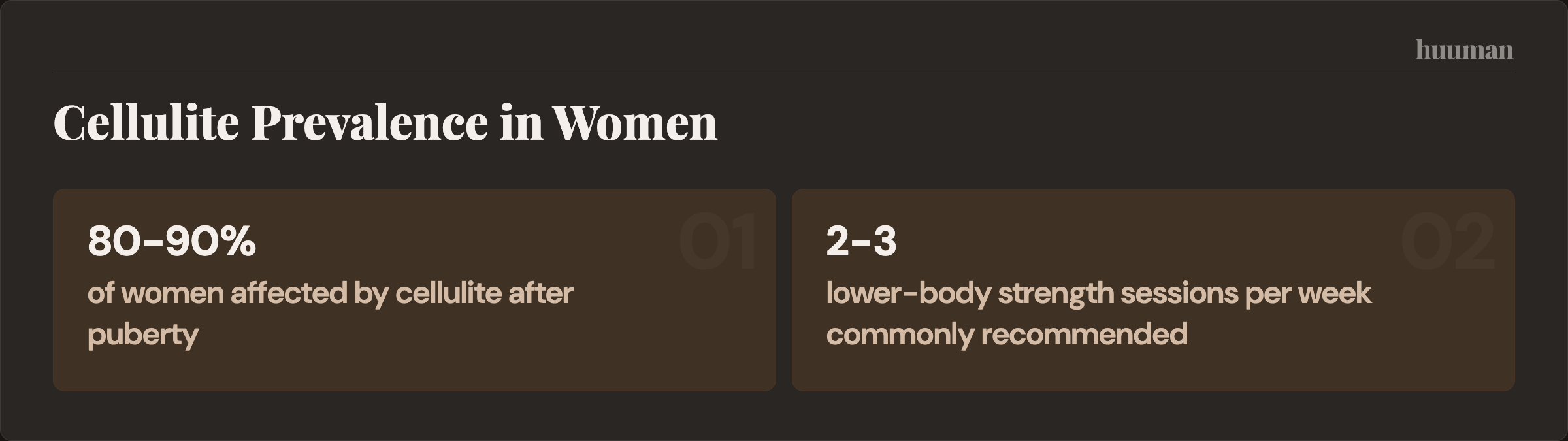
1. What to do weekly: A commonly used approach is 2 to 3 lower-body focused strength sessions per week. Many people also add daily walking or other light cardio if appropriate.
2. What exercises matter most: Prioritize squat, hinge, lunge, step-up, hip thrust or glute bridge, hip abduction, and calf work. The target is glutes, hamstrings, and quads, not endless random burn sessions.
3. What to expect: Many people need at least one full training block to judge the effect. Visible changes often emerge over 8 to 12 weeks, but results depend on baseline muscle, body composition, skin structure, and genetics.
If you want a realistic plan, focus on lower-body strength work, progressive overload, daily movement, and consistent tracking. The useful question is not "Can I make cellulite disappear?" It is "Can I improve muscle support, body composition if desired, and tissue quality enough to change what I see over the next 8 to 12 weeks?" For many people, the answer is yes. The size of that change depends on baseline muscle, body fat, skin structure, genetics, hormones, recovery, and how objectively you measure progress.
This guide gives you a 12-week structure, home and gym exercise menus, a progression model, and a simple tracking system that filters out common noise like flattering lighting, hydration swings, and random soreness. It also covers when strength training is useful, when expectations need to stay modest, and when skin changes should be checked by a clinician.
Where cellulite strength training fits in a bigger health picture
The reason cellulite strength training is worth discussing is that it sits at the intersection of performance, body composition, connective tissue support, and expectation management. A stronger lower body often improves more than appearance. It can improve load tolerance, movement quality, confidence in training, and long-term physical capability. That matters if your goal is to stay fit, confident, and capable in every phase of life.
Cellulite itself has a recognizable dimpled or "orange peel" appearance. It reflects how subcutaneous fat, the dermis, and fibrous septae interact at the skin surface. A review of cellulite pathophysiology describes those anatomical components as the main structures involved, not a simple problem of "too much fat" alone key anatomical components involved. That is why crash dieting, random "toning" circuits, or creams often disappoint.
Cellulite is also common. Population data suggest it affects 80-90% of post-pubertal women. Common sites are the thighs, glutes, and hips, which conveniently are also the areas where lower-body strength training can most clearly change muscle shape and support.
If you want the broader context for how lower-body work fits into physical resilience, the Strength & Mobility overview is a useful starting point.
Quick answer
Yes, cellulite strength training can often make cellulite look less visible, mainly by building muscle under the skin and improving tissue support. It does not guarantee a smooth surface, because connective tissue structure, skin thickness, hormones, and genetics still matter.
- What exercises matter most: Prioritize squat, hinge, lunge, step-up, hip thrust or glute bridge, hip abduction, and calf work. The target is glutes, hamstrings, and quads, not endless random burn sessions.
- What to expect: Many people need at least one full training block to judge the effect. In practice, visible changes often line up with typical adaptation windows of roughly 8 to 12 weeks, but results are highly baseline-dependent and not guaranteed.
- When to get checked: Pain, sudden swelling, warmth, redness, one-sided leg changes, or a rapidly changing hard area may signal vascular conditions that need medical evaluation. These are not normal "cellulite fluctuations."
If you want to make this measurable from day one, log baseline photos, walks, and strength sessions in the huuman app so you can compare real trends instead of guessing from memory.
What cellulite is, and what training can actually change
Cellulite is not the same as being out of shape, overweight, or untrained. It is a surface appearance created by the interaction of fat under the skin, the skin itself, and the fibrous bands that tether tissue. That is why very lean people can have cellulite and why some people with higher body fat have less visible dimpling in certain areas.
Women tend to notice it more often, likely because of differences in tissue architecture, fat distribution, and hormonal environment. The useful implication is not "your hormones are the problem." It is that your baseline anatomy influences how much visual change strength training can produce.
Training does not selectively remove fat from one small area. Training does not reliably remove fat from one small area in response to exercises that target that area. So if someone claims you can spot reduce thigh cellulite with one special move, that is the wrong model.
What training can do is alter the layer beneath the skin. More muscle in the glutes, hamstrings, and quads may change contour and support. If body composition changes at the same time, that may further alter appearance. Some people also notice short-term changes from fluid shifts, inflammation, and recovery status, which is one reason appearance can vary from week to week.
How strength training may improve cellulite appearance
The highest-leverage mechanism is hypertrophy. More muscle can create a firmer-looking base under the skin, particularly in the glutes and upper thighs. Building more muscle in the glutes, hamstrings, and quads is the most reliable training lever for changing what sits under the skin, which is what practical lower-body work can most directly influence.
A second lever is body composition. If someone wants fat loss and achieves it without sacrificing muscle, cellulite appearance may improve, stay the same, or in some cases become more noticeable depending on skin quality and tissue structure. This is why body-fat change is a secondary lever, not a guaranteed fix.
A third lever is skin and connective tissue quality. Evidence here is more limited and should not be overstated, but it is worth noting. A randomized trial in sedentary middle-aged women found that 16 weeks of resistance training improved skin structure and enhanced dermal extracellular matrices improved skin structure. That does not mean lifting "tightens skin" in a predictable cosmetic way for everyone. It does suggest that resistance training may influence tissue quality through more than muscle gain alone.
Circulation and fluid handling may also matter at the margin. Daily walking, light cycling, or incline walking can support general movement, energy balance, and reduced stiffness. The mistake is treating this as "flushing toxins" or some guaranteed lymphatic fix. It is better viewed as useful background support that should not interfere with recovery from your main lower-body work.
What matters most in the program
The best cellulite strength training plan is not the one with the fanciest exercise list. It is the one that creates enough tension to build muscle, repeats the main movement patterns consistently, and is still recoverable.

Progressive overload
Progressive overload means gradually asking your muscles to do more over time. That can mean more load, more reps with the same load, cleaner reps through a fuller range of motion, more sets, or better control. If week 1 and week 8 look identical in effort and output, the stimulus usually will too.
For intensity, many programs use a rating of perceived effort scale from 0 to 10. In practice, most hypertrophy-focused work sits in a hard-but-repeatable range, often around 7 to 9 out of 10 effort. That means the set feels challenging, but technique still holds.
Movement patterns over exercise novelty
The key patterns are squat, hinge, lunge, step-up, hip thrust or glute bridge, hip abduction, and calf work. You do not need all of them in every session, but your week should cover them in some mix. This builds the muscles that have the biggest visual influence on the areas where cellulite is usually most visible.
Range of motion and control
Research suggests that training through a full range of motion can produce greater muscle size gains than shorter-range work full range of motion produces superior muscle size gains. For this topic, that matters because if muscle gain is the main training lever, your exercise quality matters. Controlled eccentrics, stable positioning, and enough depth to challenge the target tissues usually beat rushed partial reps.
Consistency beats punishment
Many people overdo volume or cardio when they want a cosmetic change quickly. That can backfire by increasing fatigue, reducing lower-body performance, and making recovery less reliable. Better to train hard enough, recover well, and repeat for 12 weeks. If you need support with home sessions, building muscle at home and these dumbbell exercises for cellulite reduction can help you choose practical substitutions.
12-week weekly plan and exercise menus
The plan below is non-prescriptive. Think of it as a commonly used structure, not a rule. Pick the tier you can repeat consistently.
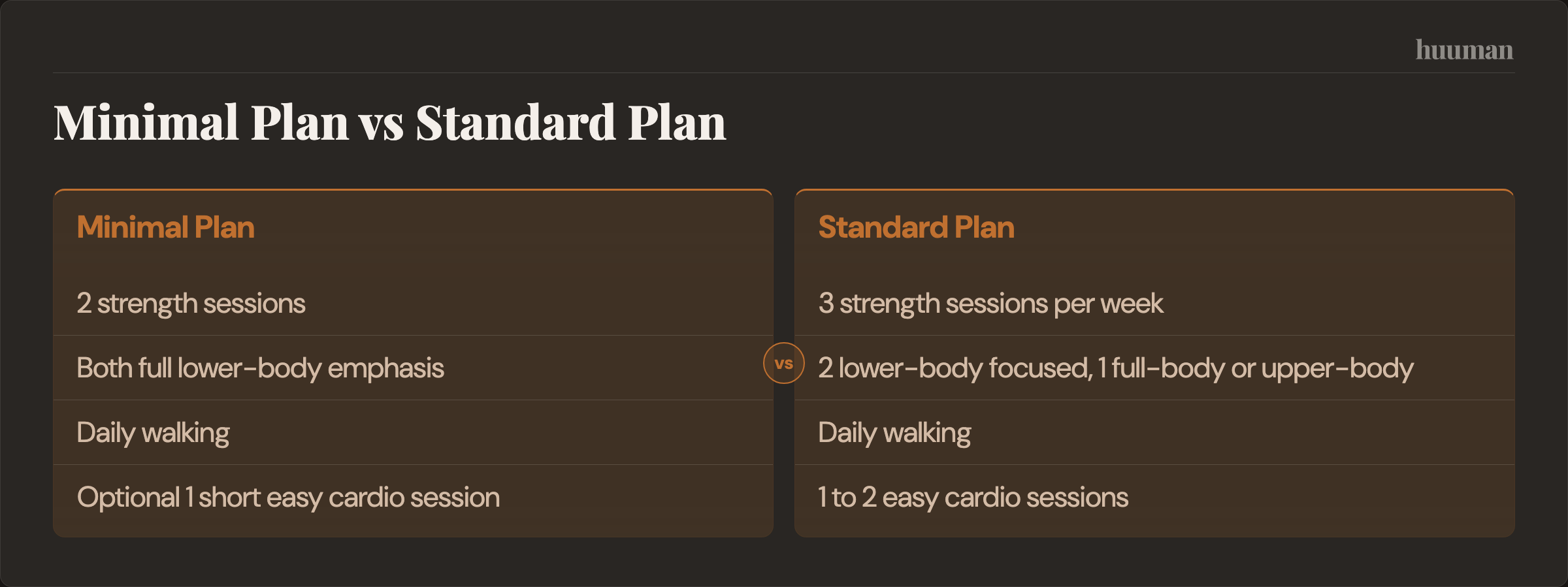
Weekly plan table
- Minimal: 2 strength sessions, both full lower-body emphasis; daily walking; optional 1 short easy cardio session.
- Standard: 3 strength sessions per week, with 2 lower-body focused and 1 full-body or upper-body support day; daily walking; 1 to 2 easy cardio sessions.
- Advanced: 4 strength sessions per week, including 2 lower-body focused sessions, 1 mixed full-body day, and 1 accessory or upper day; daily walking; 2 easy cardio sessions. This only makes sense if recovery is good.
Home exercise menu
- Goblet squat or split squat
- Romanian deadlift with dumbbells or bands
- Hip thrust, glute bridge, or feet-elevated bridge
- Step-up or reverse lunge
- Banded hip abduction or side-lying abduction
- Single-leg calf raise
Gym exercise menu
- Back squat, front squat, hack squat, or leg press
- Romanian deadlift, deadlift variation, or machine hinge pattern
- Barbell hip thrust, Smith hip thrust, or glute drive machine
- Walking lunge, split squat, or step-up
- Cable or machine hip abduction
- Seated or standing calf raise
Sample session structure
Lower A: squat pattern, hip thrust pattern, split squat, abduction, calf work.
Lower B: hinge pattern, step-up or lunge, glute bridge pattern, abduction, calf work.
Optional third day: full-body support with one lower-body main lift and simpler accessories. If you already have an upper-body split, keep it. There is no need to abandon broader training just to chase a cosmetic outcome. If you want that broader balance, articles on a solid chest day routine and strength training for older adults show how lower-body priorities can still fit into a long-term plan.
12-week progression table
- Weeks 1 to 4: Learn the movements, establish baseline loads, stop most sets with a little room left, and standardize technique. Most exercises live in moderate rep ranges with effort around 7 to 8 out of 10.
- Weeks 5 to 8: Progress either load or reps on the main lower-body lifts. Add a set only if recovery stays good. Most work is challenging but controlled, often around 8 out of 10 effort.
- Weeks 9 to 12: Keep the main lifts hard and stable, avoid random exercise hopping, and push select accessory work closer to a 9 out of 10 effort if form remains solid. If fatigue rises, reduce volume before reducing consistency.
If progress stalls, a lighter week can help restore performance. These guides on deload weeks to support muscle toning, planning a recovery week, and deloading in a weightlifting routine explain how to pull back without losing momentum.
Cardio, recovery, and readiness
Cardio can help, but mainly as support. Walking, incline walking, cycling, and other easy aerobic work can improve activity levels and may support fluid dynamics and body composition. They are not direct cellulite treatments. If your lower-body sessions are the priority, cardio should usually leave your legs feeling better, not cooked.
A practical structure is daily walking plus a small amount of easy cardio during the week if appropriate. Zone 2 is often described as a conversational pace, which is useful because it avoids false precision and keeps recovery intact. Rowing can work too, though it may add more fatigue than walking or cycling for some people. If you like that option, rowing for full-body toning is worth reading.
HIIT is optional, not required. Most people do not need frequent intervals for cellulite appearance goals, and some recover worse when they add them on top of hard lower-body lifting. If you include HIIT, keep it conservative and let performance determine whether it stays.
Recovery is not cosmetic fluff. Muscle gain and performance improvements require enough sleep, adequate nutrition, and load management. Protein adequacy matters for muscle retention and growth, but this article stays broad because individual needs vary. Menstrual cycle phases can also affect water retention, performance, and subjective texture, so cycle-aware tracking can improve interpretation. Soreness alone is not a sign the plan is working.
If you train frequently but struggle to recover, methods like Greasing the Groove for consistent strength can help you think more clearly about frequency versus fatigue. If illness interrupts training, maintaining muscle during illness is a better frame than trying to force progress.
Evidence and limits
The evidence base supports a careful claim, not a miracle claim. Clinical and review literature supports the idea that cellulite is structural and that exercise may improve its appearance, especially through changes in muscle mass and tissue support.
The strongest evidence in this area is indirect rather than "cellulite-specific training protocol" evidence. We have decent evidence on cellulite structure, decent evidence on hypertrophy principles, evidence against spot reduction, and some evidence that resistance training affects skin-related tissue characteristics. We do not have a precise universal protocol that guarantees visible cellulite reduction in a fixed timeline.
That matters for expectations. An 8 to 12 week window is reasonable as a practical checkpoint because that is often long enough to detect training adaptation and meaningful performance change. But it is still just a checkpoint. Some people will notice better shape, firmness, or less visible dimpling in that time. Others may need longer, especially if they start with lower muscle mass, inconsistent training, poor recovery, or highly variable photo conditions.
Results also vary because of factors training cannot fully control: genetics, skin thickness, connective tissue architecture, age, hormonal milieu, baseline muscle, body fat distribution, edema, and how standardized your comparisons are. If one week's "before and after" is based on different lighting, camera angle, hydration, and menstrual cycle timing, you may be measuring noise rather than change.
Non-prescriptive strategies to discuss with a professional
Strategy A: Lower-body strength first
If your main goal is cellulite appearance, a lower-body priority usually makes the most sense. Choose 4 to 6 movements built around squat or lunge, hinge, hip thrust or bridge, step-up, abduction, and calf work. This gives enough coverage without turning the week into a random high-volume circuit.
Strategy B: If heavy loading is not a good fit right now
You can still make sessions productive with lighter dumbbells, bands, machines, unilateral work, slower tempo, pauses, and longer sets. Machines and cables are especially useful when joint comfort or balance is a limiter. If technique is the bottleneck, a qualified trainer can help you find stable exercise versions before load becomes the focus. For readers focused on home options, this can overlap well with building muscle faster with targeted training when exercise selection is appropriate.
Strategy C: Cardio that supports, not steals
If recovery is limited, choose incline walking, easy cycling, or steady walking before adding intense intervals. Daily movement usually gives more reliable support than trying to out-HIIT a recovery problem.
Technique and medical considerations
Knee, hip, or back discomfort often improves when exercise selection, range of motion, and loading are adjusted, but persistent pain should be assessed. Postpartum readers may want to pay attention to pelvic floor symptoms during loaded lower-body work. Swelling disorders, vascular symptoms, or suspected lymphedema are also reasons to get individualized advice rather than treating the issue as ordinary cellulite.
How to track and interpret changes
Tracking determines whether your plan is working. Without it, cellulite strength training becomes a mood-based project influenced by social media, mirror angles, and water retention.
1. Standardized photos
Use the same lighting, distance, camera height, pose, clothing, and time of day. If menstrual cycle changes affect appearance for you, try to compare the same point in the cycle each time. Front, side, and rear views are usually enough. Weekly is often better than daily because it reduces noise.
2. Tape measures
Track hips and one consistent thigh location. The value is not perfect precision. The value is repeating the same method. If size is stable while photos and performance improve, that can still mean the plan is working.
3. Performance markers
Write down loads, reps, depth, and control on your main lifts. If your split squat is deeper and steadier, your hip thrust is stronger, and your step-up is cleaner, the lower-body tissue is adapting even if the mirror is slow to catch up.
Photo tracking checklist and "what changed?" scorecard
- Checklist: same room, same light source, same stance, same underwear or shorts, same camera distance, same day of week, similar hydration and meal timing, and if relevant the same phase of your cycle.
- Scorecard: rate visual texture, firmness, glute shape, thigh contour, and confidence in the comparison quality on a simple low-to-high scale in your log.
- Example entry: Week 6, rear and side photos standardized, hip thrust up, split squat more stable, thigh texture slightly less visible, contour improved, confidence in comparison high.
If you want a simpler way to connect those observations to action, your huuman Coach can interpret trends from sleep, sessions, and check-ins over time so you can adjust training without overreacting to one off-looking week.
Signal vs noise in cellulite strength training
- "I did thigh exercises, so that fat should come off there." Local training does not equal local fat loss. Keep training the area, but judge progress through performance and photos across a full block.
- "I was sore for three days, so the workout must have worked." Soreness reflects novelty and tissue stress more than quality progression. Track load, reps, and technique next session instead.
- "The band burn means I am toning the exact cellulite spot." A burn is not the same as overload. If the movement never progresses, increase tension, range, or stability demands.
- "My before and after pictures prove nothing changed." Different lighting, angles, and posture can completely alter skin texture. Recreate the same setup before interpreting the result.
- "I need HIIT to speed this up." More intensity is not always better. If intervals reduce lower-body strength quality or sleep, remove them for two weeks and reassess.
- "I should keep changing exercises to shock the muscles." Random variation often kills progression. Keep the main lifts stable long enough to improve them measurably.
- "Cellulite looked worse this morning, so the plan is failing." Day-to-day texture can shift with hydration, inflammation, sodium, stress, and cycle phase. Compare weekly trends, not one mirror check.
- "If muscle helps, I should train hard every day." Adaptation requires recovery. If performance drops for multiple sessions, consider less volume or a lighter week.
- "A cream or massage should replace the slow work of training." Surface-level strategies may change how skin looks temporarily, but they do not replace progressive lower-body training. Keep the main lever the main lever.
Common questions
Will strength training reduce cellulite?
It may reduce the appearance of cellulite for many people, especially by increasing muscle mass under the skin and improving lower-body shape. It is less accurate to say it removes cellulite. Structural factors remain.
What is the best strength training for cellulite on thighs?
The most useful approach usually centers on lower-body patterns that train quads, glutes, and hamstrings well: squats, split squats, hinges, step-ups, hip thrusts or glute bridges, and some hip abduction work. The best plan is the one you can progress for 12 weeks.
Can building glutes make cellulite less visible?
Often, yes. More glute muscle can change contour and tissue support enough to make cellulite less obvious from certain angles. The effect varies with skin thickness, connective tissue structure, and total body composition.
How long does it take for lifting to improve cellulite appearance?
A useful first checkpoint is 8 to 12 weeks of consistent training and standardized tracking. Some people notice shape and firmness changes earlier than visible texture changes. Others need longer. Avoid fixed promises.
Is walking or cardio necessary if I lift weights for cellulite?
Not strictly necessary for everyone, but often helpful. Walking and easy cardio can support general activity, recovery, and body composition without competing much with lower-body strength work. They are support tools, not the main intervention.
Can I improve cellulite without heavy weights?
Yes. Machines, dumbbells, bands, unilateral training, slower tempo, pauses, and longer sets can all create a useful hypertrophy stimulus. Heavy loading is one option, not the only one.
Why does cellulite look worse some days even when I train?
Because appearance is influenced by fluid shifts, sleep, stress, menstrual cycle timing, inflammation, hydration, posture, and lighting. That is why weekly standardized comparisons beat daily mirror checks.
The article is educational only, not medical advice. Personal decisions about exercise, postpartum recovery, pain, swelling, vascular symptoms, sudden one-sided leg changes, new hard lumps, ulceration, or rapidly changing skin texture should be discussed with a qualified clinician or health professional.
More health topics to explore
- Strength, Muscle & Mobility – Overview
- Beginner Strength Training: A Clear 8-Week Starter Plan (Home & Gym)
- 20 Pound Muscle Gain: How Long It Takes and a Realistic Plan
- Strength Training Plan: Templates for 2–4 Days per Week (with Progression)
References
- Bass LS & Kaminer MS — Insights Into the Pathophysiology of Cellulite: A Review (2020)
- Scotto di Palumbo A et al. — Effect of combined resistance and endurance exercise training on regional fat... (2017)
- Nishikori S et al. — Resistance training rejuvenates aging skin by reducing circulating inflammato... (2023)
- Research Article — Fphys.2022.891385
- McMahon GE et al. — Impact of range of motion during ecologically valid resistance training proto... (2014)
- Luebberding S et al. — Cellulite: an evidence-based review (2015)
- Mayo Clinic — Thrombophlebitis