Treading water sits in an awkward middle ground. It can feel brutally hard in short bursts, yet doesn't always translate cleanly into calorie numbers on your watch. If you're looking for a clear answer to calorie burn treading water, the reality is this: it's a range shaped by how you tread, how hard you work, and your body weight.
This guide gives you a practical benchmark using MET-based estimates, then shows you how to validate your own number using effort, heart rate trends, and recovery. You'll also see why pool data behaves differently from land-based cardio and how to make it useful instead of misleading.
Key takeaways
1. Moderate effort: roughly 5 to 9 calories per minute
2. Vigorous effort: roughly 9 to 14 calories per minute
3. 155 lb (70 kg): ~210 to 280 kcal in 30 minutes (moderate)
If your goal is better conditioning, weight management, or joint-friendly cardio, this helps you use treading water without overestimating what it can do.
Where treading water fits in performance and metabolism
Treading water is a low-impact, joint-friendly conditioning tool that sits between steady cardio and skill-based movement. It contributes to total energy expenditure, which is one piece of the broader Metabolism & Nutrition picture. It also challenges breathing control and muscular endurance, connecting directly to cardiovascular capacity and cardio recovery.
Compared to running, it removes repetitive ground-impact loading on joints. Compared to lap swimming, it removes forward propulsion and replaces it with vertical stabilization. That difference matters for calorie burn, technique, and how sustainable it feels across a week.
Quick answer: realistic calorie burn ranges
For calorie burn treading water, the most useful way to think is in ranges, not fixed numbers.

- Moderate effort: roughly 5 to 9 calories per minute
- Vigorous effort: roughly 9 to 14 calories per minute
"Moderate" often feels like steady, controlled breathing where you could speak short sentences. "Vigorous" feels closer to interval training where speech breaks down.
Here's a practical benchmark preview:
- 155 lb (70 kg): ~210 to 280 kcal in 30 minutes (moderate)
- 155 lb (70 kg): ~280 to 420 kcal in 30 minutes (vigorous)
These ranges align with public health tables and consumer-facing estimates, but individual variation is large, as reflected in databases like MyFitnessPal's treading water entry and government tables such as the Wisconsin DHS calorie expenditure guide.
The key: pick a range, then validate it with your own effort and recovery rather than chasing a single calorie number.
To move beyond guesswork, track your treading water sessions with intensity and recovery notes in the huuman app. Log RPE, duration, and how you felt afterward to build your personal baseline over consistent sessions.
What "treading water" actually means (and why it changes calories)
Treading water in deep water is a vertical task. You are actively preventing sinking using leg and arm motion. That's fundamentally different from shallow-water "water walking," where you can offload weight through the pool floor.
Several technique variables shift energy cost: Several technique variables shift energy cost. A comparison of treading techniques found that flutter kick elicits oxygen consumption similar to running, while eggbeater requires roughly 20% less.
- Kick style: eggbeater (circular, continuous) vs flutter (alternating up and down)
- Arm action: sculling helps stabilize but also adds workload
- Posture: upright and aligned vs leaning back or sinking
- Drag: clothing, resistance gloves, or fins increase effort
- Structure: steady vs intervals dramatically changes average intensity
A relaxed, efficient eggbeater can feel easier than a panicked flutter kick, even if both keep you afloat. But if you intentionally push eggbeater intensity or remove your hands, the same technique becomes much more demanding.
How calorie burn is estimated (without overcomplicating it)
Most calorie estimates use METs, or Metabolic Equivalents. One MET represents resting energy use. Activities are multiples of that baseline.
The standard formula:
Calories per minute = MET × 3.5 × body weight (kg) / 200
Example:
A 70 kg person treading water at a moderate effort (around 7 METs in common activity tables):
Calories per minute ≈ 7 × 3.5 × 70 / 200 ≈ ~8.6 kcal/min
Over 30 minutes, that's about 250 kcal. But this is an estimate, not a measurement. Technique, temperature, and fatigue all shift the real number.
Compendium-style MET values typically place moderate treading in the mid-range and vigorous treading significantly higher, which is why the spread in real-world estimates is wide.
Benchmarks: calories burned treading water
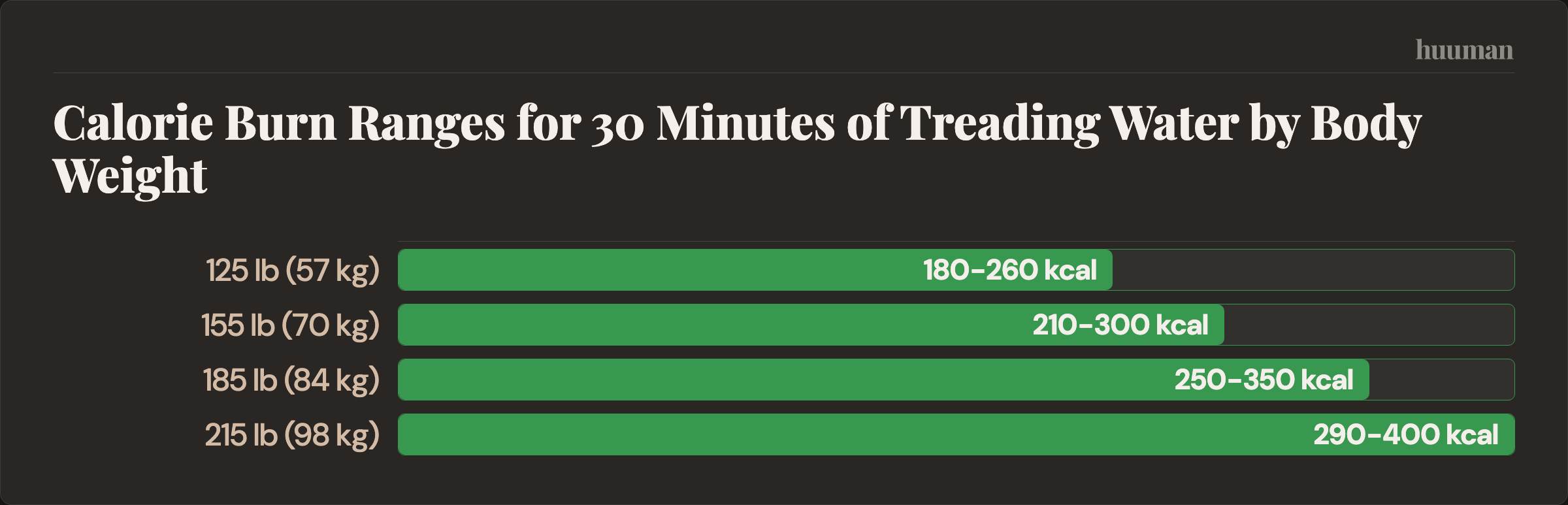
Calories burned in 30 minutes
- 125 lb (57 kg): ~180 to 260 kcal (moderate), ~260 to 360 kcal (vigorous)
- 155 lb (70 kg): ~210 to 300 kcal (moderate), ~300 to 420 kcal (vigorous)
- 185 lb (84 kg): ~250 to 350 kcal (moderate), ~350 to 490 kcal (vigorous)
- 215 lb (98 kg): ~290 to 400 kcal (moderate), ~400 to 560 kcal (vigorous)
Calories burned in 60 minutes
- 125 lb (57 kg): ~360 to 520 kcal (moderate), ~520 to 720 kcal (vigorous)
- 155 lb (70 kg): ~420 to 600 kcal (moderate), ~600 to 840 kcal (vigorous)
- 185 lb (84 kg): ~500 to 700 kcal (moderate), ~700 to 980 kcal (vigorous)
- 215 lb (98 kg): ~580 to 800 kcal (moderate), ~800 to 1120 kcal (vigorous)
Quick time conversions
- 10 minutes: ~50 to 140 kcal depending on weight and intensity
- 15 minutes: ~75 to 210 kcal
- 45 minutes: ~270 to 630 kcal
These numbers are derived from MET-based estimates and align with broad ranges seen in public datasets like the Wisconsin DHS table. They are not precise for individuals.
Why your number can vary day to day
Even at the same body weight, calorie burn treading water can swing meaningfully between sessions.

Water temperature: cooler water can increase energy expenditure through thermoregulation, while warmer water may reduce it but increase perceived fatigue.
Fatigue and stress: poor sleep or high stress can raise perceived effort at the same workload, often reducing total output.
Technique drift: small changes in posture or kick timing increase unnecessary movement.
Intervals vs steady work: short hard efforts can feel intense without producing the same total energy burn as longer steady sessions.
Heart rate response: heart rate is often lower in water at a given effort due to hydrostatic pressure and cooling effects. That makes HR-based calorie estimates less reliable in isolation.
Evidence and limits
Most calorie estimates for treading water come from two sources: MET tables such as the Compendium of Physical Activities, and population-level calorie tables like the Wisconsin DHS dataset. These provide reasonable averages across large groups.
The limitation is that they assume "typical" execution. In reality, treading water varies more than many activities because technique and buoyancy differ widely between people. A trained swimmer may appear more efficient but can sustain higher intensities, offsetting that efficiency in total energy cost.
Research on exercise in water also shows different cardiovascular responses compared to land, including altered heart rate behavior. That means HR-based estimates should be interpreted cautiously rather than taken at face value.
Consumer apps and databases are useful for quick estimates but often compress wide ranges into single numbers, which can give false precision.
Non-prescriptive strategies to use treading water effectively
Steady aerobic treading
A common approach is continuous, moderate effort where breathing stays controlled. The talk test works well here. You should be able to speak in short phrases. This is where treading most closely resembles brisk walking or easy jogging in energy terms.
Interval treading
Short bursts of harder effort can raise conditioning demand quickly. Structures like repeated short efforts with longer recovery periods are frequently described in training literature. In water, heart rate lags during short intervals, so perceived exertion and pace are more reliable guides.
Skill-based progression
Instead of adding equipment, many programs increase difficulty by changing mechanics. Examples include removing hand support, maintaining a taller posture, or adding directional changes. These increase demand without requiring external load.
How to track and interpret your progress
Instead of chasing exact calorie numbers, track signals that actually reflect improvement:
- Session RPE (1 to 10)
- Talk test consistency
- Duration and interval structure
- Heart rate trends if your device is reliable
- Morning resting heart rate, as explained in athlete resting heart rate explained
- Sleep and perceived recovery, including patterns seen in all about heart rate during sleep
A simple method: repeat the same session after two weeks. If it feels easier at the same duration, or you recover faster, your conditioning improved even if calorie estimates stay similar.
Rather than chasing perfect data, focus on patterns that guide better decisions. Have your huuman Coach build weekly cardio plans that incorporate pool work based on your recovery signals and adapt intensity when your body needs it most.
Signal vs noise in calorie burn treading water
- Signal: consistent weekly volume drives results. Adjust your schedule, not just intensity.
- Signal: RPE plus recovery gives better insight than calorie readouts. Note how you feel the next day.
- Signal: technique improvements reduce wasted effort. Track whether sessions feel smoother over time.
- Noise: assuming a fixed calories-per-minute number. Recalculate ranges when conditions change.
- Noise: comparing pool HR directly to land HR zones. Instead, build water-specific baselines.
- Noise: comparing your numbers to others without matching body weight and intensity. Normalize before comparing.
- Signal: body composition trends, like those discussed in all about body fat percentage, matter more than single sessions.
- Noise: using one hard workout as proof of fat loss. Look at multi-week patterns instead.
Common questions
How many calories do you burn treading water for 30 minutes?
For most adults, roughly 180 to 400 calories depending on body weight and whether the effort is moderate or vigorous. Heavier individuals and higher intensity push the number up.
How many calories per hour does treading water burn?
Typical ranges fall between about 360 and over 1000 calories per hour. The lower end reflects steady moderate effort, while the upper end reflects sustained vigorous effort.
Is treading water good cardio?
Yes. It challenges breathing, muscular endurance, and coordination. It can support cardiovascular fitness, especially when structured consistently.
Does treading water burn more calories than swimming laps?
Not inherently. Lap swimming often allows higher sustained output. Treading can match or exceed it only if intensity is high enough and maintained.
Why is my heart rate lower in the pool?
Water immersion changes cardiovascular dynamics through pressure and cooling effects. Some research suggests this may lower heart rate at the same perceived effort.
How can I increase calorie burn safely?
Increase intensity through intervals, improve technique, or reduce reliance on your arms. Avoid jumping straight to maximal effort and monitor fatigue and recovery.
More health topics to explore
- Metabolism, Nutrition & Energy – Overview
- Aqua Running Calories Burned: Realistic Ranges + How to Estimate Yours
- Dates & Blood Sugar: What They Really Do (and How to Use Them Wisely)
- Can High Triglycerides Cause Weight Gain? The Real Link
References
- Ainsworth BE et al. — 2011 Compendium of Physical Activities: a second update of codes and MET values (2011)
- Farhi LE et al. — Cardiopulmonary readjustments during graded immersion in water at 35 degrees C. (1977)
- Killgore GL et al. — A lower-extremities kinematic comparison of deep-water running styles and tre... (2006)
- Srámek P et al. — Human physiological responses to immersion into water of different temperatures (2000)
- Texas A&M Health — Use Metabolic Equivalents Mets to Calculate Calories Burned
- Research Article — Fphys.2021.719788
- Pendergast et al. — Human Physiology in an Aquatic Environment (2015)
- Kruel et al. — Using heart rate to prescribe physical exercise during head-out water immersion. (2014)
- Button et al. — A Multidisciplinary Comparison of Different Techniques Among Skilled Water Treaders. (2021)