If you're searching for "faster muscle growth," you probably want one thing: results without wasting time. You want to know which levers actually matter, and how to combine them without getting lost in the details. That's exactly what this guide is about.
"Fast" doesn't mean overnight. It means focusing on the few variables that reliably accelerate progress. Strength often improves within weeks. Visible changes usually take longer, but they're predictable if you follow the right process.
Key takeaways
1. Progressive strength training: gradually increase reps, weight, or sets over time.
2. Calorie surplus + protein: enough energy and protein to support muscle protein synthesis (MPS).
3. Consistent recovery: sleep, rest, and stress management determine what you actually gain from training.
You'll get clear decision rules, three practical weekly plans, a simple progression model, and a tracking system to keep you on course.
Where Muscle Building Fits In
Muscle mass is more than aesthetics. It's a foundation for performance, metabolism, and day-to-day resilience. In our Strength & Movement overview, you can see how resistance training connects with endurance, recovery, and nutrition.
For many people between 30 and 50, building muscle becomes a question of priorities: limited time, high stress, but strong expectations for health and performance. The goal isn't maximum effort, it's maximum return per hour invested. That's where this plan comes in.
If you want to revisit the basics, check out the foundations of effective muscle building. Here, we'll focus on what drives faster progress.
Quick Answer
Faster muscle growth comes down to three key levers:

- Progressive strength training: gradually increase reps, weight, or sets over time.
- Calorie surplus + protein: enough energy and protein to support muscle protein synthesis (MPS).
- Consistent recovery: sleep, rest, and stress management determine what you actually gain from training.
A practical starting point:
- 3 full-body sessions per week
- several "hard" sets per muscle per week, close to failure (RIR 1–3)
- track strength, body weight, and measurements weekly
"Extremely fast" is usually marketing. Realistically, expect strength gains within weeks and visible changes over months.
These training principles work best when you track what actually drives results. You can log your strength sessions and RPE directly with the huuman app to see which exercises and intensities produce consistent progression over time.
What "Fast" Really Means
In the beginning, your body responds quickly. Training increases muscle protein synthesis, improves net protein balance, and drives growth. This "beginner effect" tapers over time. More experienced lifters need greater precision with volume, intensity, and recovery.
It's important to separate measurable progress from visible change. Strength in compound lifts usually improves first. Visual changes depend on body fat, genetics, and starting point. If you rely only on the mirror, you'll miss real progress.
Common mistakes can slow you down: chasing the pump, endlessly increasing volume, or overemphasizing protein while neglecting sleep and progression.
The 4 Training Drivers That Matter
1) Proximity to failure (RIR): Effective reps happen when sets are challenging. In practice, RPE 8 means about 2 reps in reserve. You don't need to go to failure every set, but too far from it, the stimulus is too weak.
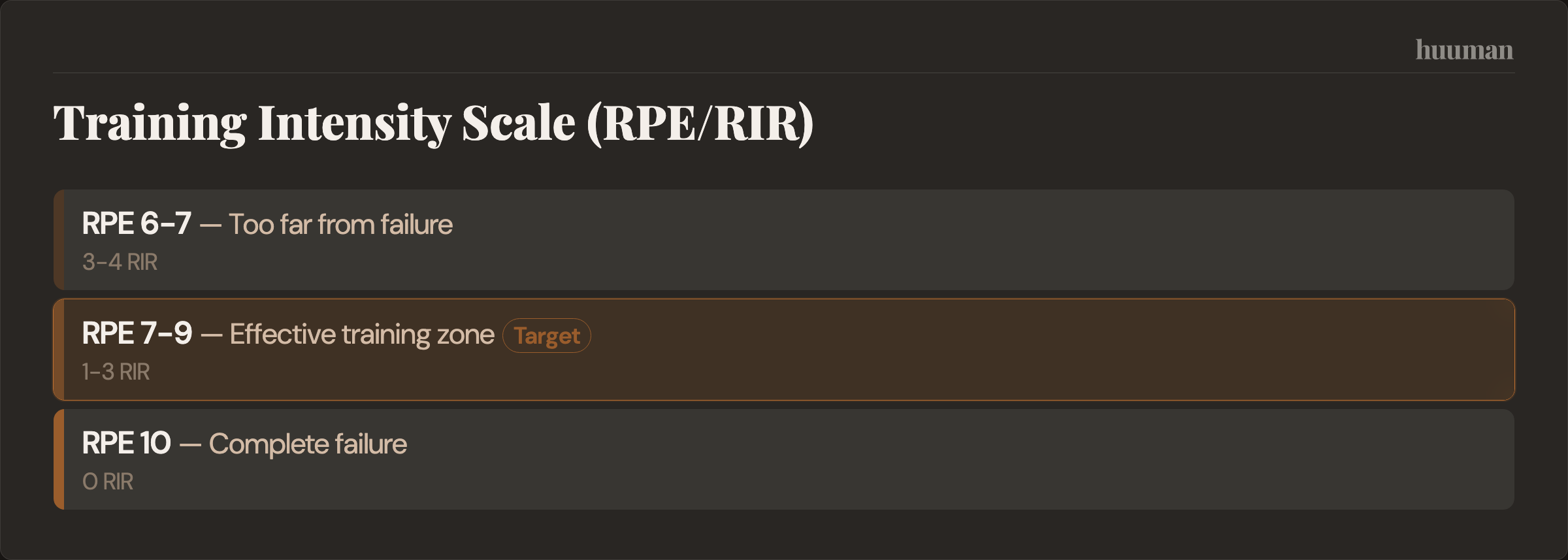
2) Volume: The number of hard sets per muscle per week is a key driver. There's a dose-response relationship, up to your individual limit. More only helps if you can recover from it.
3) Frequency: Training each muscle 2 or more times per week can help distribute volume and improve technique. Methods like greasing the groove for faster strength gains show how frequency can be used strategically.
Meta-analyses have found that when weekly volume is equated, muscle hypertrophy is similar whether training muscle groups 1, 2, or 3+ times per week, supporting flexible frequency approaches.
4) Exercise selection and technique: Build your program around core movement patterns:
- Squat variations
- Hinge or deadlift variations
- Horizontal and vertical pressing
- Horizontal and vertical pulling
Accessory work fills in weak points. Full, pain-free range of motion and stable execution matter more than rigid tempo rules.
What to Adjust When Progress Stalls
- Strength stalls: check sleep and technique first, then add 1–2 sets per muscle.
- Constant fatigue: reduce volume by 20–30% or add a deload.
- Good performance, no size gains: review your calorie intake.
- Joint stress: adjust exercise selection, modify range of motion, or use machines.
Progression Without Chaos: Double Progression
Choose a rep range, like 6–10 or 8–12, and stick to a fixed number of sets.
- First, increase reps within the range.
- Once you hit the top of the range on all sets, increase the weight and start again at the lower end.
Back-off sets: after a heavy top set, do lighter sets for additional quality reps. This builds volume without compromising technique.
Hypertrophy works across a wide rep range, as long as sets are close enough to failure. The range is a tool, not a rule.
Nutrition: Building Blocks for Faster Growth
Energy: A moderate calorie surplus increases the likelihood of a positive muscle protein balance. Too much surplus mainly increases fat gain. The right amount shows up in your weight trend.
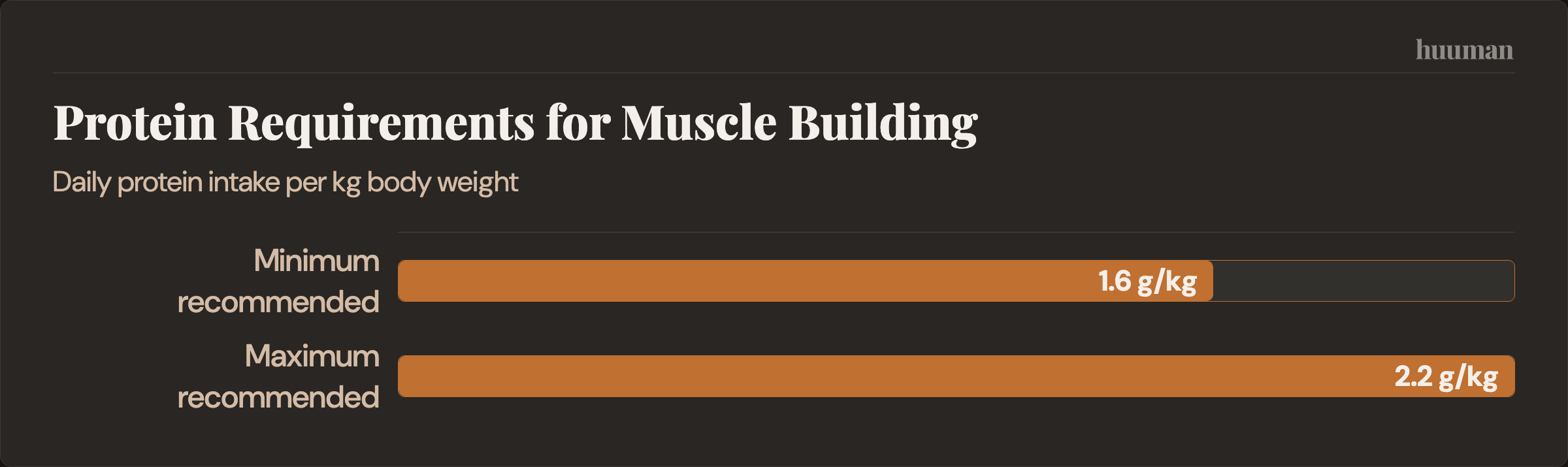
Protein: Research commonly suggests around 1.6–2.2 g per kg of body weight per day for people who train. Even distribution across the day helps support MPS. Protein quality matters, especially essential amino acids and leucine.
Carbohydrates: Support training performance. Better training creates stronger growth signals through higher mechanical tension.
Fat: Essential for hormonal function. Extremely low intake can be counterproductive.
Timing: Meals around training are helpful, but not magical. What matters most is total daily and weekly intake.
Supplements: Creatine monohydrate is well researched and can support strength and lean mass. It doesn't replace the basics.
Recovery: Where Growth Happens
Training provides the stimulus. Adaptation happens during recovery. Sleep is the biggest lever, most guidelines suggest 7 to 9 hours for performance and adaptation.
Daily stress, high step counts, or extra intense cardio all add to overall fatigue. Combining strength and endurance training is possible, but too much intense cardio can interfere with strength and hypertrophy. A common guideline is 1–2 shorter intense sessions per week, plus lower-intensity work.
Deloads are planned periods of reduced volume or intensity. They help reduce fatigue and maintain training quality. A typical approach is every 4–8 weeks or as needed.
To understand why recovery directly improves performance, see why recovery accelerates muscle growth and how to structure recovery between intense sessions.
High-Impact Levers for Faster Muscle Growth
- Training: progressive overload, enough weekly volume, proximity to failure. High impact, moderate effort.
- Nutrition: slight surplus, adequate protein, consistency. High impact, moderate effort.
- Sleep: duration and quality. Very high impact, often underestimated.
- Exercise selection: stable, repeatable movements. Moderate impact, low effort.
- Supplements: optional support. Low to moderate impact.
Program Templates: 2, 3, or 4 Days per Week
Choose based on your schedule. All plans use double progression and mostly operate at RPE 7–9.
2 Days: Minimal Effective Dose
- Goal: build or maintain muscle with minimal complexity.
- Session: 4–6 movement patterns, 2–3 working sets each.
- Squat, push, pull, hinge, shoulders, optional arms.
- Intensity: mostly RPE 7–8, occasionally RPE 9.
- Schedule: 2 sessions of 45–60 minutes, optional short accessory session.
- Progression: double progression per exercise.
- Readiness: skip PR attempts after poor sleep; reduce sets if fatigued.
3 Days: Full Body (Standard)
- Goal: maximize results with moderate time investment.
- Split: alternate A and B sessions.
- A: squat, bench press, row, hamstrings, overhead press.
- B: hinge, incline press, lat pulldown, lunges, lateral raises.
- Intensity: RPE 7–9 (about 3–1 RIR).
- Schedule: 3 sessions of 45–75 minutes.
- Add-on: optional Zone 2 cardio session.
- Progression: double progression; add 1 set per muscle if stalled.
4 Days: Upper/Lower (Advanced)
- Goal: higher volume and improved technique quality.
- Split: lower 1, upper 1, lower 2, upper 2.
- Focus: one heavy block and one hypertrophy block per session.
- Intensity: heavy RPE 8–9, moderate RPE 7–9.
- Schedule: 4 sessions of 60–75 minutes, optional cardio.
- Deload: every 4–8 weeks or as needed.
If you want more structured options, see this training plan for faster progress and specific adaptations like the muscle-building plan for women. For home workouts, check strength training at home for women.
Are You in a Surplus? Quick Check
- Body weight increases slowly over weeks
- Hunger is moderate, not extreme
- Training performance improves
- Waist size doesn't rise quickly relative to body weight
If only your waist is increasing and performance isn't, your surplus is likely too high or training quality too low.
Evidence and Limitations
The big levers are well established: progressive strength training, sufficient volume, and enough protein. Meta-analyses show a relationship between training volume and hypertrophy up to an individual plateau. Hypertrophy is also possible across a wide rep range, if sets are close to failure.
Protein intake in the ranges mentioned is consistently associated with muscle growth. Creatine is one of the most well-researched supplements, with positive effects on strength and lean mass in healthy adults.
Less supported, or often overstated, are timing hacks and "boosters." Concurrent training is beneficial for health, but dosage matters for avoiding interference effects.
Limitations remain: genetics, training history, injuries, and energy availability. Results are probabilities, not guarantees.
Strategies to Discuss with a Professional
- Prioritize levers: structure training first, then secure energy and protein, then fine-tune.
- Start simple: use hand portions or plate methods before tracking precisely.
- Adapt exercises: switch to machines or variations if you feel pain; adjust range of motion.
- Limited time: two sessions per week can work; increase to three or four if possible.
- Recomposition: building muscle while losing fat is more realistic for beginners or after breaks. Otherwise, prioritize clearly.
- Long-term view: building muscle after 40 is absolutely possible, but requires careful fatigue management.
- Conflicting goals: if fat loss is the priority, use strength training for fat loss strategically.
- Context: muscle mass is one part of the bigger picture – see muscle mass as a longevity factor.
Track and Interpret Progress
Without tracking, "fast muscle growth" quickly becomes guesswork. Use a simple 4-week scorecard.
- Strength: 3 key lifts, top set with reps and load.
- Body weight: 3 mornings per week, averaged.
- Measurements: arms, chest, waist, thighs once per week.
- Recovery: sleep duration, energy levels, soreness.
Decision rules:
- Weight stable, strength rising: stay the course.
- Weight and waist rising quickly: reduce calories.
- Strength stalled for 2–3 weeks: check sleep and volume first, then calories.
Real progress comes from adapting your training based on what the data actually shows. Your huuman Coach can build personalized weekly plans that respond to your strength trends and adjust volume, intensity, or recovery based on your actual performance patterns.
Signal vs. Noise in Muscle Growth
- Signal: progressive overload over weeks. Are reps or weights increasing?
- Signal: enough hard sets per muscle. Count working sets, not warm-ups.
- Signal: consistent protein and calories. Look at weekly habits, not single days.
- Signal: sleep quality. Improve your pre-sleep routine.
- Noise: "8–12 is the only range." Use multiple ranges if you train close to failure.
- Noise: "Every set to failure." Leave 1–3 reps in reserve to sustain performance.
- Noise: boosters and "hormone hacks." Focus on training and sleep first.
- Noise: "6 minutes per week." Plan realistically for 2–4 sessions.
- Noise: supplements as the main lever. They support, not replace, the basics.
FAQ
How can you build muscle quickly without gaining unnecessary fat?
Keep your calorie surplus moderate, prioritize training progress, and monitor your waist alongside body weight. If your waist increases quickly, slightly reduce calories instead of pushing training volume higher.
Can you build visible muscle in 3 weeks?
Measurable progress, yes. Visible changes are usually subtle at first. Strength improvements tend to show up sooner, while noticeable changes take several weeks to months.
How long does it take to build 1 kg of muscle?
It varies significantly based on training experience, starting point, and context. There's no fixed timeline, use trends in strength and measurements rather than focusing on a specific number.
How often should you train for faster muscle growth?
2 to 4 sessions per week work well. Choose a frequency that fits your schedule and allows you to maintain high-quality training.
Is 8–12 reps really the best range?
No. Muscle growth can occur across a wide range of reps as long as sets are challenging. Rep ranges are tools for progression and fatigue management.
Do you have to train to failure?
Not necessarily. Training close to failure is enough to stimulate growth. Going to failure too often can increase fatigue and reduce overall performance.
How much protein do you need?
Most guidelines suggest around 1.6–2.2 g per kg of body weight per day for active individuals. Total daily intake matters more than perfect timing.
What actually helps – creatine, protein shakes, or boosters?
Protein helps you meet your daily intake. Creatine can support strength and performance. "Boosters" are usually less impactful. The foundation remains training, nutrition, and sleep.
Can you build muscle effectively at home?
Yes, with dumbbells, bands, or machines. The key is stable movements, progression, and sufficiently challenging sets. See strength training at home for women for practical adjustments.
How do you combine cardio with muscle building?
Keep intense cardio sessions limited and, if possible, separate them from heavy strength workouts. Use low-intensity sessions for active recovery.
More health topics to explore
- Strength, Muscle & Mobility – Overview
- Body Fat Percentage: Normal Ranges, Charts & How to Interpret (Women/Men)
- 20 Pound Muscle Gain: How Long It Takes and a Realistic Plan
- One and Done Workout: The Evidence-Aware 7-Minute Protocol (Without the Hype)
References
- Schoenfeld et al. — Resistance Training Volume Enhances Muscle Hypertrophy but Not Strength (2019)
- Kreider et al. — ISSN Position Stand: Safety and Efficacy of Creatine Supplementation (2017)
- Nunes EA et al. — Systematic review and meta-analysis of protein intake to support muscle mass ... (2022)
- Refalo MC et al. — Influence of Resistance Training Proximity-to-Failure on Skeletal Muscle Hype... (2023)
- Schoenfeld BJ et al. — Dose-response relationship between weekly resistance training volume and incr... (2017)
- Schoenfeld BJ et al. — How many times per week should a muscle be trained to maximize muscle hypertr... (2019)
- Jäger R et al. — International Society of Sports Nutrition Position Stand: protein and exercise (2017)
- Morton et al. — Protein Intake and Resistance Training: Meta-Analysis of Muscle Mass and Strength (2018)
- Schoenfeld BJ et al. — Effects of Resistance Training Frequency on Measures of Muscle Hypertrophy: A... (2016)
- Antonio J et al. — The Top 5 Can't-Miss Sport Supplements (2024)