Box breathing is a simple technique you can use in moments of acute stress to quickly regain calm and focus. It fits easily into everyday life: before an important conversation, between meetings, after a workout, or in the evening to wind down. When your mind is racing and your body feels "wired," a steady breathing rhythm gives you a direct way to reset.
The advantage: no setup, no app, no prior experience needed. Just a few steady breathing cycles can noticeably calm your nervous system. That said, box breathing isn't a cure-all. It's a tool for short-term self-regulation, not a replacement for therapy or a way to fix underlying causes.
Key takeaways
1. Sit or stand upright, relax your jaw
2. Inhale quietly through your nose for 3–4 seconds
3. Hold for 3–4 seconds (optional)
In this guide, you'll learn how to do box breathing (also called square breathing) safely, when different variations make sense, and how to check whether it's working for you.
When to Use Box Breathing in Daily Life
Think of box breathing as a transition tool: from tension to control, from overwhelm to focus. It's best used in specific moments rather than continuously. Typical use cases:
- Before performance: a quick reset before presentations, exams, or intense training.
- During the day: a "quiet anchor" in meetings or while waiting.
- After stress: to wind down after work or exercise, and even for waking up at night.
In the context of mental health and recovery, it acts as a nervous system reset. If you want a broader framework, see Mindset & mental health overview to place tools like this in context.
This reset is associated with parasympathetic nervous system activation, helping move the body out of stress-driven sympathetic states.
Quick Summary
Box breathing consists of four equal phases: inhale, hold, exhale, hold. A common pattern is 4-4-4-4 seconds, but that's not mandatory. Start conservatively with 3–4 seconds per phase and repeat for about 4–8 cycles. If holding your breath feels uncomfortable, shorten or skip the holds.
- Sit or stand upright, relax your jaw
- Inhale quietly through your nose for 3–4 seconds
- Hold for 3–4 seconds (optional)
- Exhale slowly (through your nose or gently through your mouth) for 3–4 seconds
- Hold again for 3–4 seconds (optional)
A typical session lasts a few minutes, though even shorter practice can be useful depending on your goal and situation. You can start shorter and see how your body responds.
Stop if needed: If you feel dizzy, tingly, short of breath, or experience pressure in your chest, stop or switch to a simpler version.
Whether you're using box breathing before meetings or to wind down at night, consistency matters more than perfection. You can track your stress levels and breathing comfort with the huuman app to see which patterns and timing work best for your daily rhythm.
What Is Box Breathing?
Box breathing means all four phases of the breath are equal in length, forming a "square": inhale, hold, exhale, hold. The common 4-4-4-4 count is just one option, not a strict rule.
This structure serves two purposes: it slows your breathing and gives your mind a simple, steady rhythm to focus on. Together, that can help dampen acute stress and improve attention.
Why It Can Work
Breathing is closely linked to the autonomic nervous system. Slower, controlled breathing is associated with a shift toward the parasympathetic state, often described as "rest and recovery." Research on paced breathing suggests it can influence heart rate variability and perceived stress, though effects vary from person to person.
Another factor is CO₂ tolerance. Breathing too fast or too deeply can paradoxically increase the sensation of breathlessness. Steady, moderate breathing helps maintain a stable, comfortable rhythm.
The counting itself acts as a mental anchor. Instead of getting lost in racing thoughts, you focus on a simple, repeatable pattern, one reason breathing techniques are widely used in mindfulness and stress management.
Safety Guidelines: Keep It Comfortable
The key rule: breathing techniques work best when they feel calm and controlled, not extreme.
- Nasal, quiet, not maximal: breathe gently rather than deeply. "Too much air" is a common mistake.
- No straining: holds should feel relaxed, not forced.
- Adjust as needed: if 4 seconds feels too long, drop to 3 or 2.
Stop rules
- Dizziness or lightheadedness
- Tingling in fingers or face
- Feeling short of breath or tightness
- Uncomfortable chest pressure
If this happens: pause, return to normal breathing, or switch to an easier variation.
Use extra caution if you have heart or lung conditions, asthma, are pregnant, experience panic symptoms, or have an acute infection. When in doubt, check with a professional first.
2-Minute Box Breathing: Quick Start
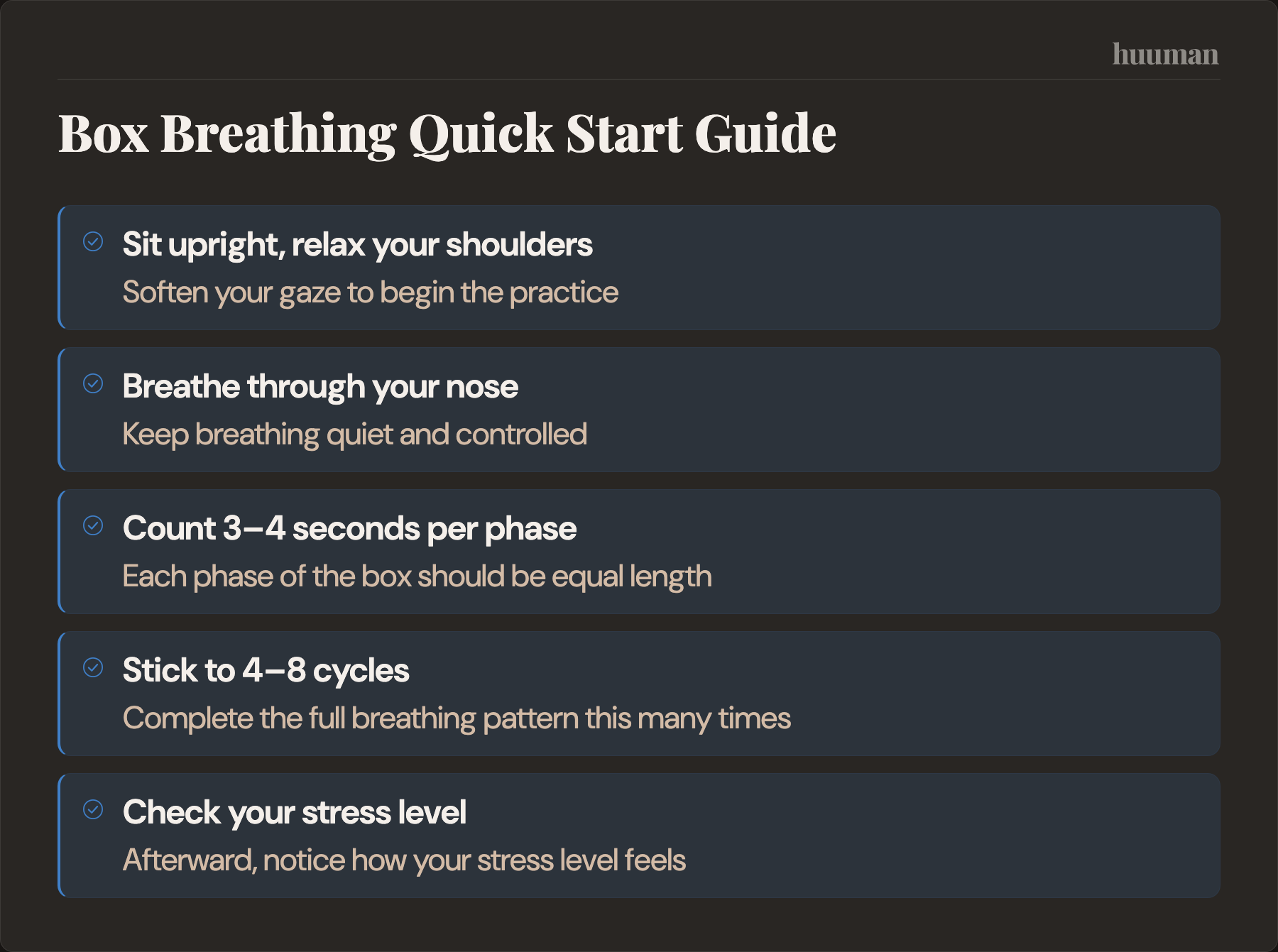
- Sit upright, relax your shoulders, soften your gaze
- Breathe through your nose, quietly and controlled
- Count 3–4 seconds per phase
- Stick to 4–8 cycles
- Afterward: check how your stress level feels
Timer Pattern (visual)
Inhale (4) → Hold (4)
↑ ↓
Hold (4) ← Exhale (4)
Variations for Different Goals
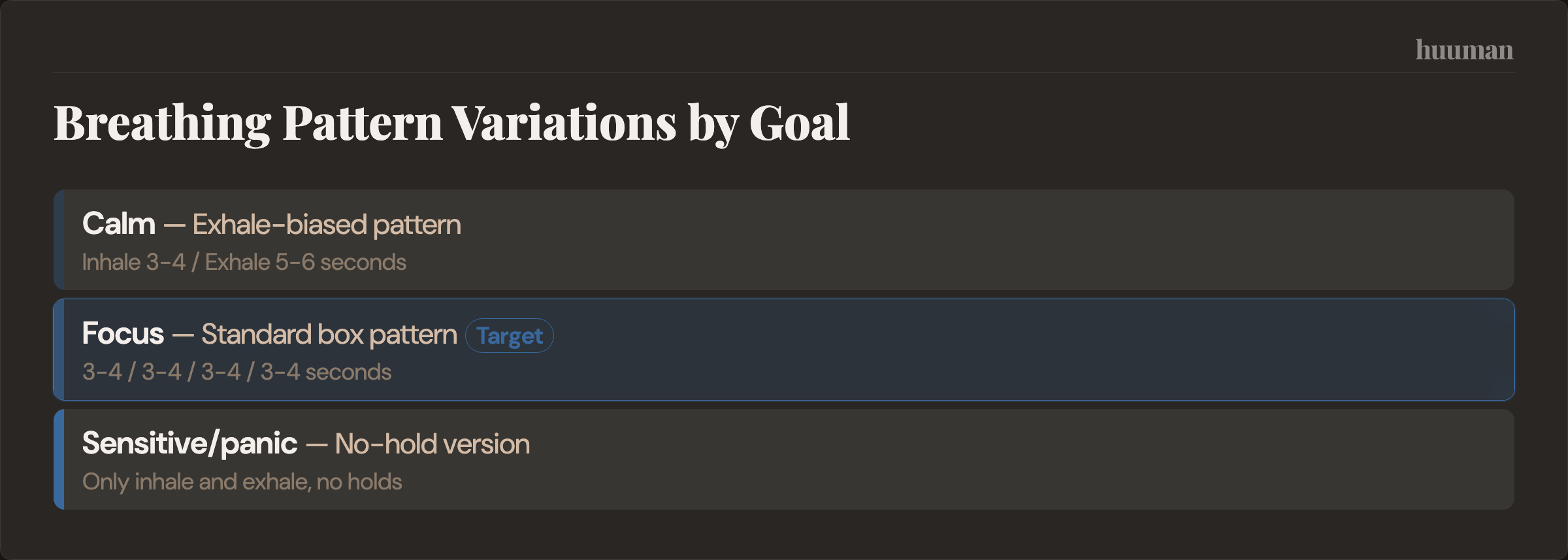
- Calm · Variation: Exhale-biased · Description: Inhale 3–4 / Exhale 5–6. A longer exhale can feel more calming.
- Focus · Variation: Standard box · Description: 3–4 / 3–4 / 3–4 / 3–4. Even rhythm stabilizes attention.
- Sensitive/panic · Variation: No-hold · Description: Only inhale and exhale, no breath holds.
- Discreet · Variation: Silent box · Description: Count internally with minimal movement.
Box Breathing vs. 4-7-8
4-7-8 breathing emphasizes longer exhales and longer holds. Many people find it more calming, but also more intense. Box breathing is more neutral and easier to control. If you're sensitive to breath-holding, start with box breathing or a no-hold version.

Common Mistakes and Quick Fixes
- Breathing too deeply: reduce intensity, keep it gentle.
- Holding too long: shorten by 1–2 seconds.
- Raised shoulders: focus on your lower ribcage.
- Counting too fast: keep a steady rhythm.
Evidence and Limitations
Slow, structured breathing is often associated with changes in stress perception and autonomic regulation. Some research on paced breathing suggests potential effects on HRV and subjective stress, though individual responses vary widely.
Claims like "lowers blood pressure" or "reduces stress hormones" should be interpreted cautiously. Some studies show associations, but results show high heterogeneity and effects aren't universal or guaranteed. Even popular narratives like "used by Navy SEALs" are more anecdotal than scientific.
In practice: box breathing is a low-risk, plausible tool, but not a substitute for medical care or comprehensive stress management.
How to Use It Around Stressful Moments
Before: 2–4 cycles to ease into a calmer state.
During: silent box breathing or just extend your exhale.
After: several slower cycles with a focus on relaxation.
You can combine box breathing with other techniques, like a body scan or intentional attention shifts such as refocusing on yourself. For emotional situations, see also breathing for anger and frustration.
How to Measure Progress
The effects are often subtle, so a quick before-and-after check helps:
- Stress level (0–10)
- Clarity/focus (0–10)
- Breathing comfort
You can also track your resting heart rate before and after a session, or observe trends over several days. HRV may offer insights into physiological regulation, though it's best viewed as one indicator among many rather than a definitive measure for individual breathing sessions.
If you're curious how breathing relates to heart rate, see how breathing exercises may influence resting heart rate.
The real value comes from building breathing techniques into your broader stress management approach. Your huuman Coach can create weekly plans that combine mindfulness sessions with training that supports your nervous system rather than overwhelming it.
Signal vs. Noise
- You feel calmer without breath discomfort → good sign, keep going
- Your focus improves, thoughts slow down → technique fits you
- You need shorter counts → normal, adjust to your needs
- "4-4-4-4 is mandatory" → ignore, adapt it
- "Holds must be maximal" → reduce intensity
- Tingling means "detox" → more likely overbreathing, dial it back
- "More is better" → prioritize quality over duration
- No immediate effect → try a different variation before quitting
FAQ
What does box breathing actually do?
It can help regulate acute stress and improve focus. The effect is usually subtle but noticeable in everyday situations.
How exactly does 4-4-4-4 box breathing work?
You structure your breath into four equal phases. Each phase lasts the same amount of time, often around four seconds, but adjustable.
How long should you practice?
Many guides suggest several minutes per session Sanitas (German). In daily life, even a few cycles can be enough to notice an effect.
How often should you do it?
There's no fixed rule. A practical approach is to use it situationally, before stressful moments or to wind down.
Is box breathing good for the lungs?
It doesn't directly train lung function, but it can help develop a calmer breathing pattern.
Can it lower blood pressure?
Slow breathing is associated with cardiovascular changes, but effects vary and aren't guaranteed.
Which is better: box breathing or 4-7-8?
It depends on your response. Box breathing is easier to control; 4-7-8 may feel more calming but also more intense.
If you tend to feel chronically wired, it can help to build a small recovery routine and track it over time. Principles like focus on what you can control and daily mindfulness practice provide a solid foundation.
More health topics to explore
- Mindset, Stress & Mental Health – Overview
- Alone at the Holidays: A Calm, Practical Plan to Reduce Loneliness
- Anger and Meditation: A Practical Guide to Responding Instead of Reacting
- Concentration in Children: Causes, Quick Fixes, and Warning Signs
References
- University of Graz — Atemtechniken
- Sanitas — Richtig Atmen fuer Mehr Entspannung
- ZEIT — "Box Breathing": "Auftrag zum Entspannen": Warum Atemtraining Stress abbaut
- WebMD — What is Box Breathing
- Cleveland Clinic — Box Breathing Benefits
- Natarajan A — Heart rate variability during mindful breathing meditation (2022)
- Zaccaro A et al. — How Breath-Control Can Change Your Life: A Systematic Review on Psycho-Physio... (2018)
- Zaliene L et al. — Breathing Interventions Improve Autonomic Function, Respiratory Efficiency an... (2025)
- Nam TG et al. — Effectiveness of Alternative Nostril Breathing on Blood Pressure: A Systemati... (2024)
- Laborde S et al. — Effects of voluntary slow breathing on heart rate and heart rate variability:... (2022)
- Balban MY et al. — Brief structured respiration practices enhance mood and reduce physiological ... (2023)
- Lehrer PM et al. — Heart Rate Variability Biofeedback: A Systematic Review and Meta-Analysis (2025)