Meditation is often described as calming or profound. Then reality hits: you sit down, close your eyes, focus on your breath… and within a few minutes you feel bored.
If you are experiencing boredom during meditation sessions, it does not mean the practice is failing. It usually means your attention is meeting a quieter environment than it is used to. The modern brain expects stimulation, goals, and feedback. Meditation removes much of that. What appears next is whatever the nervous system was avoiding, craving, or too overloaded to notice.
Key takeaways
1. Label: quietly note "boredom is here." Treat boredom as an experience, not a verdict.
2. Locate: notice where boredom shows up physically. Heavy eyelids, restless legs, pressure in the chest, or flatness in the body.
3. Adjust attention: either refine your anchor with more detail or change the modality. That could mean focusing more closely on breath sensations, listening to sounds, widening awareness, or switching to walking meditation.
That moment is not a mistake. It is the training moment. The skill meditation develops is not entertainment or bliss. It is the ability to stay with experience without automatically escaping it.
This guide explains why boredom appears during meditation, how to diagnose what kind of boredom you are actually feeling, and what practical adjustments help you continue practicing without forcing results.
Where boredom meditation fits in your mental performance system
Meditation is fundamentally attention training. It strengthens the ability to notice where the mind goes, return attention deliberately, and stay present with sensations and emotions.
For many adults in demanding careers or busy family lives, boredom appears because the nervous system is shaped by constant stimulation. Fast media, multitasking, notifications, and high cognitive load train the brain to expect novelty. Sitting quietly removes that stimulus loop, which exposes two common patterns: craving stimulation and avoiding discomfort.
This is why boredom meditation often intersects with broader lifestyle signals. Sleep debt increases mental dullness. High caffeine intake can amplify restlessness. Long screen exposure creates rapid reward cycles that make stillness feel empty. If those patterns sound familiar, the context sections in the Mindset & Mental Health overview and the guide on dealing with mental overload describe how overstimulation affects focus.
Many practitioners also notice boredom when the body is under-recovered. Poor sleep or high training stress can make attention drift or flatten. The connection between recovery and mental clarity is explained in why rest is essential for a calm mind. In this sense, boredom is not just a meditation problem. It can be feedback from your broader nervous system load.
Meditation then becomes a useful diagnostic tool. Instead of suppressing distraction or boredom, you can observe what type of state the nervous system is actually in.
Research on brief mindfulness meditation sessions shows they are associated with increased heart rate variability, suggesting meditation influences nervous system regulation even during short practices.
Quick answer: what to do when boredom appears
Boredom during meditation is common. It usually means your brain is craving stimulation, avoiding something uncomfortable, or you have too little sensory detail in your attention.
A simple response used in many mindfulness practices is a three step adjustment:
- Label: quietly note "boredom is here." Treat boredom as an experience, not a verdict.
- Locate: notice where boredom shows up physically. Heavy eyelids, restless legs, pressure in the chest, or flatness in the body.
- Adjust attention: either refine your anchor with more detail or change the modality. That could mean focusing more closely on breath sensations, listening to sounds, widening awareness, or switching to walking meditation.
If boredom also includes dread, emotional numbness, or persistent low mood, it may help to shorten practices and consider guided sessions or professional guidance.
If you want to apply this immediately, choose the boredom type that best matches your experience and try its matching micro practice strategy below.
If you want to build awareness of your boredom patterns during meditation practice, track your mindfulness sessions and emotional patterns with the huuman app to see how different states correlate with sleep, stress, and daily readiness.
What boredom in meditation actually is and what it is not
The word boredom hides several different states. Distinguishing them changes what helps.
Boredom typically means the mind is looking for stimulation or expecting something more interesting than what is happening now.
Sleepiness is different. It shows up as heavy eyelids, fading attention, or drifting toward sleep. That usually reflects fatigue or under-arousal.
Restlessness is the opposite direction. The body feels agitated, thoughts are fast, and there is an urge to stop or move.
Numbness or disconnection can feel blank or slightly unreal. Some people describe it as "not being fully present in the body."
Low mood boredom feels like meaninglessness or "what is the point." This state overlaps more with emotional wellbeing rather than attention itself.
Different states require different responses. Treating them all as generic boredom is why many beginners struggle.
Treating boredom as a normal part of mindfulness training, rather than a sign of failure, is a common teaching point. Observing that response itself can become part of the practice rather than an obstacle. Articles discussing mindfulness practice often highlight this shift from resisting boredom to examining it directly (Mindful.org: The Bright Side of Boredom) and (Tricycle: The Antidote to Boredom? Mindfulness Practice).
In other words, boredom meditation moments are often the point of the exercise.
The boredom loop: why it grows when you fight it
Boredom compounds through a predictable internal loop.
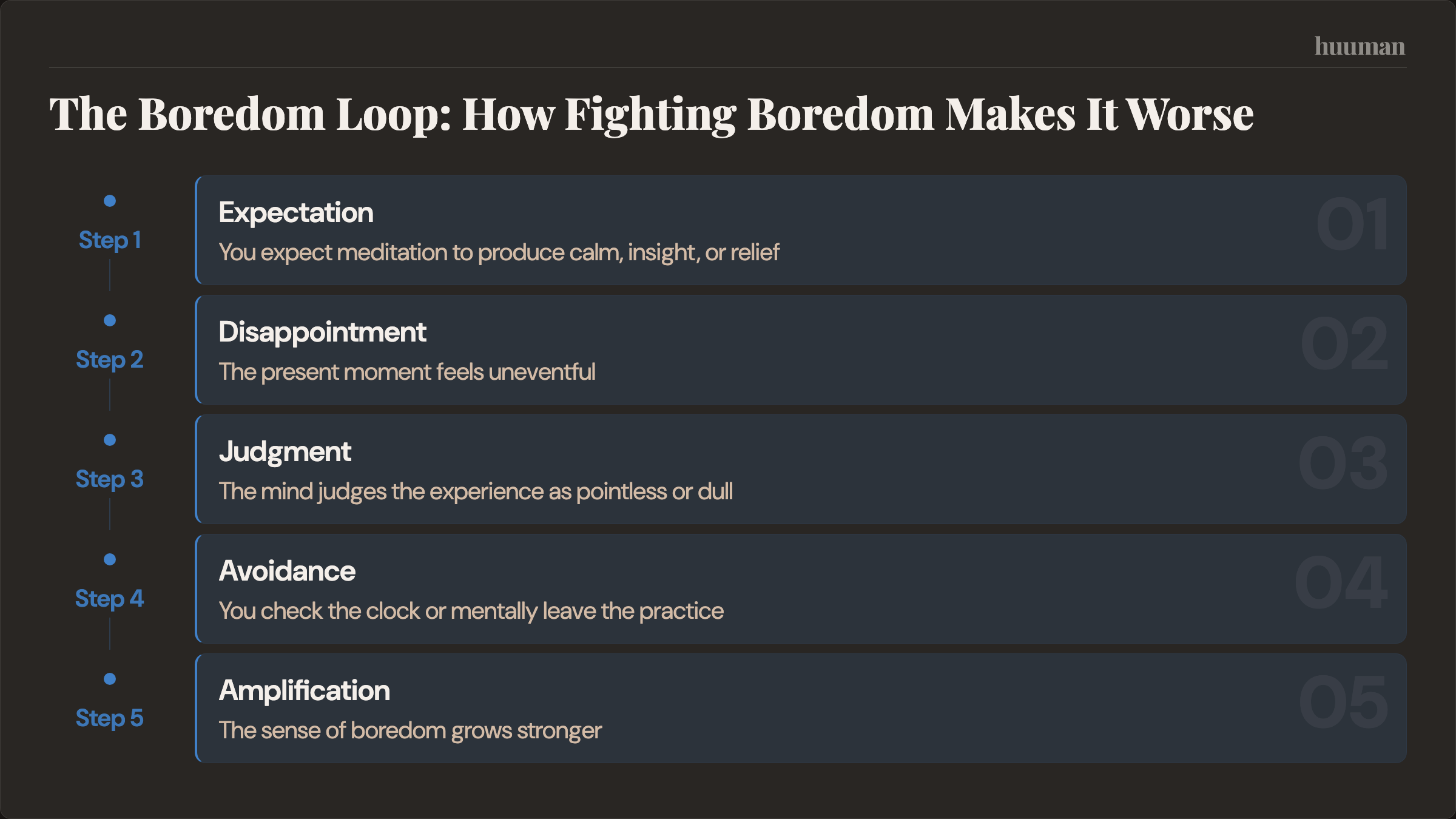
- You expect meditation to produce calm, insight, or relief.
- The present moment feels uneventful.
- The mind judges the experience as pointless or dull.
- You check the clock or mentally leave the practice.
- The sense of boredom grows stronger.
The loop is powered by expectation. When the mind demands a payoff, quiet experience can feel like failure.
Mindfulness training instead treats boredom as data. The practice is noticing the moment your attention leaves the task and gently returning. That moment of noticing is called meta awareness. It is the skill meditation repeatedly strengthens.
Many people discover they are not bored all the time. They are bored for a few seconds, followed by thoughts about the boredom, followed by judging those thoughts.
Seeing the loop clearly reduces its grip.
The four boredom profiles: diagnose before you fix
Different sensations point to different drivers. Use the descriptions below as a simple troubleshooting map.

- Dull boredom (under-arousal)
Foggy mind, heavy body, drifting attention. Often connected with fatigue, long screen exposure, or low stimulation. - Restless boredom (over-arousal)
Irritation, impatience, urge to quit. The mind feels busy and wants something more stimulating. - Numb boredom (disconnection)
Flatness, lack of sensation, or feeling partially detached. - Hopeless boredom (low mood)
Thoughts like "what is the point?" with emotional heaviness.
Many meditation teachers also describe two informal flavors:
- Hot boredom: irritated, urgent, aversive.
- Cool boredom: spacious and curious once you observe it closely.
This language is a teaching tool rather than a clinical classification. It simply highlights that boredom changes character depending on how you relate to it.
The Boredom Ladder: what your boredom feels like and what to try next
This decision tree helps translate sensations into actions.
- DULL
What it feels like: heaviness, fog, drifting attention.
Likely driver: under-arousal or fatigue.
What to try:- Open the eyes slightly and sit taller.
- Increase sensory detail of the breath at the nostrils.
- Shorten the session or switch to walking meditation.
- RESTLESS
What it feels like: itchy, irritated, time-checking.
Likely driver: over-arousal or stimulation cravings.
What to try:- Note urges such as "wanting" or "restless."
- Relax the jaw, shoulders, and belly.
- Set a tiny finish line, then return to your anchor.
- NUMB
What it feels like: blank or disconnected.
Likely driver: reduced body awareness or cognitive fatigue.
What to try:- Focus on contact points like feet on the floor or hands touching.
- Use guided meditation or body scans.
- Avoid long silent sessions.
- HOPELESS
What it feels like: apathy or loss of meaning.
Likely driver: low mood, burnout, or emotional fatigue.
What to try:- Connect the practice to a personal value.
- Shorten the session dramatically.
- Consider support from a professional if the feeling persists.
Strategies that often reduce boredom in meditation
Increase sensory resolution
Boredom frequently appears when attention is too vague. Instead of "watch the breath," zoom in on details.
This approach uses interoception, the ability to sense internal body signals.
Questions that increase sensory resolution include:
- Where exactly do you feel boredom?
- Does it have a temperature, pressure, or movement?
- Does it change across several breaths?
You can also lightly label experiences such as "thinking," "wanting," or "hearing." This noting technique adds structure to attention.
Change the attentional anchor
If boredom persists, try a different object of attention.
- Narrow anchors: breath at nostrils or belly.
- Broader anchors: sounds, body contact points.
- Simple labels for thoughts.
A narrower anchor tends to help when thoughts are fast. A broader anchor may help when the mind is dull.
Change the modality instead of forcing longer sits
Meditation does not have to mean sitting still with eyes closed.
Walking meditation is widely used when attention feels stagnant. It combines movement with awareness of each step. In some people this increases alertness without increasing agitation.
Guided practices can also help when the mind struggles to stay engaged.
Movement based activities sometimes reset attention as well. If you are feeling stuck cognitively, even short exercise can shift your mental state, which is why many people use how movement helps break mental ruts or cardio as a tool against restlessness as complementary habits.
Dial your dose and environment
For many people the solution is not pushing through boredom but adjusting the dose.
- Shorter sessions may maintain engagement better than forcing longer sits.
- Practice earlier in the day if evenings bring fatigue.
- Limit screens immediately before sitting.
Caffeine and nutrition also influence attention stability. Large caffeine swings may create jittery attention while low blood sugar can cause dullness. More context on this interaction can be found in nutrition that supports mental clarity and discussions about stimulants such as do energy drinks actually help you focus? or supplements for focus and concentration.
Reconnect meditation with meaning
For the "what is the point" flavor of boredom, motivation matters.
Instead of meditating for a special experience, connect it to a concrete value such as:
- staying calmer in difficult conversations
- reducing reactivity under pressure
- recovering more effectively after demanding days
This simple shift moves meditation from outcome chasing to skill building.
Evidence and limits
Mindfulness and meditation research consistently suggests these practices can strengthen attention regulation and awareness of mind wandering. Training attention to notice distractions and return focus is a core component of many meditation methods.
Research on mindfulness-based stress reduction shows moderate benefits for healthy individuals managing stress, suggesting meditation practices can support emotional regulation beyond clinical populations.
Researchers studying meditation mechanisms frequently describe changes in attention networks and the relationship to mind wandering and meta awareness, though the exact neural explanations remain debated. Strong claims about specific neurochemicals or single brain circuits explaining boredom are not well supported.
Reports from practitioners and teachers also indicate that boredom, restlessness, and mental drift are common challenges during meditation practice. Articles discussing meditation experiences often highlight that noticing boredom itself can deepen attention training rather than interrupting it Psyche.co: Find meditation really boring? You're not the only one.
However, meditation experiences vary widely across individuals. Boredom is not always productive. In some cases it reflects fatigue, emotional distress, or broader mental health concerns. Meditation should not be viewed as a replacement for psychological care when symptoms are significant.
Research on mindfulness-based programs suggests potential benefits for stress and emotional regulation in some populations, but outcomes differ widely depending on population, practice type, and individual factors. These results describe average patterns rather than guarantees.
Meta-analysis of mindfulness-based therapy studies found moderate improvements in anxiety and mood symptoms in clinical populations, though individual responses vary considerably.
Practical reset: a 2 minute rescue practice
When boredom spikes mid session, the following short reset is commonly used.
Pause the original technique.
Take three slightly longer exhale breaths.
Notice three physical contact points in the body.
Listen for three distinct sounds.
Return to a simple anchor such as breath or walking.
The purpose is not to force calm. The purpose is to gently bring attention back into sensory contact with the present moment.
Track your response: the 7 day B.O.R.E.D. experiment
Meditation progress is usually subtle. Tracking simple signals makes it easier to see what helps.

The huuman B.O.R.E.D. framework can guide a short experiment:
- B Baseline: notice sleep, caffeine timing, stress load.
- O Objectify: label boredom as an experience.
- R Refine: increase sensory detail.
- E Expand: shift modality if stuck.
- D Dose: adjust duration or guidance.
A simple scorecard for a 7 day experiment:
- Minutes practiced
- Boredom intensity during minute three (0 to 10)
- Urge to quit (0 to 10)
- Calm or clarity after practice (0 to 10)
- Sleep quality that night
- Caffeine timing that day
The goal is not perfect sessions. The goal is noticing trends.
Signal vs noise when boredom meditation appears
- Signal: boredom changes shape when you observe it closely. Next step: stay curious about its physical sensations.
- Signal: the urge to quit becomes noticeable earlier. Next step: label the urge before acting.
- Signal: you check the timer less frequently. Next step: keep session length stable for a week.
- Signal: short practices become more consistent. Continue prioritizing consistency.
- Noise: chasing unusual or pleasant sensations. Redirect attention to simple anchors.
- Noise: forcing longer sessions to prove discipline. Reduce duration temporarily.
- Noise: switching techniques daily without tracking. Keep one anchor for a few days.
- Noise: using stimulants to brute force alertness. First examine sleep and recovery patterns.
Common questions
Is boredom during meditation normal?
Yes. Many practitioners report boredom, restlessness, or wandering attention during early practice. These experiences highlight how strongly the mind looks for stimulation. Training attention is largely the process of noticing and returning from those moments.
Why do I get bored so fast when I meditate?
Rapid boredom can reflect several drivers: high stimulation habits, fatigue, low sensory detail in attention, or expectations about how meditation should feel. Adjusting anchors, shortening sessions, or practicing earlier in the day often changes the experience.
What should I do when meditation feels restless and boring?
Start by identifying whether the state feels dull or agitated. Dullness often improves with more sensory detail or walking meditation. Restlessness often improves by labeling urges, relaxing tension, and returning to a simple anchor.
Is boredom the same as mind wandering?
They are related but different. Boredom is the emotional tone that arises when the mind perceives low stimulation. Mind wandering is the shift of attention away from the task. Meditation trains the moment you notice that shift.
Should I meditate longer to push through boredom?
Longer sessions are not always the answer. In many cases shorter, more consistent sessions improve engagement and attention training.
What if meditation makes me feel numb or disconnected?
If you feel disconnected, emphasize grounding practices such as noticing the feet or physical contact points. Guided meditation can help maintain connection with the body. Persistent dissociation or distress should be discussed with a qualified professional.
Can boredom during meditation indicate depression or burnout?
Sometimes. When boredom comes with persistent loss of interest, hopelessness, very low energy, or intense sleep disruption, it may reflect broader mental health strain. In that case meditation may still help as a gentle awareness practice, but professional support becomes important.
If this guide helped clarify what boredom meditation is actually pointing to, consider saving the B.O.R.E.D. framework and the Boredom Ladder and sharing them with someone starting meditation.
Running your own boredom debugging experiment becomes more systematic when you can track patterns across sleep quality, training load, and meditation response. Your huuman Coach can build weekly plans that include targeted mindfulness sessions based on your current stress levels and recovery state.
More health topics to explore
- Mindset, Stress & Mental Health – Overview
- Best Time of Day to Meditate: Morning vs Midday vs Evening
- Ambition Goals: How to Set Big Targets Without Burning Out
- Anger and Meditation: A Practical Guide to Responding Instead of Reacting
References
- Tricycle — When Mindfulness Meets Boredom
- Sood & Jones — On Mind Wandering, Attention, Brain Networks, and Meditation (2013)
- PubMed: Review on mind-wandering/meta-awareness/attention networks in meditation — Self-caught methodologies for measuring mind wandering with meta-awareness: A sy
- Pascoe MC et al. — Yoga, mindfulness-based stress reduction and stress-related physiological mea... (2017)
- Barbry et al. — Effect of Brief Mindfulness Meditation Interventions on Heart Rate Variability in Adults: A Systematic Review (2026)
- Hofmann et al. — The effect of mindfulness-based therapy on anxiety and depression: A meta-analytic review (2010)
- Khoury B et al. — Mindfulness-based stress reduction for healthy individuals: A meta-analysis (2015)