The best time of day to meditate is usually not the time that sounds most spiritual or optimized. It is the time you can repeat with the least friction, then refine based on what you want meditation to do for you: sharpen focus, lower stress reactivity, improve emotional regulation, support sleep readiness, or help you shift gears after training or work.
Key takeaways
1. Choose consistency first: pick one anchor you can repeat.
2. Match timing to goal: focus, stress reset, transition, or sleep readiness.
3. Start small: a short, repeatable practice beats an ideal plan you skip.
That matters because meditation works more like a practice than a one-off intervention. The right question is not "What is the universally best time to meditate?" but "What time fits my real day, my physiology, and my current goal?" Morning, midday, after work, and evening can all work. They solve different problems.
This guide gives you a practical decision framework. You will see where each time window tends to fit best, what commonly goes wrong, how factors like caffeine, meals, workouts, commute, and childcare change the picture, and how to run a short experiment so you can choose based on evidence from your own life rather than internet folklore.
If you want broader context on where meditation fits, the Mindset & Mental Health overview is a useful starting point.
Where timing fits in a bigger health picture
Meditation sits in the overlap between attention control, stress regulation, recovery, and behavior change. That makes timing important for a simple reason: your nervous system does not feel the same at every hour. Morning comes with the transition from sleep inertia into rising alertness. Midday often brings cognitive fatigue and distraction. Early evening is when many people need a boundary between performance mode and home mode. Before bed is different again, because relaxation is not the same thing as sleepiness.
Your schedule also changes the usefulness of each slot. A parent with a compressed morning, a shift worker, someone who trains after work, and someone who spends half the day in meetings do not have the same "best time of day to meditate." The choice is shaped by circadian rhythm, daily alertness, sleep pressure, and ordinary logistics.
There is another layer: meditation type. Breath-focused mindfulness often fits well when you want steadier attention. A body scan may work better when you want to downshift physically. Loving-kindness can be useful when the real issue is irritability or emotional constriction rather than pure mental noise. Open monitoring can suit transition periods when you need to notice thoughts without getting hooked by them. Timing and style should match the job.
Quick answer
The best time of day to meditate is the time you can do consistently, ideally on most days of the week. Morning often works well for habit-building and setting a mental baseline. Midday is useful for a reset when stress, decision fatigue, or distraction start to build. After work or early evening helps many people transition out of work mode. If your goal is sleep, meditation can help as part of a wind-down routine, but it is usually more useful earlier in the evening than as a last-minute substitute for sleep treatment or sedation.
- Choose consistency first: pick one anchor you can repeat.
- Match timing to goal: focus, stress reset, transition, or sleep readiness.
- Start small: a short, repeatable practice beats an ideal plan you skip.
- Review after 14 days: keep the time if adherence is good and the intended effect shows up.
If you want to make this concrete, log your daily meditation anchor and outcomes in the huuman app for 14 days and see which time actually holds up in real life.
What "best time" really means
There are two separate questions hidden inside "best time to meditate." The first is adherence: when are you most likely to do it? The second is optimization: when does it best support the outcome you care about? Most people should solve the adherence problem first.
That is why a repeatable cue matters more than abstract ideals. A common behavior-change approach is to attach the session to a stable event rather than waiting for motivation. In practice, that looks like: after I start the coffee machine, I sit down and do a short breath-focused practice. Or: after I close my laptop for the day, I do a short open-monitoring session before I touch my phone. That reduces decision load.
The reward piece matters too. If the practice leaves you noticeably steadier, less reactive, or better able to shift states, your brain learns that the routine is worth repeating. The best time to meditate for greatest benefits is often the time where cue, practice, and short-term payoff line up clearly enough that you keep doing it.
That is also why chasing "perfect conditions" backfires. Silence, a special cushion, incense, and an empty calendar are optional. A reliable cue is not.
How timing interacts with your day
Across the day, alertness changes. Many people feel a rise in activation after waking, then a dip later, then another decline as evening approaches. Stress exposure also accumulates. By midday, many adults are not less capable than in the morning, just more cluttered. Timing meditation well means deciding whether you want to set the tone before friction starts, interrupt the buildup, or downshift afterward.
Sleep pressure matters too. Homeostatic sleep drive builds the longer you stay awake. That means the same body scan that feels settling at 6 p.m. may make you doze at 10:30 p.m. if you are already exhausted. It also means "relaxing" is not always the same as "sleep-promoting." If a practice becomes passive zoning out in bed, it may stop functioning as meditation and turn into a sleep crutch.
State-dependent factors change the picture further:
- Caffeine: a practice soon after a strong coffee may feel more restless and mentally fast.
- Meals: meditating very hungry can make you edgy; meditating very full can make you sluggish.
- Workouts: after training, some people downshift well; others are still physiologically activated.
- Commute: the end of a commute can be a strong transition cue.
- Childcare and home demands: the technically ideal time is irrelevant if it gets interrupted every day.
- Travel and jet lag: when your day is unstable, the anchor matters more than the clock time.
If your priority is attention, you may also like related reads on how meditation improves concentration, cultivating inner focus, and letting go of what you can't control.
Morning, midday, after work, or before bed
The table below gives the fastest way to compare the four common meditation windows.

- Morning: best fit for habit-building and attention. Higher rates of maintaining a meditation practice are associated with morning sessions. Main downside: sleepiness, time pressure, family logistics. Best workaround: shorter seated practice, bright light, do it before checking your phone.
- Midday: best fit for stress reset, decision fatigue, and regaining focus. Main downside: forgetting, interruptions, work culture friction. Best workaround: calendar block, headphones, keep it brief and alert.
- After work or early evening: best fit for transitioning out of work mode and reducing spillover stress at home. Main downside: depleted willpower and screen drift. Best workaround: make it the first thing after closing work, before changing clothes or opening apps.
- Evening or before bed: best fit for downshifting and rumination reduction. Main downside: falling asleep unintentionally or treating meditation as if it were sleep medication. Best workaround: do it as part of wind-down, often before you are already half asleep.
Morning meditation
Morning is often attractive because the day has not started demanding things from you yet. If your goal is to set a baseline for attention and emotional control, this is the cleanest slot. Many people also find it easier to protect because it happens before meetings, messages, and micro-decisions multiply.
The downside is obvious: mornings are fragile. If you are groggy, waking early to meditate can feel noble for three days and unsustainable by day four. If you have kids, commute constraints, or poor sleep, a long morning session may fail on logistics alone.
To make morning work, decrease ambition before you increase duration. Sit upright, use brighter light, and choose a practice that keeps you alert. Breath-focused mindfulness usually works better here than a very passive body scan. If your interest is more experiential, alpha wave meditation for morning sessions can help you think about session style.
Midday meditation
Midday is underused. It is often the best time to meditate if your actual problem is accumulated cognitive noise rather than a lack of morning discipline. This slot suits adults whose workday gets fragmented by meetings, messages, and context switching. A short reset can reduce what people often label as overwhelm but what is really accumulated arousal plus attentional fatigue.
The friction is memory and environment. People do not fail at midday meditation because it is ineffective. They fail because lunch gets compressed, calls run long, and there is no visible trigger.
Midday works best when the practice is short, specific, and linked to a strong cue such as lunch, the first afternoon coffee, or a recurring calendar block. Keep the session alert. Eyes open can be useful if closed-eye practice makes you flat after a meal. If you use sound to shape attention, music to enhance your meditation practice may help, though many people do fine without it.
After work or early evening
This is the most practical slot for people whose stress does not peak in the morning but lingers into home life. If you finish work mentally activated, meditation here becomes a boundary ritual. It helps prevent one of the most common failures of modern recovery: carrying work-mode physiology into the evening.
This window is also useful if you train after work. Sometimes the best time of day to meditate is after exercise, when your body is ready to shift from output to recovery. That does not mean every post-workout state is suitable. High activation, strong hunger, or rushing to the next task can make it feel forced. A very short transitional practice often works better than trying to "go deep."
The practical rule is simple: do it before the screen spiral starts. For many people, once the couch, messaging apps, or background TV take over, the session disappears.
Evening or before bed
Evening meditation can help with mental deceleration, especially if rumination is the issue. Body scan and softer breath awareness often fit this slot better than highly effortful concentration. Loving-kindness can also work when evening tension is emotional rather than purely physical.
But there is a trap. If you wait until you are already exhausted, meditation may function more like accidental dozing than deliberate practice. CBT-I principles generally emphasize getting in bed when sleepy and avoiding habits that confuse wakeful coping with sleep initiation, such as spending long periods in bed trying to force sleep.
So yes, it is okay to meditate before bed. It is often even better to do it slightly earlier in your wind-down if "right before bed" means you are already struggling to stay awake. If you want to pair it with a calming routine, calming music for an evening meditation or winding down after evening meditation may fit the broader ritual.
Choose your time by goal
The fastest decision tree is this: choose your main goal for this season, then pick the time with the least friction.
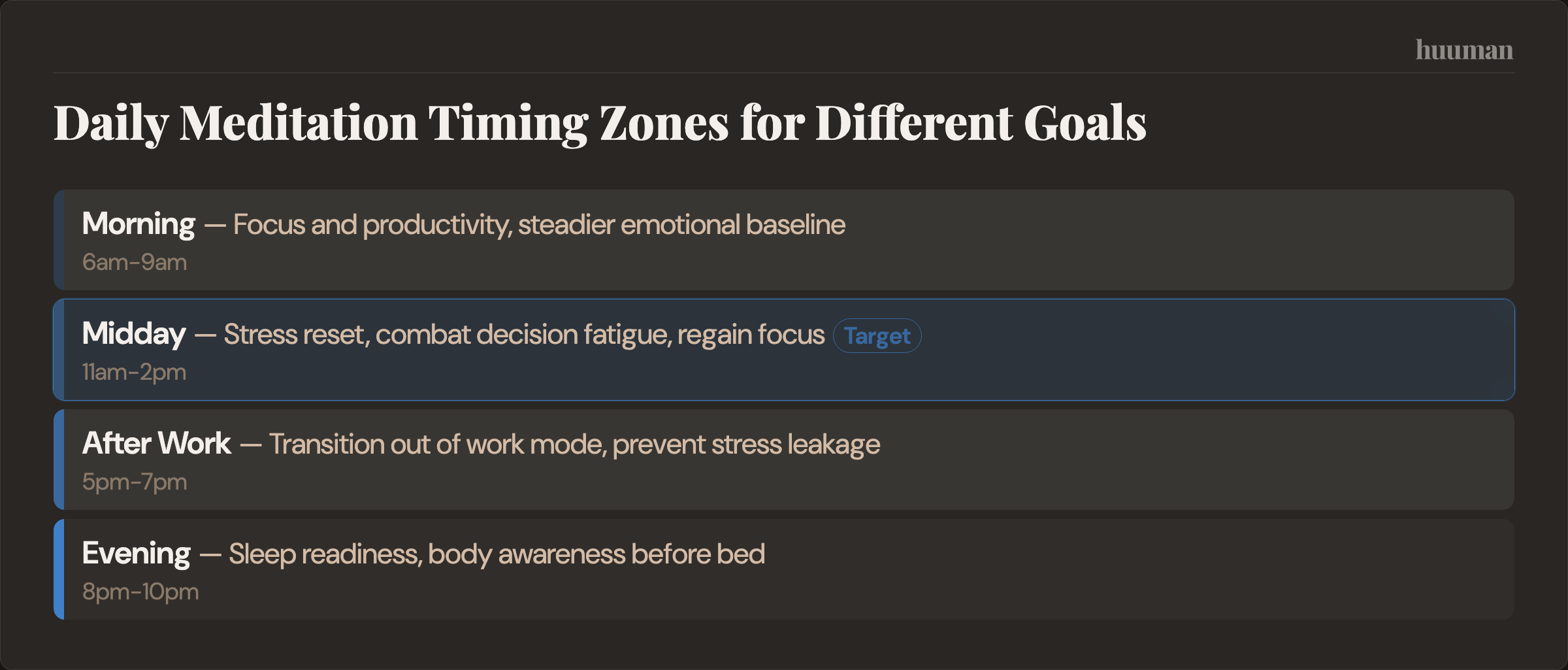
- Focus and productivity: morning or midday. Morning is better if distraction starts early. Midday is better if the real problem is attentional drift after several hours of work.
- Stress reactivity: morning if you want a steadier baseline, midday if stress accumulates during the day, after work if your stress leaks into home life.
- Emotional regulation: morning for steadiness, early evening for decompression, loving-kindness when irritability or social friction is prominent.
- Sleep readiness: evening practice as part of wind-down, usually not as a desperate last step after an overstimulating night.
- Training readiness or recovery: after training for downshift, or evening if you need recovery-oriented deceleration. If mindset supports performance, meditation for athletic motivation is relevant.
You can also use a simple Trigger, Intention, Minimum dose, Evaluate sequence. Trigger means the daily anchor. Intention means the outcome you want. Minimum dose means a small session you can repeat. Evaluate means tracking adherence and one or two effects for 14 days, then changing only one variable at a time.
Minimal effective path for busy professionals
If your calendar is crowded, do not make the process fragile. Pick one anchor and one style. Keep the first version small enough that you can do it during a normal week, not a fantasy week.
A commonly used approach is:
- Morning: brief seated breath-focused practice.
- Midday: a shorter eyes-open reset with posture and breathing.
- After work: open monitoring to notice mental residue without feeding it.
- Evening: body scan or softer breath awareness.
If you want the practice to support goals beyond calm, connect it to something concrete. For example, you might use it before planning your day, after closing work, or before shifting into a bedtime routine. That is also where articles like setting ambitious goals through meditation become more practical than abstract.
Protocol cards
AM Baseline
Best for: habit-building, reducing morning reactivity, setting attentional baseline.
Anchor: after waking, or after starting the coffee machine but before checking messages.
Practice structure: brief settling, then breath-focused attention, then a short intention for the day.
Intensity cue: keep effort low and clean. You are not trying to overpower thoughts.
Readiness gate: if sleep was poor or you feel unusually depleted, make the session gentler and shorter rather than skipping it. If you wake too early and cannot return to sleep, early-morning meditation after waking up too early may be useful context.
Midday Reset
Best for: decision fatigue, stress accumulation, regaining focus.
Anchor: before lunch, after lunch, or as a recurring afternoon calendar block.
Practice structure: upright posture, a short run of controlled nasal breathing, quick body scan, then a deliberate re-entry into the next task.
Intensity cue: stay alert. Eyes open is fine. This is not a nap substitute.
Readiness gate: if you feel wired, use a softer pace and longer exhale. If you feel flat after a meal, keep posture taller and the session shorter.
After-Work Boundary
Best for: shifting out of work mode, reducing spillover into the evening, post-training downshift.
Anchor: immediately after shutting the laptop, ending the commute, or finishing training.
Practice structure: decompression breathing, then open monitoring, then one sentence about the evening priority.
Intensity cue: calm but not vague. Avoid zoning out.
Readiness gate: if emotional activation is high, use a guided practice or grounding instead of forcing stillness. Pairing it with 4-7-8 breathing before or after meditation may help some people.
Evidence and limits
The strongest claim is not that one clock time is universally superior. It is that meditation can improve stress-related and attentional outcomes in many people, while timing research itself is limited. Adherence likely matters a great deal, but the supplied evidence does not justify declaring morning, midday, or evening as categorically best for everyone.
For physiology, a meta-analysis on stress-related measures found that mindfulness-based stress reduction and related practices affect measures such as cortisol and heart rate variability. That supports the broader idea that meditation interacts with stress physiology, but it does not prove a universal best hour of the day.
For sleep, the useful evidence in this source set comes more from CBT-I principles than from time-specific meditation trials. Structured insomnia treatment emphasizes consistency, avoiding forcing sleep, and using a sleep diary to evaluate patterns rather than guessing. That is why evening meditation should be framed as part of a wind-down routine, not a guaranteed fix for insomnia.
CBT-I protocols recommend specific sleep hygiene practices including going to bed only when sleepy and leaving bed if unable to fall asleep within 15-20 minutes.
For habit formation, the evidence provided is indirect. That supports the practical idea that regularity matters, but it is not a direct meditation timing trial, and it does not prove that a specific time of day is inherently better for habit formation.
Long-term adherence patterns may show promise; some research on older women found maintained 5+ days per week practice six months after initial yoga intervention, though this finding should be interpreted cautiously as it represents a specific population and intervention type.
Safety matters as well. Meditation is often presented as uniformly benign, but that is too simple. A study on meditation-related adverse effects found that negative experiences can occur in mindfulness-based programs, and some participants reported lasting adverse effects. That does not mean meditation is unsafe for most people. It means meditation is not a replacement for mental health care, and worsening panic, dissociation, intrusive thoughts, or sleep should be taken seriously.
Claims about before-sunrise meditation having unique physiological advantages are weaker than many pages imply. Without stronger time-specific evidence, it is safer to treat that as tradition or personal preference rather than established physiology.
Strategies to discuss with a professional
The most useful non-prescriptive strategy is a 14-day timing experiment. Pick one anchor time, one practice type, and one intended outcome. Then keep everything else as stable as possible before you judge the slot.

A common approach is:
- Anchor: wake-up, lunch break, commute end, or wind-down.
- Practice type: breath-focused, body scan, loving-kindness, or open monitoring.
- Outcome metric: calm, focus, evening rumination, sleep readiness, or post-work decompression.
- Adjustment rule: after 14 days, change style or dose before changing the time, unless adherence is clearly failing.
Friction fixes are often enough:
- If you get sleepy: sit upright, use more light, shorten the session, or move it earlier.
- If you get restless: use a guided start, label thoughts, or choose open monitoring instead of rigid concentration.
- If you miss days: strengthen the cue and shrink the dose.
- If travel disrupts you: hold the anchor behavior steady even if the clock time changes.
How to track and interpret changes
The point of tracking is not to turn meditation into a lab project. It is to improve decision quality. For 14 days, track only what helps you answer one question: is this time working for me?
A simple worksheet looks like this:
- Adherence: yes or no, plus what time you actually meditated.
- Immediate effect: a 0 to 10 calm or focus score within about 10 minutes after.
- One relevant outcome: afternoon slump for midday, irritability after work for evening, sleep diary notes if the session is part of wind-down.
- Optional wearable notes: resting heart rate or HRV trends if you already use a wearable. Treat them as context, not verdicts.
Example row: Tuesday, 12:40 p.m., midday reset, completed, focus score 7 out of 10, afternoon slump lower than usual, had coffee late morning, lunch was light.
After two weeks, make one of three decisions:
- Keep: adherence is good and the intended effect is showing up.
- Adjust: adherence is good but the effect is weak. Change style or shorten the session.
- Move: adherence is poor because the slot keeps getting disrupted. Choose a stronger anchor.
If you want a cleaner picture over time, your huuman Coach can help interpret timing patterns alongside sleep, training, and recovery signals so you can adjust the practice to your actual week rather than guessing.
Signal vs noise
- Signal: the best time of day to meditate is the one you repeat with low friction. Track adherence first, then refine.
- Signal: timing should match your goal. If your issue is afternoon overload, test midday before forcing a pure morning routine.
- Signal: short sessions still count when they are consistent. Keep the anchor and reduce the scope if life gets busy.
- Noise: before-sunrise practice is a universal physiological requirement. Treat it as a tradition or preference unless your own schedule makes it genuinely easier.
- Noise: "never meditate at night." If evening helps you downshift, keep it. Just separate deliberate practice from passively trying to knock yourself out.
- Noise: meditation should replace sleep treatment or mental health care. If symptoms worsen or become persistent, stop experimenting alone and get support.
- Noise: HRV or one bad session tells you the timing is wrong. Look for trends across at least several days and include context like sleep, caffeine, and workload.
- Signal: if a time slot works but the practice feels wrong, change the style before changing the slot.
- Noise: perfect conditions are required. Use a chair, a parked car, a bench, or headphones if that is what makes consistency realistic.
Common questions
Is it better to meditate in the morning or at night?
Neither is universally better. Morning is often better for habit-building and setting a mental baseline. Night is often better for downshifting and reducing rumination. Choose based on your goal and what you can repeat.
What is the best time to meditate for the greatest benefits?
The best time to meditate for greatest benefits is usually the slot that combines consistency with goal fit. If the practice is irregular, even a theoretically ideal time will underperform. Benefits are more likely to come from repeatable practice than from chasing a magical hour.
Is it okay to meditate right before bed?
Yes, if it helps you settle. But if it turns into lying in bed trying to force sleep, it may be less useful than doing the session earlier in your wind-down. A body scan often fits bedtime better than an effortful concentration practice.
When should you not meditate?
Not when it consistently worsens panic, dissociation, intrusive thoughts, or sleep. Also not in situations where safety requires full external attention, such as driving. If you are in acute distress or using meditation to avoid getting appropriate mental health care, that is a sign to step back and speak with a qualified professional.
What is the "golden rule" of meditation?
If there is one useful rule, it is consistency over idealization. Pick a stable cue, use a practice that fits your goal, and evaluate whether it works in your actual life.
How long should I meditate as a beginner?
There is no single universal session length that everyone needs. A common starting approach is simply to choose a brief session you can sustain and protect. If you are missing days, the session is probably too ambitious for your current routine.
Should I meditate before or after exercise?
Either can work. Before exercise may help with attentional control and pre-session steadiness. After exercise may help with downshifting and recovery. If training leaves you highly activated, keep the practice simple and transitional rather than trying to force deep stillness immediately.
If you already know your likely slot but keep hitting the same obstacle, share your chosen meditation time with your huuman Coach for a personalized timing adjustment and refine the cue, practice style, or recovery context.
More health topics to explore
- Mindset, Stress & Mental Health – Overview
- Electrodermal Activity (EDA) Score: Meaning, “Good” Ranges, and How to Interpret Your Trend
- Body Scan: how to do it, what it does, and a 3-minute version to reduce stress
- Alone at the Holidays: A Calm, Practical Plan to Reduce Loneliness
References
- Pascoe MC et al. — Yoga, mindfulness-based stress reduction and stress-related physiological mea... (2017)
- UPenn Medicine — 2.2 COMPONENTS of CBT I
- Cheung C et al. — Yoga adherence in older women six months post-osteoarthritis intervention (2015)
- Britton WB et al. — Defining and measuring meditation-related adverse effects in mindfulness-base... (2021)
- Sleep Foundation — Cognitive Behavioral Therapy Insomnia
- Ball DM et al. — The structure of sleep and how it may be altered by visual impairments (2025)
- Gál É et al. — The efficacy of mindfulness meditation apps in enhancing users' well-being... (2021)